Coping with stress
nervous system controls and coordinates how all the organs in our body work;
received information is analyzed and assessed in centres in encephalon and in spinal cord;
reaction of the body depends on how the stimulus was assessed.
to list factors that cause stress;
to list positive and negative consequences of stress;
to present how we cope with stress;
to explain the role of sleep in regenerating nervous system;
Rest is the key to success
If your body is constantly stimulated, it grows tired quickly, your ability to concentrate and think becomes worse. This is why rest is necessary, even during a day. You can rest in an active or passive way. Resting in an active way (especially outside) improves your condition, stimulates organs and systems to work, which is important especially in the case of those, which have been passive for a while. Musculoskeletal system is a great example – it usually is passive during your stay at school or when sitting in front of the TV.
A necessary form of rest is sleepsleep. When we sleep, the neural centres of the cortex stop analyzing and reacting to information they receive. This does not mean our brain stops working completely. While sleeping, information is organized and deleted or stored in long‑term memory. Thanks to this, newly gained knowledge may be recalled if needed, e.g. thanks to key words, smells or emotions which we experienced in a given situation. Nervous cells regenerate mainly at night. This is when energy reserves and new neural connections between cells are created.
The amount of sleep depends mainly on how old you are – as the years pass, we need less sleep. A newborn baby sleeps around 21 hours a day and its sleep is divided into parts. An adult sleeps around 7‑8 hours. However, for regaining strength and proper body functioning it is not only important how long we sleep, but also the conditions which we sleep in. Comfortable sleep requires silence, darkness and lower temperature than during the day (18‑20Indeks górny ooC). In winter, when we use central heating, the air becomes dry, which is why it is important to have adequate air humidity in your house, by putting a water container on the radiator or by hanging a wet towel on it. It is also good to air the room before we go to sleep, and to eat our last meal about 2 hours before our bedtime.
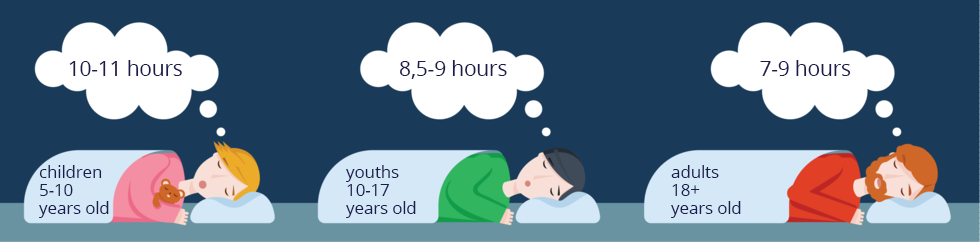
Lack of sleep causes problems with conducting neural impulses, which slows down reaction to stimuli, makes it harder to focus and impairs the immune system. This is also the cause for being tired and having problems with concentration. Not sleeping at night, even if we do it to learn at the last minute or to have fun, lowers the ability to conduct information. A junior high school student should sleep 7‑7.5 hours continuously. Preferably, it should be around 8‑9 hours of sleep at night.
While we sleep, the activity of our brain changes. The brain rests, then it becomes active. Based on this, we differentiate 2 main phases of sleep. The first phase, called the phase of slow eye movement (SEM), skeletal muscles relax, breath becomes regular, blood pressure and body temperature are lowered, the processes in cells happen at a slower pace and the sleep is the deepest. After the SEM phase, the second phase begins, called the phase of rapid eye movement (REM). This is when we start to dream. During REM phase, the blood pressure increases, just like the frequency of breaths and heartbeats, and then SEM happens again. Both phases create one sleep cycle that lasts around 90 minutes. With every next cycle, SEM phase becomes shorted and REM becomes longer. Uninterrupted night sleep of an adult should last around 4‑5 cycles.
Stress
StressStress is something all of us experience and is a natural reaction of our body to the stimuli, both positive and negative. Stimuli which disturb the physical and mental balance of the organism are called stressorsstressors. These can be, for example: too high or too low outer temperature, raised body temperature (fever), infections, physical injuries, strong emotions, conflicts with the surroundings, fear (e.g. of a test), excitement before travel, etc.
The reaction of the body to factors that disturb the physical and mental balance has adaptive and protective character. As a result of the cooperation of the sympathetic nervous system and the hormonal nervous system, the body is mobilized to act. The level of adrenaline, also called the stress hormone, is increased, which causes typical reactions to stress: elevated blood pressure, higher heart beat frequency and breaths frequency, increased amount of blood flowing to the brain and the muscles, lowered amount of blood flowing to the intestine and widening of the pupils. Mild stress is necessary for the functioning of the body – it stimulates the body to work, allows us to concentrate, overcome obstacles and achieve our goals. With too little stress, the life activity decreases and we are less interested in the things we do, our body becomes less immune, we are bored and tired. Each of us feels stress differently.
Stressors that appear suddenly and in big force (e.g. the loss of a loved one) and those, which work on your body for a long time are very dangerous. Too strong or too long stress gradually causes problems with the functioning of the body. We get headaches, high blood pressure, heart problems, excessive sweating (especially of the palms), diarrhea or constipation, excessive appetite (the so‑called stress‑eating) or lack of appetite. Stomach wall cells produce too much hydrochloric acid, which leads to acid reflux and can cause ulcers. Our immune system doesn’t work as it should, which leads to bacterial and viral infections. Skin reactions, mainly in form of a rash (also allergic reactions) happen very often. Increased psychological stress causes negative emotion with which we sometimes cannot cope.
The strength of the reaction depends mainly on the stressor, the age, gender, personality, our surroundings and experiences. Support of the family and friends allows us to cope with stress and counteracts its negative consequences. That is why:
you should anticipate events, plan actions, come up with solutions that will allow you to avoid stressful situations;
you should plan your tasks and duties for the next day and week and set priorities;
instead of constantly thinking of your problems, you should pay attention to other, more pleasant things;
you should look for positive aspects of stressful situations;
you should learn relaxing techniques and use them;
you should ease tension and negative energy during physical work or intense exercises;
you should use the support of others.
Look at the illustration below. Which causes of stress affect you most often? Do you know how to deal with them?
How stress influences our organism
Long‑term stress destroys the organism. Traumatic events, requirements which cannot be met, conflicts with others lead to psychological problems like neurosis, depression and schizophrenia. The most common problem is neurosis. People who suffer from it very often have headaches, stomach aches, heart problems, are irritated, have problems with memory and concentration that make their lives difficult. Such people also have feeling of fear. Sometimes, they have obsessive thoughts which cannot be stopped, obsessive movements and actions, e.g. pulling at fingers, nail picking, playing with a pen, etc.
The disease that affects more and more people, both adults and children, is depression also called mood disease. It is accompanied by a feeling of sadness and hopelessness, lack of appetite, insomnia, problems concentrating and inability to act. Sometimes, people who suffer from depression have suicidal thoughts.
People suffering from mental diseases should not be alone. Support of friends and family, help of a psychiatrist and therapist can restore the balance and help such people find the sense of their life and the happiness.
Highlight what may be the result of stress.
- sweating hands
- diarrhea
- palpitations
- abdominal pain
- toothache
- tearing eyes
Summary
The appropriate length of sleep and the time we go to sleep, a good rest and making sure that our bodies function properly, especially when it comes to acquiring knowledge.
In stressful situations our body initiates a series of reactions that mobilize it, e.g. by tensing the muscles.
Optimal level of stress motivates us to act; when we have too much stress, the physical and mental balance of our organism is disturbed.
Too much stress can cause diseases.
Keywords
stress, stressor, sleep
Glossary
sen – cyklicznie pojawiający się stan układu nerwowego, w którym następuje czasowy brak świadomości i bezruch
stres – reakcja organizmu na działanie czynnika zaburzającego stan równowagi psychicznej i fizycznej
stresory – czynniki wewnętrzne lub zewnętrzne wywołujące stres