Try to refresh your knowledge about the ancient philosophy.
The main principles of Augustinism and Thomism
Dark Ages – is an unfair term concerning different aspects of life in this epoch. It suggests that people then had no sensible approach towards the world. Weren’t there any rationally thinking people at that time? Of course there were, but they considered the justification of the catechism their calling.
Exercise 1
Try to recall what does the theocentricism mean.
St. Augustine (354–430 r. n.e.)
RR1EPLTQCR0Nv1
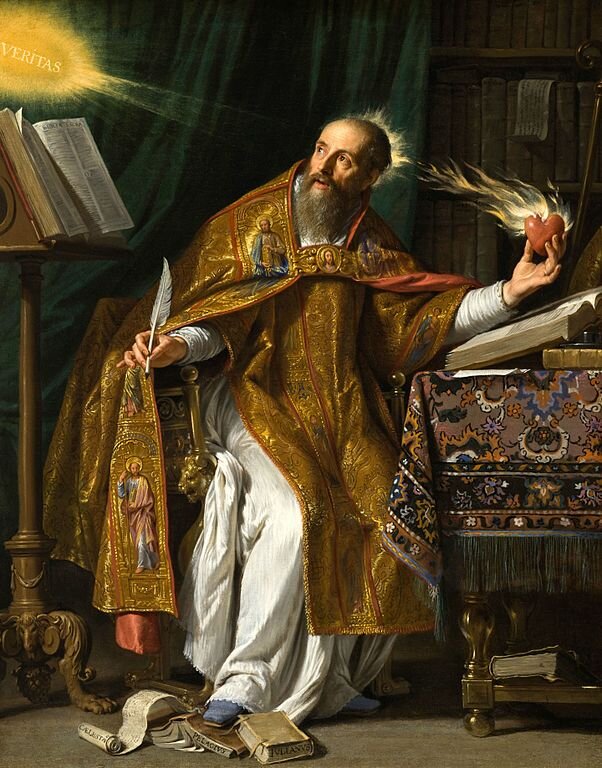
Obraz przedstawia jednego z Doktorów Kościoła, świętego Augustyna. Ubrany jest w pokrytą złotem szatę, w prawej dłoni trzyma pióro, w lewej – płonące serce. Nad jego głową można zobaczyć jaśniejącą aurę. W prawym górnym rogu obrazu znajduje się światło, w centrum którego jest słowo veritas.
Source: Philippe de Champagne, Saint Augustine, domena publiczna.
One of the greatest medieval theologians, philosophers and doctors of the Catholic church was bishop of Hippo. The philosophical belief, Augustinism, was named after him; its main principle was dualismdualismdualism. Saint Augustine believed that the reality consisted of two elements: good and evil, God and Satan, virtuevirtuevirtue and sinsinsin, darkness and brightness. The human is also composed of two elements: mattermattermatter and spiritspiritspirit. In the age‑old struggle of good and evil, the nation of God and Satan, people should actively fight on the side of the former. The Christian knight who fought with infidels was on duty. Moreover, even a peasant could be such a knight, struggling with his temptations, praying and mortifying their flesh.
Exercise 2
Read a passage from “Confessions” by Saint Augustine and follow the instructions:
Present the way in which the author justifies that it is not God who is responsible for the existence of evil in the world
RCSGlucPz4DoH
Wykonaj ćwiczenie zgodnie z poleceniem.
Wykonaj ćwiczenie zgodnie z poleceniem.
Write 5 questions concerning the text above.
RCSGlucPz4DoH
Wykonaj ćwiczenie zgodnie z poleceniem.
Wykonaj ćwiczenie zgodnie z poleceniem.
Determine who is the speaker and the receiver of the text.
RCSGlucPz4DoH
Wykonaj ćwiczenie zgodnie z poleceniem.
Wykonaj ćwiczenie zgodnie z poleceniem.
Saint Thomas Aquinas (ca. 1225–1274)
R1TjDZXoCR5rr1
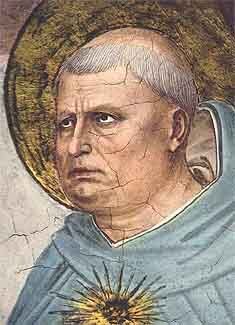
Fragment obrazu przedstawiającego świętego Tomasza z Akwinu. Nosi on jasną szatę, wokół głowy ma aureolę. Ma wygolony czubek głowy – zgodnie z mnisim zwyczajem.
Saint Thomas Aquinas
Source: domena publiczna.
Saint Thomas was a Black Monk, theologian and doctor of the Catholic Church considered to be the greatest medieval philosopher. His beliefs are often called the Aristotelian theology. He proclaimed that to discover the truth about the world and fully understand it, one should not only by experiencing the God’s illumination, but also use their own mind. In this way, Saint Thomas contributed to the development of ScholasticismscholasticsScholasticism. He saw the world as very hierarchical. He believed that on the top of the “Ladder of BeingLadder of BeingsLadder of Being” there is God and then angels, below them there were people, animals, plants and at the end - minerals. The special significance of human guaranteed the combination of the “Divine Spark” with the body matter. The human mind helped the philosopher to lead the evidence concerning the catechism; hence, Saint Thomas presented five evidences for the existence of God. The most important work of Aquinas is Summa theologica. The philosophical system, which bases on the Saint Thomas’ view was called Thomism
Exercise 3
Read the passage from an essay by Leszek Kołakowski and follow the instructions:
Present the evidence proving that St Thomas Aquinas contributed to theology and philosophy development.
RCSGlucPz4DoH
Wykonaj ćwiczenie zgodnie z poleceniem.
Wykonaj ćwiczenie zgodnie z poleceniem.
What was more important for Saint Thomas: the mind or faith? Do you agree with his opinion? Justify your answer.
RCSGlucPz4DoH
Wykonaj ćwiczenie zgodnie z poleceniem.
Wykonaj ćwiczenie zgodnie z poleceniem.
Exercise 4
Present the differences between the views of Saint Thomas Aquinas and Saint Augustine.
R142LztPw4IBt
Wykonaj ćwiczenie zgodnie z poleceniem.
Wykonaj ćwiczenie zgodnie z poleceniem.
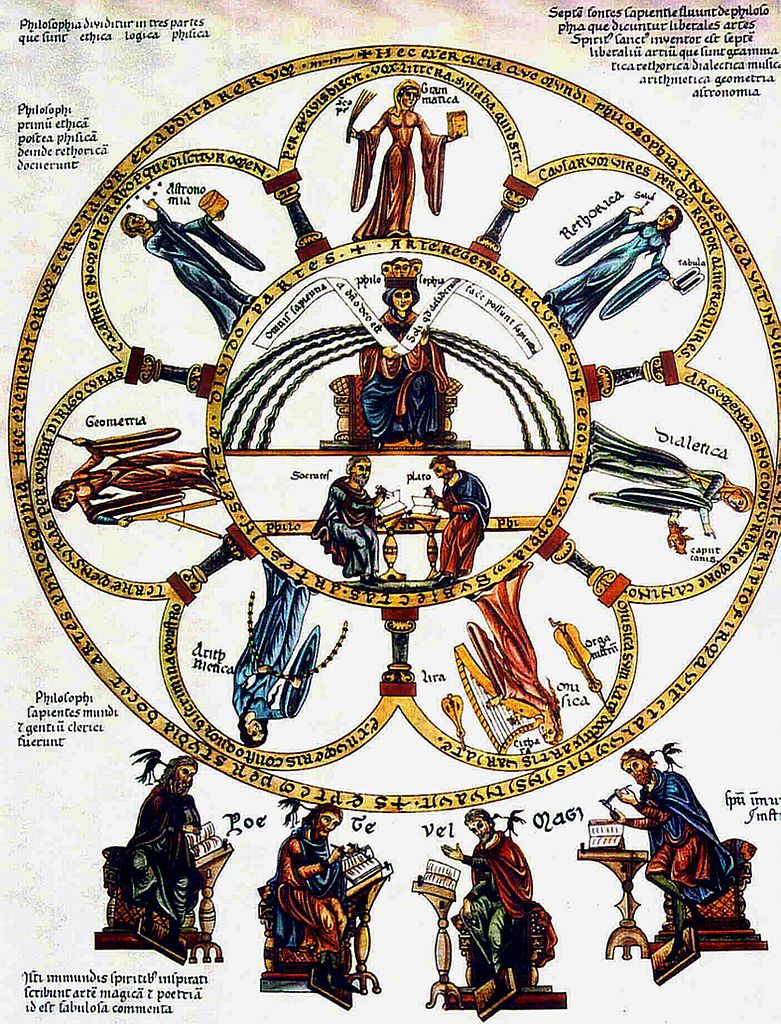
The philosophy was part of so‑called seven liberal arts (Latin: septem artes liberales). That were the branches of science based on the power of mind. Moreover, they were the basis of the education in the Middle Ages. Children started the course of artes liberales in the age of seven and it lasted for about seven years. Its completion was a prerequisite to study law, medicine or theology. The liberal arts were also called as seven ways to wisdom. They were divided into two groups: trivium (three ways) and quadrivium (four ways).
Trivium included grammar, dialecticsdialecticsdialectics, rhetoricrhetoricrhetoric and quadrivium consisted of geometrygeometrygeometry, arithmeticarithmeticarithmetic, astronomyastronomyastronomy and music.
RkGVL3Rja8Asl
Exercise 5
Wymień i scharakteryzuj siedem sztuk wyzwolonych.
Wymień i scharakteryzuj siedem sztuk wyzwolonych.
Solve the puzzle.
Exercise 6
Do you know which attributes were assigned to the liberal arts? Talk about it with the others.
Do you know which attributes were assigned to the liberal arts? Talk about it with the others.
Try to identify each of the liberal arts on the illustration above or on the cover illustration for the lesson. Which attributes were assigned to them?
RCSGlucPz4DoH
Wykonaj ćwiczenie zgodnie z poleceniem.
Wykonaj ćwiczenie zgodnie z poleceniem.
Exercise 7
The dominating view in the Middle Ages was theocentrism. Think how each of seven liberal arts could help understand God. If the task is difficult, try to find out what was the subject of each of the scientific field and how did they fulfil the theocentric principles.
rhetoric
dialectics
arithmetic
geometry
astronomy
music
RSTmszD5birDF
Exercise 8
Sort the universities built in the Middle Ages starting from the oldest one. Use the available sources if necessary. Elementy do uszeregowania: 1. University of Paris, 2. University of Bologna, 3. Univeristy of Padova, 4. Univeristy of Prague, 5. University of Oxford, 6. Univeristy of Montpellier, 7. Univeristy of Cambridge, 8. The Jagiellonian Univeristy
Sort the universities built in the Middle Ages starting from the oldest one. Use the available sources if necessary. Elementy do uszeregowania: 1. University of Paris, 2. University of Bologna, 3. Univeristy of Padova, 4. Univeristy of Prague, 5. University of Oxford, 6. Univeristy of Montpellier, 7. Univeristy of Cambridge, 8. The Jagiellonian Univeristy
Sort the universities built in the Middle Ages starting from the oldest one. Use the available sources if necessary.
Univeristy of Cambridge
University of Paris
Univeristy of Montpellier
Univeristy of Padova
The Jagiellonian Univeristy
University of Oxford
Univeristy of Prague
University of Bologna
Exercise 9
Saint Augustine was a strong believer of the human dignitydignitydignity. He believed that in every person there is value. That’s why we should all be respected. Discuss this idea in pairs.
R7ZyATceTYmc6
Exercise 10
Listen to the abstract recording to review the material and new vocabulary. Then do the vocabulary exercise. Match the pairs: English and Polish words. Word: dualism. Możliwe odpowiedzi: 1. dualizm, 2. godność, 3. materia, 4. scholastyka, 5. cnota, 6. duch, 7. drabina bytów, 8. grzech. Word: virtue. Możliwe odpowiedzi: 1. dualizm, 2. godność, 3. materia, 4. scholastyka, 5. cnota, 6. duch, 7. drabina bytów, 8. grzech. Word: sin. Możliwe odpowiedzi: 1. dualizm, 2. godność, 3. materia, 4. scholastyka, 5. cnota, 6. duch, 7. drabina bytów, 8. grzech. Word: spirit. Możliwe odpowiedzi: 1. dualizm, 2. godność, 3. materia, 4. scholastyka, 5. cnota, 6. duch, 7. drabina bytów, 8. grzech. Word: matter. Możliwe odpowiedzi: 1. dualizm, 2. godność, 3. materia, 4. scholastyka, 5. cnota, 6. duch, 7. drabina bytów, 8. grzech. Word: scholastics. Możliwe odpowiedzi: 1. dualizm, 2. godność, 3. materia, 4. scholastyka, 5. cnota, 6. duch, 7. drabina bytów, 8. grzech. Word: Ladder of Beings. Możliwe odpowiedzi: 1. dualizm, 2. godność, 3. materia, 4. scholastyka, 5. cnota, 6. duch, 7. drabina bytów, 8. grzech. Word: dignity. Możliwe odpowiedzi: 1. dualizm, 2. godność, 3. materia, 4. scholastyka, 5. cnota, 6. duch, 7. drabina bytów, 8. grzech.
Listen to the abstract recording to review the material and new vocabulary. Then do the vocabulary exercise. Match the pairs: English and Polish words. Word: dualism. Możliwe odpowiedzi: 1. dualizm, 2. godność, 3. materia, 4. scholastyka, 5. cnota, 6. duch, 7. drabina bytów, 8. grzech. Word: virtue. Możliwe odpowiedzi: 1. dualizm, 2. godność, 3. materia, 4. scholastyka, 5. cnota, 6. duch, 7. drabina bytów, 8. grzech. Word: sin. Możliwe odpowiedzi: 1. dualizm, 2. godność, 3. materia, 4. scholastyka, 5. cnota, 6. duch, 7. drabina bytów, 8. grzech. Word: spirit. Możliwe odpowiedzi: 1. dualizm, 2. godność, 3. materia, 4. scholastyka, 5. cnota, 6. duch, 7. drabina bytów, 8. grzech. Word: matter. Możliwe odpowiedzi: 1. dualizm, 2. godność, 3. materia, 4. scholastyka, 5. cnota, 6. duch, 7. drabina bytów, 8. grzech. Word: scholastics. Możliwe odpowiedzi: 1. dualizm, 2. godność, 3. materia, 4. scholastyka, 5. cnota, 6. duch, 7. drabina bytów, 8. grzech. Word: Ladder of Beings. Możliwe odpowiedzi: 1. dualizm, 2. godność, 3. materia, 4. scholastyka, 5. cnota, 6. duch, 7. drabina bytów, 8. grzech. Word: dignity. Możliwe odpowiedzi: 1. dualizm, 2. godność, 3. materia, 4. scholastyka, 5. cnota, 6. duch, 7. drabina bytów, 8. grzech.
Listen to the abstract recording to review the material and new vocabulary. Then do the vocabulary exercise. Match the pairs: English and Polish words.
dualizm, materia, drabina bytów, scholastyka, grzech, godność, cnota, duch