Health and illness, causes of diseases
diseases attack all human organs;
following the prevention rules can reduce the risk of a disease.
to distinguish between health and illness;
to specify the examples of infectious and parasitic diseases.
Nagranie dostępne na portalu epodreczniki.pl
Nagranie dźwiękowe abstraktu dotyczące zdrowia i przyczyn chorób
Health and illness
HealthHealth is a condition when a person does not feel any discomfort and their body is in balance. A person can be described as healthy when they are both physically and mentally well and when they have good relations with other people. Therefore, health is a sense of comfort in the physical, mental and social sphere. The state of health is related to the proper functioning of organs and the proper life processes, the ability to think clearly, learn and mentally develop, the ability to control emotions and deal with stressful situations. The symptom of health is also a good functioning in society – having friends, being ready to meet new people and work with others and take on the responsibility to fulfill various social functions. Health means also spiritual health, or a sense of inner peace, which we get from living according to certain moral or religious principles and beliefs.
Human health
Physical health | Mental health | Social health | |
mental health | emotional health | ||
efficient and correct functioning of all organs and body systems | the ability to think coherently, learn and realize the intellectual potential | the ability to recognize, control and express emotions such as fear, joy, anger, regret | the ability to establish and maintain good relationships with people |
the ability to perform daily activities without excessive effort | the ability to deal with stress, tension, sadness | the ability to cooperate with other people | |
accepting responsibility for yourself and others | |||
DiseaseDisease is a health disorder. It is associated with irregularities in the structure or functioning of the human body. It is often a reaction of the organism to the environmental factors referred to as pathogenic agents or pathogens. Diseases include e.g. easily spreading infectious diseasesinfectious diseases and parasitic diseaseparasitic disease and non‑infectious – genetic diseases, cancerous, allergic and mental diseases.
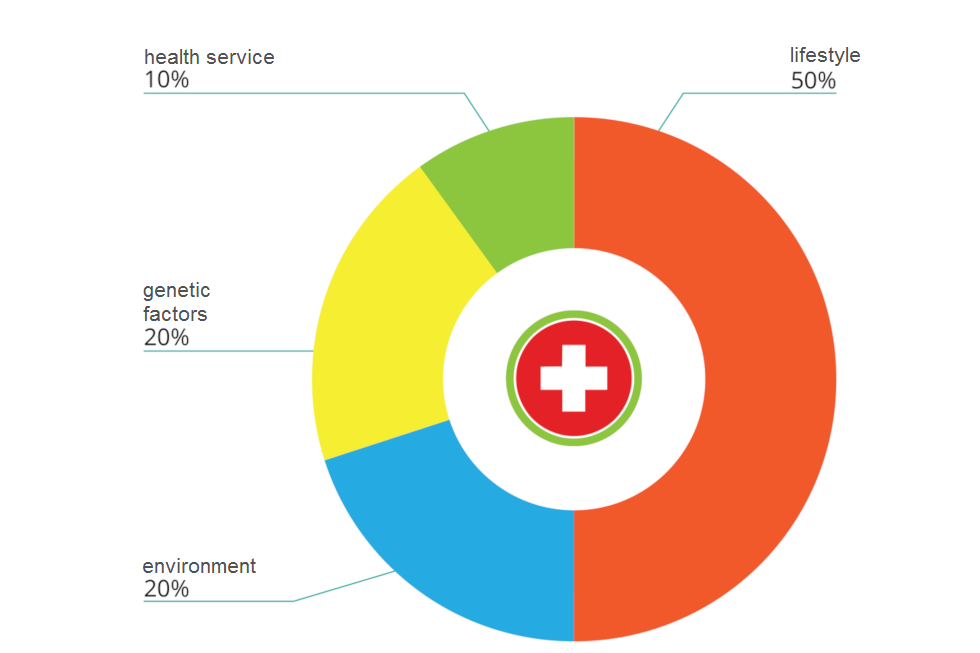
Approx. 65% of Poles mention health as a condition for a happy life. And how important is health for you? List the most important life values for you and indicate the position of health.
The causes of diseases
Pathogenic agents attack constantly. Fortunately, the body has defensive mechanisms and repels most of the attacks. Despite that, almost every year we suffer from certain infectious diseases of the respiratory system, food poisoning or skin mycosis. The immediate cause of these diseases are viruses, bacteria and fungi. Often we are dealing with parasitic diseases caused by tapeworms, pinworms or mites.
Pathogens
Biological contagious | Factors | ||
chemical | physical | social | |
viruses | alcohol | UV radiation | poor living conditions |
bacteria | heavy metals | X‑ray radiation | bad family relations |
fungi | poisons | ionizing radiation | bad peer relations |
protozoa | irritant substance | temperature changes | stress |
parasitic worms and arthropods | deficiency or excess of certain substances (e.g. vitamins) | mechanical injuries | |
The development of many diseases is caused by exposure to heavy metals, a number of poisonous substances or alcohol. These pathogens, like excessive body exposure to harmful radiation, can cause damage to cells, tissues and organs, which can lead to cancer and genetic diseases (hereditary).
Inadequate relationships with people, poor living conditions and constant stress and emotional tensions can be the reason for the development of depression, neurotic disorders and even mental disorders.
Match the description to every sphere of human health.
the ability to express emotions and cope with stress, efficient functioning of the body enabling daily activities, the ability to function properly in relationships with other people, the ability to develop and realize own intellectual potential
| physical sphere | |
| mental sphere | |
| emotional sphere | |
| social sphere |
Match the pathogens to the correct group.
viruses, bacteria, radiation (e.g. UV), poor living conditions, protozoa, fungi, parasitic worms, alcohol, stress, heavy metals, vitamin deficiency, mechanical injuries
| infectious agents | |
|---|---|
| chemical agents | |
| physical factors | |
| social factors |
Mark all correct statements.
- Disease is a full health disorder.
- Disease is sometimes caused by the action of pathogens.
- Genetic and allergic diseases are contagious.
- Cancer and mental diseases are not contagious
Summary
Health is a state of physical, mental and social well‑being, not just a lack of illness or infirmity.
Pathogenic factors are biological, physical, chemical and social factors as well as improper diet.
Infectious diseases are caused by pathogenic organisms and spread through direct contact with a sick person, by droplet, food and sexual intercourse.
In order to counteract diseases, the principles of a healthy lifestyle should be applied.
Taking medicines, especially antibiotics, should be under the supervision of a doctor.
Keywords
disease, health, infectious agents
Glossary
choroba – stan nieprawidłowego funkcjonowania organizmu wywołanego przez zmiany jego budowy lub zmiany przebiegajacych w nim procesów; na ogół towarzyszy mu złe samopoczucie
choroba pasożytnicza – choroba wywołana przez jeden z biologicznych czynników chorobotwórczych – pasożyta – tasiemca, przywrę, nicienie; ze względu na charakter i sposób szerzenia stanowi zagrożenie dla zdrowia i życia ludzi; szerzy się przez kontakt bezpośredni (z osoby na osobę) i drogą pokarmową
choroba zakaźna – choroba wywołana przez jeden z biologicznych czynników chorobotwórczych (wirusy, bakterie, grzyby, pasożyty); ze względu na charakter i sposób szerzenia stanowi zagrożenie dla zdrowia i życia ludzi; może szerzyć się przez kontakt bezpośredni (z osoby na osobę), drogą kropelkową, drogą pokarmową, przez kontakt seksualny, przez wkłucie zrobione zakażoną strzykawką, a także przez owady i kleszcze
zdrowie – stan pełnego, dobrego samopoczucia fizycznego, psychicznego i społecznego, a nie tylko brak choroby lub niedomagania