Get to know me, and you will understand. The nation and national minorities
A citizenship is a formal relation between an individual and a state. Not all Polish citizens are ethnically Polish.
Poland’s history was a turbulent one. Many Polish citizens had to leave Poland and now they, or their descendantsdescendants, live abroad.
Ethnic diversity might be one of the division lines causing conflicts in society.
You will be able to give a legal definition of national and ethnic minorities in Poland, as well as a regional language minority.
You will be able to name all the national and ethnic minorities recognized by the Polish lawrecognized by the Polish law.
You will be able to explain what rights national and ethnic minorities in Poland enjoy.
You will be able to discuss the complicated situation of the Silesians.
You will be able to explain what the Polish diaspora is and what the reasons of emigration from Poland were throughout its history.
You will be able to describe the activities of the Polish diaspora nowadays.
You will be able do explain what national stereotypes are, where they originate fromoriginate from, and why they should be confrontedbe confronted and eliminated.
National and ethnic minorities
According to the Polish law an ethnic minority is a group of Polish citizens fulfilling all the above‑mentioned conditions necessary for a national minority, but it does not identify itselfidentify itself with a nation organized in its own state.
Take a look at the infographics presenting the national and ethnic minorities in Poland.
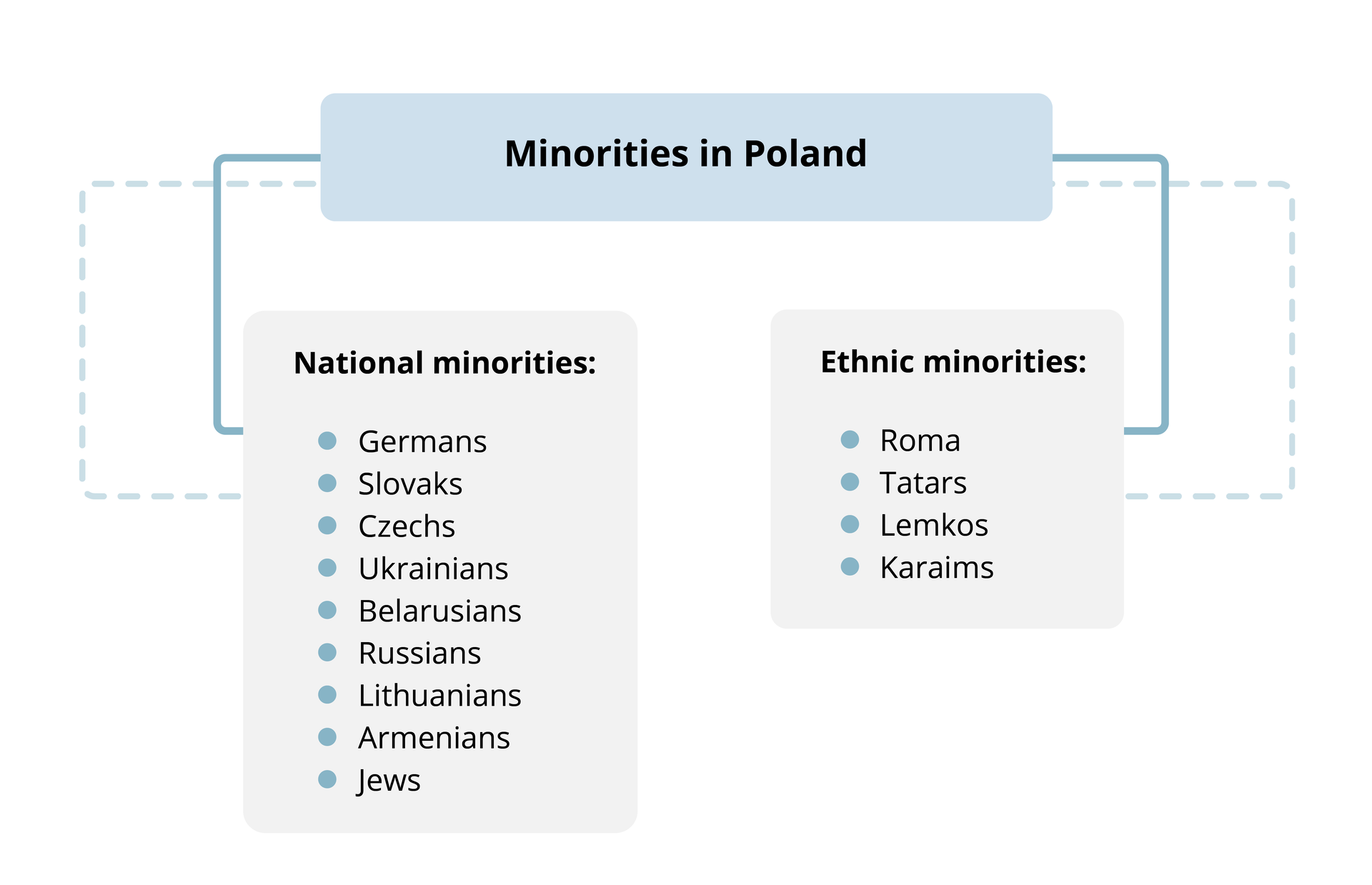
Kashubians are a special community in Poland. They are Polish citizens, who alongsidealongside the Polish language, use their own Kashubian language, which according to the statute is recognized as a regional language. This means that persons using this language have similar rights to members of national and ethnic minorities.
National and ethnic minorities constitute currently a rather small percentage of Polish society. However, the Polish‑Lithuanian Commonwealth and the Second Republic of Poland, reborn after the first world war, were multinational states. Until the outbreakoutbreak of the second world war around 35% of Polish citizens were not ethnically Polish. The largest minorities were Ukrainians and Jews. The extermination of the Jewish nation during the second world war and the post‑war changes of Polish borders turned Poland into a state dominated by a Polish nation only.
All the people who belong to national or ethnic minorities are also Polish citizens, so they enjoy all the rights any Polish citizen has, e.g. the right to vote in national elections. Additionally, the members of minorities were granted a number of rights that enableenable them to cultivatecultivate their cultural identity. Moreover, the Polish law forbidsforbids any form of discrimination against national or ethnic minorities.
The rights of national and ethnic minorities in Poland:
the right to learn the language and in its own language, to study the cultural history of the minority and to take external exams in the minority language;
the right to address local authorities in the minority language and (at requestat request) receive answers in that language;
the right to write names and surnames according to the rules of the minority language;
the right to receive funding for the development of social organizations, libraries, radio broadcasts, etc.;
the right to put the names of towns, streets, etc. in the minority language, next to the Polish name.
There is a considerablyconsiderably large group of Polish citizens living in Upper Silesia who consider themselves members of the Silesians minority. The group, however, is not recognized by the Polish law, and therefore not granted any minority rights. The issue has been a source of an ongoingongoing conflict for many years now.
Polonia
Polish history is a history of radicalradical changes of state borders and numerous migrations of the Polish population. The 18th century partitions of Polandpartitions of Poland forced many Poles to leave their Homeland. In the following century many had to flee our country because of persecutionpersecution of the participants of national uprisingsuprisings or simply migrated to the West for economic reasons. A lot of Poles were deported to the far East by Russian authorities as political prisoners. The second world war resulted in more migration waves, and right after the war Polish borders were changed, which contributed to a lot of Poles being left abroad. In the 1980s leaving Poland was a chance to escape both – the communist regime and the deepening economic crisis and poverty. Even now a lot of Polish families decide to emigrate and build their future in other states of the world – Polish accession to the European Union and the resultant border opening made such decisions much easier than before.
There are many Poles or their descendants living all around the world nowadays who try to maintain cultural relationships with Poland. Those people are collectivelycollectively called “Polonia” or “Polish diaspora”.
Polish diaspora (Polonia) – citizens of various states of Polish ethnic origin who have a sense of belonging to the Polish nation
National stereotypes
The stereotypical way of looking at others is essentially incomplete, because it consists in highlightinghighlighting only selected elements of the behaviour of some members of a given nation or ethnic group and judging the whole group (usually negatively) based on that selective assessment. National stereotypes often transfer conflicts from previous generations to contemporary relations. Their sources include difficult historical experiences. Some of the still vividvivid stereotypes in Poland date back to the period of the Second Republic of Poland and the drama of the second world war. Very often stereotypical beliefs allow for building a false sense of superioritysuperiority and uniquenessuniqueness of one’s own group. Stereotypes result in difficulties in contact and cooperation between different ethnic groups and unnecessarily exacerbateexacerbate social conflicts.
National stereotypes – images of the nature and functioning of specific nations or ethnic groups that are preservedpreserved in the social consciousnessconsciousness and passed from generation to generation, often one‑sided and simplified, very difficult to change.
Relations between ethnic groups sometimes prove very difficult, especially when they involve a painful history or deep cultural differences. Proper shaping of relations between ethnically diversediverse groups is a very important task of state authorities, but all the inhabitants of a country are responsible for a harmonious coexistence of the whole society. European societies are becoming more and more ethnically diverse and they have to learn to solve problems resulting from this diversity. Regardless ofRegardless of how different we are because of our nationality, we are all human beings, and we all have the right to respect for our dignitydignity.
Listen to the abstract recording to review the material and new vocabulary. Then do the vocabulary exercise. Match the pairs: English and Polish words.
pochodzić z, wynikać z, różnorodny, godność, przodkowie, potomkowie, zachowywać, kultywować, prześladowanie
| to originate from | |
| to preserve | |
| ancestors | |
| to cultivate | |
| persecution | |
| descendants | |
| diverse | |
| dignity |
Keywords
national/ethnic minority, regional language, Polonia, Polish diaspora, national stereotype
Glossary
uznane przez prawo
pochodzić z, wynikać z
być sprawdzanym, konfrontowanym z rzeczywistością
łącznie
znacząco
dążyć
zachowywać
być ukierunkowanym na
przodkowie
identyfikować się
obok
wybuch
umożliwiać
kultywować
zabraniać, zakazywać
na życzenie
wydatnie, znacznie
trwający
radykalnie
podział
zabory
prześladowanie
powstanie
potomkowie
zbiorowo
podkreślać, uwydatniać
żywy
wyższość
wyjątkowość
zaostrzać
zachowany
świadomość
różnorodny
bez względu na
godność