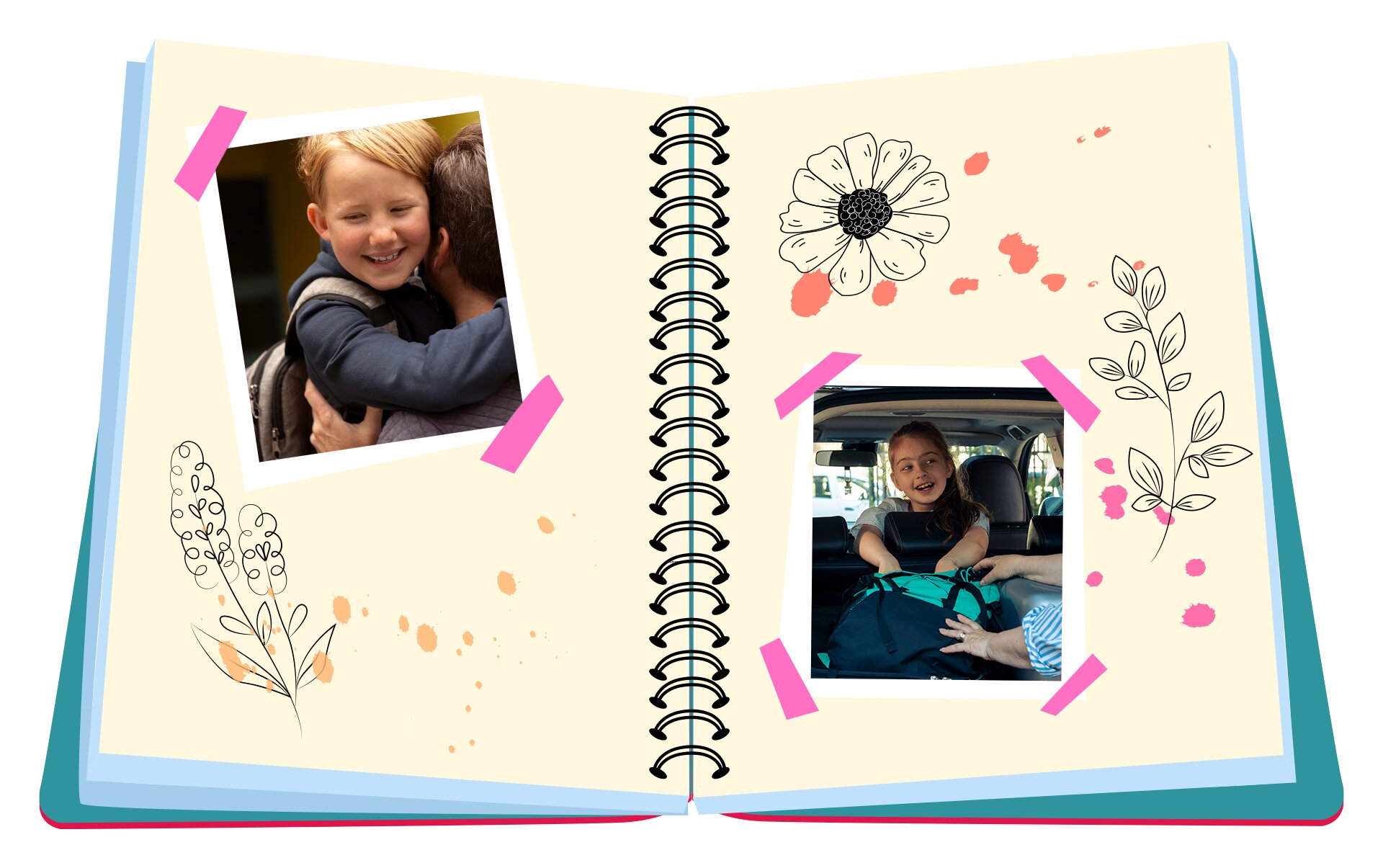
Do you remember days from your past? Do you remember your last birthday? And last Christmas? And what about the first day of school? What was the weather like then? Were you happy or sad? Here are Mark’s days from the past.
Czy pamiętasz dni ze swojej przeszłości? Na przykład swoje ostatnie urodziny? A ostatnie święta Bożego Narodzenia? A co z pierwszym dniem szkoły? Jaka była wtedy pogoda? Czułeś/czułaś radość czy smutek? Oto dni z przeszłości Marka.
R1OtpyVyF6xdg
Ilustracja przedstawia otwarty notes z jasnożółtymi kartkami. Na stronie notesu po lewej widoczne jest wklejone zdjęcie uśmiechniętego małego chłopca trzymanego na rękach przez mężczyznę. Na stronie notesu po prawej widoczne jest wklejone zdjęcie uśmiechniętej dziewczynki siedzącej w samochodzie, która sięga do plecaka. Strony notatnika są ozdobione rysunkami kwiatów i listków.
Important days from the past
Ważne dni z przeszłości
Źródło: dostępny w internecie: https://freepik.com/ [dostęp 16.10.2022], domena publiczna.
Exercise1
Match the following words with their translation.
Połącz poniższe wyrazy z ich tłumaczeniem.
R1ddNE9KkjtXJ
Źródło: GroMar Sp. z o.o., licencja: CC BY-SA 3.0.
Exercise1
Play MEMO: click on the cards and match the words with the pictures.
Zagraj w MEMO: klikaj w karty i połącz odpowiednie wyrazy z obrazkami.
RXIAvwvTjYwdl
Źródło: dostępny w internecie: https://freepik.com/ [dostęp 16.10.2022], domena publiczna.
Study the text about the days from Mark’s past. Then do the exercises below.
Przeczytaj tekst o dniach z przeszłości Marka. Następnie wykonaj poniższe ćwiczenia.
A Day in the Past
ElaBorowiecA Day in the Past
Do you rememberrememberremember special days from the pastfrom the pastfrom the past? Who waswas [be]was with you? What was the weather like?What was the weather like?What was the weather like? Can you remember? Here are Mike’s stories.
It was a good day. I was really happyhappyhappy about school. Many children and teachers werewere [be]were at school. And my new friends were in the classroom. Ms Jones was my first teacher. She was really nice.nicenice. And what was the weather like? It was sunnysunnysunny. I was hothothot.
The School Trip
It was a very good day in Mayin Mayin May. I was on a school trip with my class. We were at the zoo. We were happy because there were many animals. There were giraffes, kangaroos and penguins! And what was the weather like? First, it was warmwarmwarm. Then, it was cloudycloudycloudy and windywindywindy.
My Last Birthday
My birthday was a terribleterribleterrible day in Augustin Augustin August. I was in London with my parents. A trip to London was my birthday present. We were touriststourists [tourist]tourists. I was on the London EyeLondon EyeLondon Eye but the weather was terrible. First, it was foggyfoggyfoggy. Then it was rainyrainyrainy and stormystormystormy. I was sadsadsad and really wetwetwet.
Last Christmas
It was a very nice day last Christmas. The weather was good. It was snowysnowysnowy and coldcoldcold. I was really excited. Why? There were many presents under the Christmas treeunder the Christmas treeunder the Christmas treein the morningin the morningin the morning. There were toystoys [toy] toys and board games for me! Yippee!
1 Źródło: ElaBorowiec, licencja: CC BY-SA 3.0.
Exercise2
What was the weather like? Match the sentences to the correct translations.
Jaka była pogoda? Połącz zdania z odpowiednimi tłumaczeniami.
R17R7FO7lUGWp
It was foggy. Możliwe odpowiedzi: 1. Było mgliście., 2. Było wietrznie., 3. Było pochmurno., 4. Było deszczowo., 5. Było słonecznie., 6. Było śnieżnie. It was windy. Możliwe odpowiedzi: 1. Było mgliście., 2. Było wietrznie., 3. Było pochmurno., 4. Było deszczowo., 5. Było słonecznie., 6. Było śnieżnie. It was rainy. Możliwe odpowiedzi: 1. Było mgliście., 2. Było wietrznie., 3. Było pochmurno., 4. Było deszczowo., 5. Było słonecznie., 6. Było śnieżnie. It was cloudy. Możliwe odpowiedzi: 1. Było mgliście., 2. Było wietrznie., 3. Było pochmurno., 4. Było deszczowo., 5. Było słonecznie., 6. Było śnieżnie. It was snowy. Możliwe odpowiedzi: 1. Było mgliście., 2. Było wietrznie., 3. Było pochmurno., 4. Było deszczowo., 5. Było słonecznie., 6. Było śnieżnie. It was sunny. Możliwe odpowiedzi: 1. Było mgliście., 2. Było wietrznie., 3. Było pochmurno., 4. Było deszczowo., 5. Było słonecznie., 6. Było śnieżnie.
It was foggy. Możliwe odpowiedzi: 1. Było mgliście., 2. Było wietrznie., 3. Było pochmurno., 4. Było deszczowo., 5. Było słonecznie., 6. Było śnieżnie. It was windy. Możliwe odpowiedzi: 1. Było mgliście., 2. Było wietrznie., 3. Było pochmurno., 4. Było deszczowo., 5. Było słonecznie., 6. Było śnieżnie. It was rainy. Możliwe odpowiedzi: 1. Było mgliście., 2. Było wietrznie., 3. Było pochmurno., 4. Było deszczowo., 5. Było słonecznie., 6. Było śnieżnie. It was cloudy. Możliwe odpowiedzi: 1. Było mgliście., 2. Było wietrznie., 3. Było pochmurno., 4. Było deszczowo., 5. Było słonecznie., 6. Było śnieżnie. It was snowy. Możliwe odpowiedzi: 1. Było mgliście., 2. Było wietrznie., 3. Było pochmurno., 4. Było deszczowo., 5. Było słonecznie., 6. Było śnieżnie. It was sunny. Możliwe odpowiedzi: 1. Było mgliście., 2. Było wietrznie., 3. Było pochmurno., 4. Było deszczowo., 5. Było słonecznie., 6. Było śnieżnie.
Źródło: GroMar Sp. z o.o., licencja: CC BY-SA 3.0.
Exercise2
What was the weather like? Match the sentences to the pictures.
Jaka była pogoda? Dopasuj zdania do obrazków.
RyQbPjFVJ99rF
Źródło: dostępny w internecie: https://freepik.com/ [dostęp 16.10.2022], domena publiczna.
Exercise3
What was the weather like? Study the text again and choose the correct answer.
Jaka była pogoda? Ponownie przeczytaj tekst i wybierz poprawną odpowiedź.
RfFTS4QkONRZr
1. It was sunny and hot.
a) The first day of school
b) The school trip
c) My last birthday
d) Last Christmas
2. It was snowy and cold.
a) The first day of school
b) The school trip
c) My last birthday
d) Last Christmas
3. It was foggy and stormy.
a) The first day of school
b) The school trip
c) My last birthday
d) Last Christmas
4. It was cloudy and windy.
a) The first day of school
b) The school trip
c) My last birthday
d) Last Christmas
1. It was sunny and hot.
a) The first day of school
b) The school trip
c) My last birthday
d) Last Christmas
2. It was snowy and cold.
a) The first day of school
b) The school trip
c) My last birthday
d) Last Christmas
3. It was foggy and stormy.
a) The first day of school
b) The school trip
c) My last birthday
d) Last Christmas
4. It was cloudy and windy.
a) The first day of school
b) The school trip
c) My last birthday
d) Last Christmas
Źródło: GroMar Sp. z o.o., licencja: CC BY-SA 3.0.
Exercise4
Explore the sentences and order the letters to make words.
Przeczytaj zdania i ułóż litery w odpowiedniej kolejności, aby powstały wyrazy.
Rqlmh6ycLT1Gt
1. It was really sunny. I was 1. t, 2. o, 3. h1. t, 2. o, 3. h1. t, 2. o, 3. h.
1. It was really sunny. I was 1. t, 2. o, 3. h1. t, 2. o, 3. h1. t, 2. o, 3. h.
Źródło: GroMar Sp. z o.o., licencja: CC BY-SA 3.0.
R1402UgKJB2cy
2. It was snowy. I was 1. d, 2. o, 3. c, 4. l1. d, 2. o, 3. c, 4. l1. d, 2. o, 3. c, 4. l1. d, 2. o, 3. c, 4. l.
2. It was snowy. I was 1. d, 2. o, 3. c, 4. l1. d, 2. o, 3. c, 4. l1. d, 2. o, 3. c, 4. l1. d, 2. o, 3. c, 4. l.
Źródło: GroMar Sp. z o.o., licencja: CC BY-SA 3.0.
R4n4ZrD83mptO
3. It was cloudy and windy but it was 1. a, 2. w, 3. r, 4. m1. a, 2. w, 3. r, 4. m1. a, 2. w, 3. r, 4. m1. a, 2. w, 3. r, 4. m.
3. It was cloudy and windy but it was 1. a, 2. w, 3. r, 4. m1. a, 2. w, 3. r, 4. m1. a, 2. w, 3. r, 4. m1. a, 2. w, 3. r, 4. m.
Źródło: GroMar Sp. z o.o., licencja: CC BY-SA 3.0.
RNpgnthAP2l2Y
4. It was stormy. We were 1. e, 2. t, 3. w1. e, 2. t, 3. w1. e, 2. t, 3. w.
4. It was stormy. We were 1. e, 2. t, 3. w1. e, 2. t, 3. w1. e, 2. t, 3. w.
Źródło: GroMar Sp. z o.o., licencja: CC BY-SA 3.0.
R12ZJwXGTWdAe
5. It was my birthday. I was 1. p, 2. h, 3. a, 4. p, 5. y1. p, 2. h, 3. a, 4. p, 5. y1. p, 2. h, 3. a, 4. p, 5. y1. p, 2. h, 3. a, 4. p, 5. y1. p, 2. h, 3. a, 4. p, 5. y.
5. It was my birthday. I was 1. p, 2. h, 3. a, 4. p, 5. y1. p, 2. h, 3. a, 4. p, 5. y1. p, 2. h, 3. a, 4. p, 5. y1. p, 2. h, 3. a, 4. p, 5. y1. p, 2. h, 3. a, 4. p, 5. y.
Źródło: GroMar Sp. z o.o., licencja: CC BY-SA 3.0.
Exercise5
Read the text again and write the missing words
Przeczytaj tekst ponownie i wpisz brakujące słowa.
R1atF47orgJ7j
1. It was sTu uzupełnij on the first day of school. 2. It was cTu uzupełnij and wTu uzupełnij on the school trip. 3. It was sTu uzupełnij on my birthday. 4. It was sTu uzupełnij last Christmas.
1. It was sTu uzupełnij on the first day of school. 2. It was cTu uzupełnij and wTu uzupełnij on the school trip. 3. It was sTu uzupełnij on my birthday. 4. It was sTu uzupełnij last Christmas.
Źródło: GroMar Sp. z o.o., licencja: CC BY-SA 3.0.
Exercise6
Think about three days from the past. What was the weather like? Write your answer in 1–2 sentences.
Pomyśl o trzech dniach z przeszłości. Jaka była wtedy pogoda? Napisz swoją odpowiedź w 1–2 zdaniach.
What was the weather like last Christmas?
RraZl6c6KmIoH
(Uzupełnij).
Źródło: GroMar Sp. z o.o., licencja: CC BY-SA 3.0.
Hintazurewhite
It was… and… at Christmas. It was…, too.
Answerazurewhite
It was sunny and snowy at Christmas. It was cold, too.
What was the weather like on your last birthday?
RGaVEl998165Z
(Uzupełnij).
Źródło: GroMar Sp. z o.o., licencja: CC BY-SA 3.0.
Hintazurewhite
It was… and… on my birthday. It was…, too.
Answerazurewhite
It was sunny and warm on my birthday. It was windy, too.
What was the weather like on your school trip?
RBi11zJxcl7nS
(Uzupełnij).
Źródło: GroMar Sp. z o.o., licencja: CC BY-SA 3.0.
Hintazurewhite
It was… and… on my school trip. It was…, too.
Answerazurewhite
It was stormy and rainy on my school trip. It was cloudy, too.
GRAMATYKA
The verb ‘to be’ in the past (Czasownik „być” w przeszłości)
Czasownik „być” w języku angielskim ma w czasie przeszłym dwie formy:wasiwere.
Zdanie twierdzące tworzymy poprzez dodanie wyrazuwaslubweredo osoby (osoba + was/were).
Liczba pojedyncza
Liczba mnoga
I was – ja byłem/byłam
Przykład:
I was at the zoo. – Byłem/byłam w zoo.
we were – my byliśmy/byłyśmy
Przykład:
We were in Spain. – Byliśmy/byłyśmy w Hiszpanii.
you were –ty byłeś/byłaś
Przykład:
You were in London. –Byłeś/byłaś w Londynie.
you were – wy byliście/byłyście
Przykład:
You were excited. – Byliście podekscytowani./ Byłyście podekscytowane.
he was – on był
she was – ona była
it was – to było, ono było
Przykłady:
He was tired. – On był zmęczony.
She was happy. – Ona była szczęśliwa.
It was sunny. – Było słonecznie.
they were – oni byli/ one były
Przykład:
They were in Italy. – Oni byli we Włoszech./ One były we Włoszech.
UWAGA: Kiedy mówimy o pogodzie w przeszłości, stosujemy strukturęIt was.
Przykład:
What was the weather like yesterday? – Jaka była wczoraj pogoda?
It wassunny and warm. – Było słonecznie i ciepło.
Exercise7
Explore the sentences and choose the right form of the verb ‘to be’ in the past.
Przeczytaj zdania i wybierz odpowiednią formę czasownika „być” w czasie przeszłym.
R1biYe4weoKsJ
1. I was were hot.
2. You was were happy.
3. It was were sunny and warm.
4. She was were on a school trip.
5. We was were wet.
6. They was were in London.
1. I was were hot.
2. You was were happy.
3. It was were sunny and warm.
4. She was were on a school trip.
5. We was were wet.
6. They was were in London.
Źródło: GroMar Sp. z o.o., licencja: CC BY-SA 3.0.
Exercise8
Study the grammar section and put the words in the correct order.
Przeczytaj dział „Gramatyka” i ułóż wyrazy w odpowiedniej kolejności.
R1a9fOpc72GjK
1. 1. I, 2. cold, 3. was 1. I, 2. cold, 3. was 1. I, 2. cold, 3. was.
1. 1. I, 2. cold, 3. was 1. I, 2. cold, 3. was 1. I, 2. cold, 3. was.
Źródło: GroMar Sp. z o.o., licencja: CC BY-SA 3.0.
R1OfwYEEis2fK
2. 1. It, 2. was, 3. sunny 1. It, 2. was, 3. sunny 1. It, 2. was, 3. sunny.
2. 1. It, 2. was, 3. sunny 1. It, 2. was, 3. sunny 1. It, 2. was, 3. sunny.
Źródło: GroMar Sp. z o.o., licencja: CC BY-SA 3.0.