Electric current is an orderly movement of charges.
Question: how can the movement of charges be ordered?
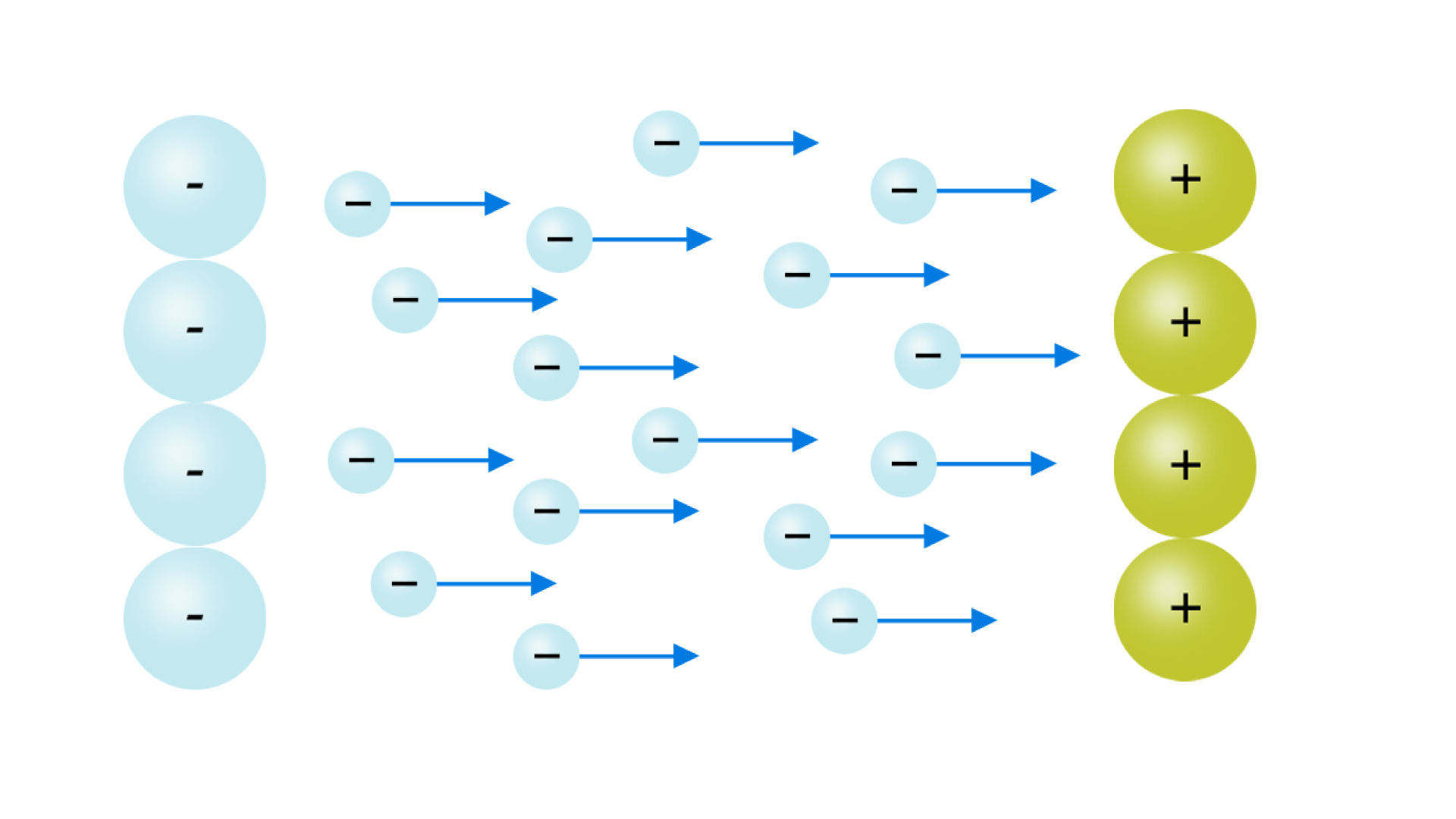
You have to force them somehow. You remember that the like charges repel each other, and unlike charges attract. If a negative charge accumulates at one end of the conductor and at the other end positive, electrons will move from the end where the negative charge has accumulated to the end with an excess of positive charge (negative deficiency).
R10u2BYs7fisT
Rysunek przedstawia symbolicznie siły elektrostatyczne powodujące ukierunkowany przepływ ładunku. Od lewej cztery ułożone pod sobą kółka ze znakiem minus wewnątrz symbolizujące ładunki ujemne, w środku szesnaście małych kółek ze znakiem minus symbolizujące wolne elektrony, od których narysowane strzałki poziome skierowane w prawo. Strzałki symbolizują kierunek przepływu prądu. Po lewej stronie rysunku cztery ułożone pod sobą kółka ze znakiem plus wewnątrz symbolizujące ładunki dodatnie.
Electrostatic forces will cause a directed flow of charge
However, charging the ends of the conductor is not enough, because the incoming electrons would neutralize charges and the force would stop working. We need to maintain this state somehow.
Source of electric current is used for this.
It has two poles or clamps to which the wires are connected. It causes the separation of the charges - it performs work to separate the charges and keep them in such a state.
Separated charges act on the electrons in the conductors connected to the source. These forces set them in motion and the current flows. The collision with atoms constantly spoils this orderly movement of charges, but the electric forces restore the order.
Hydrostatic analogy of the source of electric current
Imagine two reservoirs.
RSZntXliu6s0s
Water can only flow between the two reservoirs if there is a height difference between the water levels
Water can flow between them. Consider when it will flow. When there will be a difference in levels between reservoirs. It will flow, but during the flow in one reservoir, the level will decrease and in the other it will grow and eventually level out. The flow will end.
How to make water flow again? A difference in levels should be created. How to do it? Connect the pump and pump water from one reservoir to the other. This will create a difference in water levels between reservoirs, and the force of gravity will make water to flow from higher to lower level.
The current flowcurrent flowcurrent flow is similar
Instead of reservoirs we have a conductor or a current receiver (for example an iron), pipes with which water flows are wires, and the pump is a source of electric current.
The pump is designed to provide water with energy that constantly changes as a result of friction (changes into heat). The source of electric current has a similar task. It provides energy to the electric circuit. The energy is converted into heat as a result of collisions between electrons and atoms.
Why can the source of electric current supply energy? Because it has its own resources. What is this energy? It depends on what kind of source of electric current we are dealing with.
The difference in levels between reservoirs makes the water fall to a lower level. Why is it falling? Because the force of gravity works. This force, acting on a portion of water, performs some work. We measure the amount of this work by multiplying the force by the displacement caused by it. We have force here and we have displacement, so the force of gravity performs work on a portion of water. The same applies to electricity. Electric force acts on electrons in the conductor. This force moves the charges in the conductor. Therefore, this force performs some work.
The electric voltagevoltagevoltage between the ends of the conductor is numerically equal to the amount of work that electric forces perform when moving the charge of one coulomb inside the conductor.
Pokaz siadów – woltomierze. Instrukcja obsługi z poziomu klawiatury: 1. Uruchomienie aplikacji - ENTER, 2. Na każdym ze slajdów czytany jest automatycznie tekst alternatywny po polsku, 3. Przy pierwszym uruchomieniu na pierwszym slajdzie, czytanie tekstu po angielsku - TAB, 4. Przejście między slajdami: do następnego slajdu - TAB, do poprzedniego slajdu - TAB + SHIFT, 5. Przejście do czytania napisu po angielsku - strzałka w górę + strzałka w dół (czyta tekst po angielsku widoczny na slajdzie).
Pokaz siadów – woltomierze. Instrukcja obsługi z poziomu klawiatury: 1. Uruchomienie aplikacji - ENTER, 2. Na każdym ze slajdów czytany jest automatycznie tekst alternatywny po polsku, 3. Przy pierwszym uruchomieniu na pierwszym slajdzie, czytanie tekstu po angielsku - TAB, 4. Przejście między slajdami: do następnego slajdu - TAB, do poprzedniego slajdu - TAB + SHIFT, 5. Przejście do czytania napisu po angielsku - strzałka w górę + strzałka w dół (czyta tekst po angielsku widoczny na slajdzie).
Build an electric circuit similar to that shown in the figure below.
RheFCOh2iP5fT
Po lewej stronie ilustracji interaktywnej narysowany jest prosty układ prądu stałego zawierający miernik elektryczny oznaczony numerem 1, połączone z żarówką oznaczoną numerem 2. Żarówka ta połączona z drugą żarówką oznaczoną numerem 3. Druga żarówka podłączona jest do baterii (źródła napięcia) oznaczonych numerem 5. Źródło energii połączone jest z włącznikiem oznaczonym numerem 5. Włącznik połączony jest z miernikiem. Żarówki, bateria i włącznik połączone są szeregowo. Między włącznikiem i żarówką dołączony jest równolegle miernik elektryczny. Po prawej stronie ilustracji interaktywnej przedstawiony jest schemat układu znajdującego się po lewej stronie. Na ilustracji widoczne są numery, a na nich podpisy. 1. ammeter {audio}, 2. light bulb {audio}, 3. light bulb {audio}, 4. switch {audio}, 5. voltage source {audio}.
Po lewej stronie ilustracji interaktywnej narysowany jest prosty układ prądu stałego zawierający miernik elektryczny oznaczony numerem 1, połączone z żarówką oznaczoną numerem 2. Żarówka ta połączona z drugą żarówką oznaczoną numerem 3. Druga żarówka podłączona jest do baterii (źródła napięcia) oznaczonych numerem 5. Źródło energii połączone jest z włącznikiem oznaczonym numerem 5. Włącznik połączony jest z miernikiem. Żarówki, bateria i włącznik połączone są szeregowo. Między włącznikiem i żarówką dołączony jest równolegle miernik elektryczny. Po prawej stronie ilustracji interaktywnej przedstawiony jest schemat układu znajdującego się po lewej stronie. Na ilustracji widoczne są numery, a na nich podpisy. 1. ammeter {audio}, 2. light bulb {audio}, 3. light bulb {audio}, 4. switch {audio}, 5. voltage source {audio}.
A simple direct current (DC) circuit consisting of a voltage source, light bulbs, a switch and an electric meter
The constant voltagevoltagevoltage (DC) sources are cells, batteries or accumulators that convert the energy of chemical reactions into electricity. One of the first sources of chemical energy was the Volta’s cell, constructed in 1800.
The electric voltage U is numerically equal to the amount of work to be done to transfer the unit charge (1 C) in the conductor from one point to another.
The voltage unit in the SI system is volt [V]. One volt (1 V) corresponds numerically to the amount of work of one joule (1 J), which is needed to transfer the charge of one coulomb (1 C) between two points of the conductor.
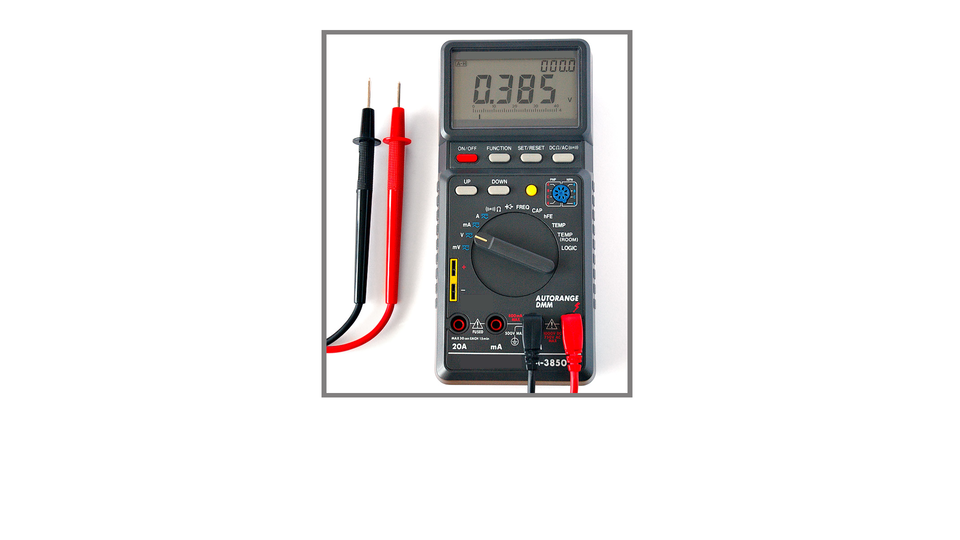
The voltmeter is a device used to measure the voltage between two points.
Exercises
R16y88SUYrQKA
Exercise 1
Wersja alternatywna ćwiczenia: Which sentence is true? Możliwe odpowiedzi: 1. The voltage unit is ampere. , 2. The voltage is equal to the work performed by movement of the charge q between points A and B. , 3. There is a voltage of 5 V between points A and B. The electron accelerated by this voltage will gain kinetic energy of 5 J. , 4. The conductor is supplied with 10 V. If a charge of 120 C has passed through it, the voltage source has performed a work of 1200 J.
Wersja alternatywna ćwiczenia: Which sentence is true? Możliwe odpowiedzi: 1. The voltage unit is ampere. , 2. The voltage is equal to the work performed by movement of the charge q between points A and B. , 3. There is a voltage of 5 V between points A and B. The electron accelerated by this voltage will gain kinetic energy of 5 J. , 4. The conductor is supplied with 10 V. If a charge of 120 C has passed through it, the voltage source has performed a work of 1200 J.
Which sentence is true?
The voltage unit is ampere.
The voltage is equal to the work performed by movement of the charge q between points A and B.
There is a voltage of 5 V between points A and B. The electron accelerated by this voltage will gain kinetic energy of 5 J.
The conductor is supplied with 10 V. If a charge of 120 C has passed through it, the voltage source has performed a work of 1200 J.
zadanie
Source: GroMar, licencja: CC BY 3.0.
Exercise 2
The voltage of 5 V was applied to the ends of the conductor. It turned out that a current of 1 A flows through the conductor. Calculate the work performed by the voltage sourcevoltage sourcevoltage source in 1 minute.
300 J.
Exercise 3
Using the sources of information available to you, write in English why high voltage is very harmful to humans. In extreme situations, high voltage can cause human death.
ReBbOSID40k8g
Exercise 4
Wersja alternatywna ćwiczenia: Indicate which pairs of expressions or words are translated correctly. Możliwe odpowiedzi: 1. wolt - voltage, 2. napięcie - volt, 3. praca wykonywana - performed work, 4. źródło napięcia - voltage source, 5. przepływ prądu - current flow
Wersja alternatywna ćwiczenia: Indicate which pairs of expressions or words are translated correctly. Możliwe odpowiedzi: 1. wolt - voltage, 2. napięcie - volt, 3. praca wykonywana - performed work, 4. źródło napięcia - voltage source, 5. przepływ prądu - current flow
Indicate which pairs of expressions or words are translated correctly.
wolt - voltage
napięcie - volt
praca wykonywana - performed work
źródło napięcia - voltage source
przepływ prądu - current flow
zadanie
Source: GroMar, licencja: CC BY 3.0.
R1QMgLRXtCrtI1
Interaktywna gra, polegająca na łączeniu wyrazów w pary w ciągu jednej minuty. Czas zaczyna upływać wraz z rozpoczęciem gry. Jeden ruch to odkrywanie najpierw jednej potem drugiej karty z wyrazem. Każdy wyraz jest odczytywany. Kolejny ruch to odkrywanie trzeciej i czwartej karty. W ten sposób odsłuchasz wszystkie wyrazy. Nawigacja z poziomu klawiatury za pomocą strzałek, odsłuchiwanie wyrazów enterem lub spacją. Znajdź wszystkie pary wyrazów.
Interaktywna gra, polegająca na łączeniu wyrazów w pary w ciągu jednej minuty. Czas zaczyna upływać wraz z rozpoczęciem gry. Jeden ruch to odkrywanie najpierw jednej potem drugiej karty z wyrazem. Każdy wyraz jest odczytywany. Kolejny ruch to odkrywanie trzeciej i czwartej karty. W ten sposób odsłuchasz wszystkie wyrazy. Nawigacja z poziomu klawiatury za pomocą strzałek, odsłuchiwanie wyrazów enterem lub spacją. Znajdź wszystkie pary wyrazów.
Match Polish terms with their English equivalents.
current flow
volt
voltage
praca wykonywana
performed work
wolt
voltage source
napięcie
źródło napięcia
przepływ prądu
Source: Zespół autorski Politechniki Łódzkiej, licencja: CC BY 3.0.