we divide organisms into groups, for example, according to the environment they live in, similarities in structure, diet, place in the food chain and other criteria.
You will learn
to explain why organisms are divided into groups, i.e. classified;
to explain what a biological species is and to give examples of species names;
to discuss the principles for classifying organisms;
to present the classification of the selected organisms;
to identify the selected organism with a simple key.
An attempt to master the chaos, i.e. the beginning of systematics
It can be assumed that the earliest division of organisms used by humans was the one based on utility, e.g. edible and inedible. Later on, they were divided according to many other criteria.
The science involved in describing, naming and classifying organisms is called systematicssystematicssystematics. The criterion used nowadays to classify organisms is their structure and mutual relationship.
Task 1
List the criteria according which you can classify the items in your school rucksack.
Biological species
The basic category in the classification of organisms is speciesspeciesspecies, i.e. a collection of all individuals having similar features and capable of producing fertile offspring. Swedish naturalist Carl Linnaeus described about 10 thousand plant species and about 6 thousand animal species. He gave the species he described binomial names in Latin, which at that time was the international language of science. To date, scientists around the world have been using Latin names for species. This ensures that any organism can be identified regardless of its local name.
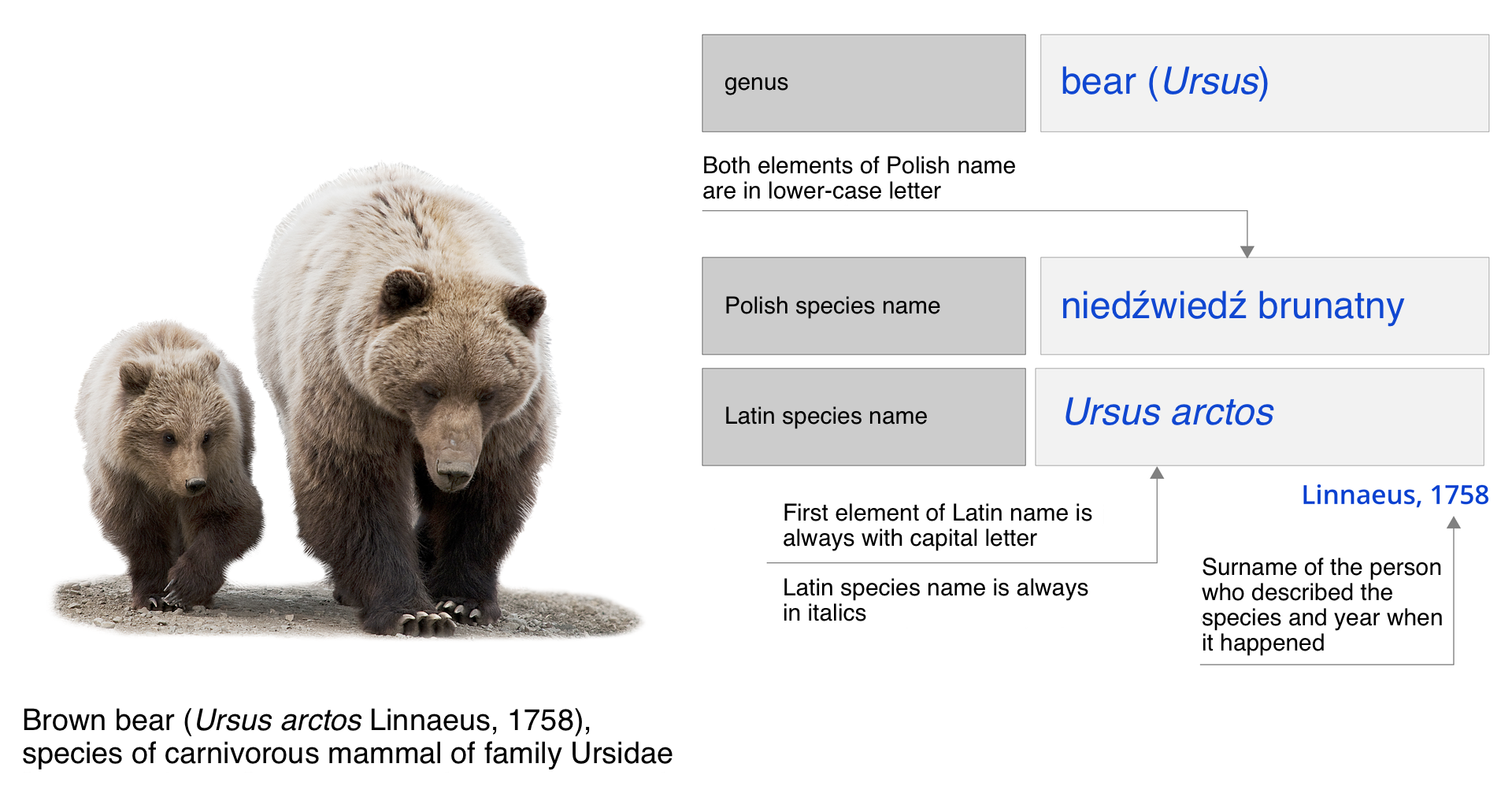
The name of each species (species name or scientific name) consists of a generic name (which is a noun) and a specific name which is and an adjective (rarely a noun) which, together, identify the species. Species names (scientific names) are Ursus arctos, i.e. brown bear and Ursus maritimus, polar bear. Both bears belong to one genus – Ursus, i.e. bear, however to two different species.
R14zsr0O4iki6
Ilustracja przedstawia zasady tworzenia nazw gatunkowych. Ilustracja składa się z dwóch elementów. Elementy ułożone jeden nad drugim. Po lewej stronie ilustracji zdjęcie niedźwiedzicy z niedźwiadkiem. Niedźwiedzica dwa razy większa od niedźwiadka. Niedźwiadek po lewej stronie niedźwiedzicy. Niedźwiedzica i niedźwiadek poruszają się w stronę obserwatora zdjęcia. Głowy niedźwiedzi skierowane w dół. Uszy małe. Oczy ciemne, małe. Długi pysk zakończony czarnymi nozdrzami. Na końcach łap długie pazury.W lewym dolnym rogu informacja: Brown bear; w nawiasie okrągłym Ursus arctos Linnaeus, rok tysiąc siedemset pięćdziesiąty ósmy, species of carvnivorous mammal of family Ursidae. W prawej części ilustracji schemat. Główne elementy schematu w prostokątach. Po lewej napis: genus. Na prawo niebieski napis: bear, w nawiasie okrągłym Ursus. Poniżej objaśnienie: Both elements of Polish name are in lower-case letter. Poniżej, po lewej, napis: Polish species name. Na prawo napis: niedźwiedź brunatny. Po lewej napis: Latin species name. Po prawej napis: Ursus arctos. Poniżej wyrazu Ursus objaśnienie: First element of Latin name is always with capital letter. Poniżej wyrazu Ursus arctos objaśnienie: Latin species name is always in italics. Na prawo wyraz Linnaeus, tysiąc siedemset pięćdziesiąt osiem. Poniżej objaśnienie: Surname of the person who described the species and year when it happened.
Brown bear
Source: Aleksandra Ryczkowska, Denali National Park and Preserve, www.flickr.com, licencja: CC BY 2.0.
Task 2
Explain why in Polish the second part of the species name, as in wąż Eskulapa (Aesculapian snake), koń Przewalskiego (Przewalski's horse), is written in capital letters.
Categories of biological classification
The classification systems used today, just like Linnaeus’ system, are hierarchical systems. They bring organisms together in higher and higher taxonomic (systematic) categories, i.e. taxonstaxonomic categorytaxons, starting from the lowest category, which is species. Taxonomic categories are groups of organisms that are related to each other, distinguished from each other by one or more features. Combining organisms into taxonomic categories according to their common features allows for organisation of knowledge about them.
R5xn9Cv0U5nvu
Ilustracja przedstawia pionowo ułożony schemat. W skład schematu wchodzą poziome prostokąty ułożone jeden pod drugim. W pionowej kolumnie znajduje się siedem prostokątów. Na górze kolumny największy prostokąt. Poniżej prostokąty są odpowiednio coraz krótsze. Najkrótszy prostokąt na samym dole kolumny. Na górze największy prostokąt. Wewnątrz informacja: Kongdom: Animalia. Poniżej w prostokącie: Phylum: Chordata. Poniżej w trzecim prostokącie: Class: Aves. W czwartym prostokącie: Order: Anseriformes. W piątym prostokącie: Family: Anatidae. W szóstym prostokącie: Genus: Anserinae. Na dole kolumny: Species: mute swan Cygnus olor. Na prawo zdjęcie stojącego białego łabędzia. Łabędź lewym bokiem do obserwatora. Głowa na długiej szyi. Szyja lekko wygięta w środku. Dziób żółty z czarnym pasem na środku. Krótkie szaroniebieskie nogi. Palce połączone błoną pławną. Numerkami zaznaczone są nazwy jednostek systematycznych: 1. This includes such species of swan as: mute swan, black swan, whooper swan., 2. This family includes birds similar to a duck. In addition to swans, these are ducks such as mallard and northern pintail, as well as geese., 3. In addition to Anatidae, these include related to them screamers., 4. Birds are feather-covered animals that lay eggs, most of them is capable of flying. Apart from Anseriformes, these include birds of prey, owls, passerines and others., 5. Chordates are animals most of which have a backbone. Apart from birds, these include also fish, amphibians, reptiles and mammals., 6. Apart from Chordates, the animal kingdom includes e.g. insects, snails and jellyfish.
Ilustracja przedstawia pionowo ułożony schemat. W skład schematu wchodzą poziome prostokąty ułożone jeden pod drugim. W pionowej kolumnie znajduje się siedem prostokątów. Na górze kolumny największy prostokąt. Poniżej prostokąty są odpowiednio coraz krótsze. Najkrótszy prostokąt na samym dole kolumny. Na górze największy prostokąt. Wewnątrz informacja: Kongdom: Animalia. Poniżej w prostokącie: Phylum: Chordata. Poniżej w trzecim prostokącie: Class: Aves. W czwartym prostokącie: Order: Anseriformes. W piątym prostokącie: Family: Anatidae. W szóstym prostokącie: Genus: Anserinae. Na dole kolumny: Species: mute swan Cygnus olor. Na prawo zdjęcie stojącego białego łabędzia. Łabędź lewym bokiem do obserwatora. Głowa na długiej szyi. Szyja lekko wygięta w środku. Dziób żółty z czarnym pasem na środku. Krótkie szaroniebieskie nogi. Palce połączone błoną pławną. Numerkami zaznaczone są nazwy jednostek systematycznych: 1. This includes such species of swan as: mute swan, black swan, whooper swan., 2. This family includes birds similar to a duck. In addition to swans, these are ducks such as mallard and northern pintail, as well as geese., 3. In addition to Anatidae, these include related to them screamers., 4. Birds are feather-covered animals that lay eggs, most of them is capable of flying. Apart from Anseriformes, these include birds of prey, owls, passerines and others., 5. Chordates are animals most of which have a backbone. Apart from birds, these include also fish, amphibians, reptiles and mammals., 6. Apart from Chordates, the animal kingdom includes e.g. insects, snails and jellyfish.
Basic unit of organisms classification
Source: Aleksandra Ryczkowska, Cezary p, licencja: CC BY-SA 3.0.
The highest taxon (taxonomic category) is the kingdom. In case of animals, it is divided into phyla and phyla into smaller categories – classes. The class consists of orders, which include families. Families have genera and these consist of species.
The plant classification categories have slightly different names than the animal classification categories, but the rules for organising the organisms are the same. In the kingdom of plants, instead of the name phylum – is used name division. In addition to the basic systematic categories, there are also so‑called auxiliary categories. Usually they have prefixes over- (e.g. superfamily), or sub- (e.g. subspecies). There are also the ones that have a separate name, e.g. variety, tribe, form.
Task 3
Specify the name of the biological species to which you belong.
Task 4
Search the sources and note down the classification of your favourite animal. Include its species name in Polish and Latin.
Rq2klXFRWzF6U
Exercise 1
Ćwiczenie wskaż prawidłowe odpowiedzi. Indicate properly written species names. Check out the Internet for the specific name of the bird which is the emblem of Poland. Możliwe odpowiedzi: 1. Homo sapiens, 2. Homo capable, 3. white eagle, 4. eagle, 5. white-tailed eagle, 6. Ursus arctos
Ćwiczenie wskaż prawidłowe odpowiedzi. Indicate properly written species names. Check out the Internet for the specific name of the bird which is the emblem of Poland. Możliwe odpowiedzi: 1. Homo sapiens, 2. Homo capable, 3. white eagle, 4. eagle, 5. white-tailed eagle, 6. Ursus arctos
Indicate properly written species names. Check out the Internet for the specific name of the bird which is the emblem of Poland.
Homo capable
white eagle
eagle
white-tailed eagle
Ursus arctos
Conclusion
Science called systematics deals with classification of organisms.
Species name (scientific name) of an organism consists of two parts. The first one is the generic name, and both of them together - are the species name.
The layout (system) of taxonomic categories is hierarchical. The lowest taxonomic category is species. Further categories in case of animals are, respectively, the genus, the family, the order, the class, the phylum and the kingdom.
Keywords
classification of organisms, generic name, species name
jednostka taksonomiczna – takson, grupa organizmów, zwykle spokrewnionych ze sobą, wyróżniająca się jedną lub kilkoma cechami, które różnią zgromadzone w niej organizmy od organizmów należących do innych grup