Sugars – starch and cellulose
what the properties and uses of simple sugars (glucose and fructose) as well as of the disaccharide (sucrose) are.
to describe the presence of starch and cellulose;
to give molecular formulas for polysaccharides;
what the properties and uses of starch and cellulose are;
to detect the presence of starch in food products.
Presence and structure of polysaccharides
Polysaccharides are complex chemical compounds composed of many radicals of simple sugars. The best known polysaccharides are starchstarch and cellulosecellulose.
The generalized formula for polysaccharides is , where is a natural number dependent on the type of polysaccharide and its origin.
Complex sugars, such as starch and cellulose, are created mainly in plants as a result of glucose molecules joining together. We call them natural polymers.
Starch is a macromolecular compound. The number of glucose molecules that produce starch varies from several hundred to several thousand, and depends on the origin. This sugar is a very important component of human diet. It is mainly found in potatoes, cereal grains, seeds, rice and corn. Starch has a granular structure – the shape of grains depends on their origin.
Cellulose, like starch, is a compound composed of many glucose radicals (2 500 to 10 000). It is the main component of plants, as it provides them with durability, flexibility and protects against water loss. It occurs in large quantities in cotton and wood. Cellulose has a fibrous structure.
Cellulose is also called fiber. Humans do not digest this sugar, but it plays an important role in the proper functioning of the digestive system.
Properties of starch and cellulose
Potato flour is starch obtained from potatoes. Cellucotton is pure cellulose.
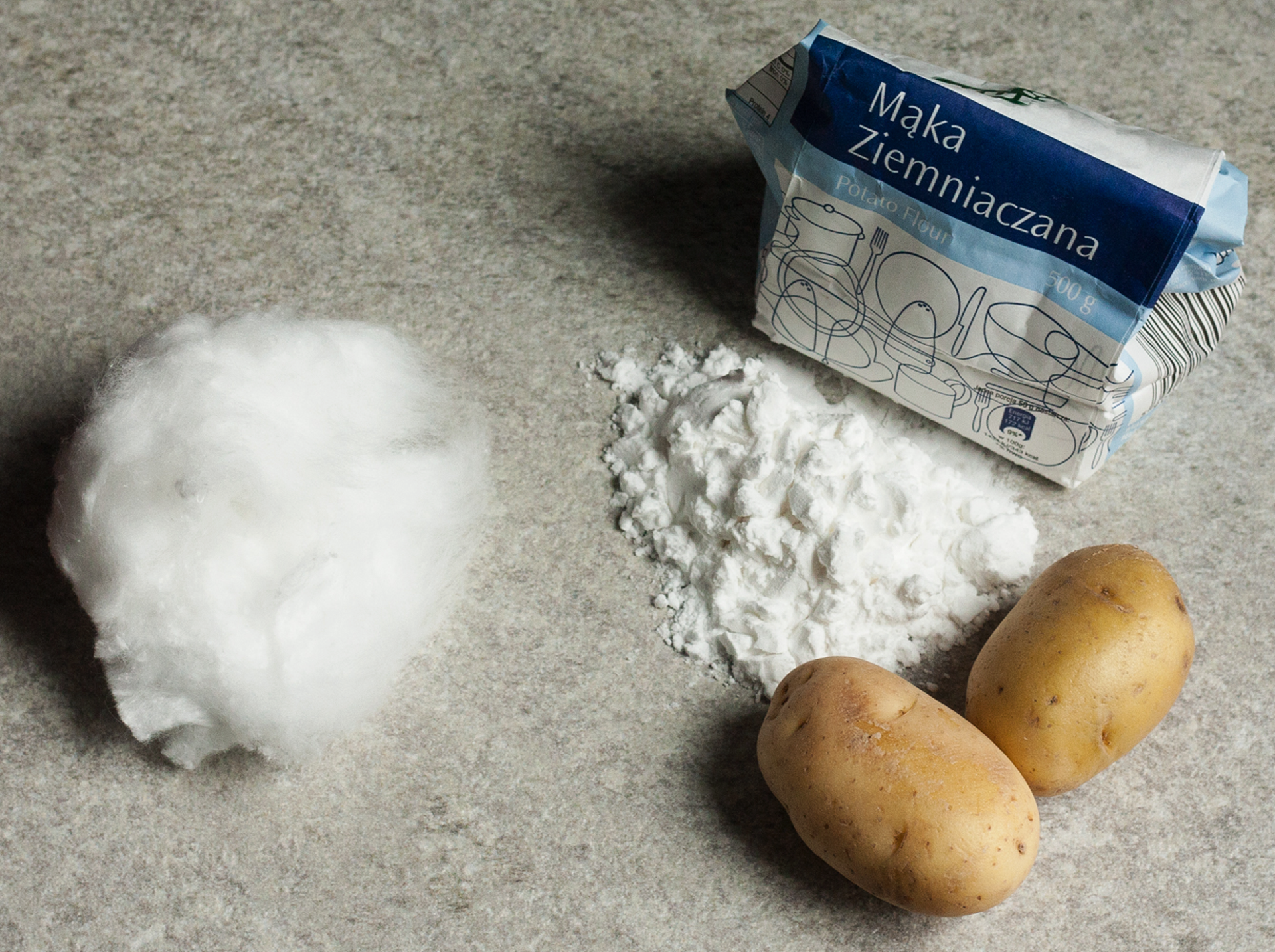
We will use these substances to test the properties of polysaccharides.
Before conducting experiment, formulate research question and hypothesis.
Do polysaccharides, such as starch and cellulose, have properties similar to those of simple sugars?
Starch and cellulose have different properties compared to simple sugars.
potato starch,
cellucotton,
water,
burner,
beakers,
wooden skewer,
watch glasses.
Place a small amount of potato starch and cellucotton on the glasses. Examine their state of aggregation, colour and odour.
Transfer the substances into beakers and add water. Test the solubility of these substances in cold water and heat up the contents of the test tubes.
Place a small amount of starch and cellucotton in two beakers. Test their solubility in kerosene.
Record the results of the experiment in the table.
Substance | Starch | Cellulose |
state of aggregation | ||
colour | ||
odour | ||
solubility in cold water | ||
solubility in hot water | ||
kerosene solubility |
Substance | Starch | Cellulose |
state of aggregation | solid | solid |
colour | white | white |
odour | odourless | odourless |
solubility in cold water | dissolves slightly | does not dissolve |
solubility in hot water | starch expands | does not dissolve |
kerosene solubility | does not dissolve | does not dissolve |
Before conducting experiment, formulate research question and hypothesis.
Are starch and cellulose flammable?
Starch and cellulose are non‑flammable substances.
potato starch,
cellucotton,
burner,
wooden skewer,
50 cmIndeks górny 33 beaker,
strainer,
funnel,
rubber tube,
watch glass.
Test the flammability of starch. To do this, do the following: place a small amount of starch on the watch glass and place a lit wooden skewer next to it. Insert the rubber tube into the narrow part of the funnel. Pour potato starch into the 50 cmIndeks górny 33 beaker, and then pour it through the sieve into the wide part of the funnel. Direct the funnel containing starch towards the lit burner and blow air into the hose thus pulverizing the starch. Observe the effects of the experiment.
Examine the flammability of cellucotton. For this purpose put a small amount of cellucotton on the glass and ignite it with the use of a wooden skewer.
Before conducting experiment, formulate research question and hypothesis.
Do starch and cellulose undergo hydrolysis?
Polysaccharides such as starch and cellulose do not undergo hydrolysis.
potato starch,
cellucotton,
10% solution of hydrochloric acid,
40% solution of sulfuric acid,
sodium hydroxide,
copper(II) sulfate solution,
all‑purpose indicator paper,
burner,
beakers,
test tubes.
Examine whether the starch decomposes into simple sugars. For this purpose, perform the following activities: put a small amount of starch to the test tube and add a 10% solution of hydrochloric acid. Heat the mixture in the beaker with hot water, add an appropriate amount of sodium base to neutralize the solution. Use the universal indicator to examine the solution’s reaction. In the second test tube obtain copper(II) hydroxide, by adding sodium base to the solution of copper(II) sulfate. Add the freshly precipitated copper(II) hydroxide to the previously prepared solution. Heat the mixture again in the beaker with hot water and observe the changes.
Examine whether the cellulose undergoes hydrolysis and decomposes into simple sugars. For this purpose, perform the following activities: put cellucotton in the test tube and add a 40% solution of sulfuric acid. Heat this mixture in the beaker with hot water for about 10 minutes. Add an appropriate amount of the sodium base to neutralize the solution – use the universal indicator to examine the solution’s reaction. Add the freshly precipitated copper(II) hydroxide. Heat the mixture again in the beaker with hot water and observe the changes.
Before watching a movie, formulate research question and hypothesis.
Film dostępny na portalu epodreczniki.pl
Film przedstawiający doświadczenie, jak wykryć skrobię w produktach spożywczych. Do przeprowadzenia eksperymentu potrzebne będą: mąka ziemniaczana (starch), jodyna (iodine), pipeta (pipette), banan (banana), cukier (sugar), mięso (luncheon meat), żelka (jelly), piętka od chleba (wheat roll), ziemniak (potato), makaron (pasta), jabłko (apple), jogurt (yoghurt), szynka (loin). Próbę kontrolną stanowi mąka ziemniaczana, natomiast próbę badaną pozostałe produkty. Na każdy produkt zostaje nakropiony roztwór jodyny. Zmiana zabarwienia produktu w miejscu nakropienia na kolor granatowy świadczy o obecności skrobi.
How to find starch in a potato and rice?
To find starch in food products, you have to treat them with iodine.
a potato,
bread,
iodine solution (solution of iodine in ethanol with addition of potassium iodide),
dropper,
Petri dishes.
Put a piece of a peeled potato and a piece of bread on Petri dishes.
Put a few drops of iodine on the tested products.
Observe the changes that occur.
Pair the correct sentences.
Starch, Cellulose, Fructose, Radicals, Copper(II) hydroxide, Hydrochloric, Iodine
| One of the chemical compounds used to test the reducing properties of sugars is the sulfate of | |
| Cotton wool is produced from... | |
| One of the simple sugars you have already learned about | |
| This acid can be used for hydrolysis of starch | |
| Starch is composed of glucose ... | |
| It is prepared from potato flour and water | |
| Allows to detect starch |
Which properties describe starch? And which ones describe cellulose? Provide the answers and turn the card to check whether they are correct.
| has a granular structure | starch |
| is the main carbohydrate in human diet | starch |
| provides plants with durability, flexibility and protects them against water loss | cellulose |
| has a fibrous structure | cellulose |
| is the primary building material in plants | cellulose |
| is digested by the human body | starch |
| is not digested by humans | cellulose |
| occurs mainly in potatoes, rice, corn, cereal grains | starch |
| occurs, among others, in wood and cotton | cellulose |
| is detected in food products by means of iodine | starch |
| dissolves slightly in cold water | starch |
| is flammable | cellulose and starch |
| does not dissolve in water | cellulose |
Conclusion
The most common polysaccharides are starch and cellulose, the molecular formula of which is .
Starch has a granular structure and occurs mainly in potatoes, cereal grains, rice and corn.
Cellulose is the primary building material in plants. It has a fibrous structure; it occurs, among others, in wood and cotton.
Starch and cellulose are white solids. Starch is slightly soluble in cold water, and it forms starch gruel in hot water. Cellulose does not dissolve in water; it is flammable.
To detect starch in food products,the iodine‑starch testiodine‑starch test is used – the reaction of starch with iodine, as a result of which a dark‑blue colour occurs.
Starch undergoes hydrolysis in the human body; it decomposes into dextrin and then into glucose molecules. Humans are unable to digest cellulose.
Indicate the differences and similarities in the properties and structure of starch and cellulose. Write them in the table.
Keywords
starch, cellulose, polysaccharides, molecular formula, hydrolysis
Glossary
celuloza – polisacharyd o wzorze sumarycznym ( = 2500‑10 000); ma budowę włóknistą; jest białą, łatwopalną substancją stałą; nie rozpuszcza się w wodzie; występuje w bawełnie i drewnie
próba jodoskrobiowa – reakcja charakterystyczna skrobi; zachodzi pod wpływem jodu zawartego m.in. w jodynie; w wyniku tej reakcji powstaje ciemnogranatowe zabarwienie
skrobia – polisacharyd o wzorze , where , gdzie n to wartość od kilkuset do kilku tysięcy i zależy od pochodzenia; ma budowę ziarnistą; jest białą substancją stałą; słabo rozpuszcza się w zimnej wodzie; występuje głównie w ziemniakach i ziarnach zbóż