Communication and its components
you will recognise biblical motives
you will explain different meanings of the word “communicationcommunication”
you will define the sendersender and the receiverreceiver in a communication process
you will name and discuss the components of a communication processcomponents of a communication process
The word communication is a loanword from Latin. In that language communication means sharing, contact and it originated from the verb communicare: to share, to participate. Therefore, communication is commonly associated with agreement, fellowship or contact and it is an attribute of all living beings, not just humans.
Take a close look at the Pieter Bruegel’s painting. Name a biblical motive the artist referred to.
- Babylonian captivity
- Plagues of Egypt
- Construction of the Tower of Babel
- Fall of walls of Jericho
- Moses entering into a covenant with Jehovah

Explain what do agreement, fellowship and communication have in common with the motive illustrated by Pieter Bruegel.
Communication is an act of sharing our thoughts, emotions, judgments and expressing our will. It can be verbal or non‑verbal, however, most frequently, people use both of them simultaneously. We can emphasize our speech with gestures, facial expressions, tone of voice, and in case of a written discourse – graphic characters.
Act of communication
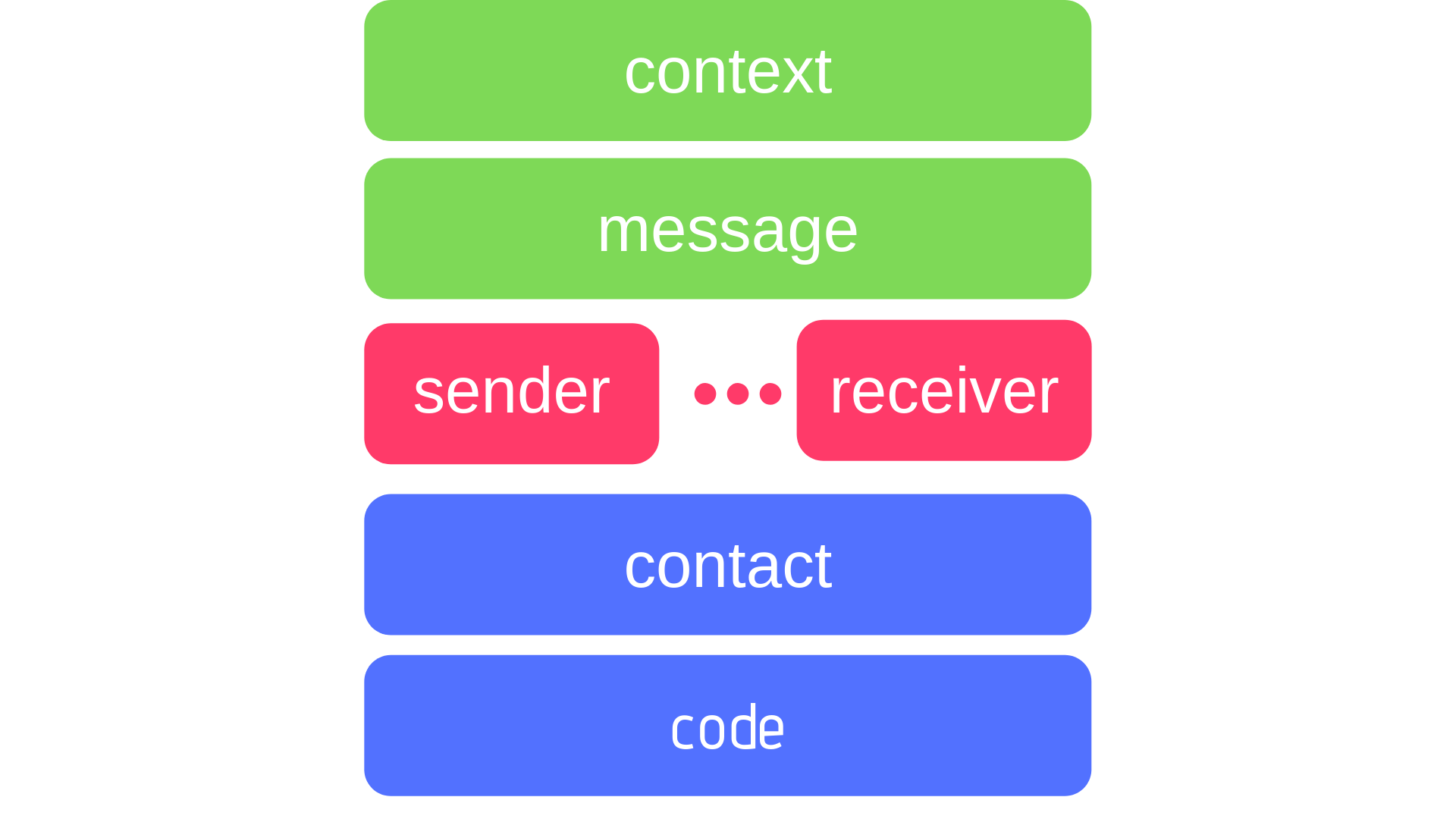
Act of communication constitutes a fundamental unit of communication. It is an act in which we use the language to reach a mutual understanding, to talk or write with the sender’s intention. The components of an act of communication include: sender, receiver, contactcontact, codecode, messagemessage and** contextcontext**.
Sender is a person that utters the words but it is also their author. For instance, we can list following senders of a message that form a part of a television news service:
presenter reading the text,
journalist preparing the information,
editor proofreading the text,
news agency releasing the information,
institutional sender, e.g. a television channel broadcasting the news.
It’s worth mentioning that the sender may be either a single individual (individual sender) or a group of people (collective sender). The second type of a sender is visible in genres such as open letter or memorial. Sometimes, the author of the text hides his/her identity under a pseudonym or does not reveal it at all – in that case we are talking about an anonymous author.
Based on the information presented above, create an infographic that would illustrate the variety of possible senders in an act of communication.

Receiver can mean one person (individual receiver) or a group of people (collective receiver), who receive a message transmitted by the sender. An intendedintended receiver, to whom the sender transmits the information intentionally, is called addressee. The ability to adjust the form of a message to the receiver is essential for communication. Lack of this capacity can lead to stylistic errors and misunderstandings. It is worth remembering that the sender and the receiver can swap their roles, e.g. during a conversation, that is to say, in case of a dialogue.
In order to make the communication successful, it is essential to create a mental contact between the sender and the receiver, which means that both of them have to show willingness to cooperate. It is also crucial to establish and maintain a physical contact during verbal communication (either visual or auditory).
Message is a content transmitted from the sender to the receiver. A message has to be about something, which means that it has to refer to reality, and therefore it should be embedded in a context. After all, a statement has to be related to concepts and values that are common for both the sender and the receiver. Moreover, it has to be set in a specific time and place, and therefore in a specific communicative situation. This way, we can omit some parts of the information as they become obvious. It is worth adding that the sender transmits the message to the receiver via communication channel: visual (e.g. newspaper articles, published books, communication via sign language), auditory (e.g. radio broadcast), visual–auditory (e.g. television broadcast, conversation accompanied by suggestive gestures) and tactile (such as Braille).
Every message has to be expressed in a language, and so in a specific code. There are verbal codes (they are based on words) and non‑verbal codes, among which the most important are:
kinetic code (gestures, position and movement of our body),
prosodic code (tone, power and intonation of our voice),
proxemic code (distance between the speaker and the listener),
graphic code (emoticons, handwriting, type and size of a chosen font).
Communication model
The above mentioned components of an act of communication form the communication model created by Roman Jakobson, which is presented in the following diagram:
In the following situations, the sender did not adjust the message to the receiver’s features. Identify the mistakes and inappropriate statements and then edit the text so that it takes into account the characteristics of the receiver. Do not change the meaning of the message.
Grandfather talking to his six‑year‑old grandson: “Dear young man, given your incompetence in the field of savoir‑vivre, severe punitive sanctions shall be applied against you”.
Engaged couple talking to an employee of a civil registrar: “Listen, we wanna get hitched and we wanna know you what kind of papers we need to give you. And one more thing. Can we sort this out by next month? You know, we’re in a bit of a rush.”
E‑mail from a student to her professor: “Dear Professor, could I ask you to let me retake the test that I failed last week? I am sure that it’ll be my time to shine and you’ll be extremely proud of me :). I send you my warmest regards Natty from IC”.
Imagine that the chain comes off your bike during a ride and even if you try, you cannot fix it on your own. Compose a request for help to the following addressees. Use different expressions each time.



Listen to the abstract recording to review the material and new vocabulary. Then do the vocabulary exercise. Match the pairs: English and Polish words.
odbiorca niezamierzony, odbiorca, komunikat, składniki aktu komunikacji, odbiorca zamierzony, nadawca, komunikacja, kod
| components of an act of communication | |
| communication | |
| sender | |
| receiver | |
| message | |
| code | |
| intended receiver | |
| unintended receiver |
Keywords
communication, sender, receiver, message
Glossary
składniki aktu komunikacji
komunikacja
nadawca
odbiorca
komunikat
kod
odbiorca zamierzony
odbiorca niezamierzony
kontekst
kontakt