Przeczytaj
The word cloud below shows many different labels that are used to describe various generations. Some people believe that not only are some of these descriptions hurtful, but also that it doesn’t make any sense to describe a whole generation with a set of a few arbitrarily chosen characteristics. Yet, generation characteristics are here to stay, so let’s take a closer look at how they work and what they say.
Poniższa chmura wyrazów pokazuje wiele rozmaitych określeń używanych do opisu różnych pokoleń. Niektórzy uważają, że nie tylko część tych opisów jest krzywdząca, ale także że nie ma sensu opisywać całego pokolenia za pomocą zestawu kilku arbitralnie wybranych cech. Jednak określenia identyfikujące poszczególne pokolenia zadomowiły się w naszym języku na dobre, więc przyjrzyjmy się bliżej temu, jak są używane i co tych pokoleniach mówią.
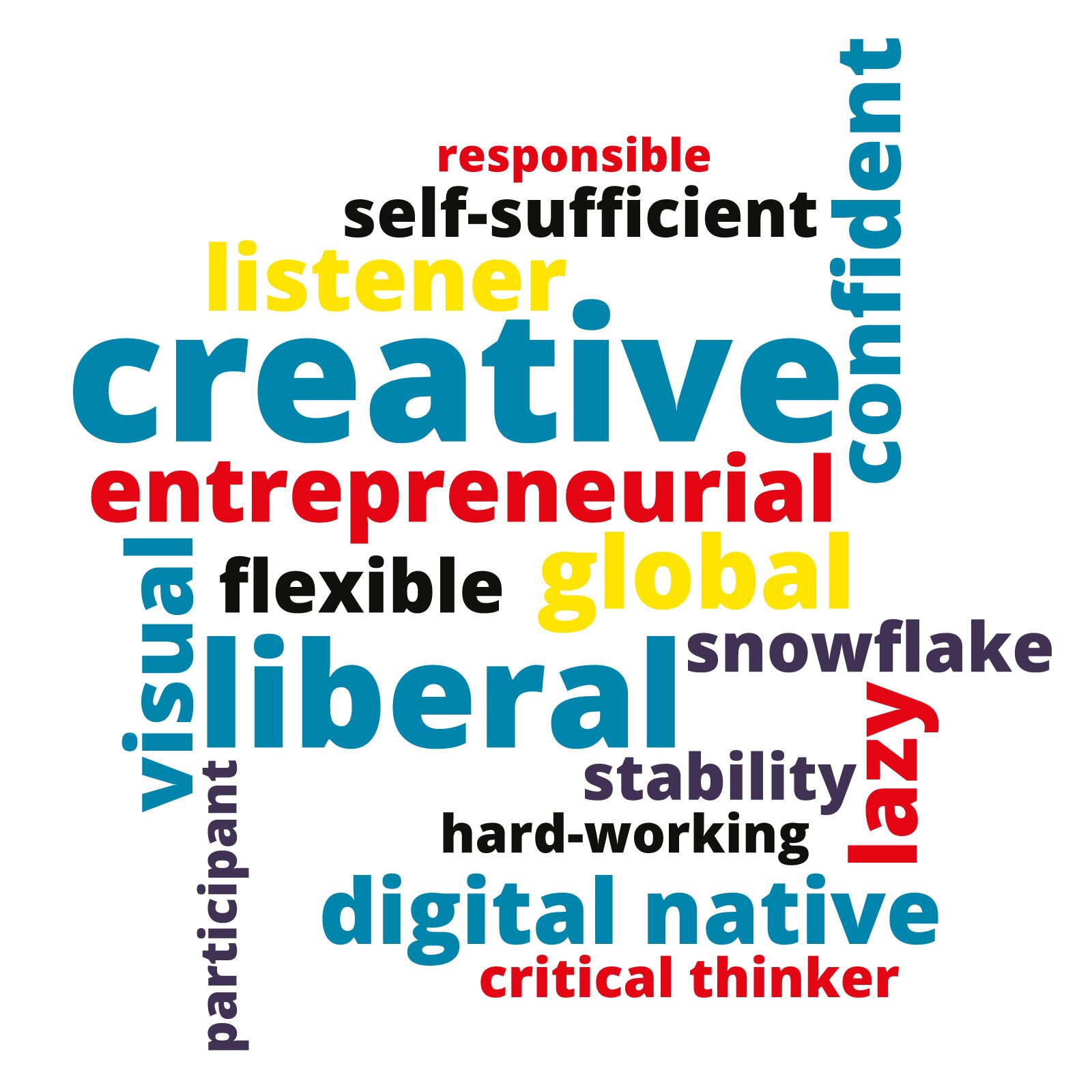
Read the text and do the exercises below.
…X, Y, Z… A?Baby boomers, Millennials, Generation Z – which do you belong tobelong to? LabellingLabelling people according to the generationgeneration they belong to started as a way for sociologists to talk about certain characteristics, blossomedblossomed into an important tool in the marketing industry (this generation prefers regular coffee while that will only buy flavoured), to finally get out of control and become a popular topic of shallow pseudo‑sociological articles that spread stereotypes, often hurtful. Which is not to say that these characteristics totally miss their markmiss their mark. Considering that each generation grows up in different technological, economic, and social situations, they will naturally be shaped by them. So, let’s take a look at what’s natural for each cohortcohort, especially the two youngest ones – the Z Generation and the Alpha Generation.
Growing up in a world connected through a multiple of devices such as laptops. tablets, mobile phones, or TV’s hooked up to streaming services, Generations Z and Alpha are ‘digital natives,’ which naturally influences their attitudes. They are much more globalglobal, compared to others. Reaching out to people, places, and services from all over the world, they’re not suspicious of them just because of a distant postcodepostcode. The digital world erases that distance, at the same time offering social opportunities which, unlikeunlike the previous generations, they treat as a rightful equivalentequivalent of face‑to‑face interactions.
In the same manner, they seem to have let go oflet go of other ‘analogue’ elements that made up the lives of the previous generations. Their music is pumped from Spotify into smart speakers. Their games are online, not on a board. Their books and news are likewise digital, not hard copyhard copy. Similarly, they have no use forhave no use for paper notebooks and textbooks, much preferring to find and note things on their screens. This, in fact, earned them another nickname – ‘screenagers.’
While the Alphas are still too young to be assessedassessed properly, it seems logical that being raised with screens they will have a lot in commonhave a lot in common with the Zs with respect to learning and working styles. Zs are very visualvisual and participativeparticipative. While the older generations preferred to sit and listen to a teacher who was the authority and whose learning was focused on the knowledge itself, the younger ones prefer that a teacher is just a facilitatorfacilitator, who helps them try and discover things for themselves and it’s about doing it their way and their development, not knowledge for the sake of knowledge. Knowledge itself used to be delivered mostly verbally, but Zs are much more visualvisual and their learning as well as working is about images, discussion, and creating things together, with everyone participating rather than following one leader or teacher.
Their whole lives are much more governed by mobilitymobility, flexibilityflexibility, and adapting to constantly changing situations than ever before. Their older counterpartscounterparts, even in their teens, sought stability and later, job security. Fate does not seem to have that in storehave that in store for the Zs and Alphas. Graduating from universities in unprecedentedunprecedented numbers, both these generations will be changing jobs, careers, and homes much more than any before them, their lives changing as fast as the world around them.
What else will they be? Time will tell. Time will also continue to influence it, like it does for every generation. It’s important to note, that while every generation is shaped by the circumstances they grow up in, they also change as they move along their life cyclelife cycle. People’s needs and values change, when from students they become parents and business people and then pensionerspensioners. Moreover, they’re influenced by circumstances. Middle‑aged baby boomers, coming in contact with the digital world for the first time, were very suspicioussuspicious of it. The generation gapgeneration gap between them and Gen X, happy to explore digital possibilities, was clearly visible. But they’ve adapted since and now over 80% of them use online banking and social media. Naturally, the COVID pandemic forced that shift a bit, but that’s besides the point. The Alphas will probably never give up their screens but who will they grow old to be? What will they have to adapt to? Only time will tell.
Źródło: Joanna Sobierska‑Paczesny, licencja: CC BY-SA 3.0.
- Studying generations and their characteristics developed thanks to people who create strategies for selling products.
True False
- The author of the text is enthusiastic about characterising generations.
True False
- Generation Alpha doesn’t treat online relationships as worse.
True False
- Generation Alpha doesn’t like to take notes on paper.
True False
- The author assumes that Alphas will be similar to Zs in the way they learn.
True False
- Younger Alphas have different needs and requirements of teachers than older ones.
True False
- The number of people with university degrees in generations Y, Z, and Alpha should be more or less equal.
True False
- The way the COVID pandemic influenced certain behaviours is presented as rather unique.
True False
Read the text above. Then, complete the sentences.
Some people say that the whole village gathering in the evenings for stories was the past 2. 1. unprecedented, 2. mark, 3. counterparts, 4. use, 5. embrace, 6. common, 7. gap, 8. equivalent of social media sharing.
While characteristics of generations don’t necessarily miss the 3. 1. unprecedented, 2. mark, 3. counterparts, 4. use, 5. embrace, 6. common, 7. gap, 8. equivalent, it doesn’t mean that all people from Generation X want to be homeowners.
Millennials were the first ones to wholeheartedly 4. 1. unprecedented, 2. mark, 3. counterparts, 4. use, 5. embrace, 6. common, 7. gap, 8. equivalent online banking and similarly, they were the first generation to move some of their social life to social media.
The future generations will most likely have no 5. 1. unprecedented, 2. mark, 3. counterparts, 4. use, 5. embrace, 6. common, 7. gap, 8. equivalent for paper magazines.
Despite the age difference between us, my mom and I have a lot in 6. 1. unprecedented, 2. mark, 3. counterparts, 4. use, 5. embrace, 6. common, 7. gap, 8. equivalent.
Many people from Generation X appreciate the usefulness of ebooks, but they still prefer their paper 7. 1. unprecedented, 2. mark, 3. counterparts, 4. use, 5. embrace, 6. common, 7. gap, 8. equivalent.
Because so many students and adults had to go online during the COVID pandemic, there was an 8. 1. unprecedented, 2. mark, 3. counterparts, 4. use, 5. embrace, 6. common, 7. gap, 8. equivalent number of cases of computer addiction.
Słownik
/ əˈsest / / əˈses /
oceniani, określani, poddani ocenie [ocenić, określić, poddać ocenie]
/ bɪˈlɒŋ tuː /
przynależysz [przynależeć]
/ ˈblɒsəmd / / ˈblɒsəm /
rozkwitł/rozkwitła [kwitnąć, zakwitać]
/ ˈkəʊhɔːt /
kohorta (a group with a shared characteristic)
/ ˈkaʊntəpɑːts / / ˈkaʊntəpɑːt /
odpowiedniki [odpowiednik]
/ ɪˈkwɪvələnt /
odpowiednik
/ fəˈsɪlɪteɪtə /
ktoś, kto ułatwia lub coś, co ułatwia
/ ˌfleksəˈbɪlɪti /
elastyczność
/ ˌdʒenəˈreɪʃn̩ /
pokolenie
/ ˌdʒenəˈreɪʃn̩ ɡæp /
różnica pokoleń
/ ˈɡləʊbl̩ /
globalni [globalny/globalna]
/ hɑ:d ˈkɒpi /
wersja papierowa
/ həv ə lɒt ɪn ˈkɒmən /
mają wiele wspólnego [mieć wiele wspólnego]
/ həv ˈnəʊ ˈjuːz fɔː /
nie używają [nie używać]
/ həv ðæt ɪn stɔː / / həv ˈsʌmthetaɪŋ ɪn stɔː /
mieć to w zanadrzu [mieć coś w zanadrzu]
/ ˈleɪbəlɪŋ / / ˈleɪbl̩ /
przyczepianie etykiet [przyczepić (komuś) etykietę]
/ ˈlet ˈɡəʊ ɒv /
odpuścić, odłożyć
/ laɪf ˈsaɪkl̩ /
cykl życia
/ mɪs ðeə mɑːk / / mɪs ðə mɑːk /
nie są trafione [nie osiągnąć celu]
/ məʊˈbɪlɪti /
mobilność
/ ˌpɑːˈtɪsəpətɪv /
zaangażowani [zaangażowany/zaangażowana]
/ ˈpenʃnəz / / ˈpenʃnə /
emeryci [emeryt/emerytka]
/ ˈpəʊstkəʊd /
kod pocztowy
/ səˈspɪʃəs /
podejrzliwi [podejrzliwy/podejrzliwa]
/ ˌʌnˈlaɪk /
w przeciwieństwie do
/ ʌnˈpresɪdentɪd /
bezprecedensowy/bezprecedensowa
/ ˈvɪʒuəl /
postrzegający przy użyciu wzroku, korzystający ze zmysłu wzroku
Źródło: GroMar Sp. z o.o., licencja: CC BY‑SA 3.0