Wyjaśnij kluczowe pojęcia związane z tematem abstraktu.
Wyjaśnij kluczowe pojęcia związane z tematem abstraktu.
Present data from table 1 from Chemical tables in the form of a bar graph, taking into account the dependence of the number of carbon atoms on the boiling and melting points. Compare them with the values for alkanes.
Construe all possible models of a butene molecule and compare them with one another.
Alkene
Chemical formula
Boiling point (°C)
Melting point (°C)
Density (g·cmIndeks górny -3-3) (20°C and 1013 hPa)
ethene
CIndeks dolny 22HIndeks dolny 44
-103.7
-169.0
0.5678
propene
CIndeks dolny 33HIndeks dolny 66
-47.6
-185.2
0.505
butene (but‑1‑ene)
CIndeks dolny 44HIndeks dolny 88
-6.2
-185.3
0.588
butene (trans‑but‑2‑ene)
CIndeks dolny 44HIndeks dolny 88
0.8
-105.5
0.599
butene (cis‑but‑2‑ene)
CIndeks dolny 44HIndeks dolny 88
3.7
-138.9
0.616
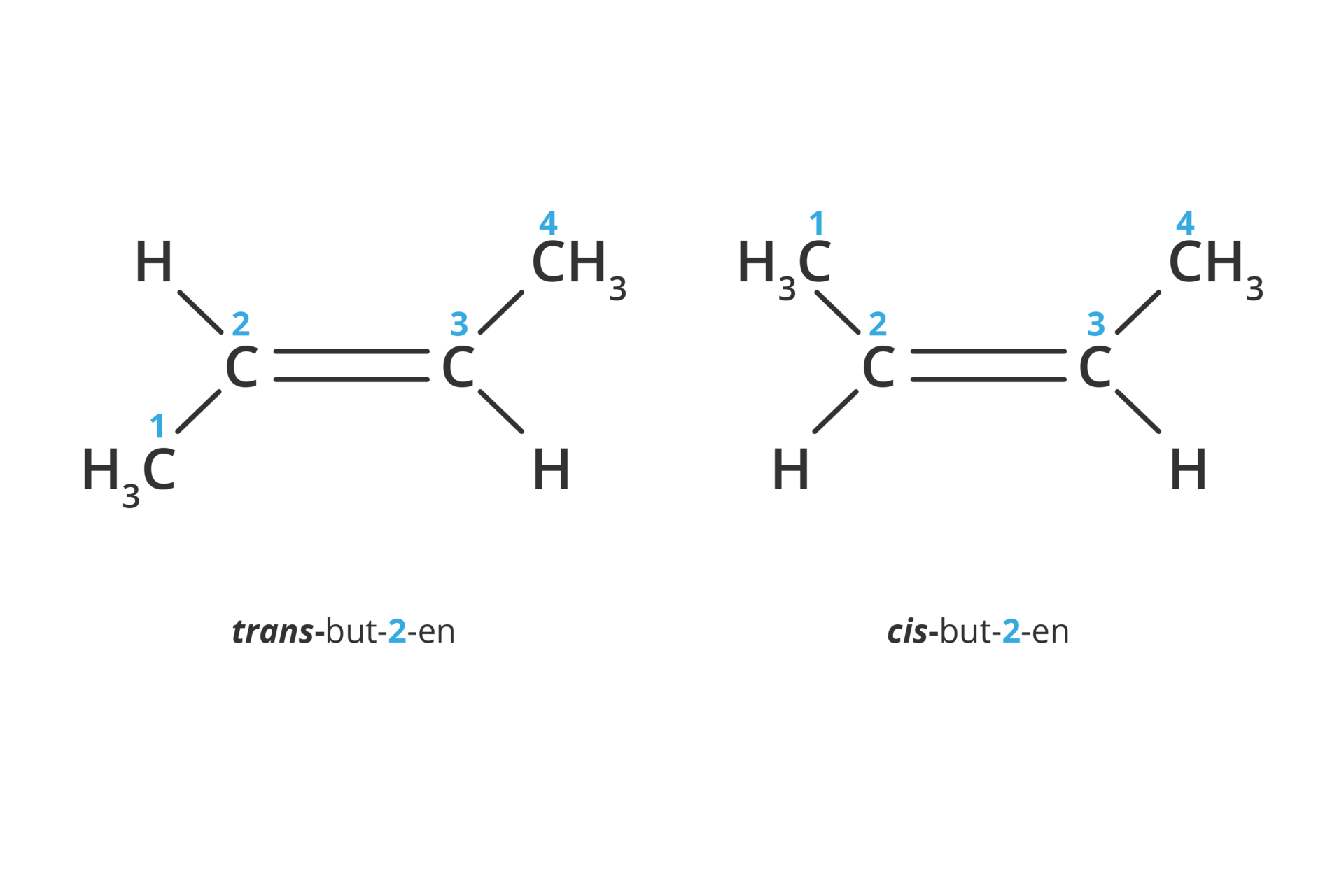
Alkenes containing a double bond at a carbon atom other than the first in the chain may have the form of cis- isomers (both methyl groups – the substituents are on the same side of the plane in which the binding lies) and the trans‑isomers (the substituents are at opposite sides of the plane). The properties of these compounds depend on the type of bonds formed by carbon atoms in molecules of organic compounds (Sawicka Jolanta, Janich‑Kilian Anna, Cejner‑Mania Wiesława, Chemical tables, Podkowa, Gdańsk 2004.).
R1G2j76286P8x
Schemat przedstawia wzór strukturalny dwóch związków. Trans but dwa en oraz cis but dwa en. Wzory różnią się położeniem grupy ce ha trzy. Przy trans but dwa en grupa ce ha trzy umiejscowiona jest po lewej stronie u dołu drugiego atomu węgla. Przy cis but dwa en grupa ce ha trzy umiejscowiona jest po lewej stronie u góry drugiego atomu węgla.
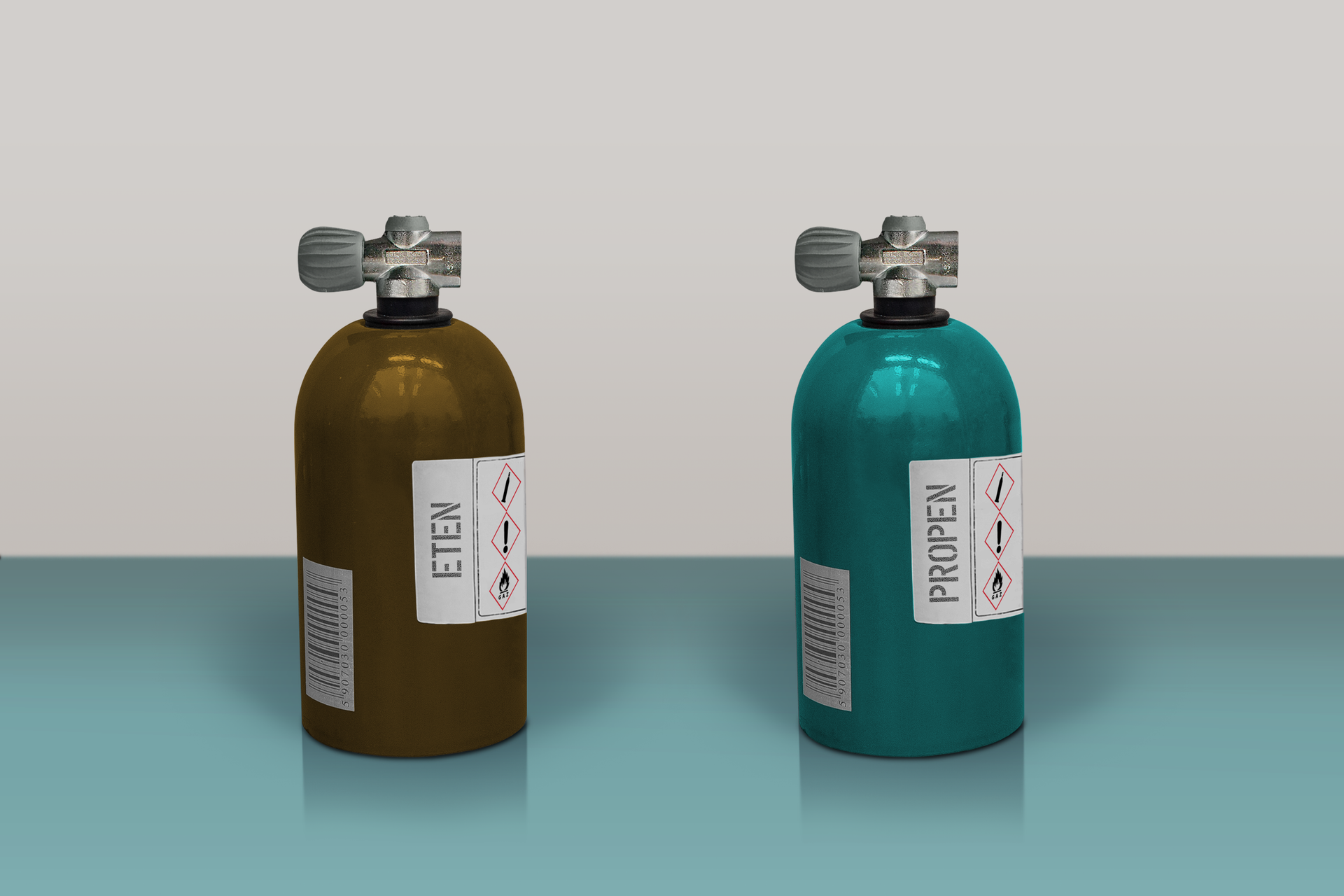
R1cry0wtiq6bi
Na zdjęciu dwie butle, podpisane: eten i propen.
Two bottles labeled: ethene and propene
Source: Tomorrow Sp. z o.o., licencja: CC BY 3.0.
Chemical properties of alkenes
Task 2
Formulate a research question and hypothesis before conducting “Testing the combustibility of alkenes”. After the experiment, do the interactive exercises in the summary to consolidate what you have learned.
R1QLInA9Smypb
Analysis of the experiment: „Testing the combustibility of alkenes”. Research question (Uzupełnij). Hypothesis (Uzupełnij).
Analysis of the experiment: „Testing the combustibility of alkenes”. Research question (Uzupełnij). Hypothesis (Uzupełnij).
Badanie palności alkenów – pokaz nauczycielski
Experiment 1
Research problem
How does ethene burn?
Hypothesis
Select one of the presented hypotheses, and then verify it.
a test tube with collected ethene, closed with a stopper,
torch.
Instruction
Remove the stopper from the tube filled with ethene.
Keep the burning torch near the outlet of the tube.
Observe the occurring changes.
Summary
With restricted oxygen access incomplete combustion takes place and the flame is smoky:
R2fSQ5JoEzwNH
Exercise 1
Fill in the reaction equation. Dostępne opcje do wyboru: water, dwa o dwa, oxygen, dwa ha dwa o.
Pierwsze równanie: ce dwa ha cztery dodać tu uzupełnij strzałka w prawo dwa ce o dodać tu uzupełnij.
Drugie równanie: ethene dodać tu uzupełnij strzałka w prawo carbon monoxide dodać tu uzupełnij.
Fill in the reaction equation. Dostępne opcje do wyboru: water, dwa o dwa, oxygen, dwa ha dwa o.
Pierwsze równanie: ce dwa ha cztery dodać tu uzupełnij strzałka w prawo dwa ce o dodać tu uzupełnij.
Drugie równanie: ethene dodać tu uzupełnij strzałka w prawo carbon monoxide dodać tu uzupełnij.
Ethene is a flammable gas. With unrestricted air access, it burns with an even flame. In this case complete combustion occurs:
RNQCmpKDHJBjH
Exercise 2
Dostępne opcje do wyboru: oxygen, dwa ha dwa o, water, trzy o dwa. Fill in the reaction equation. Pierwsze równanie: ce dwa ha cztery dodać tu uzupełnij strzałka w prawo dwa ce o dwa dodać tu uzupełnij. Drugie równanie: ethene dodać tu uzupełnij strzałka w prawo carbon dioxide dodać tu uzupełnij.
Dostępne opcje do wyboru: oxygen, dwa ha dwa o, water, trzy o dwa. Fill in the reaction equation. Pierwsze równanie: ce dwa ha cztery dodać tu uzupełnij strzałka w prawo dwa ce o dwa dodać tu uzupełnij. Drugie równanie: ethene dodać tu uzupełnij strzałka w prawo carbon dioxide dodać tu uzupełnij.
Task 3
Formulate a research question and hypothesis before conducting the experiment “Testing the reactivity of ethene”. Write your observations and conclusions. Pay attention to whether and how ethene reacts with bromine.
RKhqYTZNwfOnJ
Analysis of the experiment: “Testing the reactivity of ethene”. Research question (Uzupełnij). Hypothesis (Uzupełnij).
Analysis of the experiment: “Testing the reactivity of ethene”. Research question (Uzupełnij). Hypothesis (Uzupełnij).
Badanie reaktywności etenu
Experiment 2
Research problem
Does ethene react with bromine?
Hypothesis
Select one of the presented hypotheses, and then test it.
Ethene does not react with bromine. Ethene reacts with bromine.
You will need
two test tubes (including one with ethene),
stopper,
bromine solution.
Instruction
Fill 1/3 of the first test tube with bromine solution (control).
Fill the second test tube (with collected ethene) with the same amount of bromine solution. Close the test tube with a stopper and mix well by shaking.
Observe the occurring changes.
Compare the color in both tubes.
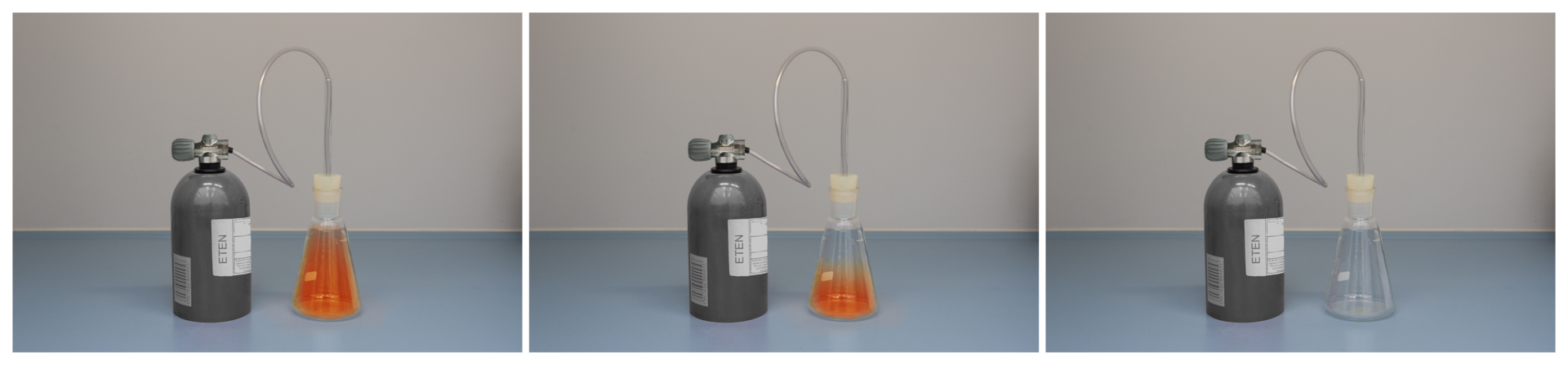
RLxGAcBcZIvqf
Zdjęcia przedstawiają reakcję etenu z bromem. Na pierwszym zdjęciu widać kolbę stożkową wypełnioną bromem, substancja ma kolor pomarańczowy. Do zlewki podłączona jest butla z etenem za pomocą giętkiej rurki. Na drugim zdjęciu połowa substancji w zlewce uległa odbarwieniu. Zawartość kolby jest pomarańczowa już tylko w dolnej części. Na trzecim zdjęciu zawartość kolby stała się przezroczysta, pomarańczowy kolor zniknął.
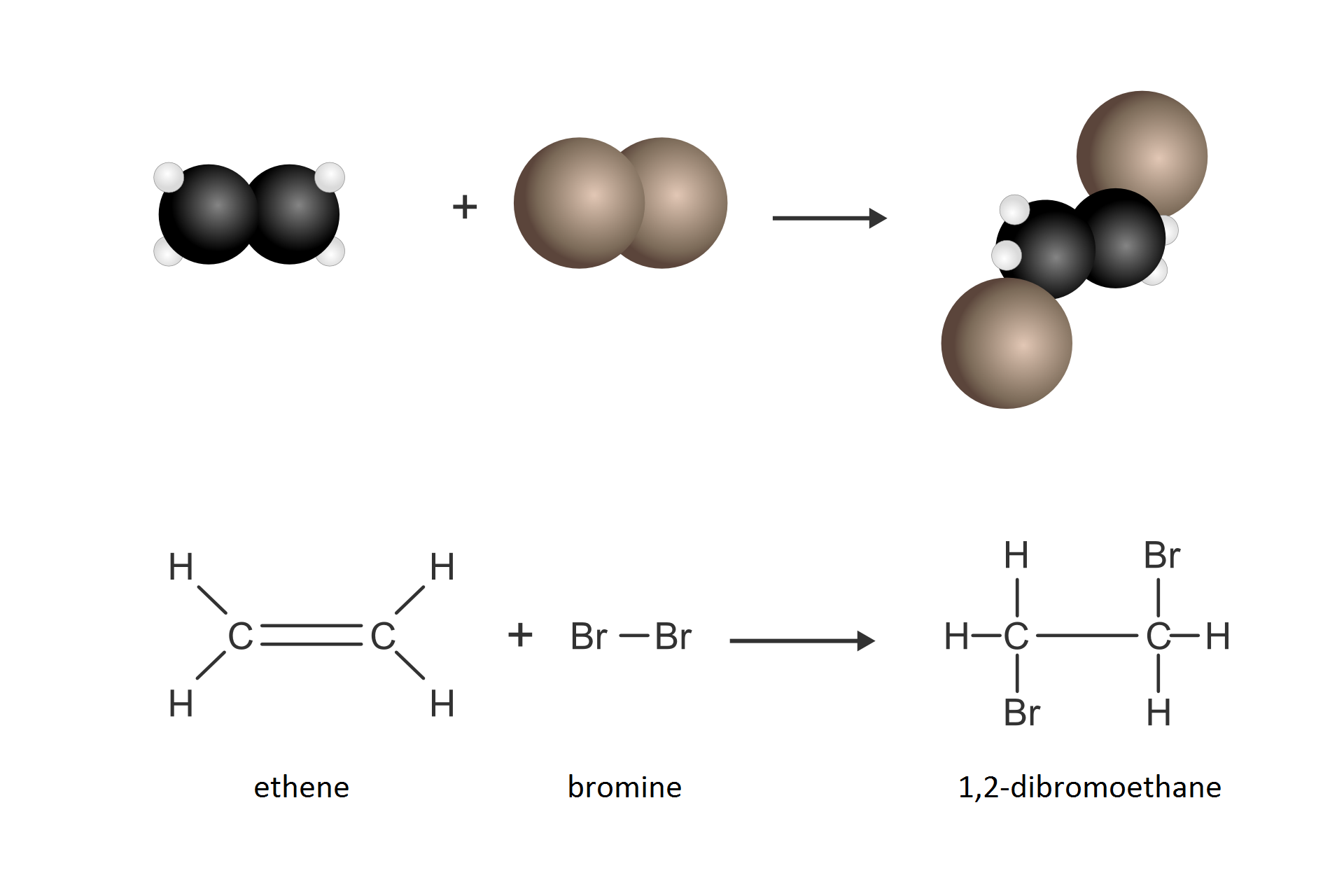
The reaction of ethene with bromine in anhydrous conditions proceeds according to the equation:
RSTsR4M8lzYvs
Schemat przedstawia zapis reakcji etenu z bromem za pomocą modeli oraz wzorów strukturalnych. Równanie reakcji: eten, ethene dodać brom, bromine strzałka w prawo jeden przecinek dwa dibromoetan, jeden przecinek dwa dibromoethane Cząsteczka etenu c dwa ha cztery reaguje z cząsteczką bromu be er dwa dając w wyniku reakcji cząsteczkę jeden dwa dibromoetanu.
As a result of this reaction, the multiple bond breaks and a saturated compound dibromoethane forms (the di - prefix informs that there are two bromine atoms in the molecule). This type of reaction is called the addition reaction.
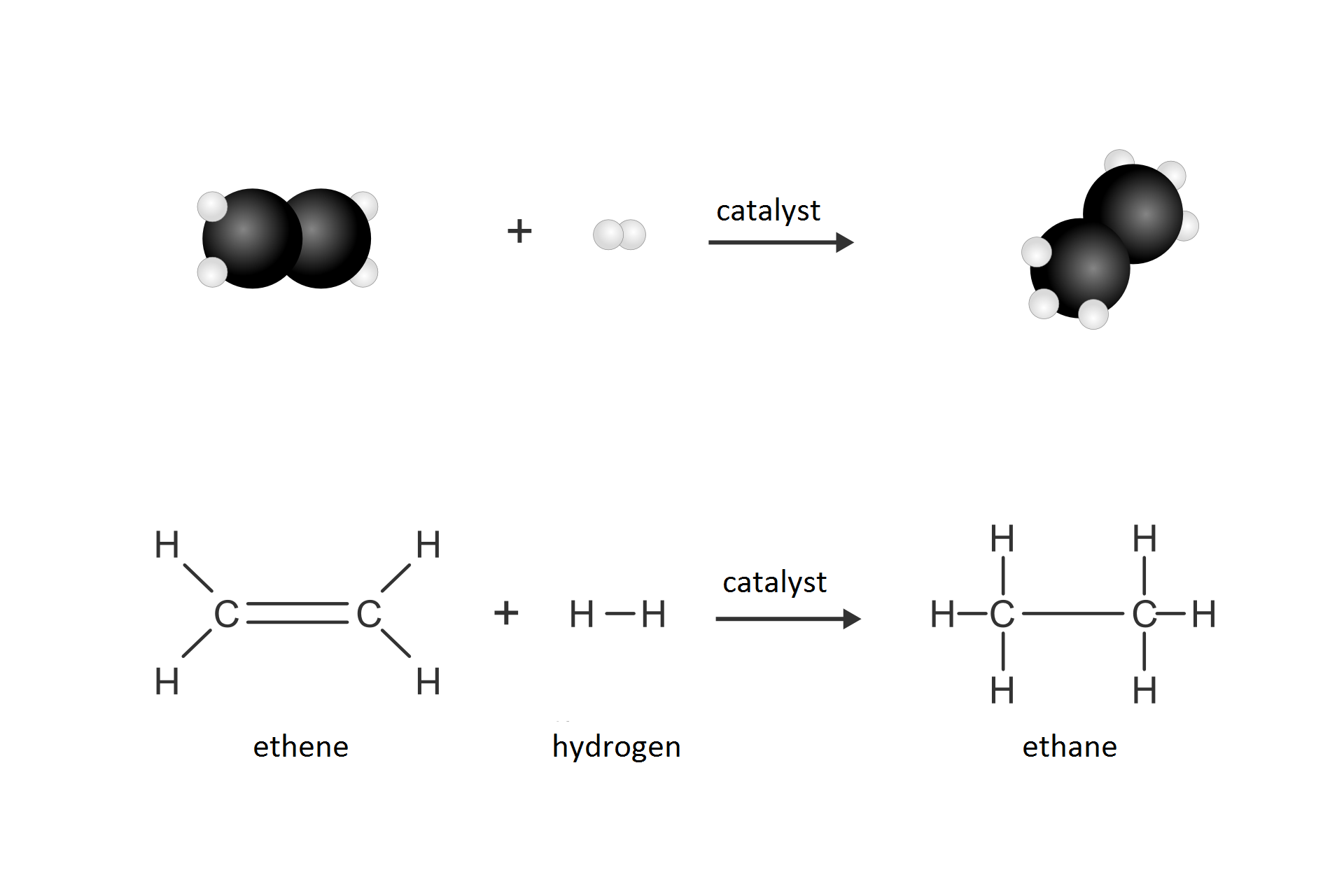
Under appropriate conditions, hydrogen may be added to alkenes. This reaction is called the hydrogenation reaction.
The reaction of ethylene with hydrogen proceeds according to the equation:
R19YenBSKV1RM
Schemat przedstawia zapis reakcji etenu z wodorem za pomocą modeli oraz wzorów strukturalnych. Równanie reakcji: eten, ethene dodać wodór, hydrogen strzałka w prawo, nad strzałką napis katalizator, catalyst, dalej etan, ethane. Cząsteczka etenu ce dwa ha cztery reaguje z cząsteczką wodoru ha dwa. W wyniku reakcji powstaje etan.
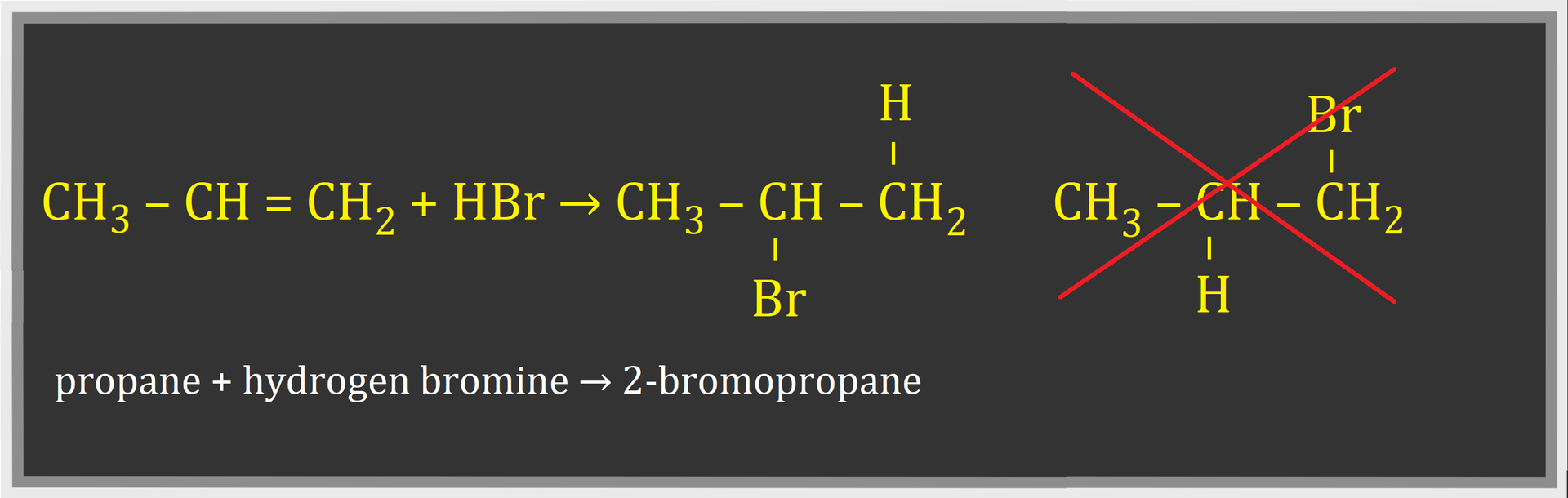
In 1869, the Russian chemist Vladimir Markownikov proposed a rule defining the direction of the reaction of addition of elements to the double bond between carbon atoms.This principle is that, generally, in addition reactions to the -C=C- bond, occurring in many organic compounds (e.g., alkenes), lower electronegativity atoms or groups attach to it from two carbon atoms to which it was previously attached more atoms or groups with electropositive properties.
The rule is not always satisfied for all addition reactions to the -C=C- bond. Strictly speaking, it is fulfilled only when this reaction occurs through the ionic mechanism, monomolecular. When this reaction proceeds according to another mechanism, it often joins contrary to the Markownikov's rule.
RvjmLxZyhtEhf
Schemat przedstawia regułę Markownikowa, która określa zasadę przyłączania do podwójnego wiązania węgiel - węgiel cząsteczek typu HX. Równanie reakcji przebiega następująco: propen, propene dodać bromowodór, hydrogen bromine strzałka w prawo dwa bromopropan. Czyli: c ha trzy wiązanie pojedyncze c ha wiązanie podwójne ce ha dwa dodać ha be er strzałka w prawo c ha trzy wiązanie pojedyncze c ha wiązanie pojedyncze c ha trzy. Do środkowego atomu węgla dołączony wiązaniem pojedynczym atom bromu. Nieprawidłowe jest przyłączanie atomu be er do pierwszego atomu węgla połączonego wiązaniem podwójnym z drugim atomem węgla, czyli grupy ce ha dwa na początku łańcucha we wzorze propenu, gdyż zgodnie z regułą Markownikowa atom wodoru przyłącza się do tego atomu węgla, gdzie było wcześniej przyłączonych więcej atomów wodoru.
The Markownikov's Rule
RuRk0tUPnBoD5
Exercise 3
Indicate true statements. Możliwe odpowiedzi: 1. Saturated hydrocarbons can be distinguished from unsaturated hydrocarbons by using potassium permanganate., 2. In the addition reaction of ethene with hydrogen chloride we can obtain a chemical compound called dichloroethane, 3. The addition reaction of hydrogen with unsaturated hydrocarbons is called a hydrogenation reaction., 4. The physical properties of alkenes do not depend on the length of the carbon chain., 5. Ethene burns with a pale blue flame.
Indicate true statements. Możliwe odpowiedzi: 1. Saturated hydrocarbons can be distinguished from unsaturated hydrocarbons by using potassium permanganate., 2. In the addition reaction of ethene with hydrogen chloride we can obtain a chemical compound called dichloroethane, 3. The addition reaction of hydrogen with unsaturated hydrocarbons is called a hydrogenation reaction., 4. The physical properties of alkenes do not depend on the length of the carbon chain., 5. Ethene burns with a pale blue flame.
R1VVaUSPULfuS
Exercise 4
Indicate true statements. Możliwe odpowiedzi: 1. As the number of carbon atoms in the alkene molecule increases, their melting point increases., 2. As the number of carbon atoms in the alkene molecule increases, their boiling point decreases., 3. As the number of carbon atoms in the alkyne molecule increases, their melting point increases., 4. As the number of carbon atoms in the unsaturated hydrocarbon molecule increases, their boiling point increases.
Indicate true statements. Możliwe odpowiedzi: 1. As the number of carbon atoms in the alkene molecule increases, their melting point increases., 2. As the number of carbon atoms in the alkene molecule increases, their boiling point decreases., 3. As the number of carbon atoms in the alkyne molecule increases, their melting point increases., 4. As the number of carbon atoms in the unsaturated hydrocarbon molecule increases, their boiling point increases.
Task 4
Design an experience in which you use bromine water to distinguish between saturated and unsaturated hydrocarbons. Remember to write down the research problem and the hypothesis. Then try to do a list of all chemical reagents and laboratory equipment, that are necessary to complete the experiment. Create instructions and write down observations and conclusions.
R5JqnZBT0mi3V
Research problem (Uzupełnij). Hypothesis (Uzupełnij). Chemical reagents and laboratory equipment (Uzupełnij). Instructions (Uzupełnij). Observations (Uzupełnij). Conclusions (Uzupełnij).
Research problem (Uzupełnij). Hypothesis (Uzupełnij). Chemical reagents and laboratory equipment (Uzupełnij). Instructions (Uzupełnij). Observations (Uzupełnij). Conclusions (Uzupełnij).
Summary
The physical properties of alkenes and alkynes are similar to the physical properties of the alkanes. They change as the number of carbon atoms in the chain increases.
Alkenes and alkynes are chemically reactive, flammable, and undergo addition reactions.
Alkynes are more reactive than alkenes.
R25CRcTX1dzAz1
Grafika przedstawiająca tablicę szkolną, na której znajdują się zdania do dokończenia. Finish selected sentences. 1 It was easy for me (uzupełnij). 2 It was difficult for me (uzupełnij). 3 Today I learned (uzupełnij). 4 I understood that (uzupełnij). 5 It surprised me (uzupełnij). 6. Today I found out (uzupełnij. 7. I was interested in (uzupełnij). 8. I still have to repeat (uzupełnij.
Grafika przedstawiająca tablicę szkolną, na której znajdują się zdania do dokończenia. Finish selected sentences. 1 It was easy for me (uzupełnij). 2 It was difficult for me (uzupełnij). 3 Today I learned (uzupełnij). 4 I understood that (uzupełnij). 5 It surprised me (uzupełnij). 6. Today I found out (uzupełnij. 7. I was interested in (uzupełnij). 8. I still have to repeat (uzupełnij.
Source: GroMar Sp. z o.o., licencja: CC BY-SA 3.0.
Homework
Task 5.1
Explain the differences between ethane, ethene and ethyne molecules.
Keywords
alkenes, unsaturated hydrocarbons, physical properties of alkenes, chemical properties of alkenes
reakcja addycji – reakcja przyłączenia atomów innych pierwiastków, np. fluorowców (chloru, bromu, jodu), do cząsteczki z wiązaniem wielokrotnym, bez wydzielenia produktów ubocznych