The first regions for the domestication of plants and animals in Asia
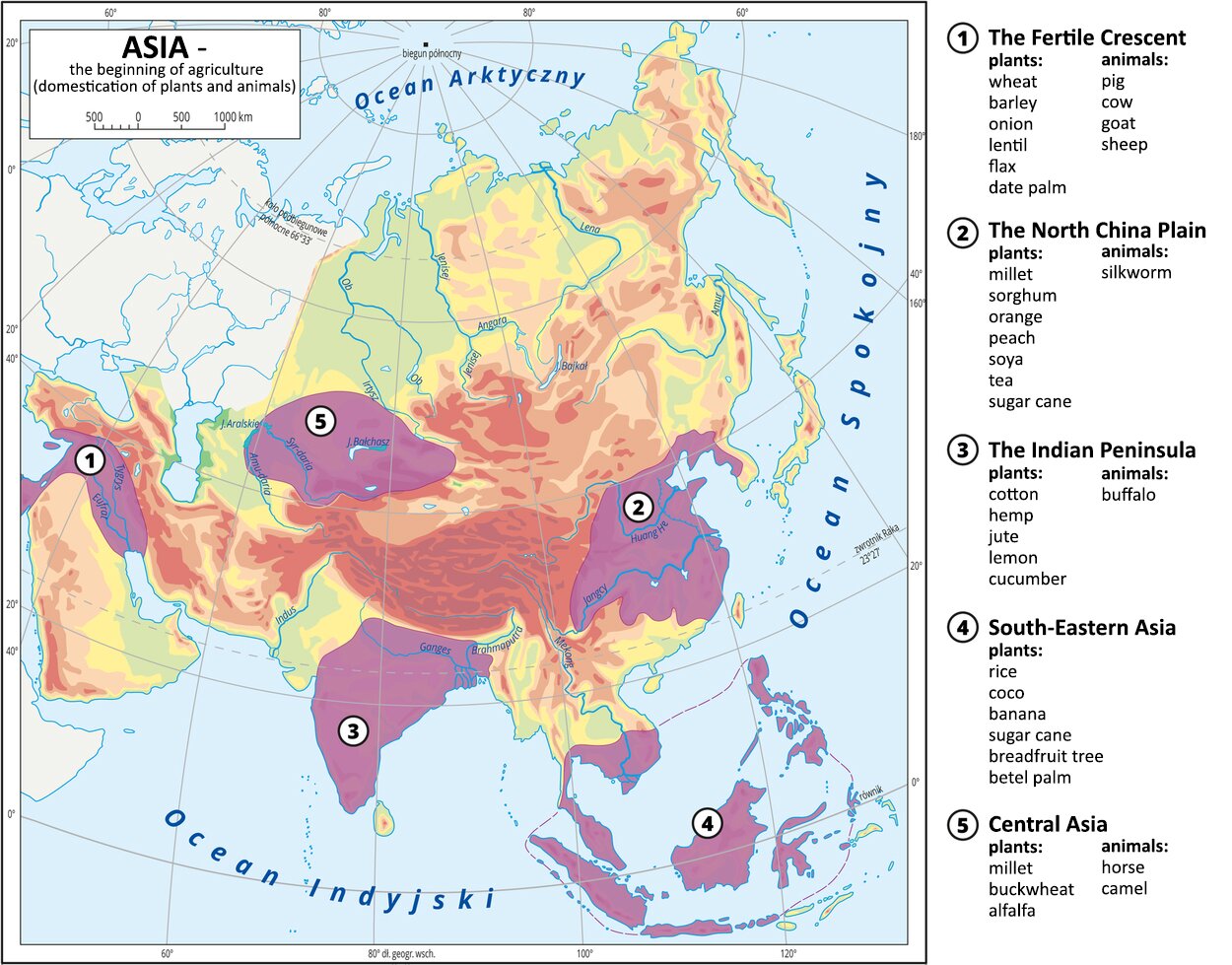
In South‑Western Asia, around 8.5 thousand years ago, the ancient hunter‑gatherers started their first agricultural revolution, effects of which are apparent also nowadays. Here, in the region called the Fertile Crescent, which covers the Lower Nile Valley, the eastern coast of the Mediterranean Sea and the Tigris‑Euphrates River Basin, is where the plants' and animals' domestication processes started. The reasons for the agricultural development have never been fully explained. However, it would be fair to assume that the reasons for them were existential, environmental and cultural.
Reasons for the development of agriculture
Effects of the development of agriculture
Climate changes – around 10 thousand years ago, the ice age came to its end
Technical innovations – increase in the agricultural production efficiency
Concentration of many types of plants in the Fertile Crescent area
Developing ways of food exchange (trade)
Drop in the number of food available in the natural environment and the need of obtaining it in a controlled way and on a bigger scale
Emergence of various forms of human activity – conscious and planned agricultural activity, division of labour
Increasing need of food, growing populations
Sedentism – development of rural areas and first cities
R99LyJel4R38E
Ilustracja przedstawia mapę Azji z podziałem na 5 regionów i opisem jaka fauna i flora w nich występuje wraz z początkiem rolnictwa. Asia - the beginning of agriculture (domestication of plants and animals). W zachodniej części Azji. The fertile crescent. Plants: wheat, barley, onion, lentil, flax, date palm. Animals: pig, cow, goat, sheep. We wschodniej części Azji. The North China Plain. Plants: millet, sorghum, orange, peach, soya, tea, sugar cane. Animals: silkworm. W południowej części Azji. The Indian Peninsula. Plants: cotton, hemp, jute, lemon, cucumber. Animals: buffalo. We wschodnio-południowej części Azji. South-Eastern Asia. Plants: rice, coco, banana, sugar cane, breadfruit tree, betel palm. W centralnej części Azji. Central Asia. Plants: millet, buckwheat, alfalfa. Animals: horse, camel.
Asia - the beginning of agriculture (domestication of plants and animals)
In the Fertile Crescent area around 70 types of plants were domesticated, which later expanded all over the world. The most important were grains, legumes and numerous kinds of fruit trees. Goats, sheep, cows and pigs were the first domesticated animals. The North China Plain was the second region where the independent plants' and animals' domestication processes took place. In that region, around 7.5 thousand years ago they domesticated millet, sorghum, soya, tea, sugar cane, peach and orange. They also grew silkworms and reared pigs and buffalos. Soon after the agriculture started to develop in the Indus Valley, in the Indian Peninsula and in South‑Eastern Asia. The Turran Depression in Central Asia, in turn, is thought to be the region where horses and camels were domesticated.
The ancient Asian civilizations
CivilizationcivilizationCivilization is a level of material, technical and spiritual culture achieved by a given population in a certain moment of its history. One civilization differs from another in: language, history, religion, traditions, social institutions. Those are crucial elements that a community living in the same area has in common.
RVCIryydOzVXd
The Sumerian Civilization The ancient Asian civilizations emerged in 4000-3000 BC on the plains, close to big rivers and in the subtropical climate. The oldest civilization is Sumer which emerged on the river Euphrates and the Tigris – a major river system in South-Western Asia., The Harappan Civilization The Harappan Civilization, also known as the Indus Valley Civilization, emerged in the central and lower region of the Indus in 2500-1750 BC. It is believed that those regions were inhabited by the Dravidians., The Chinese Civilization The Chinese Civilization emerged on the North China Plain, in the basin of the Yellow River, 4000 BC. The archeologic studies show that between 4000 and 1000 BC the Chinese Civilization expanded considerably in Eastern Asia. The inhabitants of the North of China domesticated two types of millet that was resistant to drought and those from the south expanded the rice cultivation. In China, they also domesticated buffalo, silkworms, ducks and geese. Around 500 BC, the Chinese already knew how to smelt and work iron.
The Sumerian Civilization The ancient Asian civilizations emerged in 4000-3000 BC on the plains, close to big rivers and in the subtropical climate. The oldest civilization is Sumer which emerged on the river Euphrates and the Tigris – a major river system in South-Western Asia., The Harappan Civilization The Harappan Civilization, also known as the Indus Valley Civilization, emerged in the central and lower region of the Indus in 2500-1750 BC. It is believed that those regions were inhabited by the Dravidians., The Chinese Civilization The Chinese Civilization emerged on the North China Plain, in the basin of the Yellow River, 4000 BC. The archeologic studies show that between 4000 and 1000 BC the Chinese Civilization expanded considerably in Eastern Asia. The inhabitants of the North of China domesticated two types of millet that was resistant to drought and those from the south expanded the rice cultivation. In China, they also domesticated buffalo, silkworms, ducks and geese. Around 500 BC, the Chinese already knew how to smelt and work iron.
The ancient civilizations
The Sumerian Civilization The ancient Asian civilizations emerged in 4000-3000 BC on the plains, close to big rivers and in the subtropical climate. The oldest civilization is Sumer which emerged on the river Euphrates and the Tigris – a major river system in South-Western Asia.
The Harappan Civilization The Harappan Civilization, also known as the Indus Valley Civilization, emerged in the central and lower region of the Indus in 2500-1750 BC. It is believed that those regions were inhabited by the Dravidians.
The Chinese Civilization The Chinese Civilization emerged on the North China Plain, in the basin of the Yellow River, 4000 BC. The archeologic studies show that between 4000 and 1000 BC the Chinese Civilization expanded considerably in Eastern Asia. The inhabitants of the North of China domesticated two types of millet that was resistant to drought and those from the south expanded the rice cultivation. In China, they also domesticated buffalo, silkworms, ducks and geese. Around 500 BC, the Chinese already knew how to smelt and work iron.
The people of Asia and its population distribution nowadays
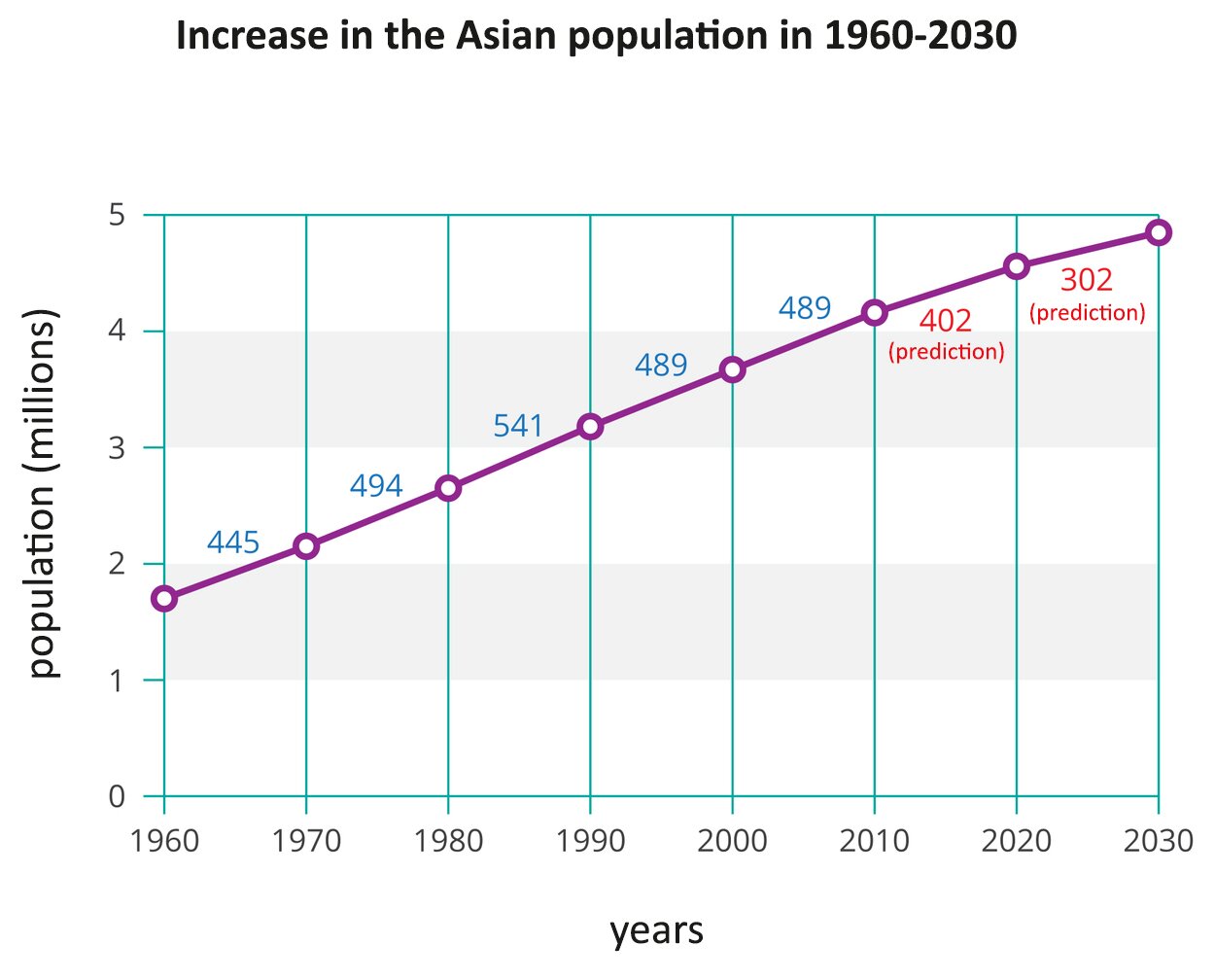
Asia is inhabited by 4 billion 393 million people, which constitutes almost 60% of all the people in the world (figures from 2015). This graph shows the increase in the number of people in Asia.
RPQgNotYfFgro
Na ilustracji wykres liniowy zależności populacji w Azji w latach 1960 - 2030 od lat. Tytuł wykresu: Increase in the Asian population in 1960 - 2030. Na osi Y podpisano: population in millions, na osi X podpisano: years. Na wykresie wskazano regularny wzrost liczby ludności Azji o stałą (około pół miliona) liczbę osób w poszczególnych dziesięcioleciach od tysiąc dziewięćset sześćdziesiątego roku do dziś. Prognoza przewiduje zmniejszenie przyrostu (do trzystu milionów osób) w następnym dziesięcioleciu. Szczegółowe dane w zakresie populacji: 1960 rok - 1,8 miliona populacji. 1970 rok - 2,1 miliona populacji. 1980 rok - 2,8 miliona populacji. 1990 rok - 3,1 miliona populacji. 2000 rok - 3,6 miliona populacji. 2010 rok - 4,1 miliona populacji. 2020 rok - 4,5 miliona populacji. 2030 rok - 4,8 miliona populacji. Szczegółowe dane w zakresie wzrostu populacji:1960 rok - wzrost o 445 milionów populacji. 1970 rok - wzrost o 494 milionów populacji. 1980 rok - wzrost o 541 milionów populacji. 1990 rok - wzrost o 489 milionów populacji. 2000 rok - wzrost o 489 milionów populacji. 2010 rok - wzrost o 402 miliony populacji. 2030 rok - wzrost o 302 miliony populacji.
Increase in the Asian population in 1960-2030
Source: Dariusz Adryan, licencja: CC BY 3.0.
RGTit2qlT3TVn
Wykonaj zadanie zgodnie z poleceniem.
Wykonaj zadanie zgodnie z poleceniem.
In Asia, the absolute population growth has been on the extremely high, steady level since the mid‑50s of the 20th century. In that period, many countries of the continent experienced improvement in health situation and vaccines were introduced. This big wave of population growth is called the population explosion.
People of white race make 43% of all the people, and they live mostly in the regions of Southern and South‑Western Asia and in the area of Southern Siberia. People of black race make around 1.5% of all the people of Asia, and they live in some small areas of the Indian Peninsula and on the islands of South‑Eastern Asia. Each of the main varieties can be subdivided into numerous groups with different physical features.
R1T2LH2RS1gTg
Exercise 1
Wysłuchaj nagrania abstraktu, wyodrębnij jego części i nadaj im tytuły.
Wysłuchaj nagrania abstraktu, wyodrębnij jego części i nadaj im tytuły.
Source: licencja: CC 0.
Rm3W0qEu4sAXO
Exercise 2
Wysłuchaj nagrania abstraktu i zastanów się, czego jeszcze chciałbyś się dowiedzieć w związku z tematem lekcji.
Wysłuchaj nagrania abstraktu i zastanów się, czego jeszcze chciałbyś się dowiedzieć w związku z tematem lekcji.
Source: licencja: CC 0.
An important quality of the Asian people is a big national and linguistic mosaic. There are around 5 thousand languages used in the world out of which a thousand is used in Asia. The largest Asian language families include: the Sino‑Tibetan languages and the Indo‑European languages. The smaller ones are: the Malayo‑Polynesian languages, the Dravidian languages (in India), the Afro‑asiatic languages (variations of Arabic) and also Japanese and Korean language families.
The map below shows the population density in Asia.
RPO1BHcNNnzEm
Na ilustracji mapy Azji przedstawiono gęstość zaludnienia kontynentu, Asia density of population. Liczba dwustu osób na jeden kilometr kwadratowy, number of people per kilometer występuje głównie w Japonii, Chinach, Indiach oraz na wyspach w Indonezji. Najmniej, liczba poniżej dziesięciu osób na jeden kilometr kwadratowy dotyczy mieszkańców Rosji, Mongolii, Kazachstanu, Uzbekistanu, Turkmenistanu, Tadżykistanu, Iranu, Arabii Saudyjskiej, środkowej części półwyspu indochińskiego i wyspy Borneo. W centralnej części Azji znajduje się niewielki obszar, który jest niezamieszkany, uninhabited area.
Na ilustracji mapy Azji przedstawiono gęstość zaludnienia kontynentu, Asia density of population. Liczba dwustu osób na jeden kilometr kwadratowy, number of people per kilometer występuje głównie w Japonii, Chinach, Indiach oraz na wyspach w Indonezji. Najmniej, liczba poniżej dziesięciu osób na jeden kilometr kwadratowy dotyczy mieszkańców Rosji, Mongolii, Kazachstanu, Uzbekistanu, Turkmenistanu, Tadżykistanu, Iranu, Arabii Saudyjskiej, środkowej części półwyspu indochińskiego i wyspy Borneo. W centralnej części Azji znajduje się niewielki obszar, który jest niezamieszkany, uninhabited area.
Asia population density
Source: Wydawnictwo Edukacyjne Wiking, licencja: CC BY 3.0.
75% of the Asian population live in those two regions. Other than this, people live mostly in South‑Eastern Asia, for example, on some islands of the Malay Archipelago (Java, Bali), in Philippines, Vietnam or Thailand – around 500 million people in total live there.
Religion among the Asian population
Religion is a socio‑cultural phenomenon. It includes beliefs, cult, rituals and sometimes also well‑developed institutions. Religions influence the everyday life of the believers. The biggest monotheistic religions that acknowledge the existence of only one god were born in Asia: Judaism, Christianity and Islam. The religions that are popular mostly in Asia are: Islam, Hinduism, Buddhism, Confucianism, Taoism and Shinto. In several countries on the continent there are considerable groups of people that declare atheism. Those are: China (around 40%), North Korea (around 95%), Mongolia (around 50%), Kazakhstan (around 30%).
RwRkcnELOuWFa
Exercise 3
Match the pairs: country and religion. Saudi Arabia Możliwe odpowiedzi: 1. Catholicism, 2. Shinto/Buddism, 3. Islam, 4. Hinduism, 5. Eastern Orthodox Church, 6. Confucianism/Buddism, 7. Buddism Filippines Możliwe odpowiedzi: 1. Catholicism, 2. Shinto/Buddism, 3. Islam, 4. Hinduism, 5. Eastern Orthodox Church, 6. Confucianism/Buddism, 7. Buddism Nepal Możliwe odpowiedzi: 1. Catholicism, 2. Shinto/Buddism, 3. Islam, 4. Hinduism, 5. Eastern Orthodox Church, 6. Confucianism/Buddism, 7. Buddism Vietnam Możliwe odpowiedzi: 1. Catholicism, 2. Shinto/Buddism, 3. Islam, 4. Hinduism, 5. Eastern Orthodox Church, 6. Confucianism/Buddism, 7. Buddism Japan Możliwe odpowiedzi: 1. Catholicism, 2. Shinto/Buddism, 3. Islam, 4. Hinduism, 5. Eastern Orthodox Church, 6. Confucianism/Buddism, 7. Buddism Russia Możliwe odpowiedzi: 1. Catholicism, 2. Shinto/Buddism, 3. Islam, 4. Hinduism, 5. Eastern Orthodox Church, 6. Confucianism/Buddism, 7. Buddism China Możliwe odpowiedzi: 1. Catholicism, 2. Shinto/Buddism, 3. Islam, 4. Hinduism, 5. Eastern Orthodox Church, 6. Confucianism/Buddism, 7. Buddism
Match the pairs: country and religion. Saudi Arabia Możliwe odpowiedzi: 1. Catholicism, 2. Shinto/Buddism, 3. Islam, 4. Hinduism, 5. Eastern Orthodox Church, 6. Confucianism/Buddism, 7. Buddism Filippines Możliwe odpowiedzi: 1. Catholicism, 2. Shinto/Buddism, 3. Islam, 4. Hinduism, 5. Eastern Orthodox Church, 6. Confucianism/Buddism, 7. Buddism Nepal Możliwe odpowiedzi: 1. Catholicism, 2. Shinto/Buddism, 3. Islam, 4. Hinduism, 5. Eastern Orthodox Church, 6. Confucianism/Buddism, 7. Buddism Vietnam Możliwe odpowiedzi: 1. Catholicism, 2. Shinto/Buddism, 3. Islam, 4. Hinduism, 5. Eastern Orthodox Church, 6. Confucianism/Buddism, 7. Buddism Japan Możliwe odpowiedzi: 1. Catholicism, 2. Shinto/Buddism, 3. Islam, 4. Hinduism, 5. Eastern Orthodox Church, 6. Confucianism/Buddism, 7. Buddism Russia Możliwe odpowiedzi: 1. Catholicism, 2. Shinto/Buddism, 3. Islam, 4. Hinduism, 5. Eastern Orthodox Church, 6. Confucianism/Buddism, 7. Buddism China Możliwe odpowiedzi: 1. Catholicism, 2. Shinto/Buddism, 3. Islam, 4. Hinduism, 5. Eastern Orthodox Church, 6. Confucianism/Buddism, 7. Buddism
Match the pairs: country and religion.
Buddism, Islam, Hinduism, Catholicism, Shinto/Buddism, Confucianism/Buddism, Eastern Orthodox Church
Saudi Arabia
Filippines
Nepal
Vietnam
Japan
Russia
China
Keywords
civilization, population explosion, population density
cywilizacja – stan kultury materialnej, technicznej i duchowej, jaki osiągnęło dane społeczeństwo zamieszkujące określony obszar; główne elementy odróżniające jedną cywilizację od innej to: język, historia, religia, obyczaje, twórczość artystyczna, instytucje społeczne