Birth and development of Christianity
where and when Christianity began;
what the fate of the first Christians was;
when Christianity became the official religion of Ancient Rome;
why Christianity has become the greatest monotheistmonotheist religion in the world.
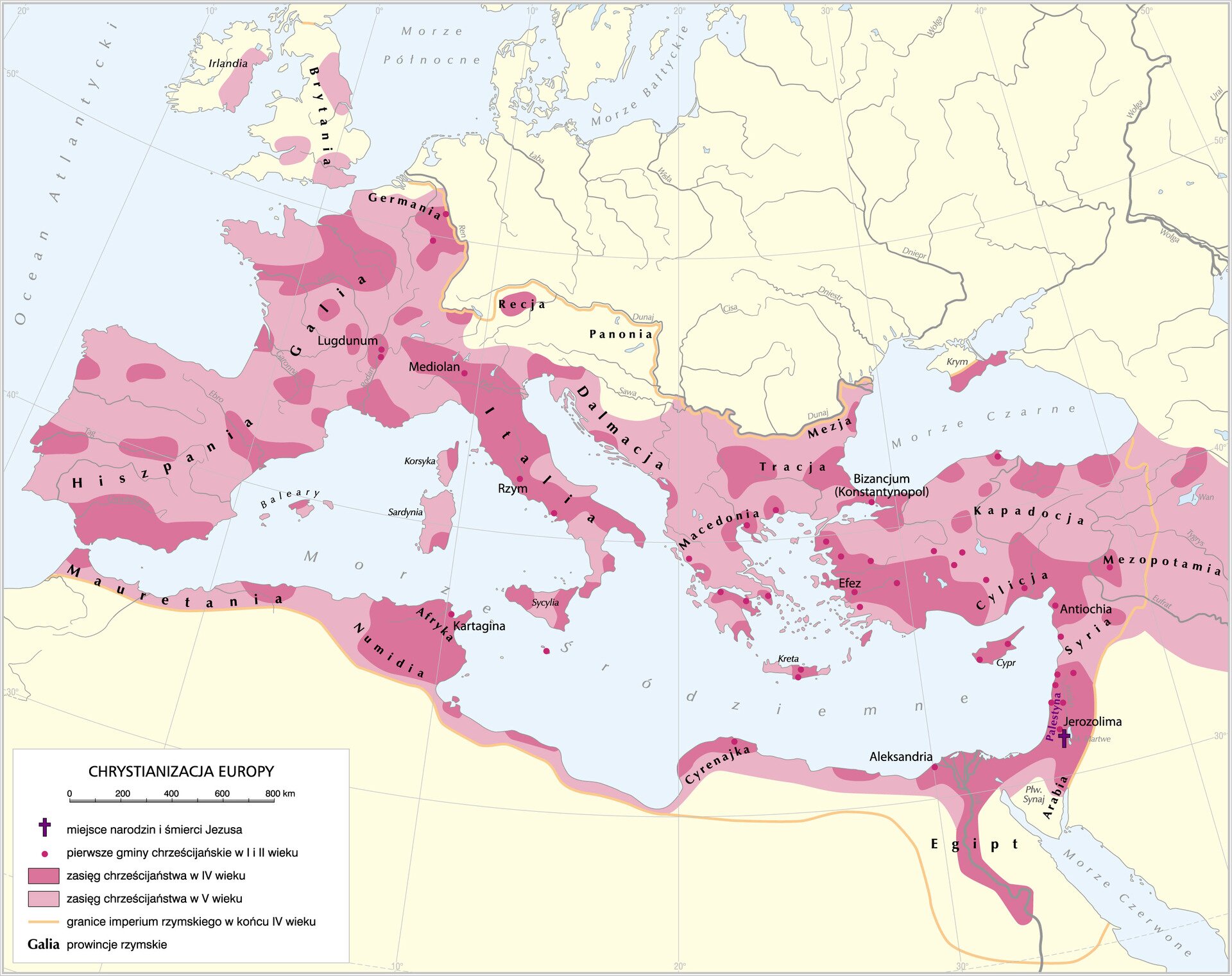
The beginning of the largest monotheistic contemporary religion – Christianity is associated with Jesus Christ, who his followers took the be the MessiahMessiah – God's anointed one had come to Earth to redeem peoples' sins and bring everlasting peace. His death and resurrection, as described in the New Testament, gave rise to a new religion. Roman and Jewish sources do not give a lot of information about his teachings activities or life. And although Jesus of Nazareth is an historical figure, it is difficult to assess how in the Gospels and Acts of the ApostlesApostles relationships reflect actual events. The new faith initially gained members only amongst Jews living in PalestinePalestine, where Jesus was born and preached. Their centre was Jerusalem and the leaders were his relatives and some of his Apostles. The wider spread of Christianity only began with the conversion of Paul from Tarsus (St Paul) – who had earlier been a persecutor of the followers of Christ. He decided to spread the teachings of Jesus to other places, such as Asia Minor, Greece and Cyprus, even to non‑Jews. Thanks to his apostolic mission many communities were established, mostly in the eastern part of the Roman Empire. Thanks to its followers, Christianity spread quickly right across the Empire. In the beginning the Romans could not differentiate the followers of Jesus from the Jews, and treated then in the same way. They were often met with various acts of hatred and hostility. The first large‑scale persecution of Christians took place in AD64 when large areas of Rome were destroyed by fire. In blaming the followers of Jesus for this, Emperor Nero ordered they be persecuted. Various epidemics, wars and state crises in the second and third centuries had a similar outcome. Accused of supporting the enemy and causing other problems, many Christians suffered a Martyr's death.
The growing number of the faithful, and above all their determination and loyalty to their faith, proved to be a force that not even waves of oppression and imperial edicts could destroy. Finally, on the back of the Grand Milanese Edict of 313, issued by Emperor Constantine, Christianity became tolerated, a religion with equal footing to others in existence within the Roman Empire. The Emperor himself, even though he does not profess faith in Jesus, often was seen as the guardian of Christians. In 325 he led a Council where the first principles of the faith were adopted. Finally (in 392) thanks to the Emperor Theodosius the Great, Christianity was recognised as the dominant religion, and all other forms of worship and worship of ancient deities was forbidden.
From the sentences below, select those that are correct.
- Jesus proclaimed the end of the world, or apocalypse
- the apostles were the first disciples of Jesus
- Pontius Pilate condemned Jesus to death
- Paul the Apostle directed his teaching to the Gentiles
- Jesus was born in Nazareth
Henryk Siemiradzki, a 19th century Polish painter, did one of the most interesting paintings of the tragic history of Christianity in its first centuries. In his painting Nero's Torches he presents and image of the Martyrdom of Roman Christians accused of starting the Great Fire. The persecution of Jesus' followers by the Emperor Nero, was the first to be initiated by the powers of the Empire.
Put the events related to the rise and development of Christianity in chronological order.
- Jesus death as a Martyr
- Birth of Jesus
- Increased repression of Christians
- Teaching of Jesus
- Edict by Constantine the Great
- Teaching of Paul the Apostle
Keywords
Christianity, first Christians, pogrom, Rome, Nero
Glossary
Politeizm – wiara w wielu bogów, którzy zajmują się odrębnymi sferami życia.
Monoteizm – wiara w jednego Boga, wykluczająca istnienie innych bóstw.
Palestyna – kraina geograficzna w zachodniej Azji, kolebka judaizmu i chrześcijaństwa.
Judaizm – religia monoteistyczna, wiara w jednego Boga Jahwe, wyznawana przez Żydów.
Faryzeusze – nazywani również uczonymi w piśmie, grupa wyznawców judaizmu uznająca jako prawo zapisy zawarte w Biblii.
Prefekt – w starożytnym Rzymie wyższy urzędnik reprezentujący władcę i wykonujący część jego obowiązków, np. w prowincji.
Prorok – dosłownie „osoba przemawiająca w czyimś imieniu”, w religiach były to osoby pozostające w kontakcie z Bogiem, który przez nie miał wyrażać swoją wolę i zamierzenia.
Mesjasz – w judaizmie i chrześcijaństwie osoba, zapowiedziana przez Boga i proroków, która ma uwolnić świat od grzechu i śmierci oraz ustanowić królestwo niebieskie.
Apostoł – najbliżsi uczniowie Jezusa Chrystusa wybrani przez niego do głoszenia jego nauk.
Pogrom – zorganizowany i grupowy napad polegający na zniszczeniu, rabunku i przemocy jednej grupy społecznej wobec innej. Jego celem jest zastraszenie, wypędzenie lub wymordowanie przeciwnika.