Copyright
the terms of copyrightcopyright and the right to intellectual property.
to use internet resources while respecting the binding law.
The protection of intellectual property includes several categories of the so‑called intangible goods:
works,
data bases,
patents, utility models and industrial designs, trademarks,
maps and cartographic resources.
In Poland, actsacts are a basic source of lawlaw. There are several actsacts that regulate the protection of intellectual property.
A workwork is the result of the creative activity of a person.
A workwork must be original in order to be copyrightedcopyrighted. WorkWork is an abstract term and its definition is constantly modified. The approach to the term differs greatly in many countries. In some countries an idea is already protected, while in others only the way of its implementation.
CopyrightCopyright is a set of rights granted to the creator of a workwork.
The author of the workwork is eligible to:
– moral rightsmoral rights,
– economic rightseconomic rights.
Moral rightsMoral rights include the right to be acknowledged as the author of the workwork, to preserve its integrity and to control the way it is shared. They are unlimited in time and non‑transferable.
Economic rightsEconomic rights are rights to obtain benefits from the sales of the workwork and the conditions of its distribution. They usually expire after a defined period (usually 70 years after the author’s death).
The actact on the protection of copyrightcopyright also details the related rights, whose aim is to protect the interests of the entities taking part in the distribution of worksworks.
The copyrightcopyright defines a range of legal permissions to use copyrightedcopyrighted worksworks. They include: permitted public use, permitted private use, the right to quotequote or the right to reprint. A particular case of permitted public use is permitted educational use.
The majority of the content of websites is copyrightedcopyrighted. The placement of a given material on the internet does not mean that it can be freely used because it is not a public property but the private property of its author. These materials are copyrightedcopyrighted regardless of whether he or she has given his/her name, initials or a nickname. Moreover, the workwork does not need to be marked with the © sign. The conditions of using the content of somebody’s website are detailed in the licencelicence which should be placed on the portal. If the website does not contain such terms of use, in order to make use of the portal content, one must contact the author of the workwork to negotiate the conditions of its use.
Using the internet, find out which works are not copyrightedcopyrighted.
Using the internet, give the examples of works which in your opinion are subject to the copyrightcopyright protection.
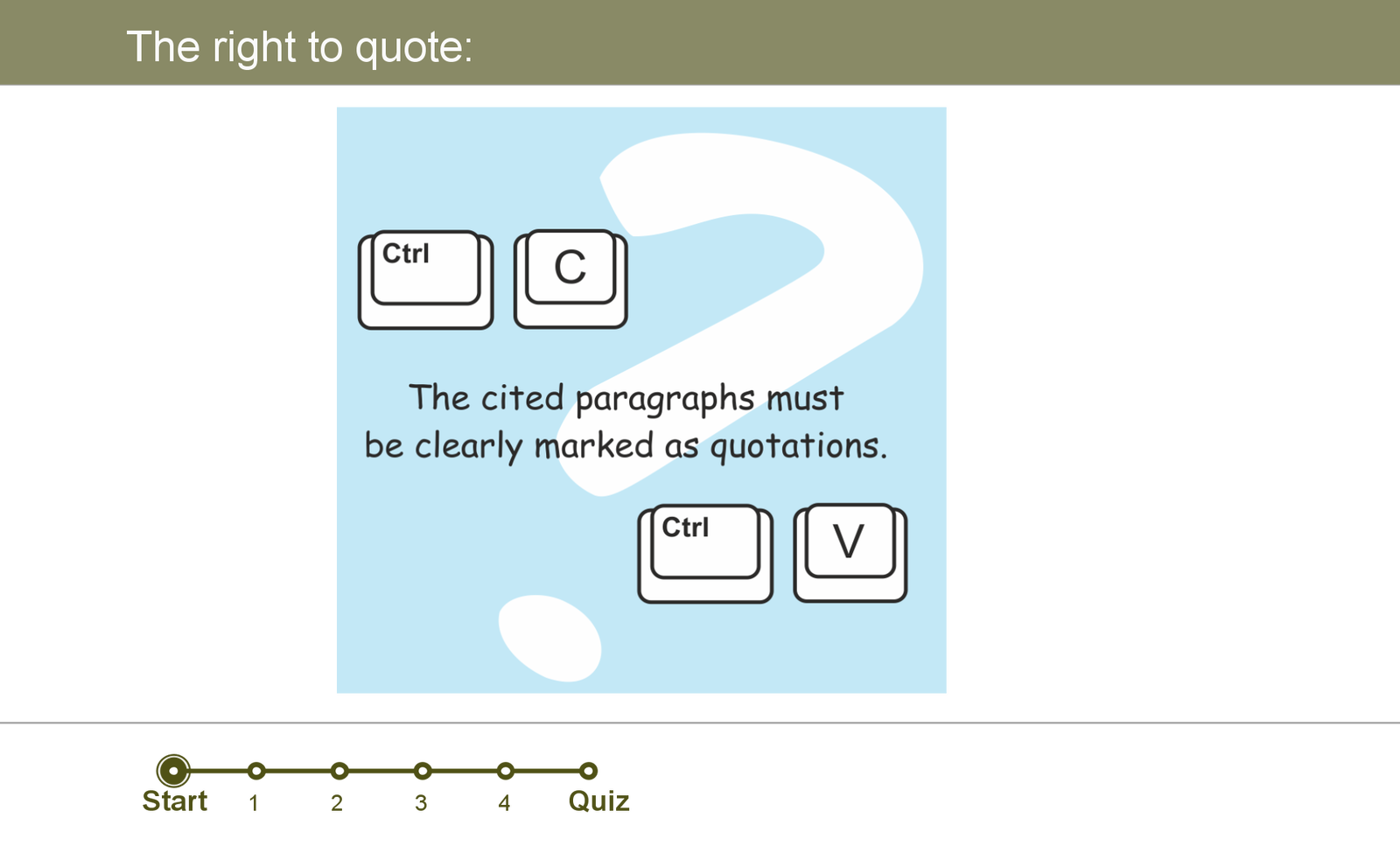
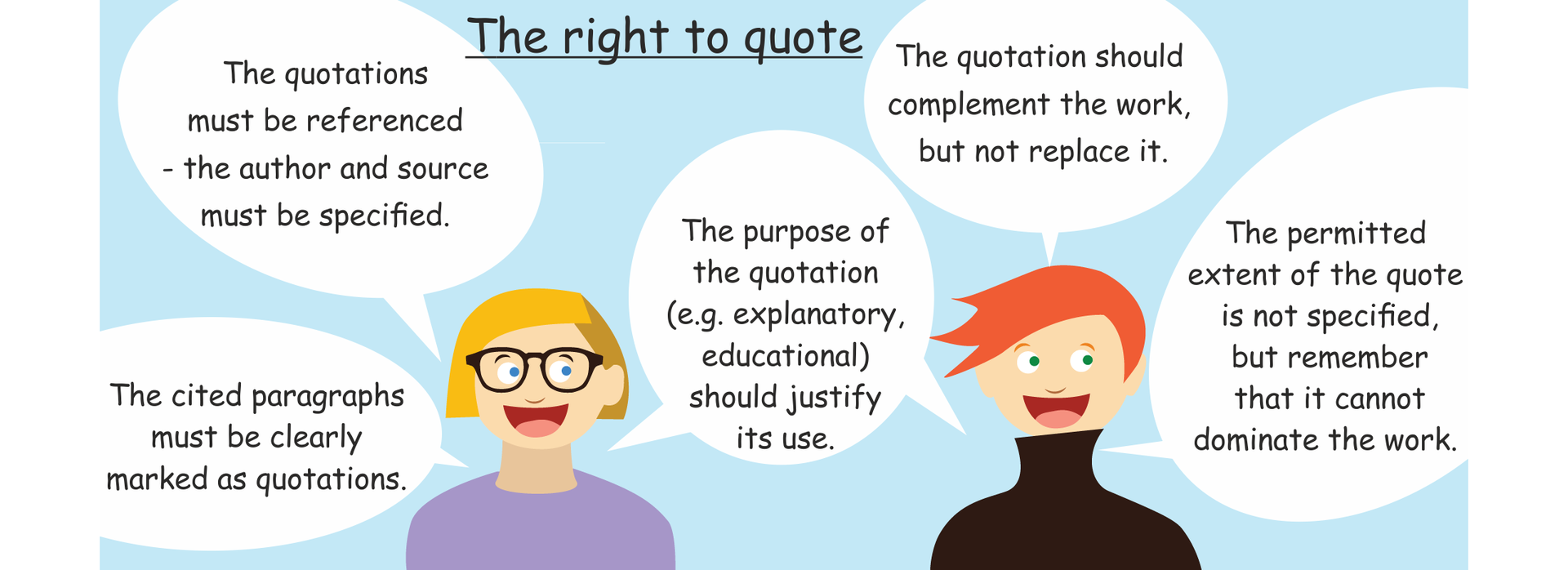
It is possible to use materials found on the internet free of charge without the permission of their author when, for example, we make use of the right to quotequote, included in the copyrightcopyright act.
Zasób interaktywny dostępny pod adresem https://zpe.gov.pl/a/Dpwz0DqBu
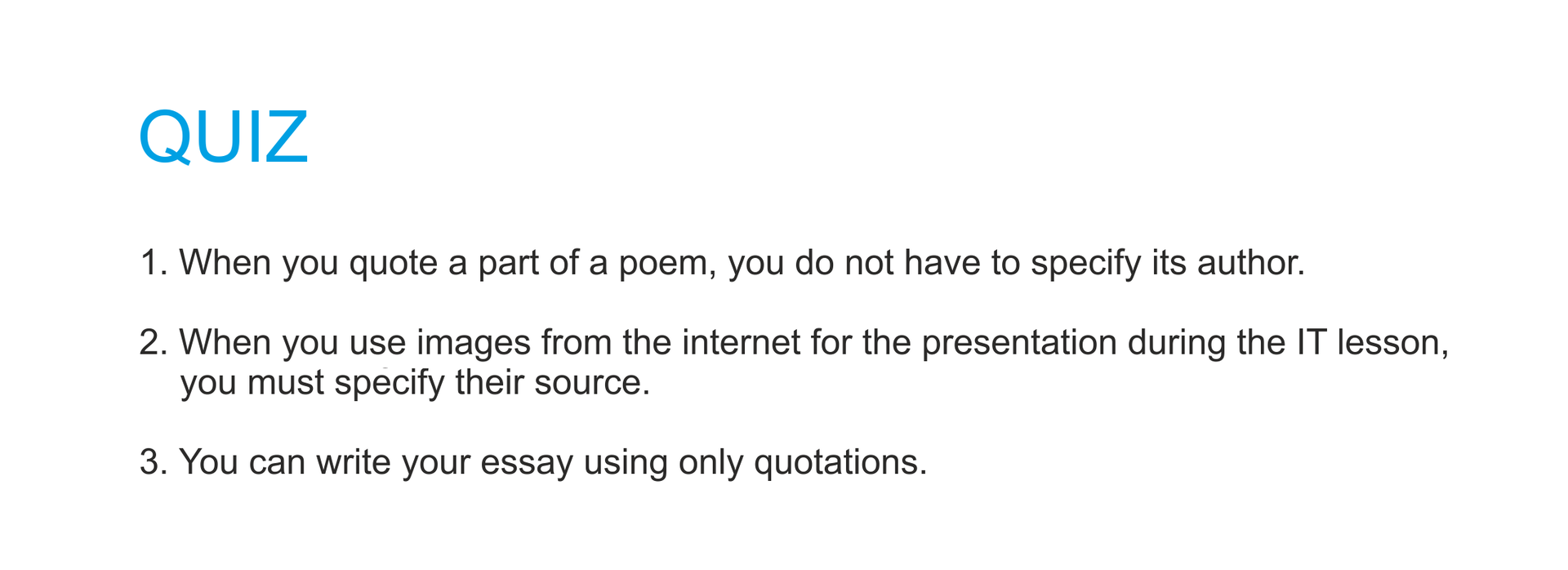
When you make use of the content of websites, remember that every piece of information, an image, a film or a text found on the Internet has been created by its author. The creators have the copyrights to their works. Anyone can become an author and would like his copyrights to be respected.
Exercises
Decide which works are protected by copyright:
- computer programmmes
- encyclopedias
- novels
- poems
- photographs
- posters
- press information
- public instruments
Decide which sentences are true.
- Moral rights are unlimited in time and non-transferable.
- Economic rights usually expire after a defined period.
- A work does not need to be original in order to be copyrighted.
- The work is an unchangeable term and shall not be modified.
Describe in English the differences of copyrightcopyright between moral rightsmoral rights and economic rights.
Indicate which pairs of expressions or words are translated correctly.
- prawa autorskie - copyright
- utwór - work
- prawa osobiste - moral rights
- prawa majątkowe - economic rights
- licencja - the law
- ustawa - a quote
- copyright
- prawa majątkowe
- prawa autorskie
- prawa osobiste
- utwór
- moral rights
- work
- economic rights
Glossary
prawa autorskie
Nagranie dostępne na portalu epodreczniki.pl
wymowa w języku angielskim: copyright
utwór
Nagranie dostępne na portalu epodreczniki.pl
wymowa w języku angielskim: work
prawa osobiste
Nagranie dostępne na portalu epodreczniki.pl
wymowa w języku angielskim: moral rights
prawa majątkowe
Nagranie dostępne na portalu epodreczniki.pl
wymowa w języku angielskim: economic rights
licencja
Nagranie dostępne na portalu epodreczniki.pl
wymowa w języku angielskim: license
prawo
Nagranie dostępne na portalu epodreczniki.pl
wymowa w języku angielskim: law
ustawa
Nagranie dostępne na portalu epodreczniki.pl
wymowa w języku angielskim: act
cytat
Nagranie dostępne na portalu epodreczniki.pl
wymowa w języku angielskim: quote
Keywords
copyrightcopyright
economic rightseconomic rights
moral rightsmoral rights
workwork