Democracy step by step
to recognize how Poland regained democracy and freedom.
to describe the challenges faced by Poles after 1989.
to characterize the socio‑political changes after the elections in June, 1989.
to explain what shaped Poland that you live in today.
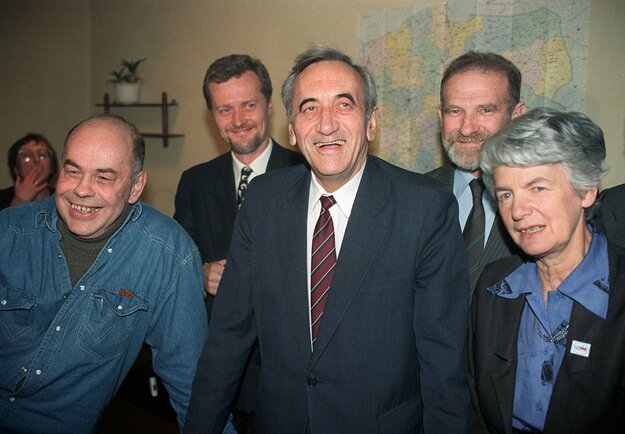
Democratic and capitalist changes started in Poland in 1989. In 1990, the state’s name was changed to the Republic of Poland. The president, Gen. Wojciech Jaruzelski, resigned from the office. Lech Wałęsa won the first universal presidential elections. The Polish United Workers' Party was dissolved. The first fully free legislative elections took place in 1991. Young Polish democracy abounded with parties originating from the Solidarity and the former political elites. The first years of the Third Polish Republic were characterised by political disputes, unstable rules and economic crisis, resulting from the poor state of the country after 45 years of the communist experiment.
When was the Constitution of PRL adopted?
What does PRL stand for?
Arrange the events in chronological order.
- Abolition of censorship (adoption by the Sejm of the Act repealing the act on the control of publications and performances, as well as changing the ‘Press Law’ Act)
- Elections to the Sejm and Senate
- Changes in the constitution
- The first programme on Polsat – the first TV station
- Elections to gmina councils
- Passport Act
- Presidential election
- First broadcast of the RMF FM radio – the first commercial radio in Poland
What had to be done in Poland in 1989 for it to become a democratic country?
- Changing the constitution, replacing the principles of the communist system with democratic ones.
- Ending the monopoly of the state in the media (television, radio, and press).
- Holding a free presidential election.
- Holding free elections to local authorities.
- Allowing citizens to travel freely abroad.
- Removing censorship.
- Providing everyone with a high salary and pension.
- Abolishing ration coupons for meat.
- Holding a free parliamentary election.
The left column there are some of the rules of the elections held in PRL. What should be in the right one? Write the answers down in your notebook.
In PRL | In free Poland |
Only one electoral committee could put forward its candidates (it was called differently in in different periods). | |
The candidates were accepted by the Polish United Workers' Party (PUWP). | |
The PUWP and censorship ruled the election campaign. | |
Voting without the actual ticking off was promoted: if the voter took the voting card and put it in the ballot box, it meant a vote for the first candidate from the list. If, however, a person wanted to tick some other name off, they had to go to a special booth, and it was apparent that they were not voting in line with what the Party wanted. | |
If the results did not meet the Party’s expectations, they were fabricated. | |
People opposing such rules could go to prison. |
Analyze the results of the parliamentary elections of 1991. What are your conclusions? What is the common feature of many of these parties?
Keywords
democracy, rule, transition
Glossary
Konstytucja – inaczej zwana ustawą zasadniczą. Jest to akt prawny, który najczęściej jest najważniejszym i najwyższym dokumentem stanowiącym prawo z państwie.
Reformy – zmiany w jakiejś dziedzinie życia lub sposobie działania mające na celu poprawę i polepszenie ich funkcjonowania.
Cenzura – kontrola i ograniczanie wolności słowa polegające na weryfikacji i przekazywaniu tylko zgodnych z punktem widzenia władzy informacji. Występuje najczęściej w krajach niedemokratycznych i czasie konfliktu zbrojnego.
Monopol – dosłownie jest to rynek, na którym swoje produkty sprzedaje tylko jeden producent. Potocznie nazywa się tak całkowitą kontrolę nad jakąś dziedziną gospodarki lub życia publicznego.
Paszport – dokument urzędowy poświadczający obywatelstwo i tożsamość, który uprawnia do przekraczania granicy i pobytu za nią.
Wybory – proces polegający na wybieraniu przez obywateli swojego kandydata spośród zgłoszonych przedstawicieli, najczęściej poprzez głosowania. Jest to podstawowy mechanizm funkcjonowania demokracji.
Godło – znak rozpoznawczy, symbol przynależności osoby bądź grupy do jakiejś społeczności lub narodu. Godło państwowe jest jednym z symboli narodowych reprezentujących dane państwo.