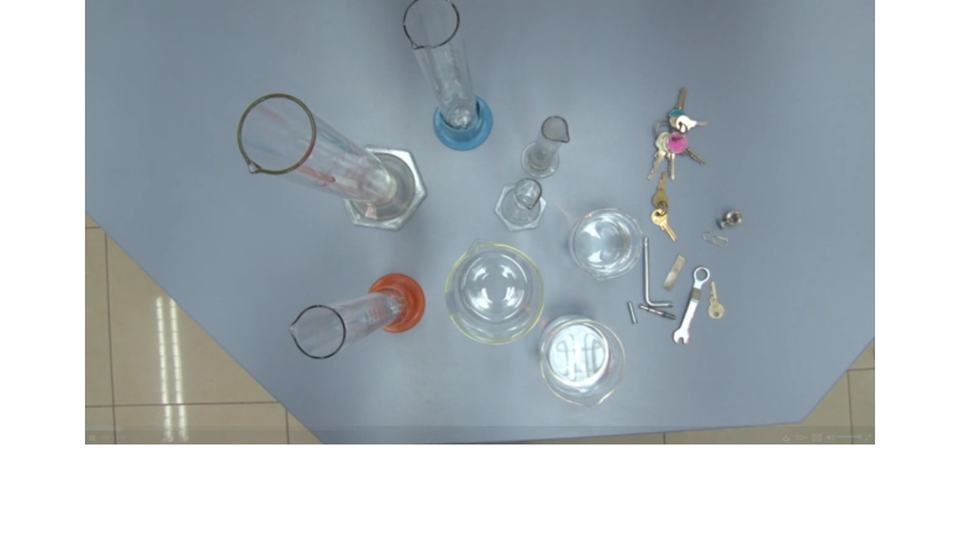
DensitydensityDensity is a physical quantity which describes the body. To determinedeterminedetermine the density of the body, we need to measure its mass and volume and use the following formulaformulaformula:
If we know the densitydensitydensity and the volume of the body, we can calculate its mass. For this purpose, the following formulaformulaformula should be used:
The body volume of a known mass and densitydensitydensity is calculated using the formulaformulaformula:
Look at the Slideshow „Determining the volume of irregularly shaped bodies”.
1. Remember the sequence of steps required to determinedeterminedetermine the volume of an irregular item - in the form of the key.
2. Consider the following problem: is it possible to determinedeterminedetermine the volume of 1 ml key with a measuring error lesser than 1 ml in the measuring glassmeasuring glassmeasuring glass with the accuracy of 1 ml.
RwcRGAcoKssbT
Pokaz slajdów - wyznaczanie objętości ciał o nieregularnym kształcie. Instrukcja obsługi z poziomu klawiatury: 1. Uruchomienie aplikacji - ENTER, 2. Na każdym ze slajdów czytany jest automatycznie tekst alternatywny po polsku, 3. Przy pierwszym uruchomieniu na pierwszym slajdzie, czytanie tekstu po angielsku - TAB, 4. Przejście między slajdami: do następnego slajdu - TAB, do poprzedniego slajdu - TAB + SHIFT, 5. Przejście do czytania napisu po angielsku - strzałka w górę + strzałka w dół (czyta tekst po angielsku widoczny na slajdzie).
Pokaz slajdów - wyznaczanie objętości ciał o nieregularnym kształcie. Instrukcja obsługi z poziomu klawiatury: 1. Uruchomienie aplikacji - ENTER, 2. Na każdym ze slajdów czytany jest automatycznie tekst alternatywny po polsku, 3. Przy pierwszym uruchomieniu na pierwszym slajdzie, czytanie tekstu po angielsku - TAB, 4. Przejście między slajdami: do następnego slajdu - TAB, do poprzedniego slajdu - TAB + SHIFT, 5. Przejście do czytania napisu po angielsku - strzałka w górę + strzałka w dół (czyta tekst po angielsku widoczny na slajdzie).
In the presented example the measurement accuracymeasurement accuracymeasurement accuracy of the measuring‑glass is 1 ml = 1 cmIndeks górny 33. This is the accuracy of determining the entire volume of water in the glass. However, our measurement is relative. We do not measure the volume of water but the difference between water volume with the key and after removing the key. Therefore, the measurement error is related only to the method of reading the water level and the meniscus height. Thus, the error of such measurement can be estimated as 0,2 ml = 0,2 cmIndeks górny 33.
The volume of water with the dipped key was VIndeks dolny waterwater + key = 26 cmIndeks górny 33. The volume of water after removing the key was VIndeks dolny waterwater = 25 cmIndeks górny 33. DeterminedetermineDetermine the volume of the key.
Because the error of such measurement can be estimated as 0,2 cmIndeks górny 33, the final result of the experimental determination of the key volume can be written in the form:
Do items made of the same material, having a greater mass, have a greater density.
Hypothesis
The greater the volume of bodies made of the same material, the greater their mass. The mass‑to‑volume ratio, i.e. the density, is constant.
You will need
3 copper nails of various sizes
a measuring‑glass
water
laboratory scales
Instruction
1. Measure the volume of all nails using the measuring glass. 2. Determine the mass of the nails using the laboratory scales. 3. Write the results of measurements in the notebook, for example in the adequatly table. 4. Make a graph of the dependence between the mass of the body on its volume.
Summary
The experiment shows that the mass of the body increases with the increase of its volume - the mass increases as many times as the volume increases. For the body of a given substance, the body‑volume ratio is constant. Bodies made of the same material have constant density, regardless of their mass and volume.
Task 2
Suggest the experiment in which you can determine the density of liquid.
Familiarise yourself with the tables of body densitydensitydensity. The bodies are in different physical states at the room temperature or below 0°C at atmospheric pressure of 1013 hPa.
1. Bodies have the lowest densitydensitydensity in the gas state.
2. Bodies in the solid state have usually the greatest densitydensitydensity.
3. The change in the temperature affects the densitydensitydensity of the body. The change in the temperature of the body is related to the change in average distances between the molecules or atoms that the tested body is made of.
4. The volume of the body depends on the average intermolecular distance. Therefore, the smaller the distance between the molecules of the body, the greater its densitydensitydensity.
5. IceiceIcedensitydensitydensity is lesser than water density, because the average distance of molecules in iceiceice is greater than in water.
The quotient of the mass and the volume of a given body is called its densitydensitydensity. Density is therefore a characteristic quantity of a given substance. Density is calculated with the formulaformulaformula . To determinedeterminedetermine the density of the body, its volume and its mass should be known. The basic unit of density is the kilogram per cubic meter. In practice, we often express the density of bodies in smaller units, e.g. . The density of the substance varies with the temperature and/or pressure changes. The density of solids and liquids is much higher than the density of gases.
Exercises
RoHL8bU3n8HKz
Exercise 4
Wersja alternatywna ćwiczenia: Which sentence is true? Możliwe odpowiedzi: 1. The density of the body does not depend on its molecular structure., 2. Knowing the density and the volume, it is possible to calculate its mass from the formula ., 3. The density of silver on the Moon is different than its density on the Earth., 4. Any liquid can be used to determine the body volume of an irregular shape., 5. 1200 corresponds to 12 .
Wersja alternatywna ćwiczenia: Which sentence is true? Możliwe odpowiedzi: 1. The density of the body does not depend on its molecular structure., 2. Knowing the density and the volume, it is possible to calculate its mass from the formula ., 3. The density of silver on the Moon is different than its density on the Earth., 4. Any liquid can be used to determine the body volume of an irregular shape., 5. 1200 corresponds to 12 .
Which sentence is true?
The density of the body does not depend on its molecular structure.
Knowing the density and the volume, it is possible to calculate its mass from the formula .
The density of silver on the Moon is different than its density on the Earth.
Any liquid can be used to determine the body volume of an irregular shape.
1200 corresponds to 12 .
zadanie
Source: GroMar, licencja: CC BY 3.0.
Exercise 5
Gas with the constant density of 1,98 was pumped into a container with the volume of 2 l under the normal pressure. What was the mass m of the pumped gas? Write the result in g and kg.
The gas mass was m = 3960 g = 3,96 kg.
Exercise 6
Write in English what equipment will you need and what activities should be done to determine the density of the sand?
To measure the density of sand, you need a measuring glass to measure the volume of the tested sand and the scale.
Activities:
1. Put sand into the glass.
2. Read on the scale of the measuring glass the volume of the poured sand (V).
3. Scatter the tested sand on the weighing pan.
4. Read the mass (m) of the tested sand.
5. Calculate the sand density by substituting the measured values of the sand volume (V) and its mass (m) to the formulaformulaformula for the density .
R1bfU9fCwQ8gh
Exercise 7
Wersja alternatywna ćwiczenia: Indicate which pairs of expressions or words are translated correctly. Możliwe odpowiedzi: 1. gęstość - density, 2. objętość ciała - volume of the body, 3. menzurka - measuring glass, 4. dokładność pomiaru - irregular shape, 5. nieregularny kształt - measurement accuracy
Wersja alternatywna ćwiczenia: Indicate which pairs of expressions or words are translated correctly. Możliwe odpowiedzi: 1. gęstość - density, 2. objętość ciała - volume of the body, 3. menzurka - measuring glass, 4. dokładność pomiaru - irregular shape, 5. nieregularny kształt - measurement accuracy
Indicate which pairs of expressions or words are translated correctly.
gęstość - density
objętość ciała - volume of the body
menzurka - measuring glass
dokładność pomiaru - irregular shape
nieregularny kształt - measurement accuracy
zadanie
Source: GroMar, licencja: CC BY 3.0.
RcDqxKtMDSh3s1
Interaktywna gra, polegająca na łączeniu wyrazów w pary w ciągu jednej minuty. Czas zaczyna upływać wraz z rozpoczęciem gry. Jeden ruch to odkrywanie najpierw jednej potem drugiej karty z wyrazem. Każdy wyraz jest odczytywany. Kolejny ruch to odkrywanie trzeciej i czwartej karty. W ten sposób odsłuchasz wszystkie wyrazy. Nawigacja z poziomu klawiatury za pomocą strzałek, odsłuchiwanie wyrazów enterem lub spacją. Znajdź wszystkie pary wyrazów.
Interaktywna gra, polegająca na łączeniu wyrazów w pary w ciągu jednej minuty. Czas zaczyna upływać wraz z rozpoczęciem gry. Jeden ruch to odkrywanie najpierw jednej potem drugiej karty z wyrazem. Każdy wyraz jest odczytywany. Kolejny ruch to odkrywanie trzeciej i czwartej karty. W ten sposób odsłuchasz wszystkie wyrazy. Nawigacja z poziomu klawiatury za pomocą strzałek, odsłuchiwanie wyrazów enterem lub spacją. Znajdź wszystkie pary wyrazów.
Match Polish terms with their English equivalents.
irregular shape
menzurka
gęstość
measurement accuracy
dokładność pomiaru
volume of the body
density
objętość ciała
measuring glass
nieregularny kształt
Source: Zespół autorski Politechniki Łódzkiej, licencja: CC BY 3.0.