Establishment of Solidarity. Martial law in Poland
why SolidaritySolidarity was established, and what it was;
what SolidaritySolidarity demanded and what public support it had;
when and why the Martial law was introduced;
the consequences of the Martial law in Poland;
what everyday life and resistance during the period of the Martial law were like.
The living ‘on credit’ in the first years of Gierek’s rule quickly brought unpleasant consequences. The need to pay off the incurred debts led to another economic crisis and the introduction, in 1976, of the rationing of products and the first ration coupons. The late 1970s made this state of affairs even worse. Trying to save the finance system, prices were increased again, which triggered strikes. In the summer of 1980, the strikes affected mainly the region of the Baltic Coast. They led to the establishment of inter‑enterprise strike committees in August, which presented 21 demands addressed to the authorities. For the first time, the workers were supported by the intelligentsia, which resulted in the creation of the ‘SolidaritySolidarity’ Independent Self‑governing Labor Union headed by Lech Wałęsa. He gained great popularity in the society, and 10 million Poles joined the union . The popularity of SolidaritySolidarity among Poles instilled fear in the authorities, who were worried about the growing strength of the organization. The Polish ‘comrades’ were also pressured by Moscow, which demanded that the situation in the country be ‘eased’.
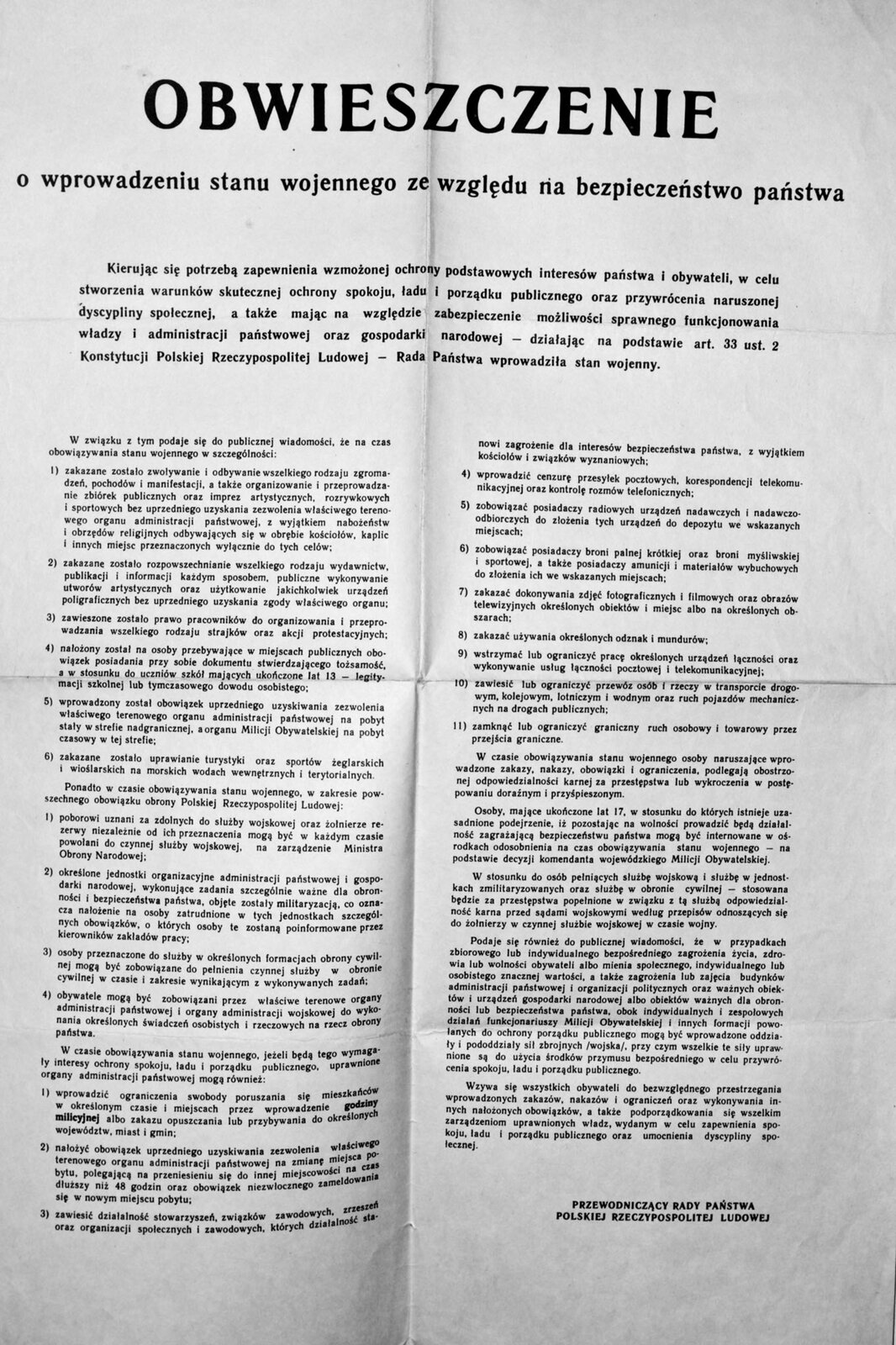
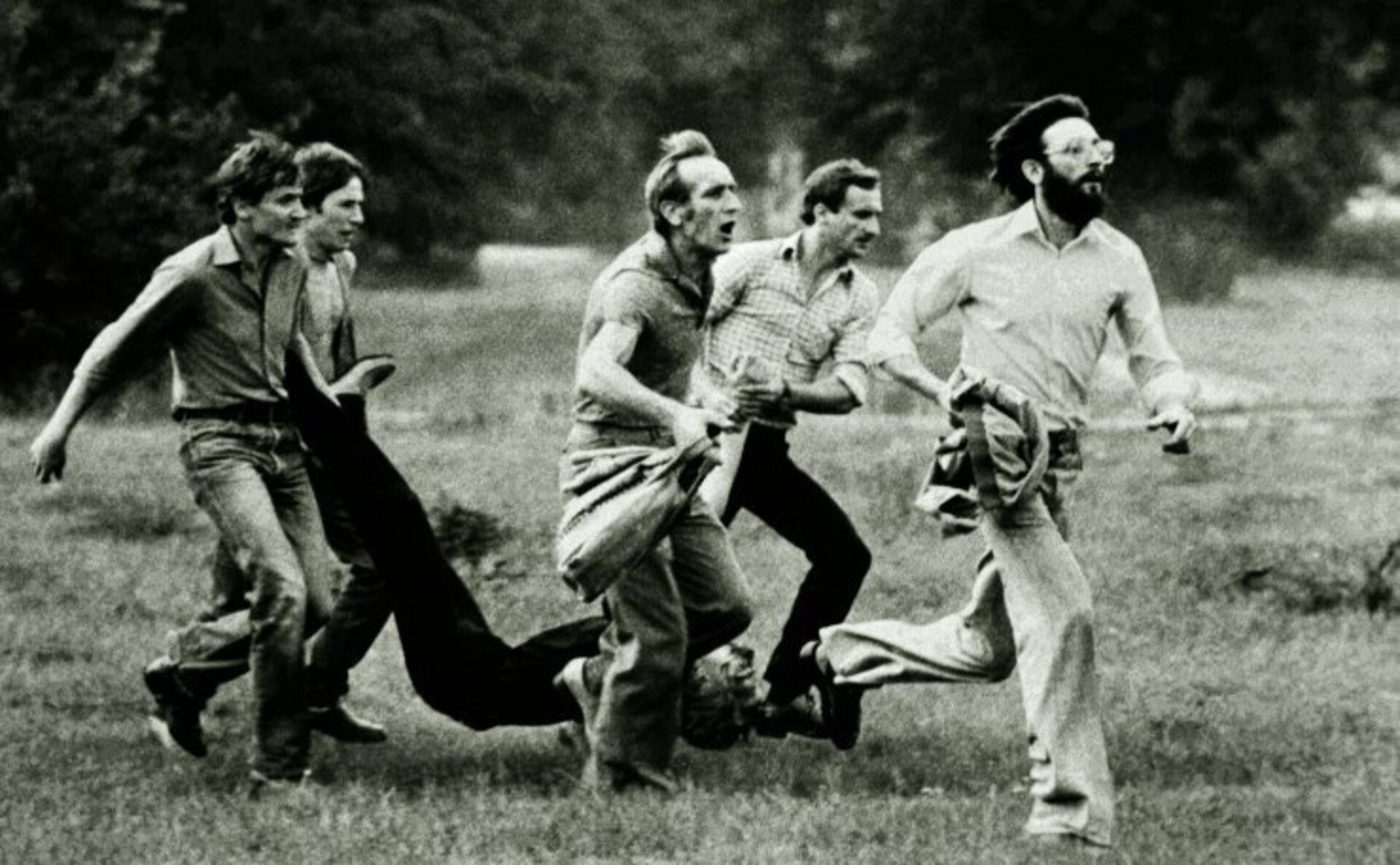
This happened on December 13, 1981, when the Martial lawMartial law was introduced by a decree of the Polish Council of State. Thousands of soldiers and heavy equipment units appeared on the streets. The activities of all social and cultural organizations were suspended, schools were closed, press publications and artistic activities were blocked. There were arrests and internmentsinternments of SolidaritySolidarity activists and all those who could be a threat to the Military Council of National SalvationMilitary Council of National Salvation (headed by gen. Jaruzelski), which took power in the country. Prohibitions and restrictions did not discourage the public from resistance. Strikes broke out in many places, but were brutally suppressed (e.g. at the Wujek Coal Mine). On important anniversaries, demonstrations of many thousand people took place on city streets. Freedom and the release of political prisoners were demanded. SamizdatSamizdat produced thousands of leaflets and magazines. The society was supported also by the Catholic Church, also some priests who sympathized with SolidaritySolidarity celebrated Masses for the homeland. Western countries imposed sanctionssanctions on Poland, which further deepened the economic crisis.
The Martial lawMartial law officially ended in July 1983. However, the crisis in the country continued for years to come. Neither were the repressions against SolidaritySolidarity activists ceased. Many of them were still imprisoned or hiding from the authorities. In 1984, as a counterbalance to SolidaritySolidarity (which was made illegal in 1982), government trade unions were established (All‑Poland Alliance of Trade Unions, or OPZZ), which did not gain much support from the society. In September 1986, the freed Lech Wałęsa set up the Provisional Council of the ‘SolidaritySolidarity’ Independent Self‑governing Labor Union, which started to function overtly, but still illegally. This was the first sign of the changes that were to take place in the following years.
Read about the events concerning the creation and activity of Solidarity.
On August 17, 21 postulates were formulated in Gdańsk. It constituted a kind of political program of the strikers. Lech Wałęsa was the head of the Gdańsk committee. Search the web and find out who is the woman in the picture, who stands next to Lech Wałęsa. How has she become famous?
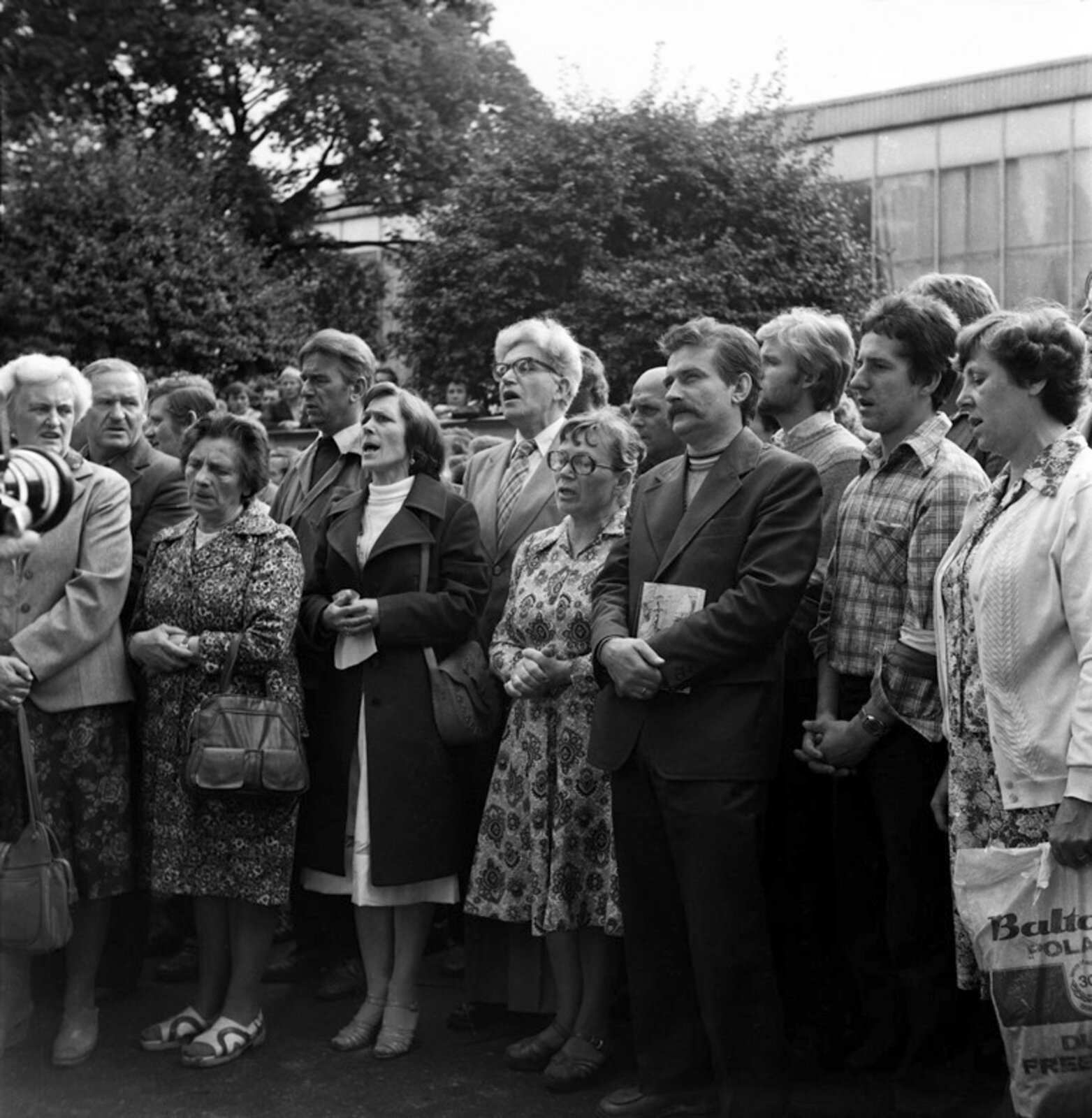
What do you think? Did Polish society welcome the decision to register Solidarity?
Find on on the Internet the TV speech of general Wojciech Jaruzelski announcing the introduction of martial law in Poland. Is it reasonable to say that it was „patriotic” and that it was dictated by the „state of necessity”?
Look for the information in various sources. Where there were bloody suppressed manifestations during the martial law?
Match the terms regarding life in the times of the Martial law to their definitions.
consequences of a breach of the applicable laws, or a negative reaction from a state to a breach of the applicable legal norms, illegal publications issued in countries where censorship does not allow the publication of all contents, intentional actions supposed to lead to specific behaviors and views, vouchers/coupons entitling to purchase goods, the arresting and confining of people in a place of isolation, without being able to leave it, restriction of free movement at certain times of the day, a nationwide trade union established in 1980 to defend workers’ rights in the Polish People’s Republic.
| Propaganda | |
| Ration coupons | |
| Solidarity | |
| Internment | |
| Curfew | |
| Sanctions | |
| Samizdat |
Keywords
Solidarity, Martial law, propaganda
Glossary
Propaganda – celowe działania, które mają doprowadzić do określonych zachować i poglądów. Służy ona do upowszechnienia dogodnych informacji dla nadawcy. W języku potocznym synonim kłamstwa i manipulacji.
Kartki – bony/kupony uprawniające do nabywania towarów. W PRL‑u nie zastępowały one pieniędzy, wprowadzały ograniczenia w kupnie pewnych produktów do ściśle określonej ilości towaru. Występują w gospodarkach okresu wojny i powojennym oraz w czasie niedoborów na rynku.
Związek Zawodowy – dobrowolna organizacja zrzeszająca grupę ludzi jakiegoś zakładu pracy (np. robotników) lub zawodu, której celem jest obrona ich interesów społeczno‑ekonomicznych.
Strajk okupacyjny – jeden z rodzajów strajku polegający na zajęciu jakiegoś budynku lub terenu uniemożliwiając mu dalsze funkcjonowanie.
Solidarność (Niezależny Samorządny Związek Zawodowy „Solidarność”) – ogólnopolski związek zawodowy powstały w 1980 roku by bronić praw pracowników w PRL. Z czasem stał się jednym z głównych ośrodków opozycji przeciwko władzy komunistycznej. Pierwszym liderem i przewodniczącym był Lech Wałęsa.
Stan wojenny – stan nadzwyczajny ogłaszany na wybranym obszarze lub całym państwie, polegający na przejęciu administracji i zarządu kraju przez wojsko.
Internowanie – przymusowe aresztowanie i osadzenie osób w miejscu odosobnienia bez możliwości jego opuszczania.
Nagranie dostępne na portalu epodreczniki.pl
Nagranie słówka: Military Council of National Salvation (WRON)
Wojskowa Rada Ocalenia Narodowego (WRON) – utworzony 13 grudnia 1981 r. organ administrujący Polską w czasie stanu wojennego. Na jego czele stał gen. Wojciech Jaruzelski.
Godzina milicyjna – wprowadzane przez władze ograniczenie swobodnego poruszania się w określonych godzinach, najczęściej nocnych, w celu zapanowania nad niebezpieczną sytuacją lub zagrożeniem.
Sankcje – w prawie, konsekwencje wynikające z naruszenia panujących przepisów lub negatywna reakcja ze strony państwa na złamanie obowiązujących norm prawnych.
Wydawnictwa podziemne – (także: drugi obieg lub samizdat) publikacje wydawane w krajach, w których cenzura nie pozwala na publikacje wszystkich treści. Wydawane były w nakładach od kilku do nawet kilkudziesięciu tysięcy kopii przez nielegalne wydawnictwa (również osoby prywatne) i najczęściej zawierały treści zabronione przez władzę.
Nagranie dostępne na portalu epodreczniki.pl
Nagranie słówka: Patriotic Movement for National Rebirth (PRON)
Patriotyczny Ruch Odrodzenia Narodowego (PRON) – organizacja polityczna utworzona w 1982 r. przez PZPR, której celem było pokazania poparcia dla działań władzy i stanu wojennego przez polskie społeczeństwo. Na jego czele stał pisarz Jan Dobraczyński.
Nagranie dostępne na portalu epodreczniki.pl
Nagranie słówka: All‑Poland Alliance of Trade Unions (OPZZ)
Ogólnopolskie Porozumienie Związków Zawodowych (OPZZ) – centrala związków zawodowych utworzona w 1984 r. jako odpowiedź władz na NSZZ „Solidarność”. Była silnie podporządkowana PZPR. Jej pierwszym przewodniczącym był Alfred Miodowicz.