Nagranie dźwiękowe abstraktu dotyczące żeńskich hormonów płciowych i przebiegu cyklu płciowego
Female sex hormones
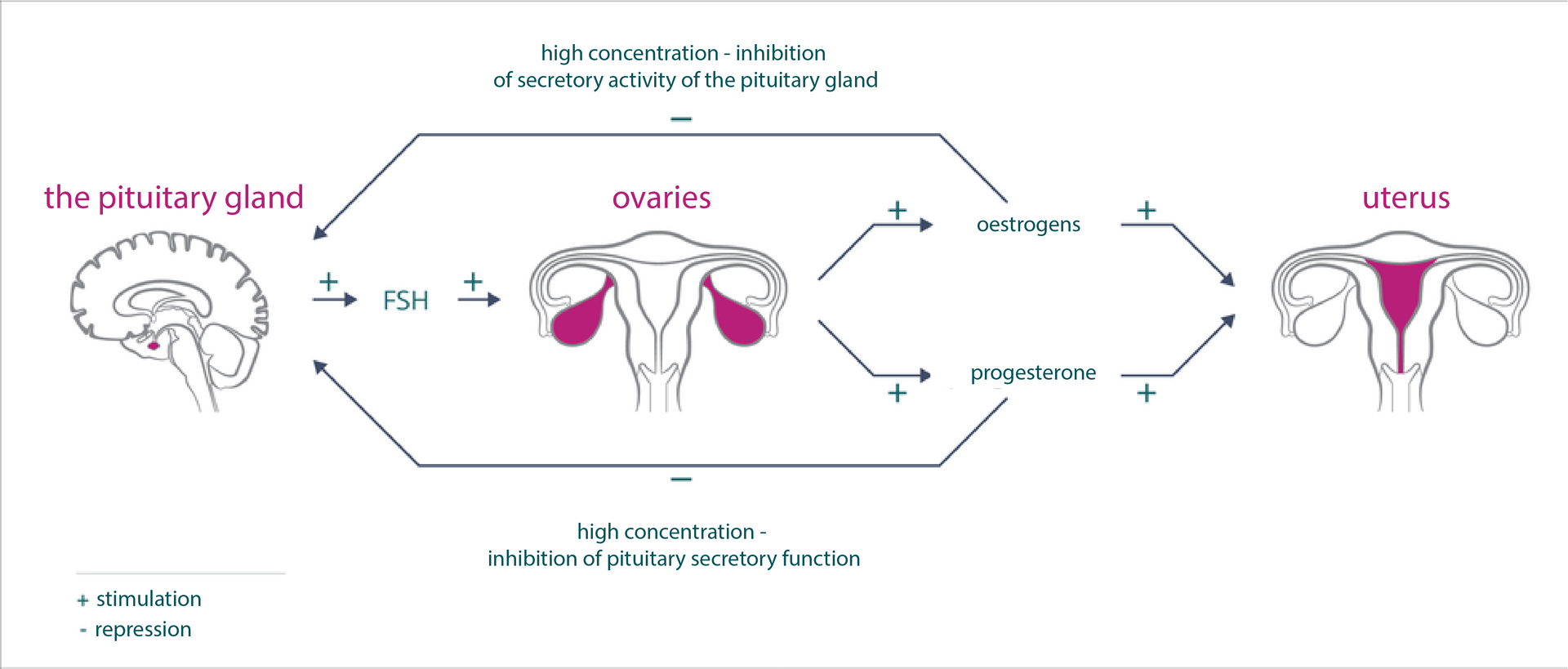
In the woman's body, within the ovary and endometrium, there are a number of regularly repeated changes. They are very precisely regulated by the hormones of the female reproductive system – estrogen and progesterone. The secretion of these hormones is controlled among others by follicle stimulating hormone (FSH), produced by the pituitary gland. Under the influence of FSH in women, the egg cell matures and every month is released from the ovary stimulating the gonads to secrete estrogens. This occurs in women between 10 and 50 years of age. After this time, the function of the ovaries expires. Estrogens during puberty are responsible for the growth and change of figure, the development of secondary sexual characteristics, the appearance of pubic hair, breast development. Estrogen interact on the uterus, preparing it for embryo adoption.
R1LkgIqTUbzJj
Schemat przedstawia sposób regulacji hormonalnej cyklu miesiączkowego. Znak plus oznacza pobudzanie, znak minus hamowanie. Z lewej szary obrys mózgu z karmazynową przysadką mózgową. W prawo pozioma strzałka, hormon FSH z przysadki pobudza jajniki, na środkowym rysunku zaznaczone kolorem. Jajniki produkują estrogeny i progesteron, wpływające pobudzająco na macicę (zaznaczona kolorem) . Jednocześnie wysokie stężenie estrogenów i progesteronu hamuje wydzielanie FSH przez przysadkę mózgową (długie strzałki u góry i u dołu). Na ilustracji są podpisy: the pituitary gland-
high concentration - inhibition of secretory activity of the pituitary gland-
oestrogens-
progesterone-
uterus-
high concentration- inhibition of pituitary secretory function-
+stimulation
-repression
Hormonal regulation of the menstrual cycle
Source: Anita Mowczan, licencja: CC BY 3.0.
Task 1
Present the primary role of the pituitary gland in regulating the secretion of female sex hormones.
Task 2
Before you see the animation „Inhibition of the secretory function of the pituitary gland by estrogens and progesterone.”, Write down the research question and the hypothesis. Make notes while watching the movie, and finally add conclusions.
R9myzbXgBuR8j
Wykonaj ćwiczenie zgodnie z poleceniem.
Wykonaj ćwiczenie zgodnie z poleceniem.
R1M0Pa1mWlx1G
Animacja przedstawiająca spowolnienie funkcji wydzielania wewnętrznego przysadki mózgowej, pituitary gland przez estrogen i progesteron. Secretion of FSH hormone by the pituitary gland. High amount of FSH hormone causes the ovaries to product estrogen. Ovaries begin producing progesterone. High amount of estrogen and progesterone stops the pituitary gland from secreting FSH. With low amount of FSH, ovaries are not made to produce estrogen and progesterone. Pituitary gland begins to secrete FSH because of low amount of estrogen and progesterone. High amount of FSH causes the ovaries to product estrogen. Ovaries begin producing progesterone. High amount of estrogen and progesterone stops the pituitary gland from secreting FSH. With low amount of FSH, ovaries are not made to produce estrogen and progesterone.
Animacja przedstawiająca spowolnienie funkcji wydzielania wewnętrznego przysadki mózgowej, pituitary gland przez estrogen i progesteron. Secretion of FSH hormone by the pituitary gland. High amount of FSH hormone causes the ovaries to product estrogen. Ovaries begin producing progesterone. High amount of estrogen and progesterone stops the pituitary gland from secreting FSH. With low amount of FSH, ovaries are not made to produce estrogen and progesterone. Pituitary gland begins to secrete FSH because of low amount of estrogen and progesterone. High amount of FSH causes the ovaries to product estrogen. Ovaries begin producing progesterone. High amount of estrogen and progesterone stops the pituitary gland from secreting FSH. With low amount of FSH, ovaries are not made to produce estrogen and progesterone.
Inhibition of the secretory function of the pituitary gland by estrogens and progesterone
Source: GroMar Sp. z o.o., licencja: CC BY-SA 3.0.
Inhibition of the secretory function of the pituitary gland by estrogens and progesterone
Source: GroMar Sp. z o.o., licencja: CC BY-SA 3.0.
Animacja przedstawiająca spowolnienie funkcji wydzielania wewnętrznego przysadki mózgowej, pituitary gland przez estrogen i progesteron. Secretion of FSH hormone by the pituitary gland. High amount of FSH hormone causes the ovaries to product estrogen. Ovaries begin producing progesterone. High amount of estrogen and progesterone stops the pituitary gland from secreting FSH. With low amount of FSH, ovaries are not made to produce estrogen and progesterone. Pituitary gland begins to secrete FSH because of low amount of estrogen and progesterone. High amount of FSH causes the ovaries to product estrogen. Ovaries begin producing progesterone. High amount of estrogen and progesterone stops the pituitary gland from secreting FSH. With low amount of FSH, ovaries are not made to produce estrogen and progesterone.
The menstrual cycle
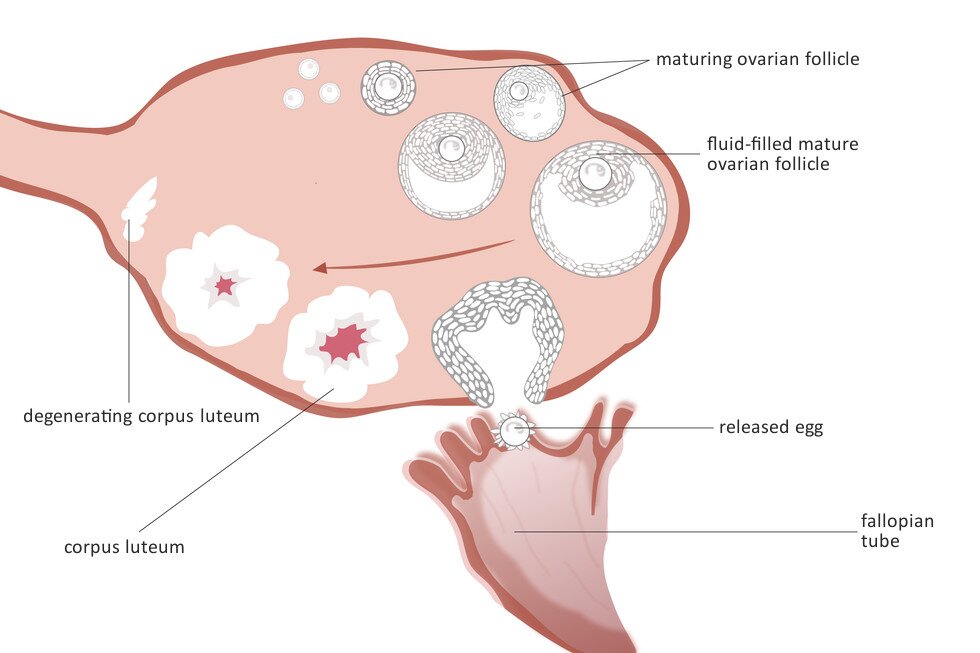
Changes in the functioning of the ovary and endometrium are subject to hormonal regulation and make up the menstrual cyclemenstrual cyclemenstrual cycle. It repeats every 28 days on average and consists of three phases. The first day of the cycle is the beginning of the bleeding (menstruation), which lasts from one to five days. Menstruation is the elimination of the exfoliative endometrium with a small amount of blood from the body. Exfoliation and removal of the mucosa support uterine muscle contractions, which can be felt as abdominal pain. At the same time, under the influence of FSH hormone, maturation of the ovarian follicleovarian follicleovarian follicle begins. The level of estrogen in the blood increases. In the preovulatory phase, which lasts about 8‑9 days, due to the increasing level of estrogen, the endometrium grows and its blood supply increases. In this way, the uterus prepares to receive a fertilized egg. In the ovary, ovarian follicle growth and egg cell maturation take place. This is a period of relative infertility that continues to release the reproductive cell. The process of releasing a mature egg cell from the ovarian follicle is called ovulationovulationovulation.
R1GW4k0V9935O
Ilustracja przedstawia duży, owalny różowy jajnik i pod nim kielichowaty jajowód. W jajniku od góry na biało wrysowano dojrzewający pęcherzyk jajnikowy. Dojrzały pęcherzyk ma w środku komórkę jajową, otoczoną innymi szarymi komórkami oraz płyn. U dołu rysunku ukazano, jak pęcherzyk przy powierzchni jajnika pęka, a uwolniona komórka jajowa wpada do jajowodu. Pęcherzyk się kurczy, tworząc ciałko żółte (tu biała chmurka z różowym środkiem). W lewo ciałko żółte zanika. Podpisano: degenerating corpus luteum; corpus luteum; maturing ovarian follicle; fluid-filled mature ovarian follicle; released egg; fallopian tube
Maturing of the ovarian follilcle
Source: Tomorrow Sp. z o.o., licencja: CC BY 3.0.
The broken ovarian follicle is transformed into corpus luteumcorpus luteumcorpus luteum. The longest phase of the cycle – postovulatory begins, which lasts about 14 days and is the period of female infertility. At this time, the corpus luteum secretes progesterone, which inhibits the maturation of subsequent follicles. High levels of estrogen and progesterone cause further intensive development of the endometrium. If fertilization does not occur, the corpus luteum disappears, estrogen and progesterone levels decrease. Their low concentration in the blood causes the uterine mucosa to begin to exfoliate and menstrual bleeding begins.
RgvGVdahKcr1x
Ilustracja przedstawia schematycznie zmiany, zachodzące w organizmie kobiety podczas cyklu miesiączkowego. U dołu podpisane dni cyklu od 1 do 28. Nad dniami cyklu przedstawiona schematycznie wyściółka macicy, o różnej grubości, zależnie od fazy cyklu-przez pierwsze 6 dni jej grubość zmniejsza się, a następnie rośnie do osiągnięcia pierwotnego poziomu. W środku schematu pionowa, przerywana linia, oznaczająca moment owulacji (dzień 14.). Różowa linia u góry z cyfrą 1 oznacza poziom hormonu FSH. FSH utrzymuje się względnie na jednakowym poziomie w trakcie trwania cyklu z jednym wyjątkiem. Poziom FSH znacząco wzrasta przed czternastym dniem cyklu- wzrost rozpoczyna się około 11 dnia cyklu, a w 13 dniu osiąga maksymalną wartość, następnie zaczyna spadać. Ma to miejsce tuż przed owulacją. Zaraz po owulacji wraca do poprzedniego poziomu. Poniżej przedstawione są zmiany zachodzące w jajniku- Strzałka wskazuje pobudzenie rozwoju pęcherzyka jajnikowego (różowo- brązowe kółeczko), owulację i zanikanie ciałka żółtego. Linia niżej z cyfrą 3 to poziom estrogenów. Poziom estrogenów jest najwyższy w okresie tuż przed owulacją. Strzałka w dół wskazuje wpływ pobudzający na błonę śluzową macicy. Błękitna linia z cyfrą 2 oznacza poziom progesteronu. Poziom progesteronu jest najwyższy między 21 a 28 dniem cyklu. Strzałka od niej wskazuje wpływ hamujący na wyściółkę macicy.
Menstrual cycle in women
Source: Tomorrow Sp. z o.o., licencja: CC BY 3.0.
RnPjNx2hiDGMh
Exercise 1
Ćwiczenie wskaż poprawną odpowiedź. Based on the illustration "Menstrual cycle in women", evaluate in which phase of the menstrual cycle the concentration of FSH is the highest. Możliwe odpowiedzi: 1. during menstruation, 2. immediately before ovulation, 3. about a week after ovulation, 4. between ovulation and the onset of menstruation
Ćwiczenie wskaż poprawną odpowiedź. Based on the illustration "Menstrual cycle in women", evaluate in which phase of the menstrual cycle the concentration of FSH is the highest. Możliwe odpowiedzi: 1. during menstruation, 2. immediately before ovulation, 3. about a week after ovulation, 4. between ovulation and the onset of menstruation
R1PvAavVOUCue
Exercise 2
Przypomnij sobie tytuł abstraktu, wysłuchaj nagrania i spróbuj zaproponować własny temat dla dzisiejszej lekcji.
Przypomnij sobie tytuł abstraktu, wysłuchaj nagrania i spróbuj zaproponować własny temat dla dzisiejszej lekcji.
RIpzxtEWSRYcF
Exercise 3
Ćwiczenie wskaż poprawne odpowiedzi. Indicate the effects of increased levels of estrogen and progesterone in the blood. Możliwe odpowiedzi: 1. stimulation of pituitary secretory function, 2. inhibition of pituitary secretory function, 3. stimulating the proliferation of the endometrium, 4. stimulation of gonads for secretion of estrogens
Ćwiczenie wskaż poprawne odpowiedzi. Indicate the effects of increased levels of estrogen and progesterone in the blood. Możliwe odpowiedzi: 1. stimulation of pituitary secretory function, 2. inhibition of pituitary secretory function, 3. stimulating the proliferation of the endometrium, 4. stimulation of gonads for secretion of estrogens
RleT6bb0cUkv7
Exercise 4
Ćwiczenie połącz w pary. What is the role of hormones in the woman's body? Combine. estrogen Możliwe odpowiedzi: 1. monthly egg cell maturation, 2. the formation of a typically female figure, preparation of the uterus for embryo adoption, 3. preparation of the uterus for embryo adoption. FSH hormone Możliwe odpowiedzi: 1. monthly egg cell maturation, 2. the formation of a typically female figure, preparation of the uterus for embryo adoption, 3. preparation of the uterus for embryo adoption. progesterone Możliwe odpowiedzi: 1. monthly egg cell maturation, 2. the formation of a typically female figure, preparation of the uterus for embryo adoption, 3. preparation of the uterus for embryo adoption
Ćwiczenie połącz w pary. What is the role of hormones in the woman's body? Combine. estrogen Możliwe odpowiedzi: 1. monthly egg cell maturation, 2. the formation of a typically female figure, preparation of the uterus for embryo adoption, 3. preparation of the uterus for embryo adoption. FSH hormone Możliwe odpowiedzi: 1. monthly egg cell maturation, 2. the formation of a typically female figure, preparation of the uterus for embryo adoption, 3. preparation of the uterus for embryo adoption. progesterone Możliwe odpowiedzi: 1. monthly egg cell maturation, 2. the formation of a typically female figure, preparation of the uterus for embryo adoption, 3. preparation of the uterus for embryo adoption
Rhex40Iwzoqg2
Exercise 5
Complete the text. The menstrual cycle lasts on average {tu uzupełnij} days and consists of three phases. It begins with the occurrence of a "bleeding" (menstruation), which is used to expel the body from the exfoliative mucous membrane of uterus. Immediately after menstruation, the preovulatory phase occurs during which the follicle begins to mature and the proliferation of the lining of the uterus. Typically, on day 14 of the cycle, {tu uzupełnij} occurs. The broken ovarian folicle turns into the corpus luteum and the high level of estrogen and {tu uzupełnij} causes further proliferation of the uterine mucosa. If fertilization does not occur, the corpus luteum disappears, estrogen and progesterone levels fall, which in turn causes the uterine mucosa to peel off and the next cycle begins.
Możliwe odpowiedzi: 1. 28, 2. progesterone, 3. ovulation
Complete the text. The menstrual cycle lasts on average {tu uzupełnij} days and consists of three phases. It begins with the occurrence of a "bleeding" (menstruation), which is used to expel the body from the exfoliative mucous membrane of uterus. Immediately after menstruation, the preovulatory phase occurs during which the follicle begins to mature and the proliferation of the lining of the uterus. Typically, on day 14 of the cycle, {tu uzupełnij} occurs. The broken ovarian folicle turns into the corpus luteum and the high level of estrogen and {tu uzupełnij} causes further proliferation of the uterine mucosa. If fertilization does not occur, the corpus luteum disappears, estrogen and progesterone levels fall, which in turn causes the uterine mucosa to peel off and the next cycle begins.
Możliwe odpowiedzi: 1. 28, 2. progesterone, 3. ovulation
R1aTaZmeAHcWU
Exercise 6
Ćwiczenie połącz w pary. Combine the effect of hormones with what causes it: hyperplasia of the endometrium Możliwe odpowiedzi: 1. production of progesterone by the corpus luteum, 2. increase in estrogen and progesterone levels in the blood, 3. decrease in estrogen and progesterone levels in the blood, 4. increase in FSH levels in the blood. peeling of the lining of the uterus Możliwe odpowiedzi: 1. production of progesterone by the corpus luteum, 2. increase in estrogen and progesterone levels in the blood, 3. decrease in estrogen and progesterone levels in the blood, 4. increase in FSH levels in the blood. starting follicular maturation Możliwe odpowiedzi: 1. production of progesterone by the corpus luteum, 2. increase in estrogen and progesterone levels in the blood, 3. decrease in estrogen and progesterone levels in the blood, 4. increase in FSH levels in the blood. inhibition of follicular maturation Możliwe odpowiedzi: 1. production of progesterone by the corpus luteum, 2. increase in estrogen and progesterone levels in the blood, 3. decrease in estrogen and progesterone levels in the blood, 4. increase in FSH levels in the blood
Ćwiczenie połącz w pary. Combine the effect of hormones with what causes it: hyperplasia of the endometrium Możliwe odpowiedzi: 1. production of progesterone by the corpus luteum, 2. increase in estrogen and progesterone levels in the blood, 3. decrease in estrogen and progesterone levels in the blood, 4. increase in FSH levels in the blood. peeling of the lining of the uterus Możliwe odpowiedzi: 1. production of progesterone by the corpus luteum, 2. increase in estrogen and progesterone levels in the blood, 3. decrease in estrogen and progesterone levels in the blood, 4. increase in FSH levels in the blood. starting follicular maturation Możliwe odpowiedzi: 1. production of progesterone by the corpus luteum, 2. increase in estrogen and progesterone levels in the blood, 3. decrease in estrogen and progesterone levels in the blood, 4. increase in FSH levels in the blood. inhibition of follicular maturation Możliwe odpowiedzi: 1. production of progesterone by the corpus luteum, 2. increase in estrogen and progesterone levels in the blood, 3. decrease in estrogen and progesterone levels in the blood, 4. increase in FSH levels in the blood
Summary
During puberty, girls develop sexual characteristics and menstrual cycle occurs.
The menstrual cycle includes changes in hormone levels as well as the structure and physiology of the ovary and endometrium.
Estrogens and progesterone affect the uterus, preparing it for embryo adoption.
The menstrual cycle is controlled by the pituitary and ovarian hormones.
The first day of menstrual bleeding marks the first day of the cycle.
In each cycle, one ovarian follicle containing an egg cell is usually matured.
The release of the egg cell from the ovarian follicle is called ovulation.