Flatworms, tapeworms, parasitic worms
maintaining proper hygiene protects against infections;
parasites live at the expense of the host organism.
to list characteristic features of flatworms;
to identify an unknown organism as a representative of flatworms based on the features of its structure;
to describe adaptations of flatworms to the parasitic mode of life;
to explain how you can become infected with tapeworms;
to assess the role of flatworms in nature.
Nagranie dostępne na portalu epodreczniki.pl
Nagranie dźwiękowe dotyczące płazińców, tasiemców, robaków pasożytniczych
Research shows that 80% of people in Poland are hosts of at least one parasitic worm. Every seventh Pole has a human roundworm, and every twelfth – tapeworm. Undesirable tenants usually settle with the owners of dogs and cats.
Flatworms
Flatworms have elongated, wormlike body with a head barely distinguished from the body. They are bilaterally symmetricalbilaterally symmetrical and strongly flattened dorsoventrally. Among the flatworms, there may be species that are free‑living, such as a planarian, which is a predator that lives in fresh waters. The vast majority of flatworms representatives are internal parasitesinternal parasites of animals, including humans. A parasite is an organism that uses the body of another organism, the so‑called hosthost, as a living environment and a source of nutrition – it feeds on the food the host has digested. Being inside the host's body, it poisons the host with its excretory products. When parasites occur in large quantities, they can cause devastation and even death of the host. An example of internal parasites are tapeworms.
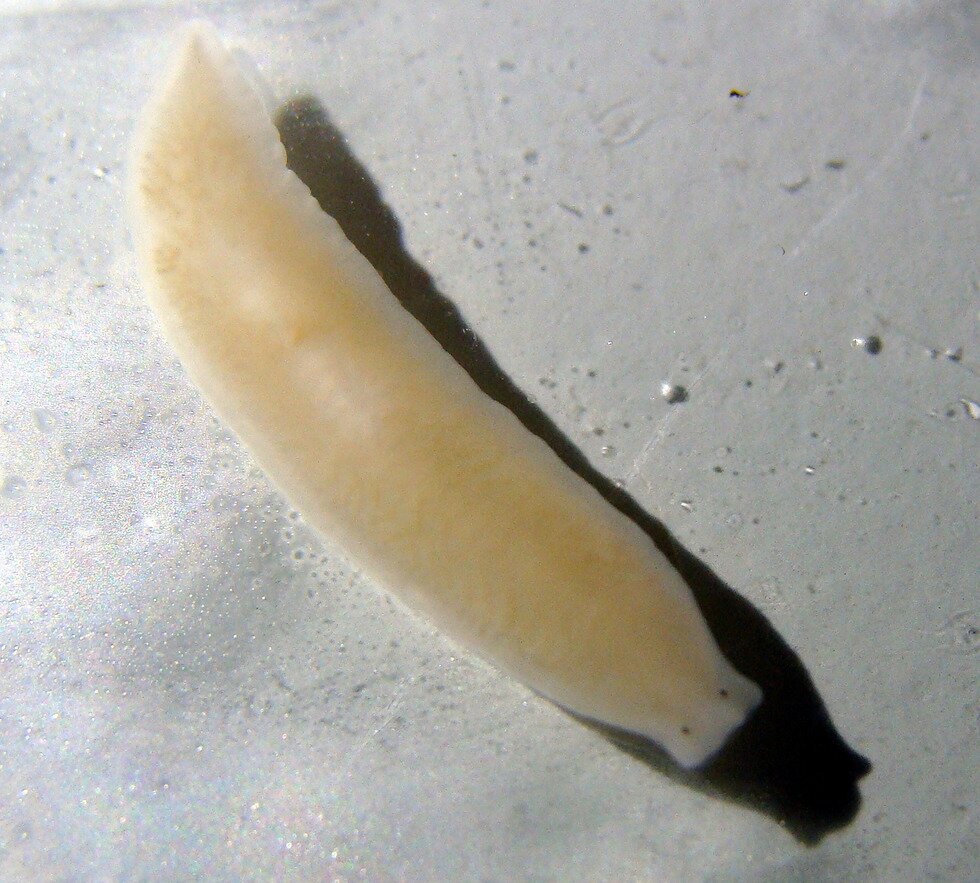
Explain why planarians have a vision organ and tapeworms do not.
Tapeworms – parasitic worms
We currently know over 3 thousand species of tapeworms. All without exception live at the expense of other organisms in their interiors (at least periodically). They are perfectly adapted to the parasitic mode of life. At the front of the tapeworm body, on the scolex, there are clasping organs: bothridium (suckers) or hooks, or both. With them, the tapeworm anchors in the host's intestine. Just behind the scolex is a short section called neck. Its task is to produce proglottids, the essential elements of building the body of a flatworm. The further from the neck, the older the proglottids are. Mature proglottids are filled with eggs. Thanks to the dorsoventral flattening of the body, even a ten‑meter tapeworm can be housed in the host's intestine.
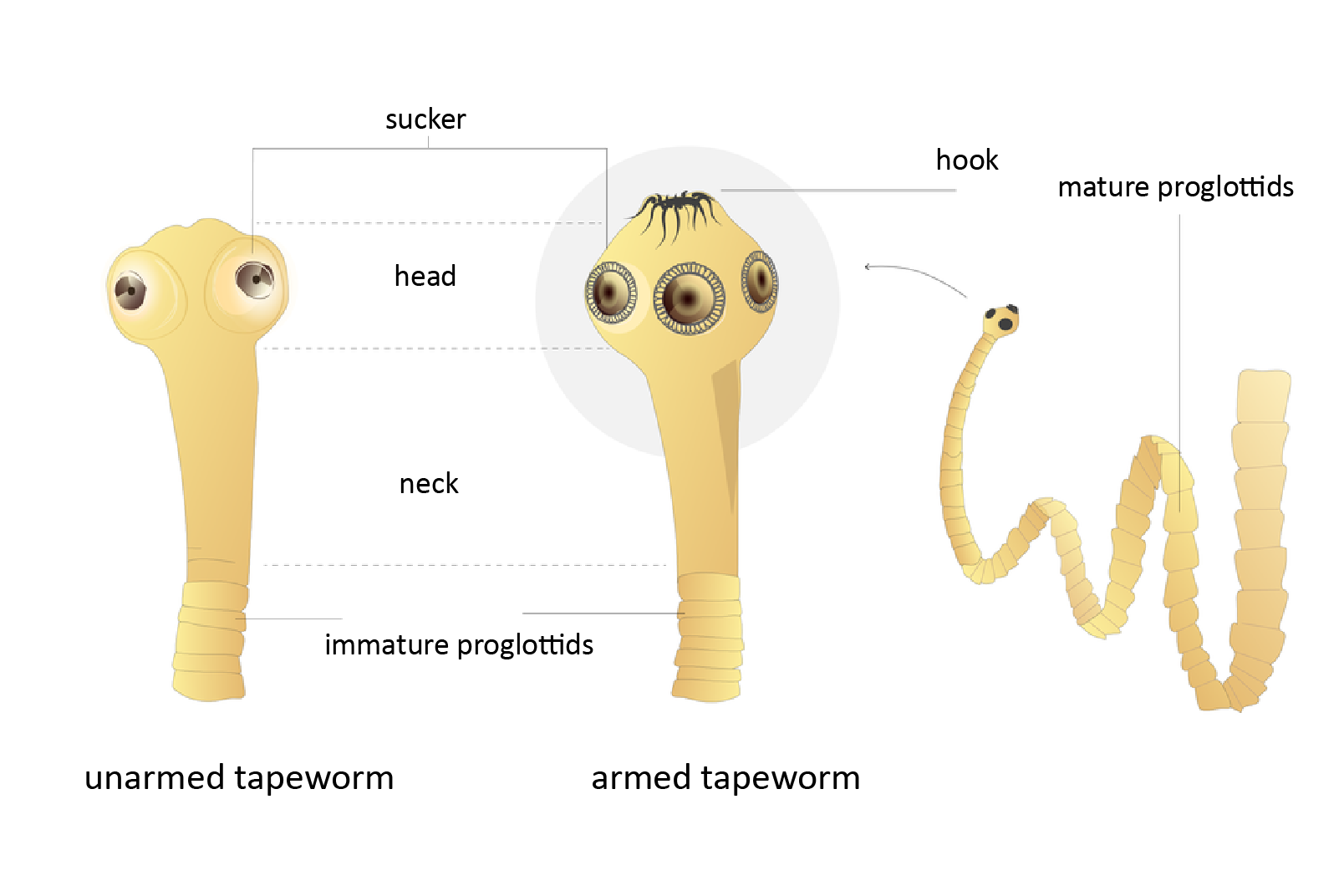
The tapeworms do not have a digestive system or a mouth. They do not need them because they are immersed in the nutrition filling the intestine and absorb nutrients with the entire surface of their body. They do not have respiratory organs, because they live in an oxygen‑poor environment, and their life energy comes mainly from anaerobic respiration. They are protected against the effects of digestive fluids by a thick cuticle.
Life cycle of flatworms
Flatworms are most commonly hermaphroditeshermaphrodites – animals of both sexes that produce both ovum and sperm. They usually undergo complex development in which the larval forms occur. A few hosts are needed for the development. LarvaeLarvae live inside intermediate hosts, and adults in the body definitive host.
In the case of a pork tapeworm and a beef tapeworm, the definitive host is a human. The intermediate hosts for a pork tapeworm is – a pig, and for a beef tapeworm – a cow. Fertilization of tapeworm eggs occurs in the mature proglottids of the tapeworm that lives inside the human body. After detaching themselves from the rest of the tapeworm’s body, these proglottids escape to the external environment with the faeces of the definitive host. The intermediate host is infected by ingesting contaminated water or grass. Inside the host's body, a larva hatches from the egg, and goes from the intestine to the blood vessels, then flows in them to the muscles, where it settles, transforming into a cysticercuscysticercus. It is a bubble with a diameter of a few millimeters, filled with the liquid in which the tapeworm’s scolex is located. A human gets infected by eating raw or undercooked meat containing cysticercus. In the human intestine, the cysticercus’ vesicular walls are digested, and the tapeworm’s scolex attaches itself to the intestinal wall and transforms into an adult tapeworm, adding further proglottids. Soon they are able to produce new eggs.
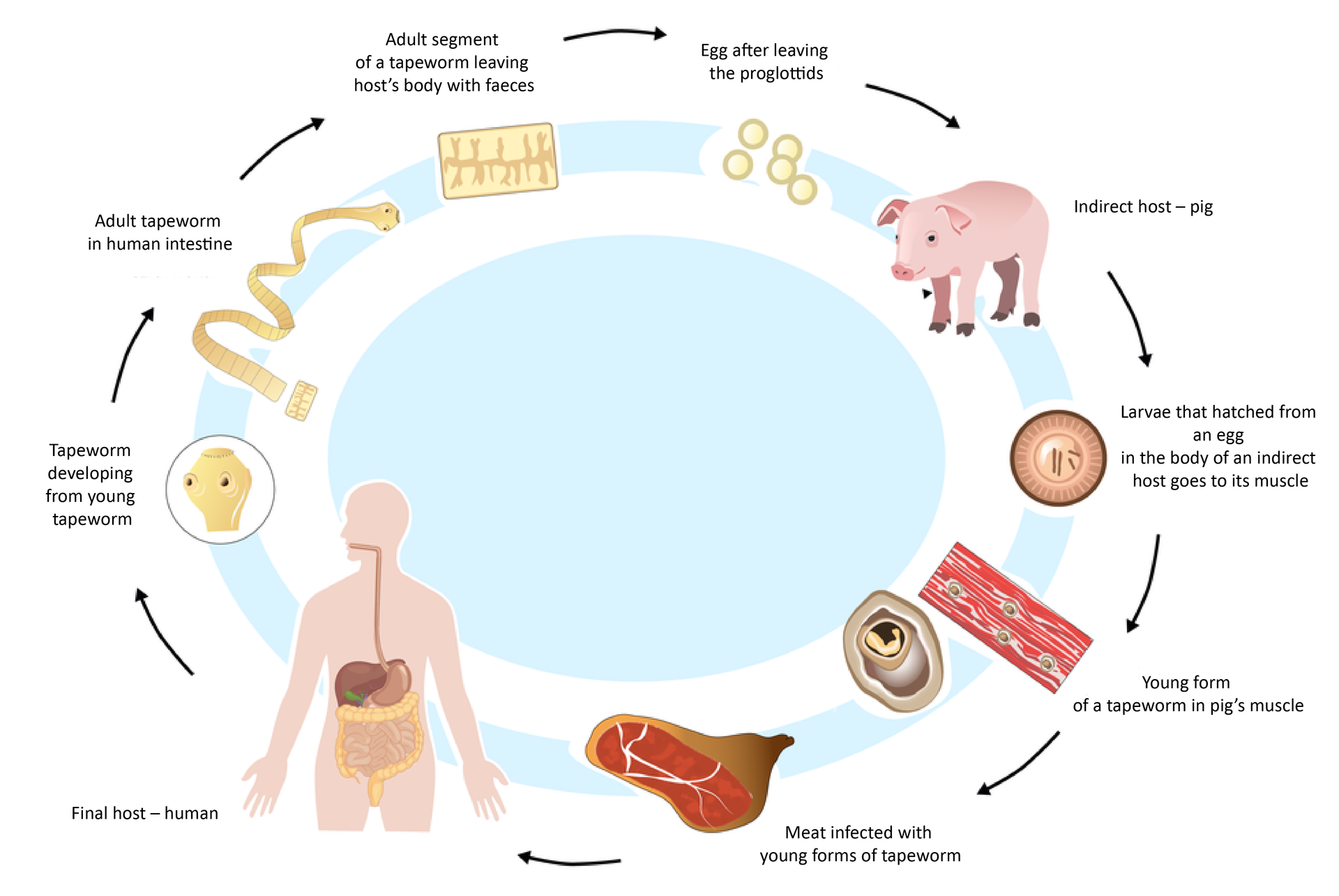
Explain in what situation a human can become the intermediate host to a tapeworm.
From one mature proglottid of the pork tapeworm up to 100 thousand fertilised eggs can be released. Estimate how many eggs are produced by an adult tapeworm whose body consists of 200 mature proglottids. Why does it produce such a large number of eggs?
Organize the development stages of a pork tapeworm. Note, it has got a different host than a beef tapeworm. Start with the consumption of the infected meat.
- Larvae leave the eggs and go to the pig's muscles.
- Attaching of a young tapeworm inside the human intestine.
- Consumption of undercooked meat containing cysticercus.
- Tapeworm growth and egg production.
- Eggs contaminate the pig's feed or the water it drinks.
- Eggs escaping outside with faeces.
Conclusion
Flatworms are worms with elongated, flattened dorsoventrally, segmented or non‑segmented body. These include internal animal parasites (tapeworms) and free‑living species.
Flatworms undergo a complex development with a change of host. Larvae live inside the body of an intermediate host, and adult forms of parasites live in the definitive host.
Adaptations of internal parasites to their mode of life consist, among others, in a very high fertility, reduction of sensory organs, immunity to digestive fluids, the ability to respirate anaerobically.
Describe how to protect yourself against infection with:
beef tapeworm (Taenia saginata).
Keywords
tapeworm, paraside, host
Glossary
larwa – młodociane stadium wielu grup zwierząt, u których występuje przeobrażenie zupełne
obojnak – (hermafrodyta) osobnik, który posiada jednocześnie męskie i żeńskie narządy rozrodcze, dzięki którym może wytwarzać zarówno plemniki, jak i komórki jajowe
pasożyt wewnętrzny – organizm cudzożywny żyjący wewnątrz żywiciela, który stanowi źródło pożywienia
symetria dwuboczna – typ symetrii ciała; organizmy o symetrii dwubocznej mają tylko jedną płaszczyznę symetrii przebiegającą wzdłuż głównej (długiej) osi ciała; występuje u większości zwierząt i u niektórych roślin
wągier – postać larwalna tasiemca; występuje w mięśniach żywiciela pośredniego; w ciele żywiciela ostatecznego przekształca się w osobnika dorosłego
żywiciel – organizm, którego kosztem żyje pasożyt dojrzały lub jego postaci larwalne