Forest distribution worldwide. Wasteful and rational management of forest resources
what impact the climate has on flora diversity on Earth;
that flora formations occur in zones on Earth;
how ecosystems function;
that environment conditions have significant impact on the forms of resource management;
that there is a conflict of interest in the Amazon between economical use of its resources and ecological consequences of deforestation.
to name the largest forest complexes in the world;
to list forests' economic and non‑economic functions;
to point where in the world forests are the most depleted and repleted;
to explain how to manage and how not to manage forest resources.
Forests worldwide and their importance
There are two large woody plant formations on Earth: taiga and humid equatorial forest. Situated at middle and high latitudes, taiga occupies the surface of approximately 19 million kmIndeks górny 22, while the area of humid equatorial forest is approximately 14 million kmIndeks górny 22.
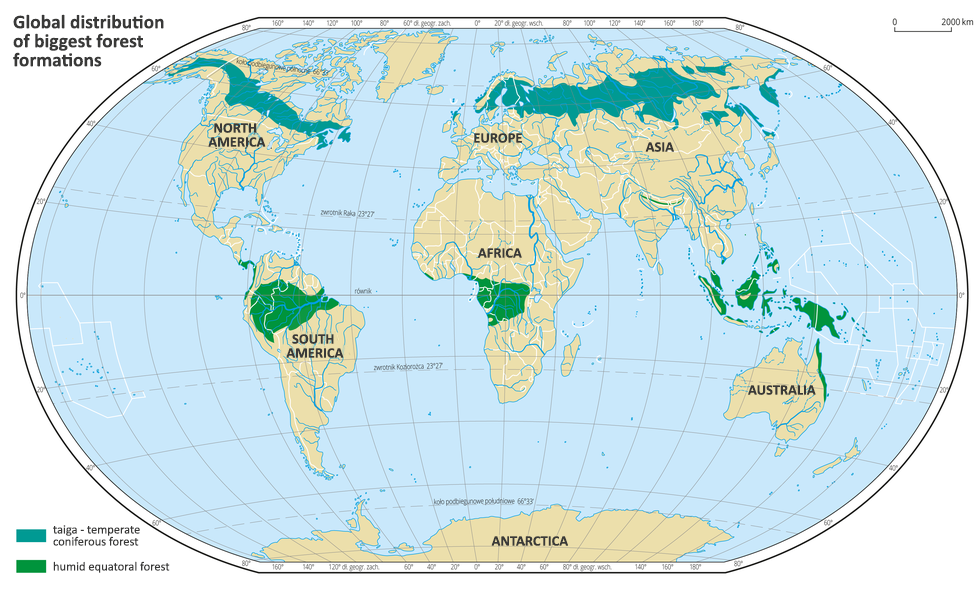
Apart from those large formations, forests grow in other climate zones as well, but they do not occupy such sizeable areas. The main limitation is the insufficient supply of water for such big plants. This can be particularly sharply noticed in equatorial zone. There is also little woodland in those countries, where trees were cut down e.g. the United Kingdom or Denmark. The rate of wood areas (forest cover)(forest cover) varies much between different countries of the world as can be seen in table 1 Other tables present countries with the highest wood area in 2010 (table 2) and countries with the highest quantities of harvested wood (table 3).
Use problem method 5Q to consider the problem: How to eliminate wasteful management of forest resources?
Management of forest resources
Forests have been cut down and otherwise exploited for ages, but it was the industrial revolution that created an increased demand for wood and provided technical means to satisfy this demand. Since the industrial revolution first happened in Europe and North America, this is where massive logging started first. Due to significant depletion of wood area in temperate zone, growing demand and availability of more efficient transport, this intensive exploitation moved to equatorial forests. It is estimated that human activities caused the area of all forests to decrease by 18 million kmIndeks górny 22.
Every year, about 130,000 kmIndeks górny 22 of woods is cut down on Earth. It means that in the last 20 years 1.4 million kmIndeks górny 22 of forest disappeared. This happened when forest's non‑economic significance was already well known. Luckily, the rate of deforestationdeforestation worldwide is falling down. In addition, there are afforestation plans carried out, the forest also grows back naturally. Afforestation and natural regeneration mean that the annual wood depletion worldwide is 52,000 kmIndeks górny 22.
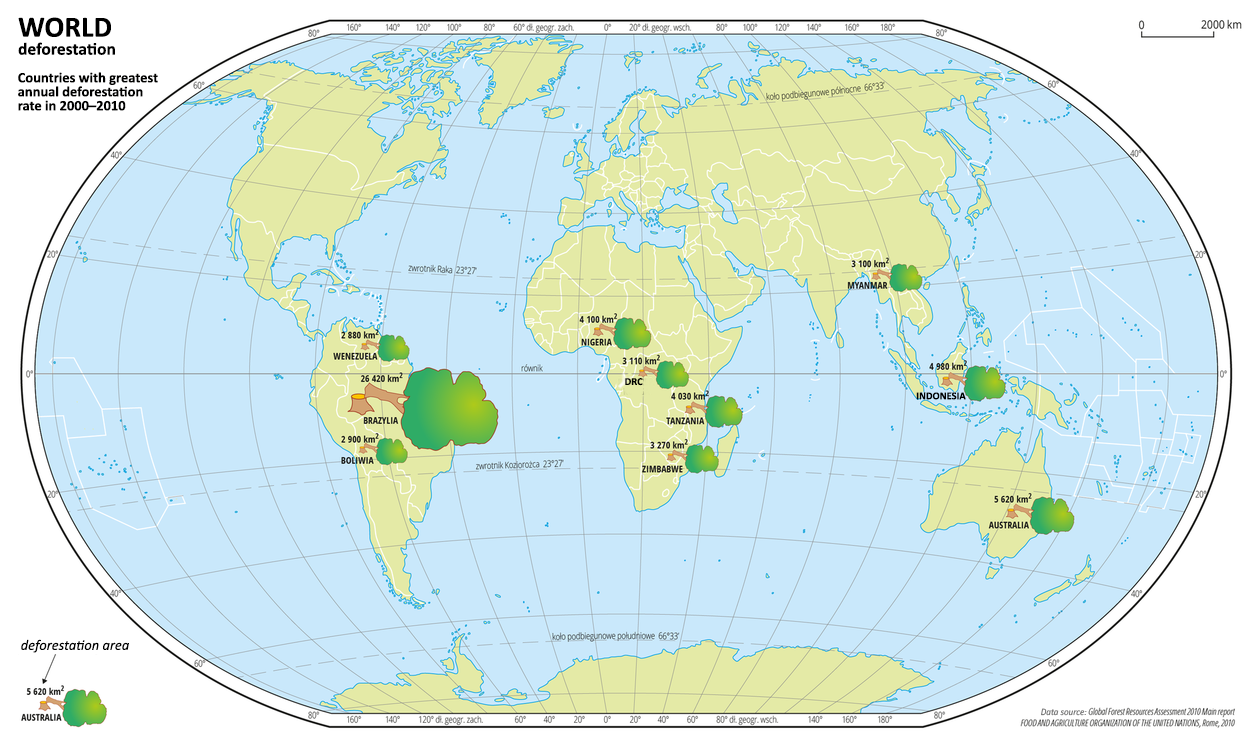
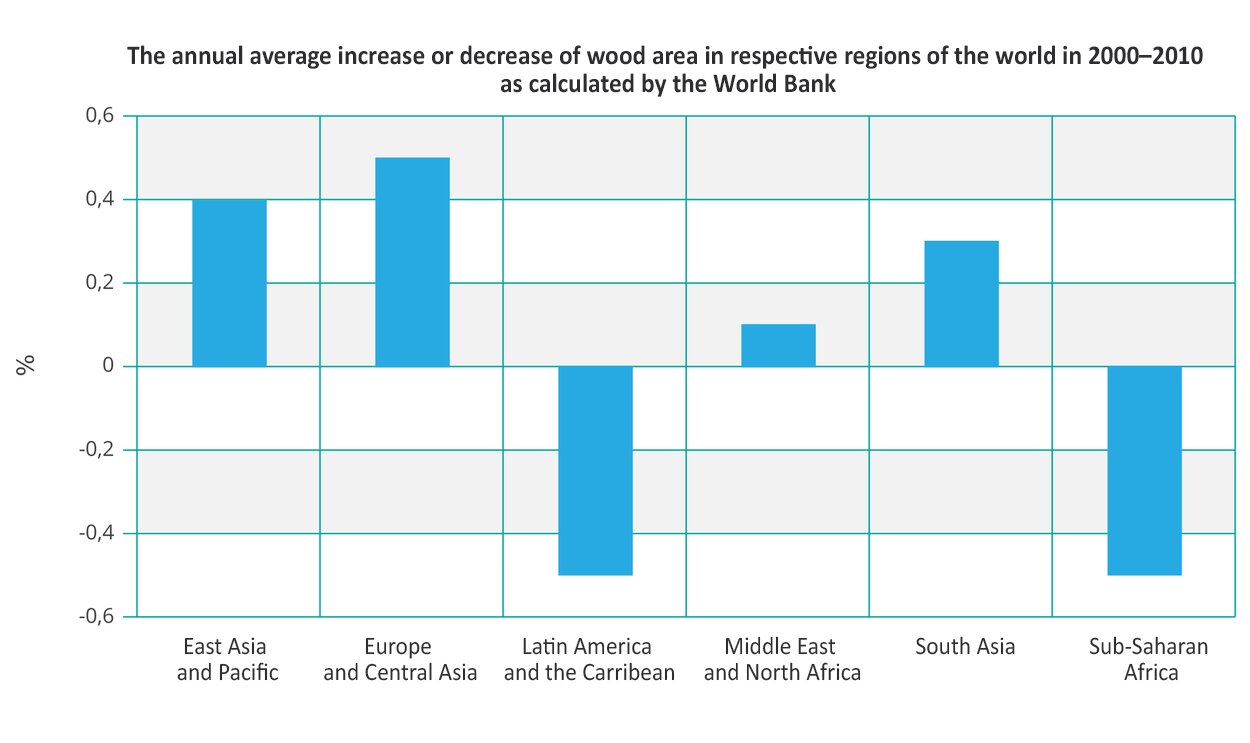
The global differences in areas affected by deforestation process are clearly visible. In two regions of the world, forests deplete at an alarmingly high rate. Those are humind equatorial forest zones in Africa and South America, which are exceptionally important in terms of nature. Luckily, at the same time wood areas in other regions are expanding.
The differences are even more visible when we look at the individual countries in the world. Those countries, where deforestation proceeds at high rate, are less developed economically and their populations grow faster - for them, forest logging is an important source of income. Meanwhile, forests are expanding in both developing countries and developed countries. Those countries increase their forest cover primarily because of the forests' non‑economic significance. They understand that the management of forest resources must be sustainable. You can see how fast deforestation and afforestation go in the selected countries in table 4.
Arrange the countries in correct order considering the forest cover. Start with the country with the greatest forest cover.
- Democratic Republic of Congo
- Sweden
- Finland
- Laos
- Japan
- Egypt
- Guyana
Among the listed countries, select the country which has the greatest deforestation worldwide of 26,420 km2 per year.
- Brazil
- Indonesia
- Bolivia
- Tanzania
Keywords
taiga, management of forest resources, equatorial forest, forest cover
Glossary
deforestacja – proces zmniejszania udziału terenów leśnych w ogólnej powierzchni danego obszaru, zazwyczaj skutek antropopresji np. nadmierne wykorzystanie gospodarcze lasów. Może prowadzić do powodzi, susz, osunięć ziemi i lawin błotnych.
lesistość – odsetek powierzchni kraju pokryty lasami