German-Soviet war
to describe why the Third Reich attacked the USSR;
to explain why the German‑Soviet war is called the Great Patriotic WarGreat Patriotic War;
to list the most important battles and campaigns of the German‑Soviet war;
to characterize the consequences of the German army defeats at Stalingrad and in the battle of Kursk;
to define what people policy was conducted by the Germans and the Russians during the German‑Soviet war.
Adolf Hitler planned the war with the Soviet Union since 1940. At that time, a plan to attack the USSR was created and its code name was „Barbarossa”„Barbarossa”. Its implementation was supposed to create a new „living space” (LebensraumLebensraum) for the Germans in the vast areas to the Urals. Initially, the war against the USSR was intended to break out in the spring of 1941, but the German intervention in the Balkans postponed this term to June 22, 1941.
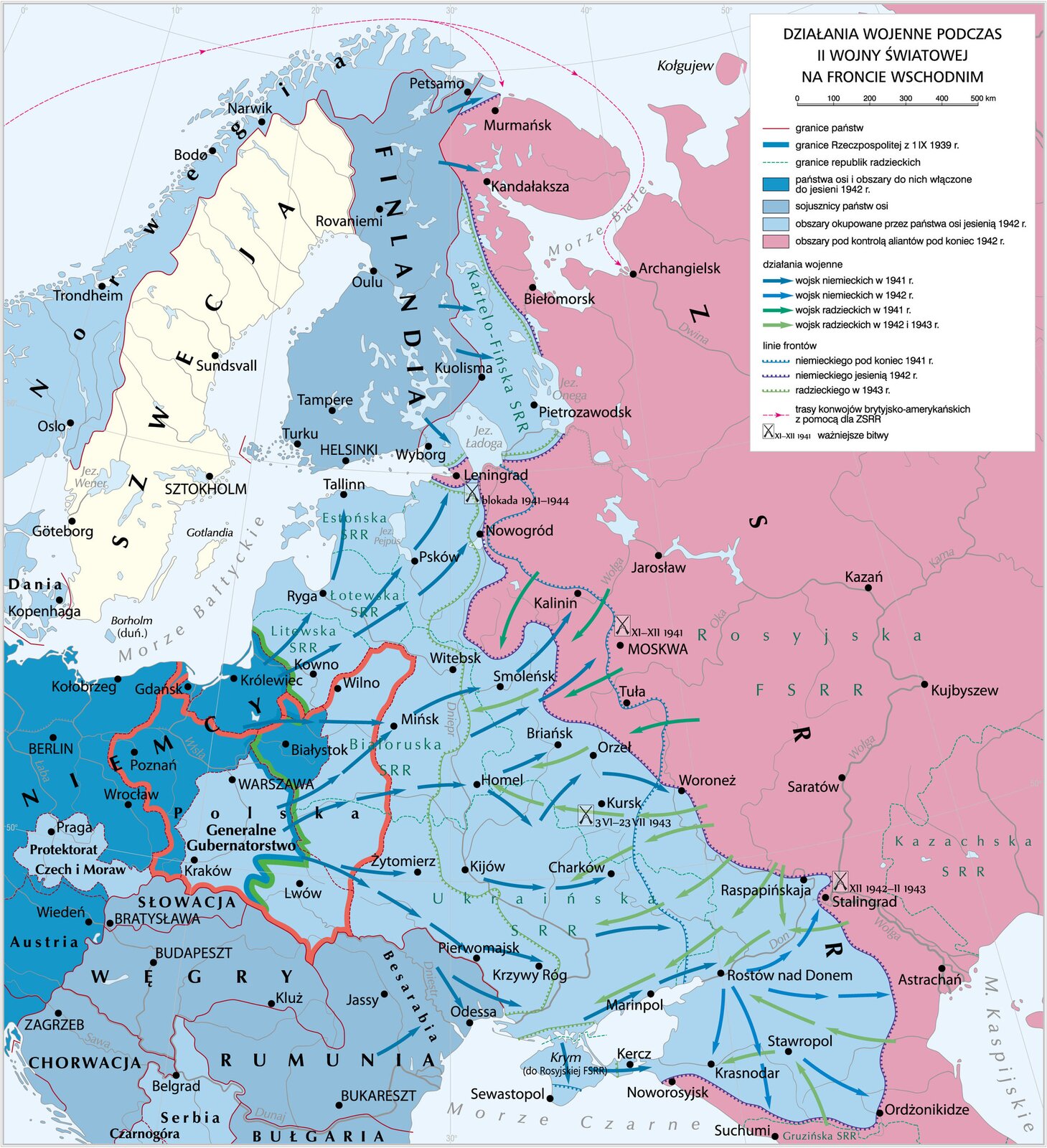
An unexpected attack was a complete surprise for the USSR. The OffensiveOffensive of the German forces crashed the unprepared Red Army and burst into the country for several hundred kilometres, capturing thousands of soldiers. In September the German frontfront reached Leningrad. Its siege lasted nearly three years. The Germans moving at a rapid pace reached Moscow in mid‑November. They did not manage to conquer it, because of the winter and unfavourable weather conditions. The enormous resistance and the return of the Soviet army from the Far East made it possible to counter‑attack and push the enemy away from the capital.
The Blitzkrieg assumed by the Barbarossa planthe Barbarossa plan failed. In the spring of 1942 the next stage of the war began. Another German offensiveoffensive started, and its aim was to take over the strategic areas of the Caucasus. The German army was detained at Stalingrad. The battle lasted for over half a year (July 1942‑February 1943), claimed nearly a million victims on both sides, and ended up with the defeat of the German army. This allowed the Russians to move to a counter‑offensive and to expel the Third Reich army to Ukraine. In attempting to regain the initiative, the German command made another attempt to break out the frontfront. Their strike near Kursk (summer 1943) went down in history as one of the greatest armoured battles. The Germans suffered huge losses (about 500,000 soldiers were killed and over 2,500 tanks and guns were destroyed), and began a retreat on the whole line of the frontfront.
The victory on the Kursk Arc initiated the Soviet attack. In the following months, the Red Army and the allied forces liberated further areas. In March 1944 they entered the lands of the pre‑war Romania, Poland and Czechoslovakia, and then, other Central and Eastern European countries. In January 1945, the last stage of the fights began, in which the western Polish and Czechoslovak lands were freed, and the Odra was crossed. On May 2, 1945, the Red Army seized Berlin, where on the night of 8 to 9 May 1945, in the headquarters of Marshal Gieorgija Zhukov, Field Marshal Wilhelm Keitel signed the capitulationcapitulation of Germany.. Find information about them.
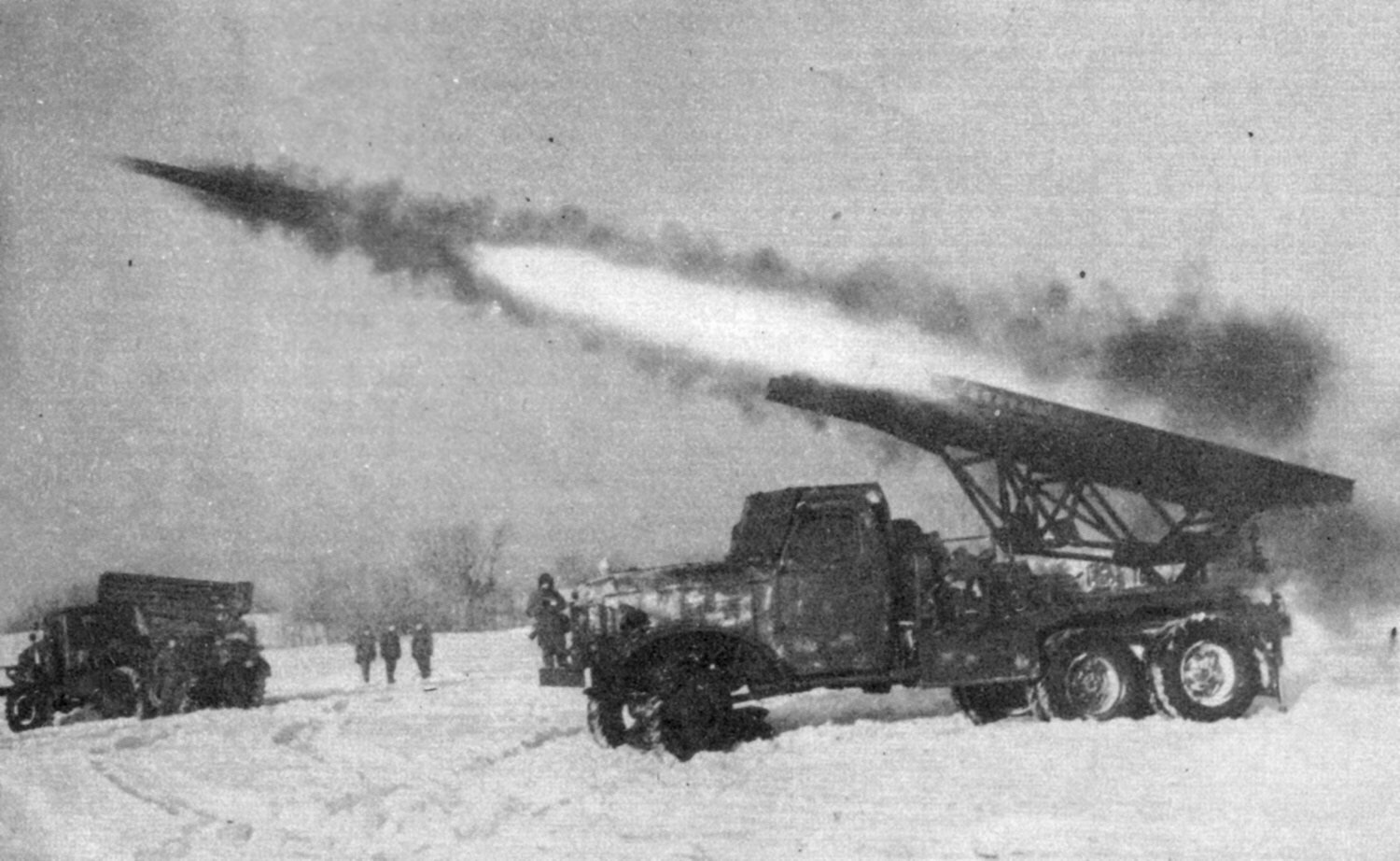
It was not without significance that the Russians recovered from the shock after being offered assistance by the USA and Great Britain and concluding relevant agreements with these powers. However, it must be remembered that the entire Soviet industry was turned into the tracks of the war economy. On the eastern front rocket batteries mounted on the chassis of trucks known as Katyusha became famous. Find out more about this weapon.
Match the following terms to their definitions.
an instant war, a term that means a quick and massive attack by the armed forces, most often of all types (aviation, navy, land forces), in order to seize the country., surrendering to a hostile armed force part of all of the army. It can be unconditional or under certain pre-determined conditions. Most often it ends the armed conflict., propaganda term describing the Soviet-German war of 1941-1945., literally: Protection Squadron, paramilitary Nazi formations, responsible for the mass extermination of the nations and terror in the conquered areas., the security authorities of the USSR. Colloquially referred to as the political police, the main tool of terror and genocide against all internal and external opponents, a violent attack on the opponent, aimed at breaking his defence and getting deeper into his army or area., a territory where the enemy armies fight each other., Soviet missile launchers used during the World War II. Called by the Germans: the “Stalin’s organ”
| Blitzkrieg | |
| Front | |
| SS (Die Schutzstaffel) | |
| NKVD | |
| Great Patriotic War | |
| Katyusha | |
| Offensive | |
| Capitulation |
Keywords
USSR, the Third Reich, the Second World War, aggression, Barbarossa
Glossary
Lebensraum – dosłownie przestrzeń życiowa; nacjonalistyczna i rasistowska niemiecka koncepcja polityczna zakładająca i usprawiedliwiająca ekspansję terytorialną Niemiec dla zdobycia niezbędnej przestrzeni do życia.
Sojusz – układ dwóch lub więcej państw lub organizacji, który ma doprowadzić do wspólnego zamierzonego celu.
Blitzkrieg – inaczej wojna błyskawiczna, termin oznaczający szybki i zmasowany atak siłami zbrojnymi, najczęściej wszystkich typów (lotnictwo, marynarka, wojska lądowe), w celu zajęcia kraju.
Plan Barbarossa - plan agresji Niemiec na ZSRS w czasie II wojny światowej. Była to największa i najważniejsza operacja niemiecka w czasie wojny, której klęska zdecydowała ostatecznie o niemieckiej przegranej w całej wojnie.
Deportacja – przymusowe przesiedlenie (wywózka), najczęściej do odległego miejsca, połączone z ograniczeniem wolności.
Front – terytorium, na którym walczą ze sobą wrogie armie.
Czystka – eliminacja, najczęściej fizyczna, niepożądanych osób zwykle stojących na czele instytucji sprawujących władzę (wojsko, policja, rząd). Najczęściej charakteryzuje się bezwzględnością i masowością.
SS (Die Schutzstaffel) – dosłownie oddział ochronny, paramilitarne formacje nazistowskie odpowiedzialne za masową eksterminację narodów i organizację terroru na podbitych terenach.
NKWD – (Narodnyj komissariat wnutriennich dieł); organ władz bezpieczeństwa ZSRS. Potocznie określany jako policja polityczna pełniąca główne narzędzie terroru i ludobójstwa wymierzonego przeciwko wszystkim wewnętrznym i zewnętrznym przeciwnikom.
Wielka wojna ojczyźniana – propagandowy termin określający wojnę radziecko‑niemiecką z lat 1941‑1945.
Ludobójstwo – termin utworzony pod koniec II wojny światowej opisujące masowe morderstwa całych grup ludzkich. Przyjęty w prawie międzynarodowym w czasie procesu w Norymberdze.
Katiusza – radzieckie wyrzutnie rakietowe używane w czasie II wojny światowej. Nazywane przez Niemców „organami Stalina”.
Propaganda – celowe działania, które mają doprowadzić do określonych zachować i poglądów. Służy ona do upowszechnienia dogodnych informacji dla nadawcy. W języku potocznym synonim kłamstwa i manipulacji.
Ofensywa – gwałtowne uderzenie w przeciwnika, mające na celu przełamanie jego obrony i wdarcie się w głąb jego wojska lub terenu.
Kapitulacja – poddanie się części lub całości wojska przeciwnikowi. Może być bezwarunkowa lub pod pewnymi wcześniej ustalonymi warunkami. Najczęściej kończy konflikt zbrojny.