Great discoveries and their heroes
what shape and size does the Earth have;
what the evidence of the spherical shape of the Earth is;
the oceans and continents of the globe;
that Columbus discovered America.
present the significance of great geographical discoveries;
indicate the participation of Polish researchers and travelers in learning about the world.
The most important voyages of discovery
For several thousand years people have been traveling for commercial purposes and also leading wars. Initially, when compasses were not invented, sea travels took place only along the shore. Using the compass allowed for traveling through the open ocean.
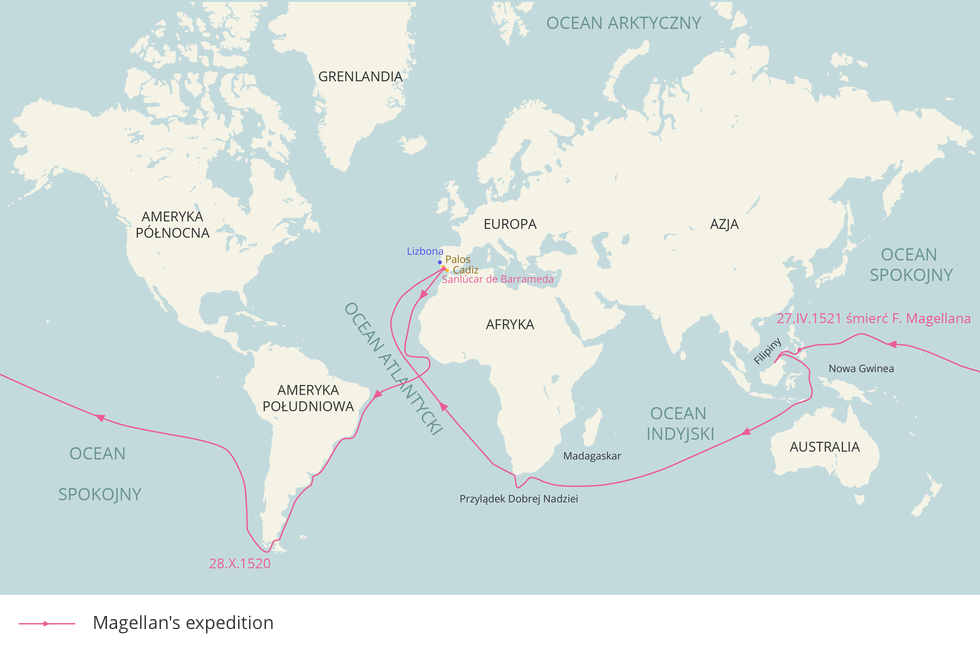
At the end of the fifteenth century, Europeans discovered America. Gold and raw materials were extracted from there, and vegetables and fruit were brought back. In 1488 years the Portuguese explorer Bartolomeu Dias sailed to the southernmost tip of Africa. Ten years later, another Portuguese, Vasco da Gama, traveled to India by sea for the first time. The Far East was the source of „roots”, as various spices were called at that time. His discovery was of great importance in trade. One of the most important trips was a cruise around the world by Ferdinand MagellanFerdinand Magellan. This Portuguese sailor organized an expedition with the money of the Spanish king, who set off in 1519, travelling towards the west. Ships circumnavigated South America from the strait, later called the name of the discoverer (Strait of Magellan), they swam through the Pacific Ocean and reached the Philippines, where Magellan died at the hands of the Filipinos. The other members of the expedition returned to Spain in September 1522, proving the spherical shape of the Earth.
In the eighteenth century James CookJames Cook he was the first European to study the northern coast of Australia and recognize that this land is habitable. However, it was only at the beginning of the 19th century that the first Europeans settled there.
Poles' participation in getting to know the world
Many Poles took part in getting to know the world. A perfect example are the achievements of Edmund StrzeleckiEdmund Strzelecki. This Polish traveler, geographer and geologist in 1834 set out on a scientific journey around the world, which took him 9 years. He explored North America and South America. Then he explored Hawaii and the islands of Polynesia. His greatest fame, however, came from the research of New Zealand and Australia.
Antoni Dybowski was one of the most outstanding naturalists of the turn of the 19th and 20th centuries. Antarctic researchers also had a significant share in getting to know the world – Henryk Arctowski and Antoni Dobrowolski. Their name bears the Polish Antarctic Station. Ignacy Domeyko studied geology and searched for mineral resources in Chile. Benedykt DybowskiBenedykt Dybowski, Aleksander Czekanowski and Jan Czerski studied Siberia. The names of Czerski and Czekanowski are give name to the great mountain ranges.
Also today, our compatriots are climbing unconquered peaks or setting new routes. The latest achievement of Poles is to reach the sources of the Amazon. One of their discoverers is Piotr Chmielinski, who was the first in 1985 to sail across the entire Amazon River - almost 7,000 kilometers.
Exploratory expeditions allow you to get to know the world and broaden your knowledge about it. They allow to describe all geographic and biological objects on Earth. They help to protect them and disseminate knowledge about them.
The sailors sailed east and west to discover the shortest sea route to India. To get there, you had to circumnavigate:
- The shores of the Pacific Ocean.
- Cape of Good Hope.
- The Malay Strait off the coast of the Philippines.
- North America.
Indicate the reasons why people could go on great trips.
- test their courage
- because they wanted to be the first and the best
- for economic and scientific reasons
- for vegetables and fruits, roots and silk
Evaluate the truth of the statements about the importance of geographical discoveries.
| True | False | |
| Geographical discoveries contributed to the growth of affluence and importance of European countries. | □ | □ |
| Geographical discoveries have already been made and nothing more can be discovered. | □ | □ |
Indicate what was most often the result of various geographical discoveries.
- name the discovered place with your name
- death of all members of the expedition
- colonization of discovered lands and deriving profits from them
- winning the race for the top priority
- entering the discovery in the Guinness Book of Records
- bringing spices and fruit from an overseas country
Decide whether the statement is true or false.
| True | False | |
| Edmund Strzelecki studied the organisms found in the Lake Baikal. | □ | □ |
| Lake Baikal is located on the Asian continent. | □ | □ |
| Gołomianka is the largest fish in the Lake Baikal. | □ | □ |
| The highest summit of Australia was named after Benedykt Dybowski. | □ | □ |
Summary
We owe the knowledge of the world to the revealing passion of many people.
Many Poles took part in getting to know all the continents and their nature.
Keywords
James Cook, Ferdinand Magellan, Edmund Strzelecki, Benedykt Dybowski
Glossary
Benedykt Dybowski – polski przyrodnik, badacz i odkrywca. Zesłany na Syberię nie zaprzestał pracy naukowej. Badał Jezioro Bajkał, wschodnią Syberię i Kamczatkę. Odkrył wiele gatunków zwierząt Syberii. Twórca ważnych teorii naukowych dotyczących pochodzenia Jeziora Bajkał.
Ferdinand Magellan – portugalski żeglarz, podróżnik i odkrywca. Pracował dla Królestwa Hiszpanii. Organizator pierwszej wyprawy, która płynąc w kierunku zachodnim, opłynęła kulę ziemską i powróciła od wschodu. Odkrywca Pacyfiku (dla Europejczyków) i wielu innych obiektów geograficznych.
Paweł Edmund Strzelecki – polski podróżnik, który podczas wyprawy dookoła świata badał i poznawał obie Ameryki, Hawaje, Nową Zelandię i Australię. Jego prace z zakresu geografii i geologii badanych lądów były przez długi czas jednymi z podstawowych publikacji naukowych dotyczących tych ziem.
James Cook – angielski żeglarz i odkrywca, kartograf, astronom. Organizował i kierował trzema wyprawami dookoła świata w latach 1768‑1780. Jako pierwszy Europejczyk zbadał północne wybrzeże Australii.