Nagranie dźwiękowe dotyczące rozchodzenia się światła.
How does light propagate?
Light travels exclusively along a straight line in given mediummediummedium, e.g. in vacuum, air or water. This rule also applies to sun rays. They propagate from the Sun in straight lines, reaching also this part of Earth which at given moment faces the Sun.
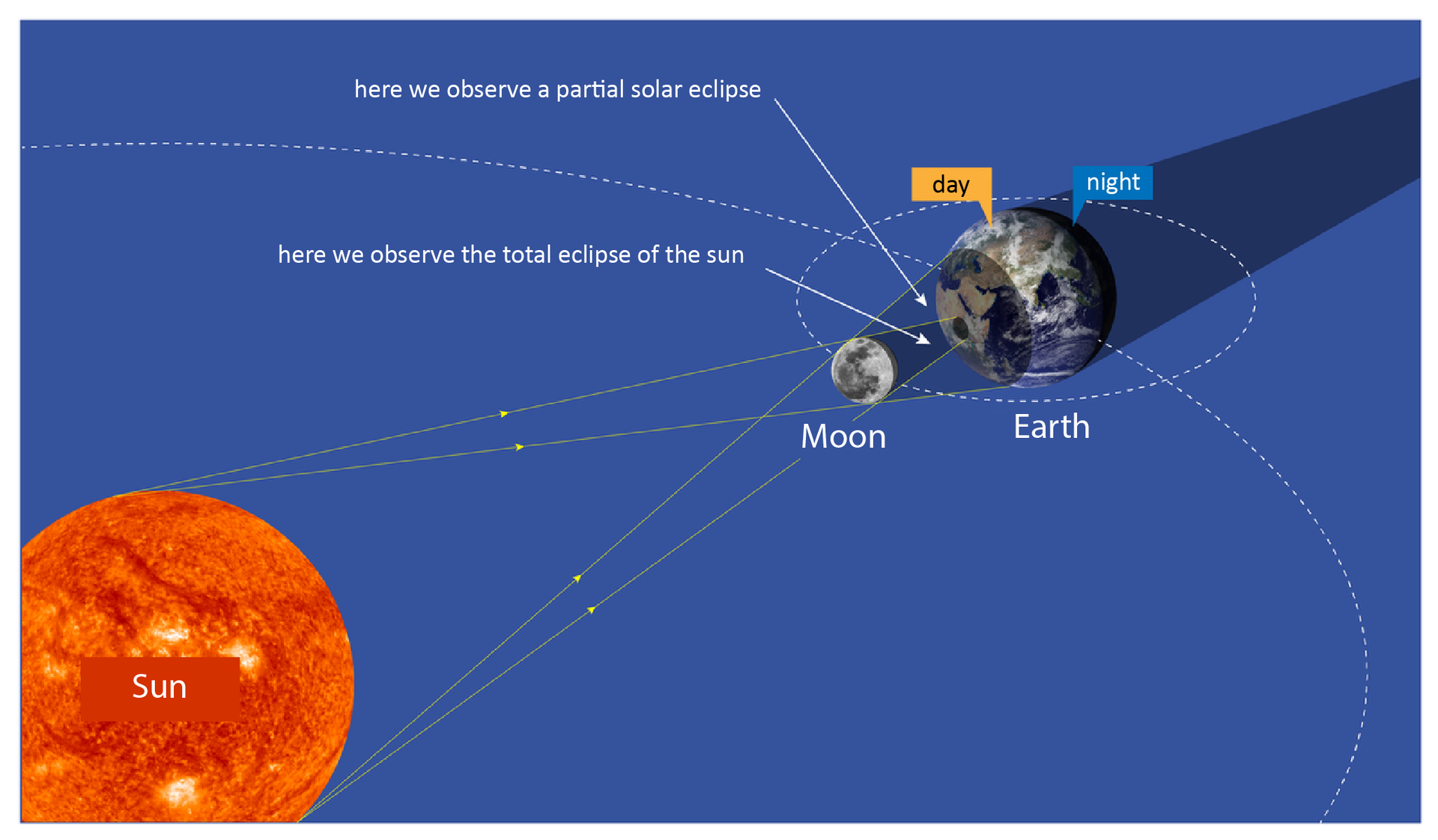
Similar to all planets, Earth is opaque. Hence, half of the Earth globe is nearly always illuminated by Sun rays and there is day on it, while the second half is in shadow, and there is night on it. Sometimes the Sun, the Moon and Earth are aligned in one line. At that time, the Moon casts shadow on Earth surface, and people in that area can observe solar eclipse.
RrEVwojOO7l37
Ilustracja prezentuje mechanizm powstawania zaćmienia Słońca. W lewym dolnym rogu ilustracji znajduje się Słońce, naprzeciwko niego, blisko prawego górnego rogu ilustracji, znajduje się mały Księżyc oraz Ziemia. Przerywanymi liniami zaznaczono orbitę Księżyca wokół Ziemi oraz orbitę Ziemi wokół Słońca. Promienie świetlne wysyłane przez Słońce natrafiają na Księżyc, który zasłania część Ziemi zwróconą do niego. W efekcie na Ziemi obserwujemy w dzień zasłonięcie tarczy Słońca przez Księżyc, czyli zaćmienie Słońca. W obszarze Ziemi, gdzie Księżyc nie zasłania całkowicie Słońca, mamy zaćmienie częściowe. Na ilustracji są opisy: here we observe a partial solar eclipsehere, we observe the total eclipse of the sun, day, night, Moon, Earth, Sun.
Solar eclipse
Source: Andrzej Bogusz, licencja: CC BY 3.0.
Ru7ErOtRTV5Xg
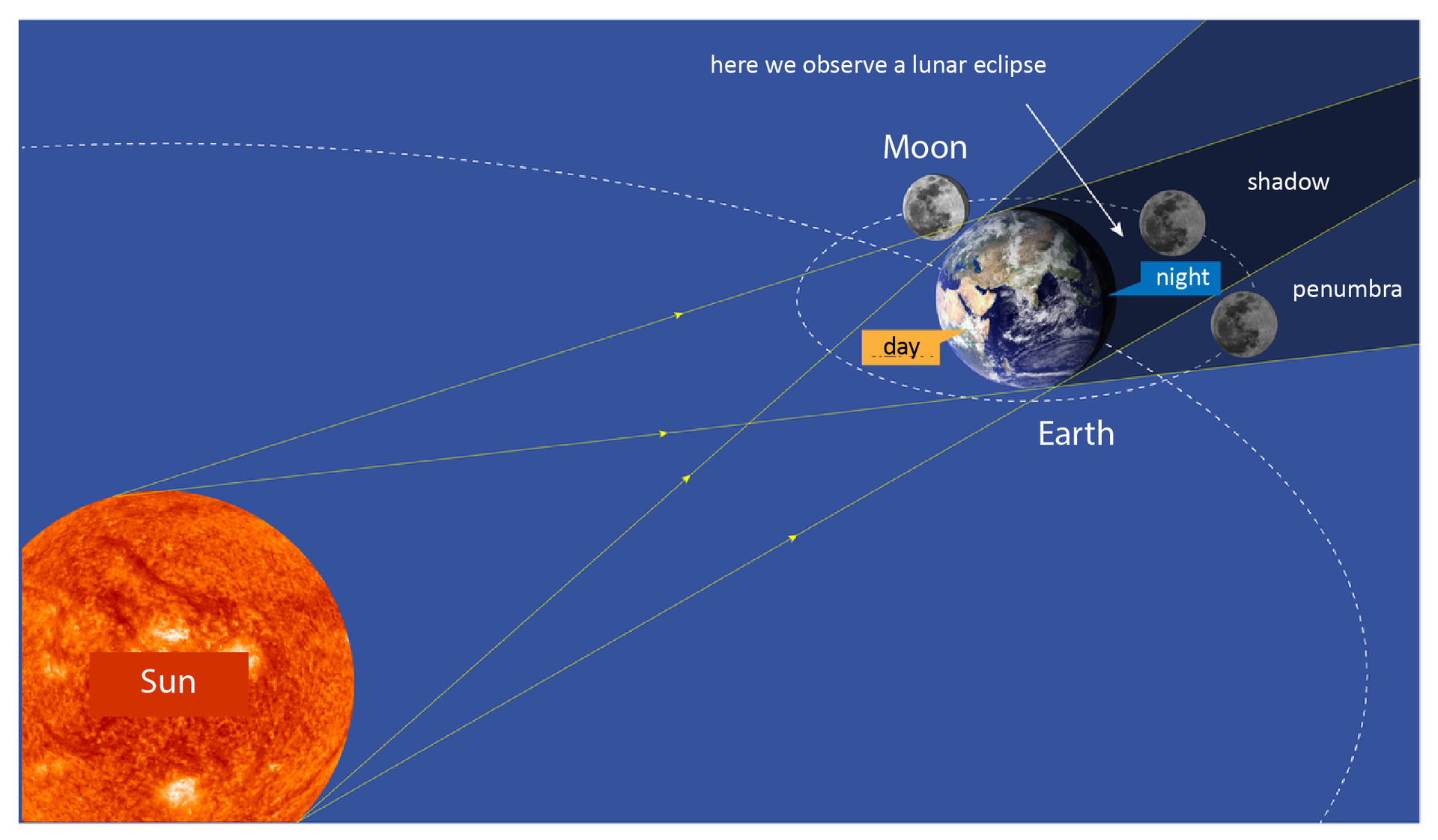
Ilustracja prezentuje mechanizm powstawania zaćmienia Księżyca. W lewym dolnym rogu ilustracji znajduje się Słońce, naprzeciwko niego, blisko prawego górnego rogu ilustracji, znajduje Ziemia, a za nią Księżyc. Przerywanymi białymi liniami zaznaczono orbitę Księżyca wokół Ziemi oraz orbitę Ziemi wokół Słońca. Promienie świetlne wysyłane przez Słońce oświetlają część Ziemi zwróconą do niego. W efekcie w tej części Ziemi jest dzień, a po przeciwnej stronie noc. Ziemia rzuca cień na Księżyc, w efekcie obserwujemy zaćmienie Księżyca. Na ilustracji są opisy: here we observe a lunar eclipse; Moon, day, night, Earth, shadow, penumbra, Sun.
Lunar eclipse
Source: Andrzej Bogusz, licencja: CC BY 3.0.
Task 1
Before you do the „Rectilinear propagation of light” experiment, write down the research question and the hypothesis. Then follow the attached instructions. Make observations during the task, and finally - conclusions.
RBDQahLeYTTTB
Polecenie sformułuj pytania, hipotezy, obserwacje i wnioski przed eksperymentem „Rectilinear propagation of light”. Before you do the „Rectilinear propagation of light” experiment, write down the research question and the hypothesis. Then follow the attached instructions. Make observations during the task, and finally - conclusions. Research question (Uzupełnij). Hypothesis (Uzupełnij). Observations (Uzupełnij). Conclusions (Uzupełnij).
Polecenie sformułuj pytania, hipotezy, obserwacje i wnioski przed eksperymentem „Rectilinear propagation of light”. Before you do the „Rectilinear propagation of light” experiment, write down the research question and the hypothesis. Then follow the attached instructions. Make observations during the task, and finally - conclusions. Research question (Uzupełnij). Hypothesis (Uzupełnij). Observations (Uzupełnij). Conclusions (Uzupełnij).
Analysis of the experiment
Rl1uwX1Wvo1b3
Ilustracja interaktywna przedstawia cztery grafiki ilustrujące rozchodzenie się światła przepuszczonego przez otwory w pudełku. Podpisano:
1. Take the box and make holes in the opposite walls. Place the box at a distance of about 2 m from a wall or billboard. The holes in the box and the light source should be directed in a straight line,
2. Tilt the box in any direction. The holes in the box and the light source should be directed in a straight line,
3. Direct the light source out of the holes on the box,
4. Position the holes in the box and the light source in such a way that they are not directed in a straight line.
Ilustracja interaktywna przedstawia cztery grafiki ilustrujące rozchodzenie się światła przepuszczonego przez otwory w pudełku. Podpisano:
1. Take the box and make holes in the opposite walls. Place the box at a distance of about 2 m from a wall or billboard. The holes in the box and the light source should be directed in a straight line,
2. Tilt the box in any direction. The holes in the box and the light source should be directed in a straight line,
3. Direct the light source out of the holes on the box,
4. Position the holes in the box and the light source in such a way that they are not directed in a straight line.
Rectilinear propagation of light
Source: GroMar Sp. z o.o., licencja: CC BY-SA 3.0.
Important!
The light visible to humans is the visible spectrumvisible spectrumvisible spectrum. However, thermal (infrared) or ultraviolet radiation is also light – we cannot see it, but we know it exists thanks to various instruments.
How is shadow cast?
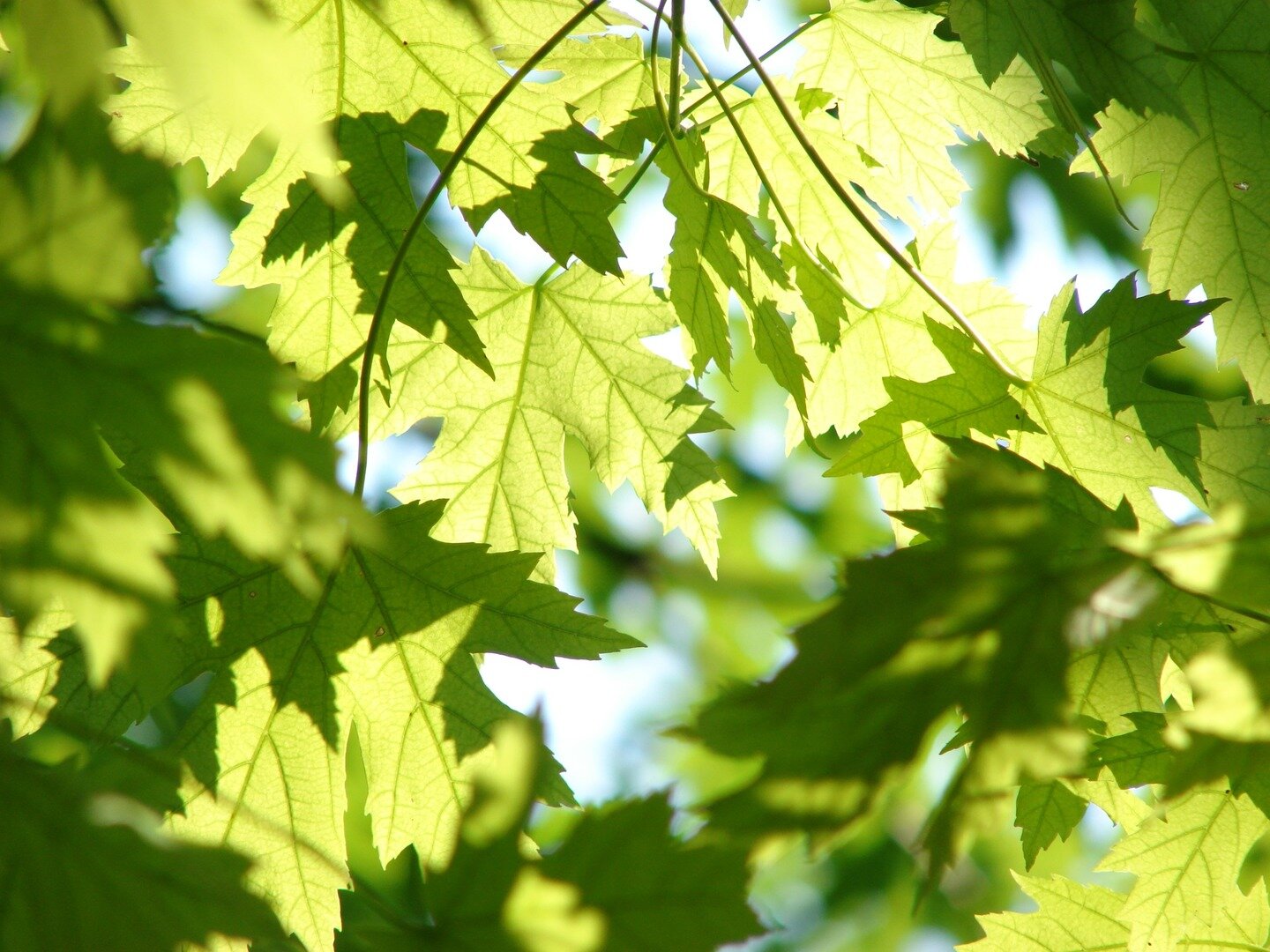
When light meets an opaque object, shadowshadowshadow, i.e. space deprived of direct access to light rays, appears directly behind it. There is no complete darkness in the shadow, because some light can get there in the result of reflection and dispersion of light in the adjacent areas.
R17kCUUJ1MQDa
Fotografia prezentuje mechanizm powstawania cienia. Na fotografii widoczne liście klonu sfotografowane od spodu. Część liści ma kolor jasnozielony. Na niektórych liściach widać ciemnozielony cień liści, które są nad nimi.
Shadows
Source: gregovish, http://pixabay.com, licencja: CC 0 1.0.
Powstawanie cienia
Observation 1
Checking how shadow is cast.
You will need
two candles,
a discretionary object, e.g. a block,
a screen, which can be a wall or a large, plain cardboard.
Instruction
Light one candle, and place it at some distance from the screen.
Place the object between the candle and the screen.
Slowly move the candle – what do you see on the screen?
Light the second candle and place it at the distance of several centimetres from the other. Observe the shadow cast by the object.
Summary
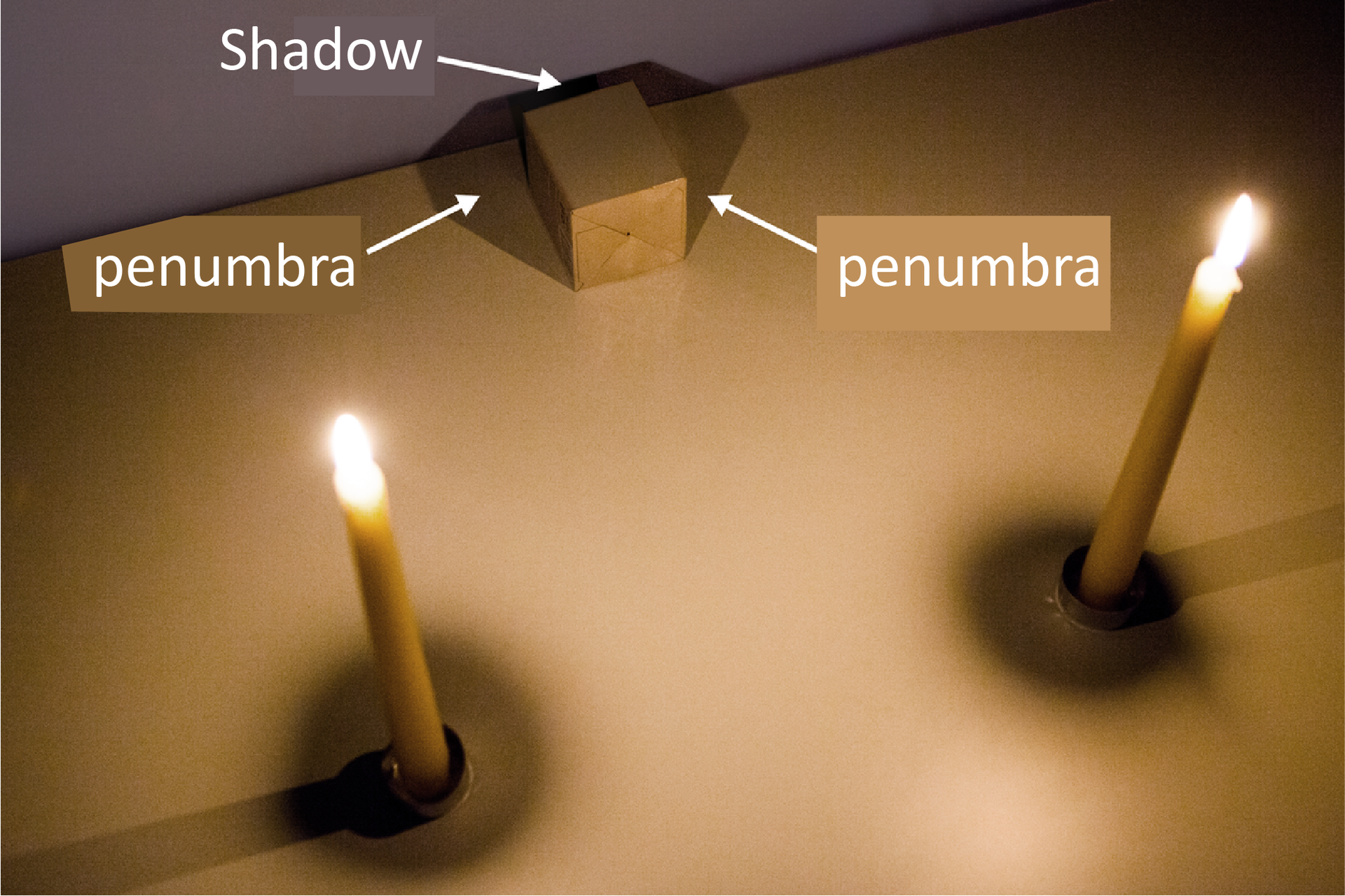
After the illumination of the object with one candle, shadow was cast on the screen, as the object covered it from the light rays. The movement of the candle causes simultaneous movement of cast shadow, as the direction, from which light comes, changes. Adding of the second candle results in casting of two shadows of the object.
R148TiShV2gPe
Fotografia przedstawia brązowy, papierowy kartonik oświetlony przez pojedynczą świeczkę. Wskazano cień.
A shadow cast by an object illuminated by one source of light
Source: Tomorrow Sp. z o.o., licencja: CC BY 3.0.
R1cUIneacdVtn
Fotografia przedstawia ten sam przedmiot, ale oświetlony z dwóch stron świeczkami. Wskazano cień i dwa półcienie.
Shadows cast by an object illuminated by two sources of light
Source: Tomorrow Sp. z o.o., licencja: CC BY 3.0.
Task 2
Observe the shadows of various opaque objects. Turn the objects around at different angles in relation to the light source and change their distance from the screen.
R12czHMJ3HIaD
Exercise 1
Ćwiczenie wskaż zjawiska, które są konsekwencją prostoliniowego rozchodzenia się światła. Możliwe odpowiedzi: 1. Solar and lunar eclipses, 2. The perception of ultraviolet radiation by some animals, 3. Thermal radiation, 4. Night on the unlit side of Earth
Ćwiczenie wskaż zjawiska, które są konsekwencją prostoliniowego rozchodzenia się światła. Możliwe odpowiedzi: 1. Solar and lunar eclipses, 2. The perception of ultraviolet radiation by some animals, 3. Thermal radiation, 4. Night on the unlit side of Earth
Point out the effects of rectilinear propagation of light.
Solar and lunar eclipses
The perception of ultraviolet radiation by some animals
Thermal radiation
Night on the unlit side of Earth
RUfdXLpzdjJd6
Exercise 2
Wybierz dowolne angielskie słówko ze słowniczka i zapytaj kolegę o jego znaczenie.
Wybierz dowolne angielskie słówko ze słowniczka i zapytaj kolegę o jego znaczenie.
Source: GroMar Sp. z o.o., licencja: CC BY-SA 3.0.
Summary
Light travels along a straight line.
Shadow is created behind opaque objects.
After hitting of an opaque obstacle, light can be reflected or dispersed.