Percentage content of a chemical element in a chemical compound is a ratio of weight of atoms of this element (expressed in units) in the smallest part of the chemical compound to the molecular weight of the compound, multiplied by 100%. A molecule is considered the smallest part of a chemical compound in case of covalent compounds, while the smallest set of repetitive ions is the smallest part in ionic compounds.
The percentage content is mass ratio of given element in total mass of a chemical element. That is why this value is sometimes called percentage mass content. If percentages of all elements present in a compound, we refer to percentage composition of the chemical compound.
Task 1
Watch presentation “How to calculate percentage composition of elements in a chemical compound”.
RnRAnoSdrvL9A
Slajd 1. Ilustracja zawiera opis: Calculation of the percentage composition of elements in a chemical compound.
Source: GroMar Sp. z o.o., licencja: CC BY-SA 3.0.
Rslp6ZSja9VL2
Slajd 2. Ilustracja zawiera opis: The percentage composition of elements in a chemical compound. Pod opisem znajduje się pozioma oś ułożona z dziesięciu kółek. Pierwsze kółko z lewej podpisano: 1.
How to calculate the percentage composition of elements in a chemical compound? Let's follow the sequence of actions on a few examples.
Source: GroMar Sp. z o.o., licencja: CC BY-SA 3.0.
R14K6LE9ymoXO
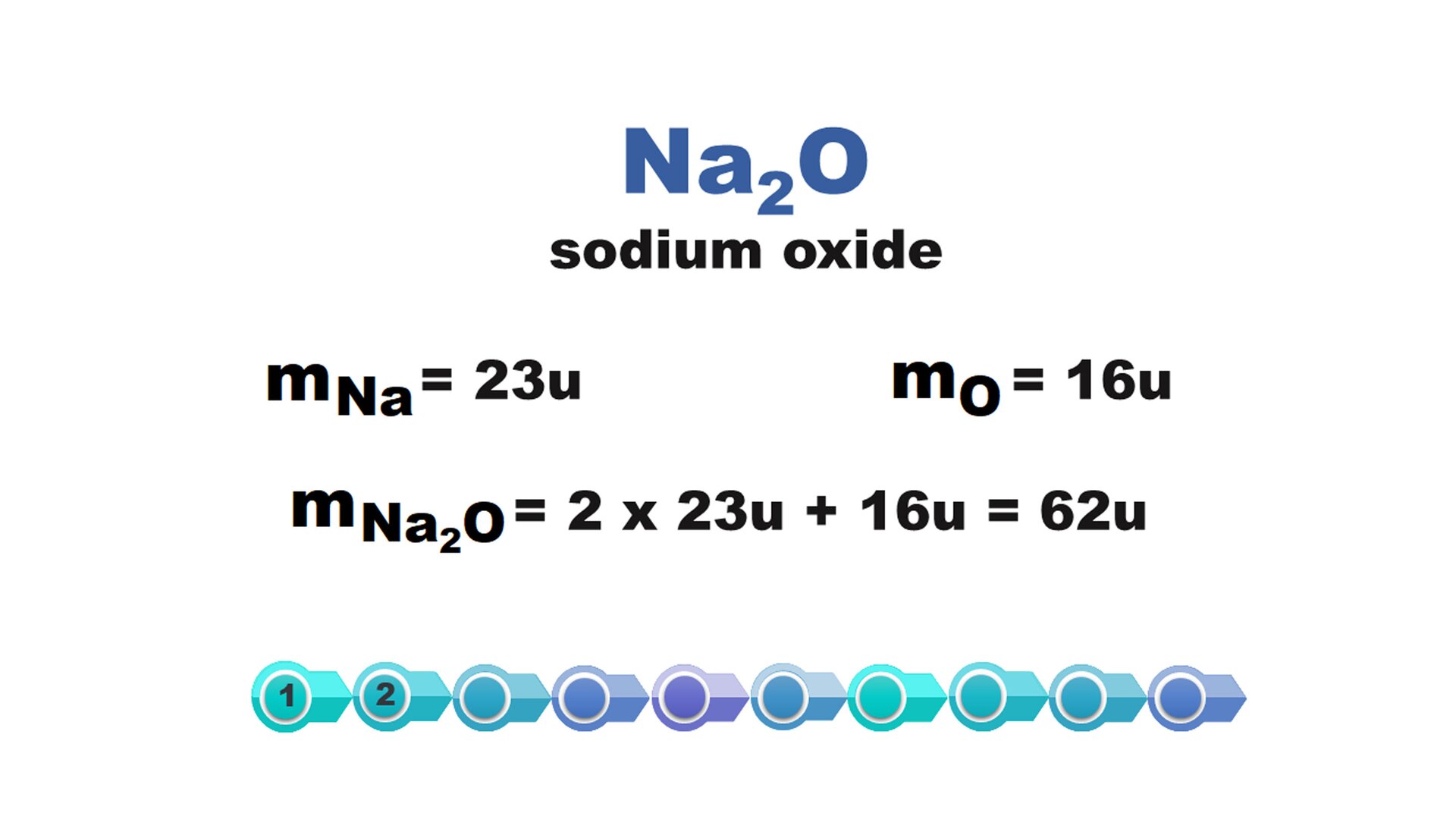
Slajd 3. Ilustracja zawiera napisy i równania. Pierwszy wers: Na2O; drugi wers: solidum oxide; trzeci wers: mNa=23u, mO=16u; czwarty wiersz: mNa2O= 2x23u+16u=62u. Pod opisem znajduje się pozioma oś ułożona z dziesięciu kółek. Kółka podpisano kolejno od lewej: 1,2.
Example 1: percentage composition of sodium oxide. We write out atomic mass of sodium and oxygen. Then we calculate the molecular weight of Na2O.
Source: licencja: CC BY-SA 3.0.
RXpVVSH9KzpcE
Slajd 4. Ilustracja zawiera równania. Pierwszy wers: mNa2O = 100%; drugi wers: mNa = X; trzeci wers: mNa2O dzielone na mNa = 100% dzielone na x; czwarty wiersz: x = mNa dzielone na mNa2O x 100% = 2 x 23u dzielone na 62u x 100% = 74,2% . Pod opisem znajduje się pozioma oś ułożona z dziesięciu kółek. Kółka podpisano kolejno od lewej: 1,2,3.
Now we are calculating the percentage composition of sodium in Na2O.
Source: licencja: CC BY-SA 3.0.
RJpnOx04cdee9
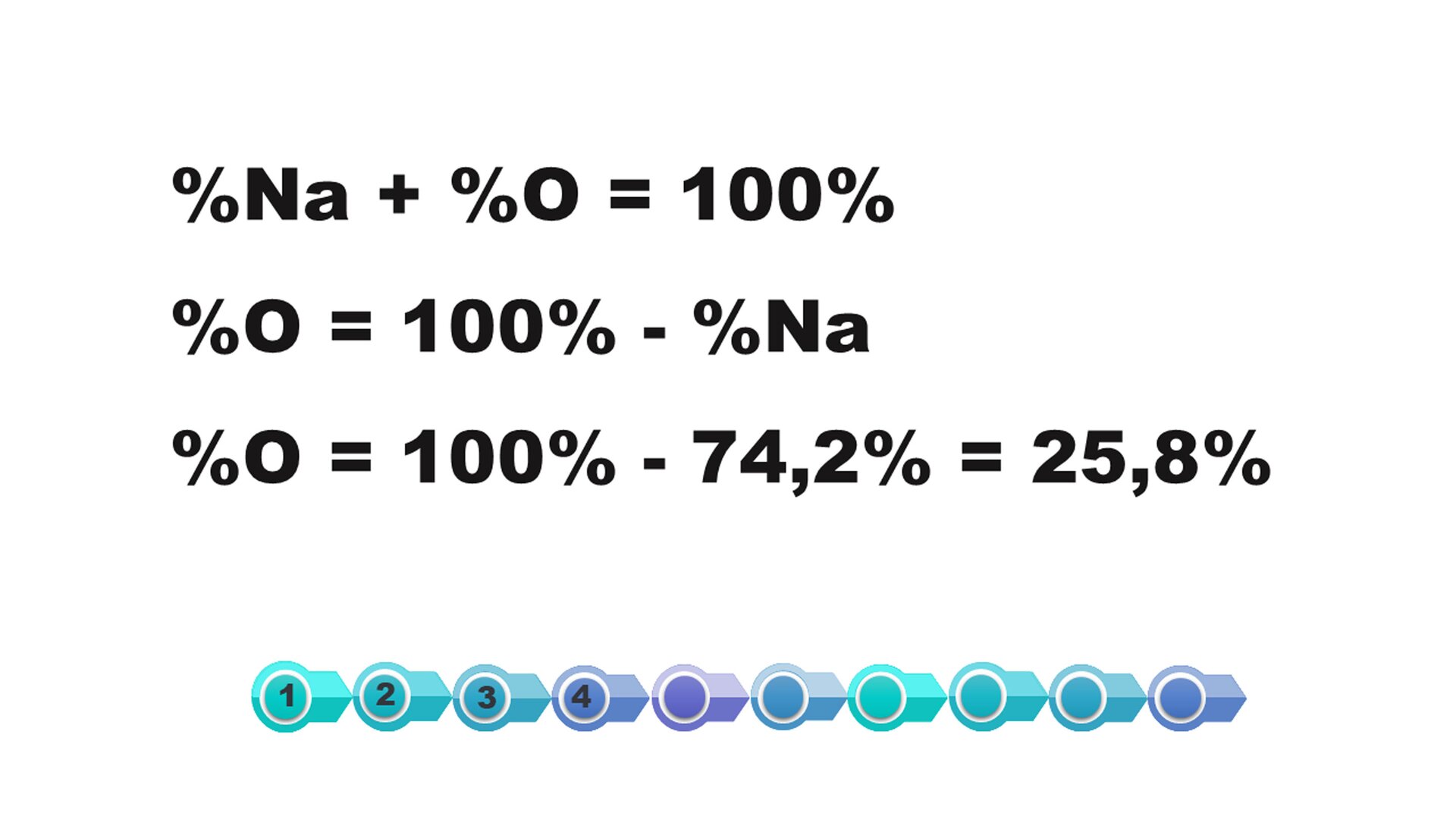
Slajd 5. Ilustracja zawiera równania. Piewszy wers: %Na +%O = 100%; drugi wers: %O = 100% - %Na; trzeci wers: %O = 100% - 74,2% = 25,8%. Pod opisem znajduje się pozioma oś ułożona z dziesięciu kółek. Kółka podpisano kolejno od lewej: 1,2,3,4.
Then we calculate the percentage composition of oxygen in Na2O.
Source: GroMar Sp. z o.o., licencja: CC BY-SA 3.0.
R1JteKmF9xK3v
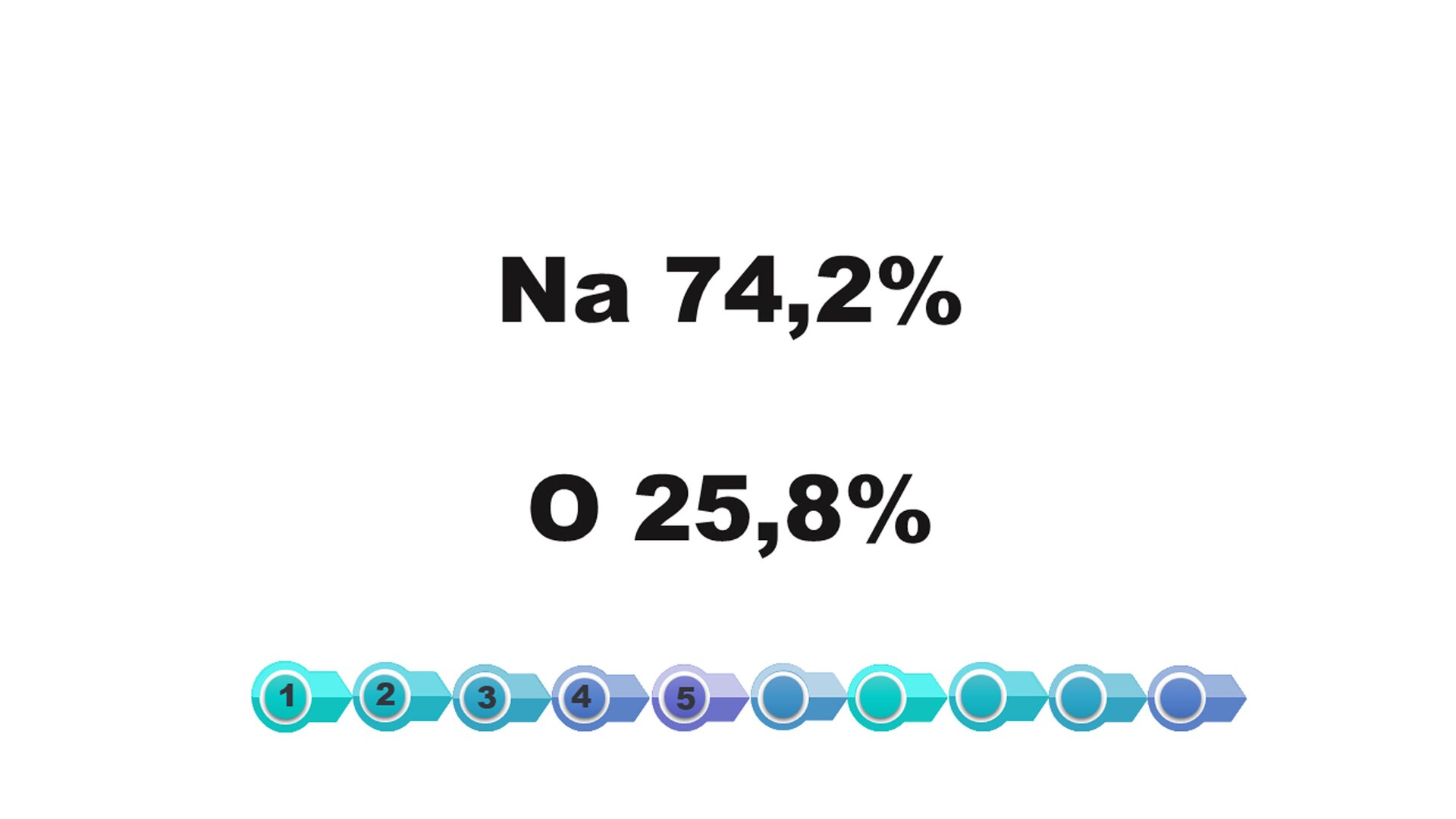
Slajd 6. Ilustracja zawiera równania. Piewszy wers: NA 74,2%; drugi wers: O 25,8%. Pod opisem znajduje się pozioma oś ułożona z dziesięciu kółek. Kółka podpisano kolejno od lewej: 1,2,3,4,5.
The percentage composition, i.e. the mass percentage of sodium in sodium oxide is 74.2% and oxygen is 25.8%.
Source: GroMar Sp. z o.o., licencja: CC BY-SA 3.0.
RjNiQd9K81bjY
Slajd 7. Ilustracja zawiera napisy irównania. Piewszy wers: H3PO4; drugi wers: phosphoric acid ; trzeci wers: mh = 1u; mP = 31u; mO = 16u; czwarty wers: mH3PO4 = 3 x 1u +31u + 4 x 16u = 98u. Pod opisem znajduje się pozioma oś ułożona z dziesięciu kółek. Kółka podpisano kolejno od lewej: 1,2,3,4,5,6.
Second example. We calculate the percentage composition of elements in phosphoric acid of the formula H3PO4. We write out the atomic mass of hydrogen, phosphorus and oxygen. Then we calculate the molecular mass of H3PO4.
Source: licencja: CC BY-SA 3.0.
RsKgJwiUjDamr
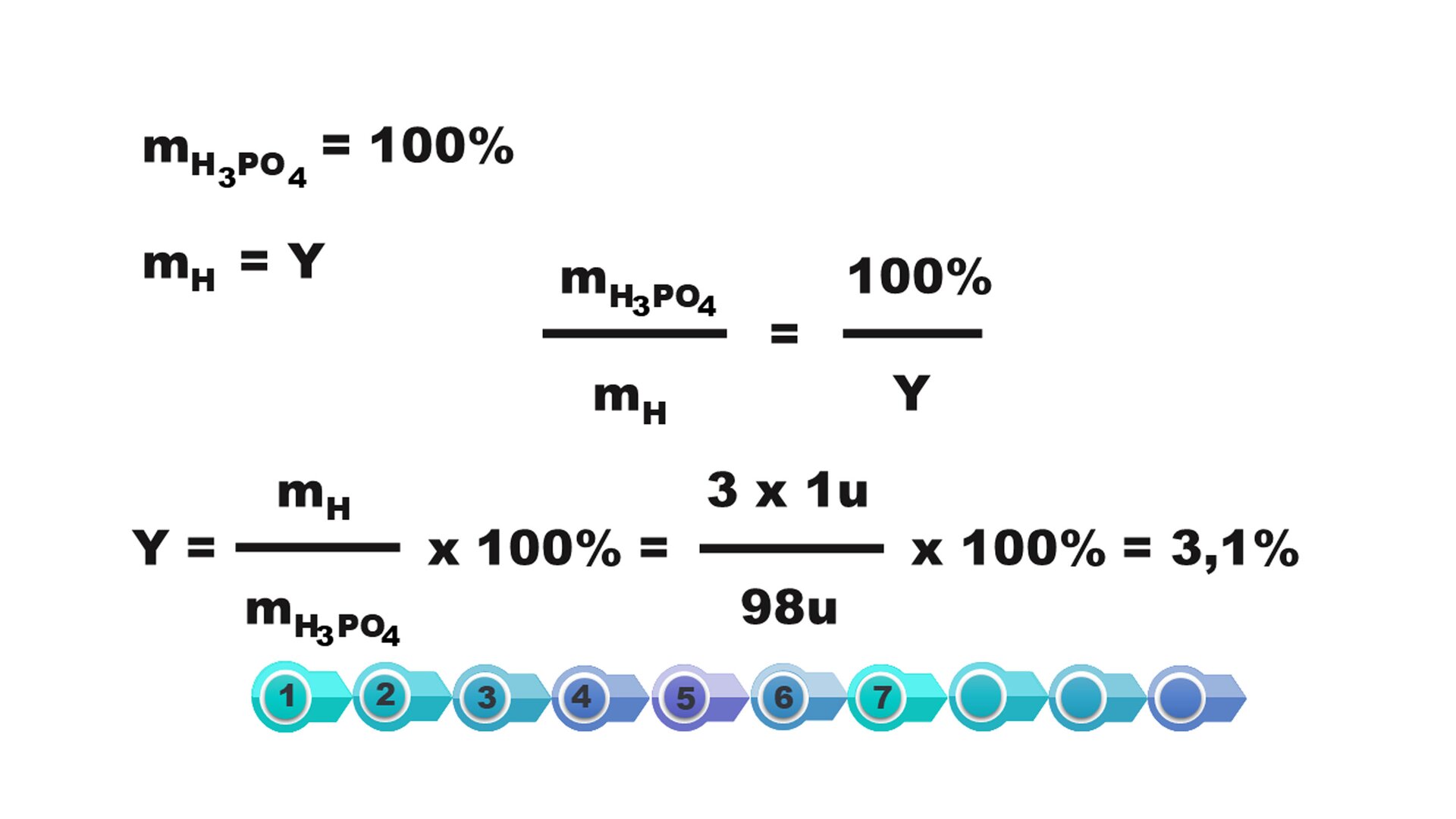
Slajd 8. Ilustracja zawiera równania. Piewszy wers: mH3PO4 = 100%; drugi wers: mH = Y ; trzeci wers: mH3PO4 dzielone na mH = 100% dzielone na Y; czwarty wers: Y= mh dzielone na mH3PO4 x 100% = 3 x 1u dzielone na 98u x 100% = 3,1%. Pod opisem znajduje się pozioma oś ułożona z dziesięciu kółek. Kółka podpisano kolejno od lewej: 1,2,3,4,5,6,7.
We calculate the percentage composition of hydrogen in H3PO4.
Source: licencja: CC BY-SA 3.0.
R1Srsl5MqIEZH
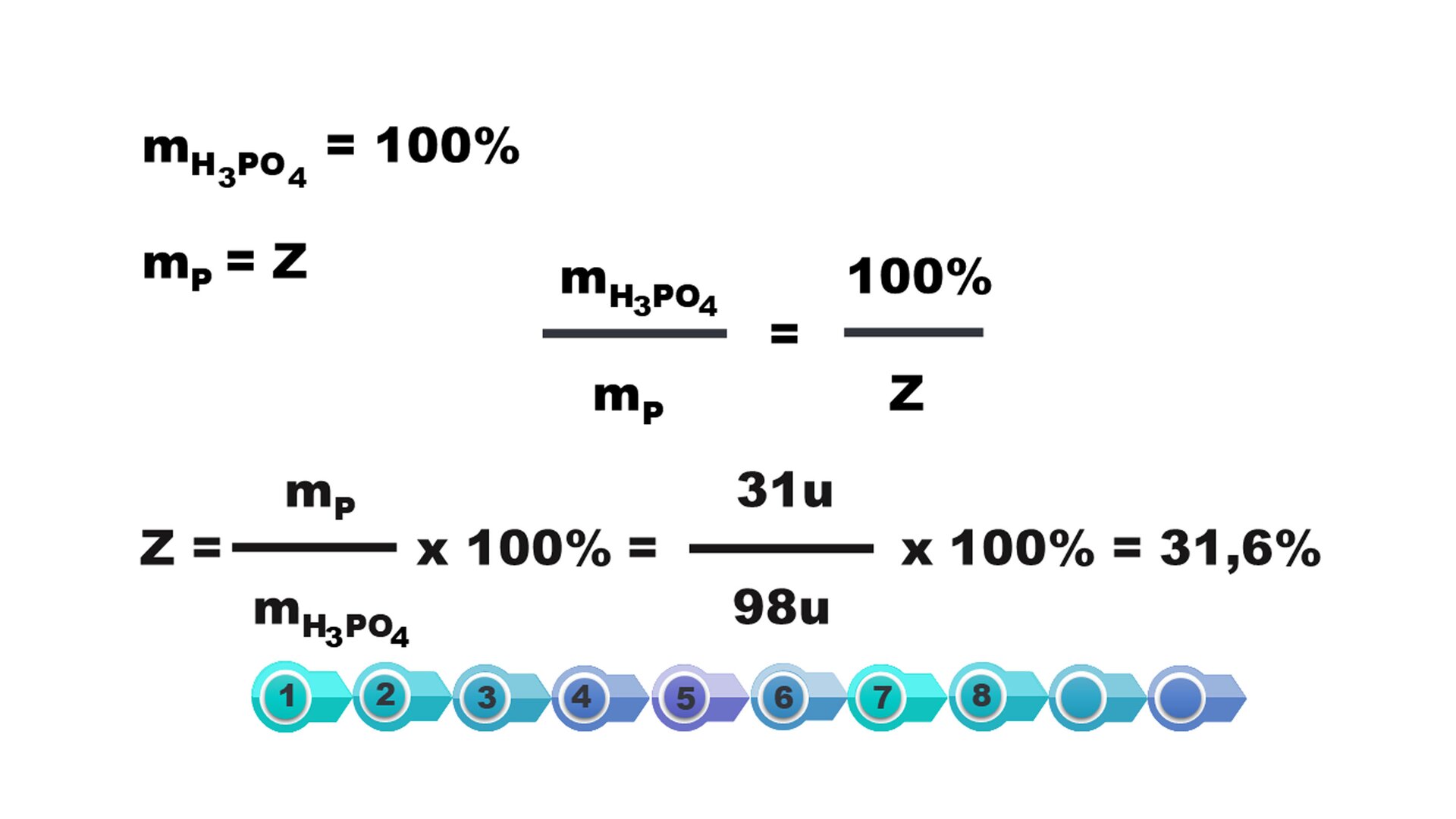
Slajd 9. Ilustracja zawiera równania. Piewszy wers: mH3PO4 = 100%; drugi wers: mH = Z ; trzeci wers: mH3PO4 dzielone na mP = 100% dzielone na Z; czwarty wers: Z= mP dzielone na mH3PO4 x 100% = 31u dzielone na 98u x 100% = 31,6%. Pod opisem znajduje się pozioma oś ułożona z dziesięciu kółek. Kółka podpisano kolejno od lewej: 1,2,3,4,5,6,7,8.
We calculate the percentage composition of phosphorus in H3PO4.
Source: licencja: CC BY-SA 3.0.
RWqd2gNI0gnLa
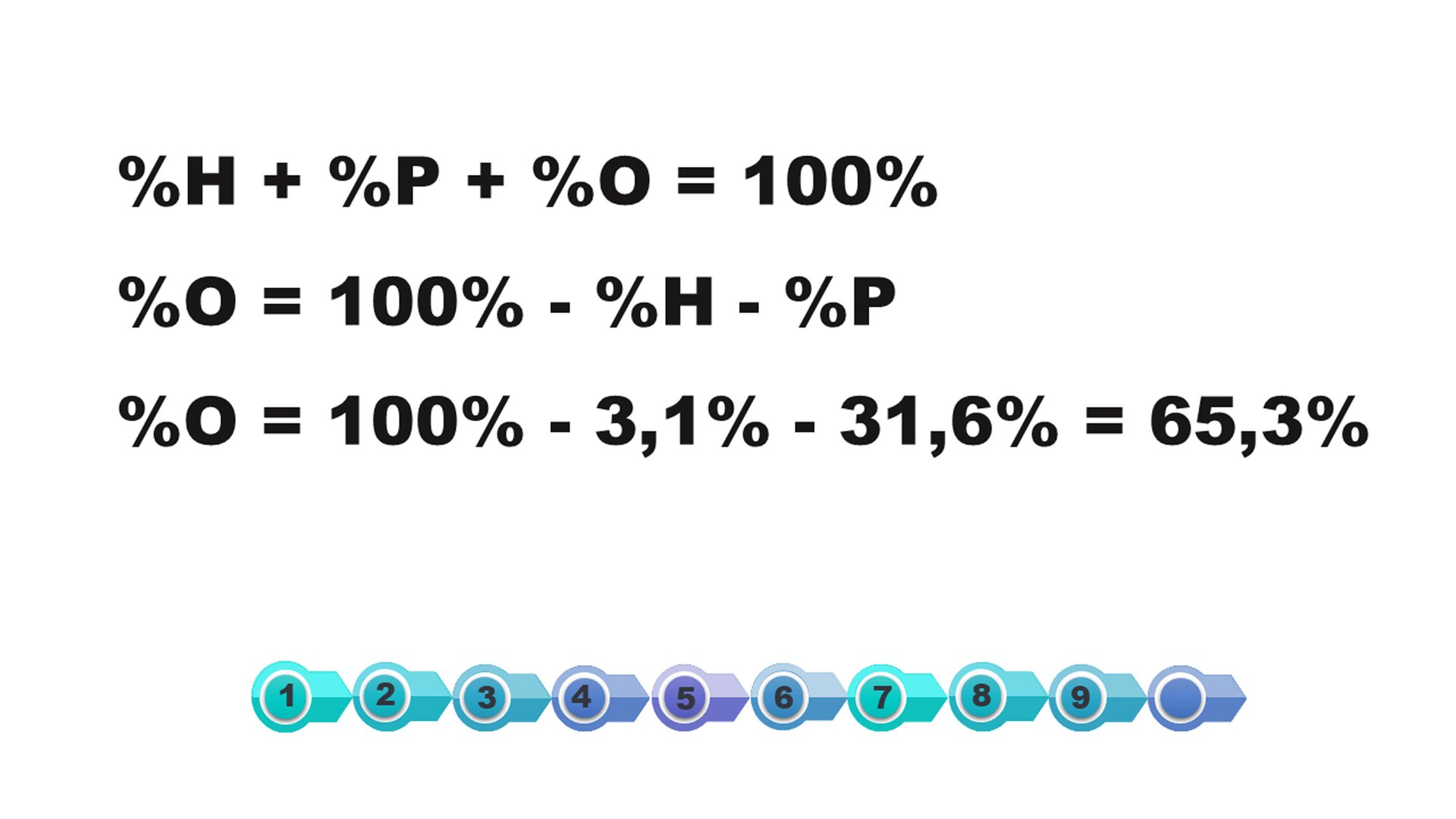
Slajd 11. Ilustracja zawiera równania. Piewszy wers: %H + %P + %O = 100%; drugi wers: %O = 100% - %H - %P ; trzeci wers: %O = 100% - 3,1% - 31,6% = 65,3%. Pod opisem znajduje się pozioma oś ułożona z dziesięciu kółek. Kółka podpisano kolejno od lewej: 1,2,3,4,5,6,7,8,9.
Finally, we calculate the percentage composition of oxygen in H3PO4.
Source: GroMar Sp. z o.o., licencja: CC BY-SA 3.0.
Rvy385Y1XRM8h
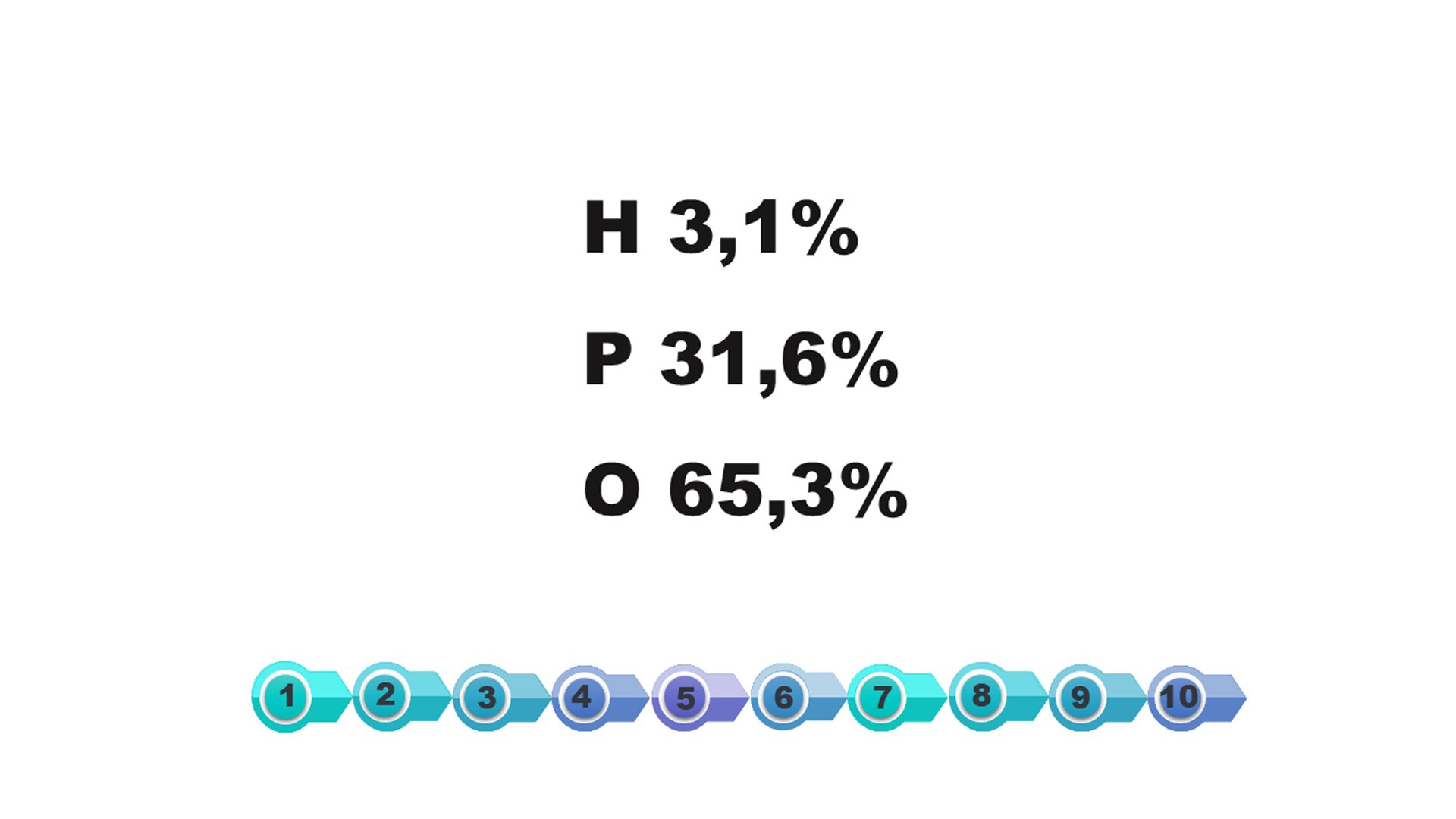
Slajd 12. Ilustracja zawiera równania. Piewszy wers: H 3,1%; drugi wers: P 31,6% ; trzeci wers: O 65,3%. Pod opisem znajduje się pozioma oś ułożona z dziesięciu kółek. Kółka podpisano kolejno od lewej: 1,2,3,4,5,6,7,8,9,10.
The percentage composition, mass percentage, of hydrogen in phosphoric acid is 3.1 %%, phosphorus 31.6% and oxygen 65.3%.
Source: GroMar Sp. z o.o., licencja: CC BY-SA 3.0.
Numerical ratio of hydrogen atoms to chlorine atoms
Molecular weight of hydrogen chloride
36.5 u
Percentage content of hydrogen
%
Percentage content of chlorine
Total percentage of hydrogen and chlorine
The total percentage of all elements in the chemical compound is always equal to 100%. This means that without knowing the percentage of one element that is part of the compound one can easily calculate this value based on percentage for other elements of given compound.
Task 2
Have a look at the table “Percentage composition of oxygen in selected chemical compounds” and analyse the examples.
Formula of a chemical compound
Name of a chemical compound
Expression for percentage content of oxygen
Percentage content of oxygen [%]
magnesium oxide
40.0
sulphur dioxide
50.0
sulphurous acid
58.5
sulphuric acid
65.3
Task 3
Calculate percentage composition (mass ratio) of chemical elements in calcium chloride if the mass ratio of calcium to chlorine in calcium chloride amounts to 4 : 7
Task 4
What is the oxygen content in magnesium oxide with the formula , if the percentage of magnesium in this compound is 60%?
Task 5
Watch presentation “Calculation of mass ratio if percentage composition of elements forming chemical compound is known”.
R15254DHD1ics
Slajd 1. Ilustracja zawierająca napis: Calculation of the mass ratio with a known percentage composition of elements forming a chemical compound
Calculation of the mass ratio with a known percentage composition of elements forming a chemical compound
Source: Gromar Sp. z o.o., licencja: CC BY-SA 3.0.
RllC4vU327Jr9
Slajd 2. Ilustracja zawierająca napis: The mass ratio of elements. Pod napisem znajduje się pozioma oś ułożona z dwóch kółek. Kółka podpisano kolejno od lewej: 1.
How to calculate the mass ratio when we know the percentage composition of elements in a chemical compound?
Source: GroMar Sp. z o.o., licencja: CC BY-SA 3.0.
R136aPRkH5Dc4
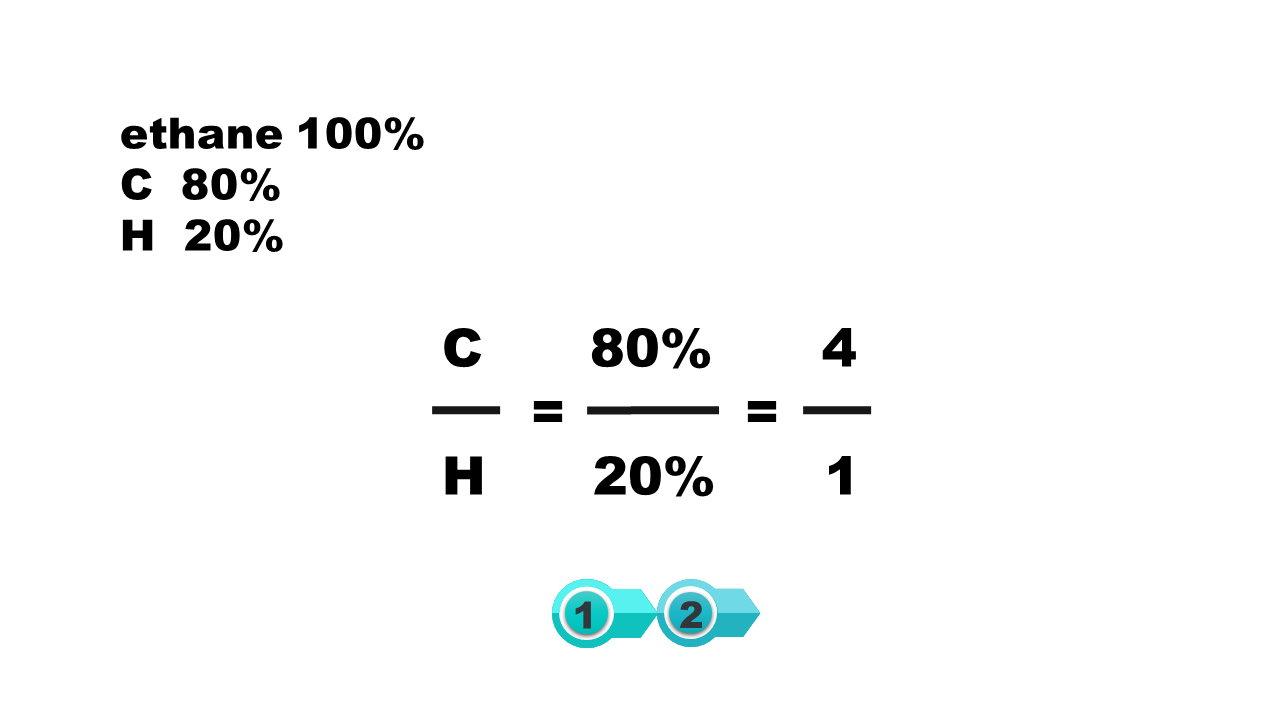
Slajd 3. Ilustracja zawiera równania. Piewszy wers: ethane 100%; drugi wers: C 80%; trzeci wers: H 20%; czwarty wers: C/H = 80%/20% = 4/1 Pod opisem znajduje się pozioma oś ułożona z dwóch kółek. Kółka podpisano kolejno od lewej: 1,2.
We calculate the mass ratio of chemical elements in ethane. Ethane is the whole, i.e. 100% of the compound, carbon is 80% of it, and hydrogen is 20%. After the calculations we have the answer: the mass ratio of carbon to hydrogen in ethane is 4 to 1.
Source: GroMar Sp. z o.o., licencja: CC BY-SA 3.0.
Percentage content of chemical elements in sulphur trioxide is as follows: Możliwe odpowiedzi: 1. 50% S and 50% O, 2. 40% S and 60% O, 3. 60% S and 40% O , 4. 86% S and 14% O
Percentage content of chemical elements in sulphur trioxide is as follows: Możliwe odpowiedzi: 1. 50% S and 50% O, 2. 40% S and 60% O, 3. 60% S and 40% O , 4. 86% S and 14% O
Percentage content of chemical elements in sulphur trioxide is as follows:
50% S and 50% O
40% S and 60% O
60% S and 40% O
86% S and 14% O
RTssmcpduOfsd
Create a multiple-choice test based on today's lesson. Then exchange your questions with a friend or classmate.
Create a multiple-choice test based on today's lesson. Then exchange your questions with a friend or classmate.
Create a multiple-choice test based on today's lesson. Then exchange your questions with a friend or classmate.
Question: ...
...
...
...
...
Summary
Mass ratio of an element in a chemical composition is called the percentage content. It can be calculated from the the mass of given element in the smallest structure of the chemical compound to the molecular weight multiplied by 100%. Molecules are the smallest elements of a covalent compound, while the smallest set of repetitive ions is the smallest part in ionic compounds.
R18Tcfx8PL0qw1
Grafika przedstawiająca tablicę szkolną, na której znajdują się zdania do dokończenia. Finish selected sentences. 1 It was easy for me (uzupełnij). 2 It was difficult for me (uzupełnij). 3 Today I learned (uzupełnij). 4 I understood that (uzupełnij). 5 It surprised me (uzupełnij). 6. Today I found out (uzupełnij). 7. I was interested in (uzupełnij). 8. I still have to repeat (uzupełnij).
Grafika przedstawiająca tablicę szkolną, na której znajdują się zdania do dokończenia. Finish selected sentences. 1 It was easy for me (uzupełnij). 2 It was difficult for me (uzupełnij). 3 Today I learned (uzupełnij). 4 I understood that (uzupełnij). 5 It surprised me (uzupełnij). 6. Today I found out (uzupełnij). 7. I was interested in (uzupełnij). 8. I still have to repeat (uzupełnij).
Source: GroMar Sp. z o.o., licencja: CC BY-SA 3.0.
zawartość procentowa pierwiastka w związku chemicznym – udział masowy danego pierwiastka w związku chemicznym; stosunek masy atomów pierwiastka w najmniejszej strukturze związku chemicznego do masy cząsteczkowej związku pomnożony przez 100%; za najmniejszą część związku chemicznego uważa się cząsteczkę (w przypadku związków kowalencyjnych) bądź najmniejszy zbiór powtarzających się jonów (w związku o budowie jonowej