How to influence the decisions of the authorities?
In a democracy, the involvement of citizens in the social and political life of the country is very important.
When you get involved and act instead ofinstead of complaining you can actually change the reality around you.
You will find out about ways to finance projects you would like to be implemented in your surroundings.
You will find out about ways to change the law.
You will understand the importance of citizen participation in the decision making process in budget planning as well as the possibility for the citizens to influence the law‑making process.
You will be able to start an action to gain support for a cause important to you and your community.
The democratic system creates a number of possibilities to influence the decisions of the authorities. Here are some examples:
Solecki fund (village fund)
Since 2014 the authorities of rural communitiesrural communities can allocate part of their budget to create a special fund. The residents of the community make the decision on how this fund will be spent by voting on various projects (also submitted by those residents) – they can build a playground for children, a bus sheltera bus shelter or plant bushes and flowers. You can find more information on the internet.
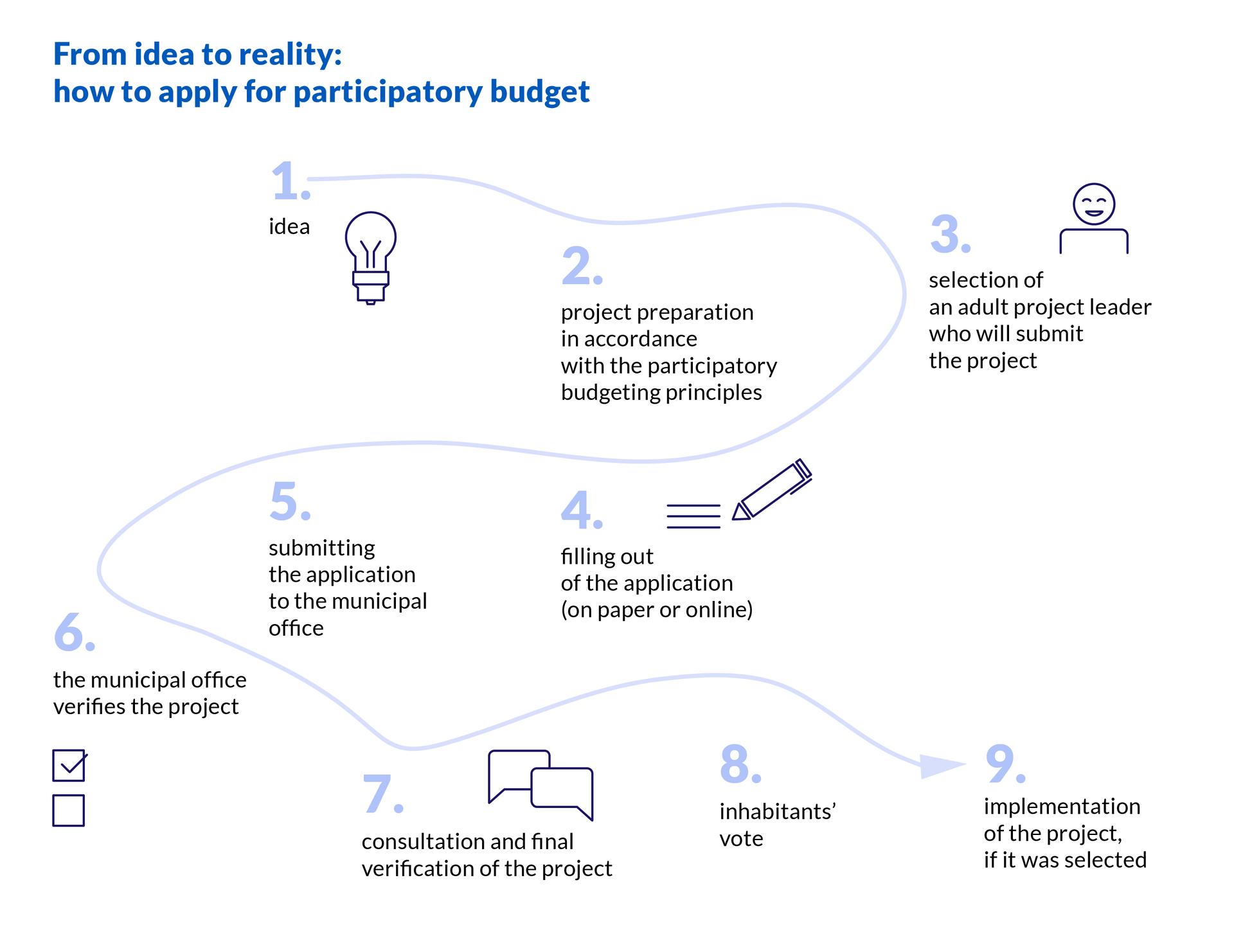
Participatory budget
For several years now, in many cities in Poland, the inhabitants can decide how to allocate part of a municipal budgeta municipal budget. Participatory budgeting allows the inhabitants to identify, discuss, and prioritiseprioritise public spending projects, and gives them the power to make real decisions by voting about how money is spent. You can find more information on the internet.
Citizens’ initiative
According to the Constitution of the Republic of Poland a group of at least 100 000 citizens having the right to vote in elections to the Sejm has the right to introduce legislation. The introduced project, however, may not concern a draft budget, nor any changes to the Constitution. You can find more information on the Sejm website.
The European Citizens’ Initiative
Since April 1, 2012, EU citizens can submit their initiatives to the European Commission. The condition is to gain the support of at least one million European citizens from seven different EU member states within 12 months. The number of votes has to be certifiedcertified by national offices, and then the European Commission analyzes the initiative, and decides what to do next: draw up a legislative proposaldraw up a legislative proposal, conduct an additional study or take no action. Eventually, the European Citizens’ Initiative can result in new EU directives, strategies or regulations. The first ECI was the proposal “Right2Water – water is a human right”, which aims at guaranteeing water and sanitation for all in Europe. You can find more information on the internet).
Referendum
A referendum is a direct vote in which an entireentire electorate has the opportunity to decide on a particular proposal. There may be a local referendum (concerning, for example, the construction of a landfilllandfill or a sewage treatment plantsewage treatment plant) or a nationwide referendum (concerning for example changes to the Constitution). There were five nationwidenationwide referendums in the history of the Third Republic of Poland so farso far. The highest turnout – 58,85% – was noted at the referendum on the Polish accession to the European Union in June 2003.
In democratic states, citizens have many ways to express their opinions. They can organise demonstrations, work‑to‑rule actions, write letters of protest and petitions or start a blog to gain support for their cause.
How many citizens have to sign a bill to present it to the Sejm as a citizens’ initiative?
- 100 000
- 250 000
- 1 000 000
How many European citizens have to sign a bill to present it to the European Commission as a citizens’ initiative?
- 1 000 000 citizens from seven UE member states
- 100 000 citizens from seven UE member states
- 1 000 000 citizens from all UE member states
- 100 000 citizens from all UE member states
Listen to the abstract recording to review the material and new vocabulary. Then do the vocabulary exercise. Match the pairs: English and Polish words.
strajk włoski, uszeregować pod względem ważności, sporządzić wniosek ustawodawczy, elektorat (głosujący, uprawnieni do głosowania), narzekać, przeprowadzić dodatkowe badanie, gmina wiejska, budżet miejski
| to complain | |
| rural community | |
| a municipal budget | |
| to prioritise | |
| to draw up a legislative proposal | |
| to conduct an additional study | |
| electorate | |
| work-to-rule action |
Keywords
solecki fund, participatory budget, citizens’ initiative, European Citizens’ Initiative, local/nationwide referendum, electorateelectorate, demonstration, work‑to‑rule actionwork‑to‑rule action, letter of protest, petition
Glossary
zamiast
narzekać
gmina wiejska
wiata przystankowa
budżet miejski
uszeregować pod względem ważności
potwierdzone
sporządzić wniosek ustawodawczy
przeprowadzić dodatkowe badanie
cały
elektorat (głosujący, uprawnieni do głosowania)
wysypisko śmieci
oczyszczalnia ścieków
ogólnokrajowe
dotychczas
strajk włoski