Ilustracja interaktywna
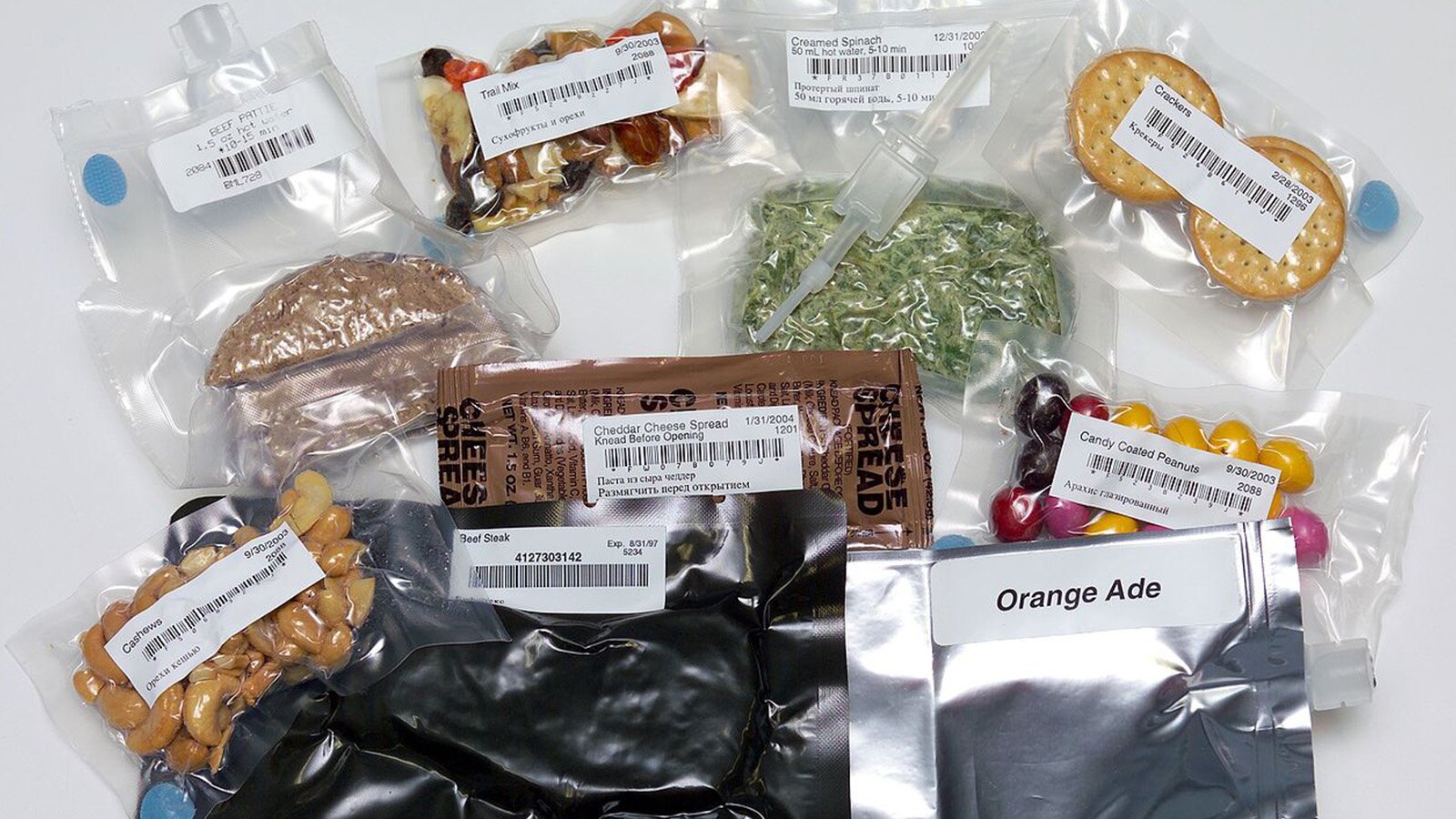
In this section you are going to learn more facts about food available on board the ISS and tools and procedures connected to it. If you also want to know something about the history of these things, have a look at the multimedium picture below and discover some fascinating information!
W tej sekcji dowiesz się kolejnych faktów na temat posiłków dostępnych na pokładzie Międzynarodowej Stacji Kosmicznej oraz narzędzi i procedur z nimi związanych. Jeśli chcesz dowiedzieć się także czegoś o historii tych rzeczy, przejdź do ilustracji interaktywnej i odkryj fascynujące informacje!
Study the transcripts of the recordings and choose the correct words. More than one answer is correct.
Study the recordings below and choose the correct pictures. You may have to select more than one picture in this exercise.
Analyse the interactive illustration and do the exercises below.
Zasób interaktywny dostępny pod adresem https://zpe.gov.pl/a/DyJrrKgzH
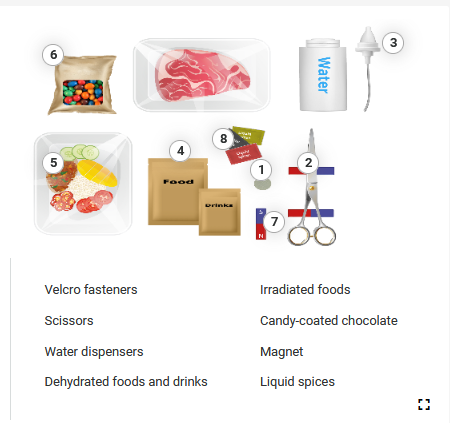
Grafika przedstawia osiem przedmiotów ułożonych na białym tle, do których przypisane są treści oznaczone kolejnymi numerami od 1 do 8. W górnej części, od lewej strony widoczne jest opakowanie z kolorowymi drażami - z przypisanym numerem 6. Na prawo widoczny jest stek na białej plastikowej tace, przykryty przeźroczystą folią. Na prawo widoczny jest cylindryczny, biały pojemnik z napisem z niebieskich liter w języku angielskim Water, obok którego znajduje się korek z rurką - z przypisanym numerem 3. Poniżej, od lewej, widoczna jest biała prostokątna tacka, na której widoczne są plastry pomidora, ogórka, papryki, kupka ryżu, żółte warzywo, galaretka - z przypisanym numerem 5. Na prawo widoczne są dwie prostokątne, brązowe torebki zamykane na zip, na większej widoczny jest napis z czarnych liter w języku angielskim Food, na mniejszej - Drinks - z przypisanym numerem 4. Powyżej, na prawo, widoczne są trzy prostokąty symbolizujące małe opakowania, w kolorze czarnym, czerwonym i zielonym z napisami z białych liter w języku angielskim: Liquid spices - z przypisanym numerem 8. Poniżej szary owal - z przypisanym numerem 1. Poniżej prostokąt podzielony na połowę, z której dolna jest czerwona z białą literą N, a górna niebieska z białą literą S - z przypisanym numerem 7. Na prawo widoczne są duże metalowe nożyczki - z przypisanym numerem 2.
Do poszczególnych numerów zostały przypisane następujące treści w języku angielskim.
Numer 1 – Velcro fasteners are one of the most important items that make astronauts’ lives easier during a space mission. As far as eating is concerned, they are used to attach packaged food for the convenience of astronauts. They are also used for all equipment, checklists, and astronauts’ suits, as well as the interior of the spacecraft itself.
Numer 2 – Even though they may have many other practical uses during a flight, the key role of surgical scissors is to open plastic food pouches. Each astronaut has their own pair of scissors, kept in a dedicated pocket that is strapped on top of the legs of their pressure suits.
Numer 3 - Water dispensers are used to rehydrate crewmember food and drinking packages. Presently, the ISS provides hot and ambient temperature potable water to US food and beverage packages.
Numer 4 - Most of the products on the menu of ISS are dehydrated foods and drinks. Removing the water from the food or drink makes it difficult for bacteria to multiply, so it reduces the chances of spoilage. It also dramatically extends the shelf life of the product. Dehydrated products have water returned to them when astronauts are ready to eat them.
Numer 5 - Irradiated foods – meat and dairy produce – have ionising radiation applied to them before packaging. This procedure reduces the risk of microbial contamination and extends the products’ shelf life.
Numer 6 - Some of the food astronauts eat can be bought in a grocery shop – including chocolate‑coated candies, although they are carefully repackaged into vacuum‑sealed pouches. They are one of the few items that can be eaten without any special preparation or food processing. Since the inside of this candy is encased in a hard sugar coat, it prevents melting and makes it heat‑resistant and easy to transport, which are perfect qualities for space travel. It is unclear if astronauts love this snack so much because it is covered in chocolate or because they love playing with these candy‑coated peanuts in a microgravity atmosphere!
Numer 7 - In space you can’t just leave something on the table and walk away, because things float in the air. Magnets are used to attach things like cutlery or hold a tray down so that it doesn’t float away.
Numer 8 - Standard ground spices are not allowed on the ISS for the same reasons as bread isn’t: imagine them flying in the air, getting into air vents, or – even worse – into your eyes or nose! It could also contaminate the sophisticated equipment. The solution is to package seasonings in liquid form.
- Which of these things does not use Velcro fasteners?
a) space suit
b) trays
c) walls of the Space Station
d) outer surface of the ISS
- Which sentence is the fact that you could learn from the material in this multi-medium?
a) A lot of astronauts lose their scissors.
b) Astronauts can keep items of their space equipment.
c) There are spare scissors on board the ISS.
d) Astronauts must sell their equipment when the mission is over.
- The temperature of water provided by the ISS is
a) hot and room temperature.
b) hot and cold.
c) cold only.
d) room temperature.
- Which feature is shared by dehydrated and irradiated foods?
a) They have no bacteria.
b) They can be safe for consumption for a long time.
c) They are liked by astronauts.
d) They are reconstituted when ready to be eaten.
- Which fact about the candy-coated chocolates was not mentioned?
a) They are used as entertainment by astronauts.
b) They are a beloved snack.
c) They can be personalised.
d) Their shell prevents them from melting.
Astronauts’ favourite type of 1. 1. fasteners, 2. Velcro, 3. hooks, 4. biomimicry, 5. loops, 6. burdock burrs, 7. attached was invented by a Swiss engineer, who, after a walk in the mountains, noticed that tiny 2. 1. fasteners, 2. Velcro, 3. hooks, 4. biomimicry, 5. loops, 6. burdock burrs, 7. attached were stuck on his pants and in his dog’s fur. He wondered how it was possible that they 3. 1. fasteners, 2. Velcro, 3. hooks, 4. biomimicry, 5. loops, 6. burdock burrs, 7. attached to hair and fabric. With the help of the microscope he observed the 4. 1. fasteners, 2. Velcro, 3. hooks, 4. biomimicry, 5. loops, 6. burdock burrs, 7. attached engaging the 5. 1. fasteners, 2. Velcro, 3. hooks, 4. biomimicry, 5. loops, 6. burdock burrs, 7. attached in the fabric of his pants. That gave him an idea for a new invention. After years of research and lots of experimenting, he finally managed to duplicate mother nature. Such a process in science is known as a 6. 1. fasteners, 2. Velcro, 3. hooks, 4. biomimicry, 5. loops, 6. burdock burrs, 7. attached, because nature is copied and imitated by a scientific solution. The result of the engineer’s work was the origin of 7. 1. fasteners, 2. Velcro, 3. hooks, 4. biomimicry, 5. loops, 6. burdock burrs, 7. attached, from the French words for velvet (“velour”) and hook (“crochet”).