Przeczytaj
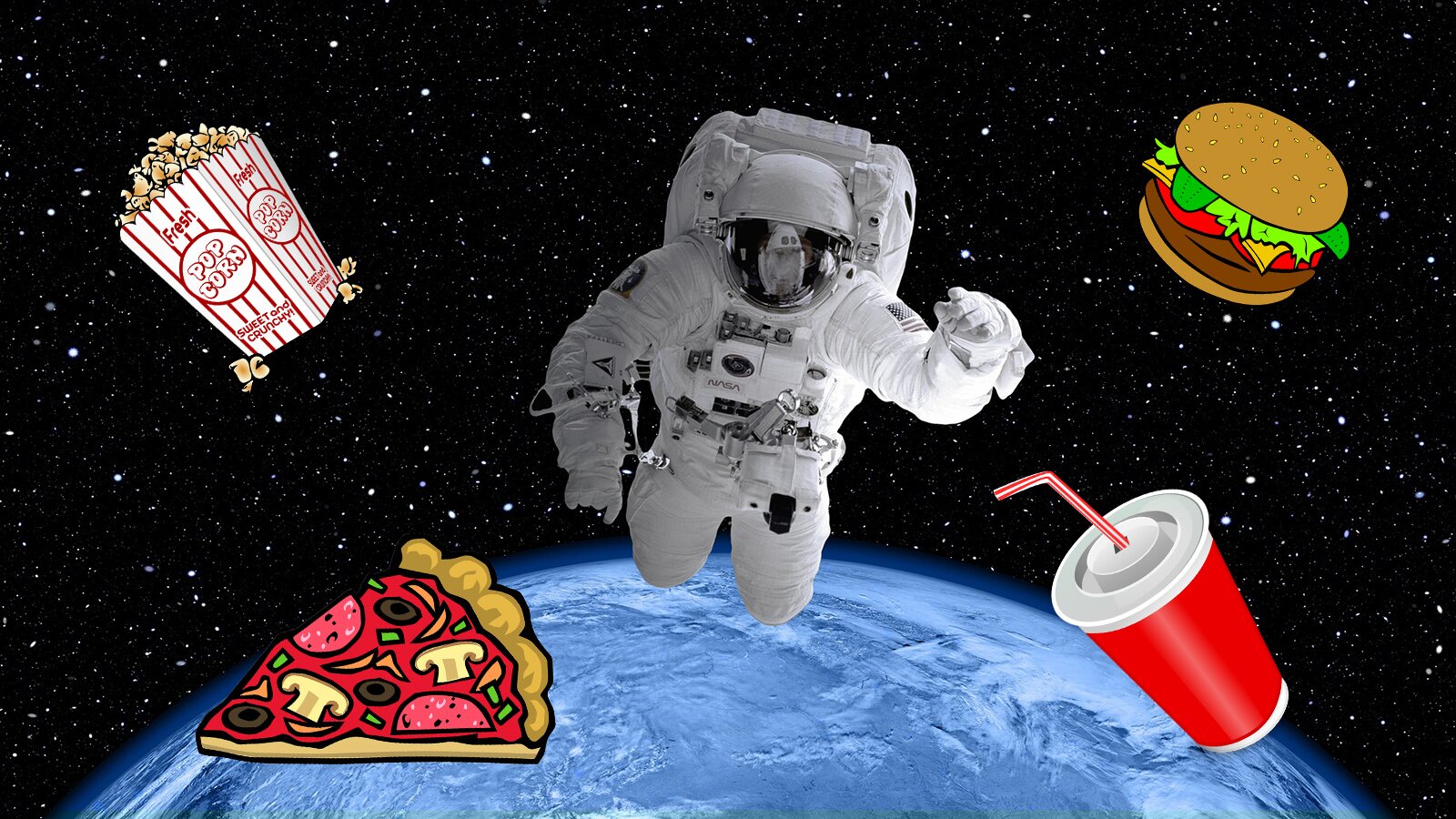
The picture below shows an astronaut in space. The food floating around him is the food the space crew can eat while on a mission. In this section you are going to read a text introducing you to space food and the processes it undergoes before it is taken into space. Do you think it tastes the same as “earth” food? Read the text and find out.
Poniższe zdjęcie pokazuje astronautę w kosmosie. Potrawy wokół niego to posiłki, które załoga statku kosmicznego może jeść w trakcie misji. W tej sekcji przeczytasz tekst przedstawiający kosmiczne dania i procesy, jakie one przechodzą zanim zostaną zabrane w kosmos. Czy sądzisz, że smakują tak jak „ziemskie” posiłki? Dowiedz się, czytając poniższy tekst.
Match the following words with their translation.
Read the text and do the exercises below.
On the Menu in OrbitDining in orbit takes culinary art to new heights and well above the Earth's standards! Astronauts today are able to eat a variety of food of different tastes and texturestextures that will not only satisfy their hunger, but also please their taste budstaste buds. They enjoy warm pouchespouches of savourysavoury shrimp cocktail and fruit punches. If they feel like having a steaming mug of coffee, they can have it, only that it will be in a specially designed microgravity coffee cup. However, it didn’t used to be like that. Mercury, Gemini and Apollo crews squeezedsqueezed their meals from tubes and poppedpopped freeze‑dried snacksfreeze‑dried snacks. For example, John H. Glenn Jr, who was the first American to orbit Earth in 1962, sucked on some apple sauce from a small roll‑up toothpaste‑like tube, which looked awkward and was quite difficult to use. Nowadays, technological advancementstechnological advancements in food packaging, preservationpreservation, preparation and nutritionnutrition have made space food much more ready to meet the challenges of space.
In order to be allowed into orbit, food must meet certain criteria. First of all, it must be compact and lightweightlightweight, as there is limited space on board the International Space Station (ISS)International Space Station (ISS) and sending food there is extremely expensive. Long missions require space food to have a long shelf lifelong shelf life, so most food must be pasteurisedpasteurised or processedprocessed. Since it should provide astronauts with enough energy and contribute to their healthy diet, it must also be highly nutritious. With a lower amount of gravitygravity, food floatsfloats in the air, so the final requirement is that it is wet or sticky, so that it holds together better without bits and crumbs floating off.
To facilitatefacilitate the process of eating for astronauts, there is a fixed ISS menu. It consists of three meals and one snack a day and was designed to ensure the astronauts get between 1,900 and 3,200 calories per day, depending on their weight, gender and special needs. Most meals on ISS have been selected and packaged so as to make sure they last for the whole mission and avoid their contamination or spoilage. A small sticker indicating the expiry dateexpiry date is on each food item. There are six categories of food consumed in space: 1) fresh, such as fruit or vegetables, delivered periodically to the ISS by a cargo vessel, 2) natural, such as nuts or tortillas, 3) dried, such as beef and fruit, 4) irradiatedirradiated, such as chicken breast and smoked turkey that is subjected to ionising radiation to kill certain microorganisms, 5) rehydratablerehydratable, so when adding water returns the food to its original, edibleedible form (for example juices and beveragesbeverages or spinach), and 6) thermostabilisedthermostabilised, that is heat‑treatedheat‑treated food, such as tuna salads of vanilla flan.
Eating in space is not a piece of cake. To prevent food from floating away at meal time, packaging usually has Velcro fastenersVelcro fasteners so it can be attachedattached to a tray or a table. Tape, clips, tetherstethers and magnets are also used to affixaffix food to different surfaces. Astronauts fasten their trays to their laps so they can enjoy a meal while sitting. Additionally, there is one extra utensilutensil we don’t usually use during a meal time on Earth: scissors. They are really essential for opening vacuum‑sealedvacuum‑sealed bags and pouches in which space food is packaged. Drinking rehydrated beverages from a pouch, in turn, requires specially adapted straws or nozzlesnozzles to prevent the liquid from floating out of them. CondimentsCondiments such as ketchup, mustard or mayonnaise are provided. Seasonings, such as salt or pepper, must be in liquid form, so they don’t accidentally get into an astronaut’s eye, mouth,or nose.
You might wonder if food in orbit tastes the same as on Earth. Well, yes and no! When floating in a microgravity environment, bodily fluids tend to rise to fill the head and sinusessinuses, causing a sensation similar to that of having a cold. When we have a stuffy nose or sinuses, we often don’t smell the food we eat, and that is what also happens to astronauts: because smell is a big part of taste, they miss out on a lot of the food’s flavours and the food seems to taste different or rather blandbland. Even though after a few days the situation slightly improves, astronauts have perpetually stuffy noses. No wonder then that they often prefer foods with intense flavors, particularly sweet, salty, bitter or spicy.
Materials and food packaging techniques which are used to protect space food have led to many innovations in food preparation here on Earth. For instance, we can enjoy freeze‑dried foods that are reconstitutedreconstituted by adding water, or buy a new generation of compact ovens which can operate quickly and efficiently and fit into small spaces. Space technology has also helped to develop shelf‑stable foods specifically designed for housebound senior adults and has improved hospital food preparation. It is safe to say then that NASA’s search for ways to improve and innovate the procedures of food preparation and food safety is going to give us many more solutions to our earthly problems in the future.
Źródło: Agnieszka Sękiewicz‑Magoń, licencja: CC BY-SA 3.0.
a) looks like toothpaste.
b) is more varied than in the past.
c) tastes the same as in the past.
d) is served in cups.
2. Before being taken onto the ISS, most of the food
a) must be tasted.
b) must be put in water so it is wet.
c) must be put on a long shelf.
d) must go through some preparation processes.
3. Based on the text, which information is true?
a) There are six types of food preparation processes.
b) Space meals may have different caloric values.
c) All meals have long expiry dates.
d) All types of food are in a changed form from the original.
4. Which item cannot be used by an astronaut during a meal in orbit?
a) tray
b) spoon
c) scissors
d) ground pepper
5. What do we learn about how food tastes in space?
a) The food has a stronger flavor.
b) You will not feel the taste of food.
c) Your sense of taste may change temporarily.
d) The food is tasteless.
6. What is the main idea of the last paragraph?
a) To show that space food science can benefit not only astronauts.
b) To make the reader more interested in food.
c) To predict the future of space food.
d) To present interesting space food innovations.
Study the text again and answer the questions. Write no more than two sentences.
What has changed about space food since the first missions?
Which criteria must be met to make space food safe for consumption?
How does eating food in space differ from how we do it on Earth?
Why does the text mention having a cold?
What is the connection between space food and some commercial products?
Słownik
/ əˈfɪks /
przyczepić, przymocować (to add to a word or root a letter or letters to create a new word or change its meaning or function)
/ ə pi:s əv keɪk /
łatwizna, drobiazg (potocznie) (An idiomatic expression meaning something is very easy or effortless)
/ əˈtætʃt / / əˈtætʃ /
przytwierdzone, przymocowane [przytwierdzić, przymocować] (to connect or fasten one object to another)
/ ˈbevərɪdʒɪz / / ˈbevərɪdʒ /
napoje [napój] (drinks or liquid refreshments)
/ ˌbʌɪə(ʊ)ˈmɪmɪkri /
inżynieria bioniczna (the practice of imitating or taking inspiration from natural biological processes, systems, or structures in the design and creation of human‑made products or solutions)
/ blænd /
mdły/mdła (adj.), mdło, nijako (adv.) (lacking strong or distinctive flavour or character)
/ ˈbɒdəli ˈfluːɪdz / / ˈbɒdəli ˈfluːɪd /
płyny ustrojowe [płyn ustrojowy] (liquids produced by the human body, such as blood, saliva, or urine)
/ klɪps / / klɪp /
zaciski, zatrzaski [zacisk, zatrzask] (small devices used to hold or secure objects together)
/ ˈkɒndɪmənts / / ˈkɒndɪmənt /
przyprawy [przyprawa] (substances added to food to enhance its flavour, such as sauces or spices)
/ kənˌtæmɪˈneɪʃn̩ /
zanieczyszczenie, skażenie (the presence of harmful or impure substances in something)
/ ˈedɪbl̩ /
jadalny/jadalna (suitable or safe for consumption as food.)
/ ɪkˈspaɪəri deɪt /
data przydatności do spożycia (the date after which a product is no longer considered safe or effective to use)
/ fəˈsɪlɪteɪt /
ułatwić (to make an action or process easier or smoother)
/ flæn /
tarta (a dessert consisting of a sweet or savoury custard filling with a caramelised sugar top)
/ fləʊts / / fləʊt /
dryfuje, unosi się [dryfować, unosić się] (to rest or move on the surface of a liquid without sinking)
/ friːz draɪd snæks / / friːz draɪd snæk /
liofilizowane przekąski [liofilizowana przekąska] (snacks that have been dehydrated by freezing and then subjected to a vacuum to remove moisture)
/ ˈɡrævɪti /
grawitacja (the force that attracts objects toward the centre of the Earth or any other physical body)
/ hi:t ˈtriːtɪd /
poddany/poddana obróbce termicznej (subjected to a specific temperature or heating process for a particular purpose, such as sterilisation or cooking)
/ hʊk ənd luːp /
haczyk i pętelka (a fastening system consisting of two components: hooks on one side and loops on the other, which interlock when pressed together)
/ ˈhaʊsbaʊnd /
nieopuszczający domu/nieopuszczająca domu (unable to leave one's home due to physical or medical restrictions)
/ ˌɪntəˈnæʃn̩əl speɪs steɪʃn / / 'aieses /
Międzynarodowa Stacja Kosmiczna (a habitable space station that serves as a laboratory and living space for astronauts in space)
/ ˈaɪənaɪzɪŋ /
jonizujący/jonizująca (generating ions or having the ability to ionise atoms or molecules)
/ ɪˈreɪdɪeɪtɪd /
naświetlony/naświetlona, napromieniowany/napromieniowana ( subjected to radiation, typically for sterilisation or treatment purposes)
/ læps /
tu: kolana [upper part of the legs of a sitting person] (upper part of the legs of a sitting person)
/ ˈlaɪtweɪt /
lekki/lekka (having a relatively low weight or mass)
/ lɒŋ ʃelf lʌɪf /
długi okres przechowywania, długi okres trwałości (the length of time a product can be stored without spoiling or deteriorating)
/ ˌmaɪkrəʊ ˈɡrævɪti /
mikrograwitacja (a state of very low acceleration between two free floating objects, found in e.g. interstellar conditions)
/ mɪs aʊt ˈɒn ˈsʌmthetaɪŋ /
być stratnym na czymś (to fail to use an opportunity)
/ ˈnɒzl̩z / / ˈnɒzl̩ /
otwory wylotowe, rozpylacze [otwór wylotowy, rozpylacz] (an outlet or inlet pipe projecting from the end or side of a hollow vessel)
/ njuːˈtrɪʃn̩ /
odżywianie (the process of providing or obtaining the necessary food and nutrients for growth and health)
/ ˈpɑːstʃəraɪzd /
pasteryzowany/pasteryzowana (treated with heat to destroy bacteria and extend the shelf life of a product)
/ pəˈpetʃʊəli /
stale, ciągle (continuously) (continually or constantly, without interruption)
/ pliːz /
zadowolić, dogodzić (to make someone happy or satisfied)
/ pɒpt / / pɒp /
wsuwali/wsuwały, jedli/jadły [wsuwać, jeść] (potocznie) (to eat)
/ ˈpaʊtʃɪz / / paʊtʃ /
torebki [torebka] (small, flexible bags or containers used for carrying or storing items)
/ ˌprezəˈveɪʃn̩ /
konserwacja (żywności) (the act of protecting or maintaining something in its original state or condition)
/ ˈprəʊsest /
przetworzony/przetworzona (subjected to a series of mechanical or chemical operations to alter or prepare for consumption)
/ ˌriːˈkɒnstɪtjuːtɪd /
odtworzony/odtworzona, przywrócony/przywrócona do stanu pierwotnego (restored to a previous state )
/ ˌriːhʌɪˈdreɪtəbl /
rehydratowalny/rehydratowalna (capable of being rehydrated or replenished with water)
/ ˈseɪvəri /
wytrawny/wytrawna, słonawy/słonawa (having a pleasant, salty or spicy taste; not sweet)
/ ˈsiːznɪŋz / / ˈsiːzn̩ɪŋ /
przyprawy [przyprawa] (substances added to food to enhance its flavour, such as salt, herbs, or spices)
/ ʃelf ˈsteɪbl fuːd /
żywność niepsująca się łatwo (food that can be stored at room temperature for an extended period without spoilage)
/ ˈsaɪnəsɪz / / ˈsaɪnəs /
zatoki [zatoka] (anatomia) (air‑filled cavities in the skull connected to the nasal passages)
/ ˈspɔɪlɪdʒ /
proces psucia się (the process in which food or other substances stop being good enough to eat or use, or turn into waste)
/ skwiːzd / / skwiːz /
wyciskali/wyciskały [wyciskać] (to apply pressure to something by pressing it firmly between two surfaces)
/ teɪst bʌdz / / teɪst bʌd /
kubki smakowe [kubek smakowy] (sensory organs on the tongue that enable the perception of different flavours)
/ ˌteknəˈlɒdʒɪkl̩ ədˈvɑːnsmənts /
ulepszenia technologiczne, rozwój technologiczny (innovations or improvements in technology)
/ ˈteðəz / / ˈteðə /
linki, smycze [linka, smycz] (ropes, chains, or cords used to secure or restrain something)
/ ˈtekstʃəz / / ˈtekstʃə /
konsystencje, struktury [konsystencja, struktura] (the physical quality or feel of a surface or substance)
/ thetaəːməʊˈsteɪb(ə)laɪzt /
stabilizowane termicznie (made resistant to changes in temperature)
/ juːˈtensɪl /
narzędzie, sprzęt (tools or implements used for cooking, eating, or serving food)
/ ˈvækjʊəm siːld /
pakowany/pakowana próżniowo (packed or sealed airtight using a vacuum to remove air)
/ ˈvelkrəʊ ˈfɑːsnəz /
zapięcia na rzepy (fastening devices consisting of two strips, one with tiny hooks and the other with small loops, that adhere to each other when pressed together)