It’s a hard job looking for a job! Part II
You are able to indicate the importance of work in human life.
You are able to characterize the concept of „labor market”.
You are able to define the terms: employee, employee, employer.
You are able to explain what migration is and what the main causes of migration are.
You will be able to plan your job search effectively.
You will analyze various types of employment.
You will be able to explain what workers’ rights are and how they are sometimes violated.
How to plan your job search effectively? Here are some hints to take into consideration:
Everyday, write down a to‑do list – plan what you have to do to find a job.
Submit your applications early in the morning – this makes a good impression, and allows you to have enough time to fill all the questionnaires in, go to job interviews, take the required tests.
Call your potential employers to find out, what is the best time to ask about a job - some companies only allow applications on certain hours and days of the week.
Write down all the employers you have made contact with, together with the date of your application, the names of the people you spoke to, and all the important details about the contact.
If it’s possible, apply for various companies in the same region at one time – this will save you money and time in case you have to travel for interviews.
Be prepared, carry your CV and an outline of your personal statement with you at all times, along with a pen, and a notebook to write down information about available workplaces – you never know, when you hit the bulls‑eye.
Immediately seize every opportunity, when you find out about available workplace – never wait until the next day.
Spread the news that you are looking for a job – tell all your friends and family, keep in touch with anybody that can help you.
Read on various ways to find a job – you can use all the hints there are.
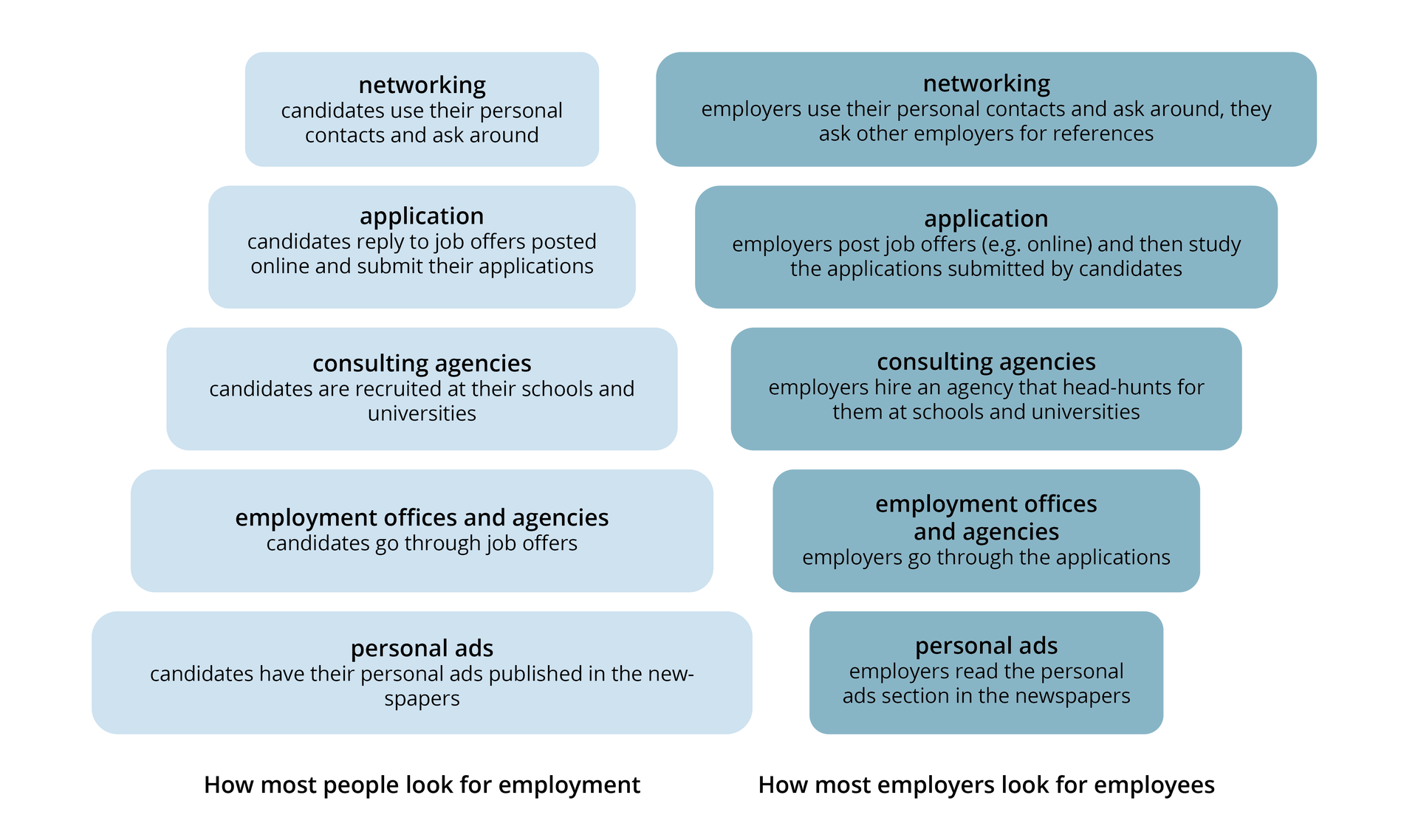
Remember about the so‑called inverted pyramid – the methods that most people use to look for a job might not be the most effective ones.

1. Step 1: Reflect Ask yourself:
– What causes are you passionate about?
– What do you value in a job?
– What type of work energizes you?
2. Step 2: Explore Here are some places to start:
– Browse the internet to learn about interesting fields of occupation.
– Read about professionals who found their paths to impact and take advantage of their advice and tips.
– Use social media and online tools like LinkedIn to identify people with interesting jobs and career paths.
– Sign up for newsletters and choose other methods of looking for your dream job.
3. Step 3. Target You should be able to describe your target in one or two sentences with key examples. Contrary to popular belief, being flexible and open to everything is likely to decrease your chances of honing in on something great and make it difficult to make a decision. Decide on the following issues concerning your future job:
– Where do you want to work (a city? abroad?)
– What problem do you want to solve?
– Is there a particular industry that intrigues you?
– Do you get energized by start-ups and new ventures? Or are you more comfortable in a large, established company with systems and processes in place?
– What kind of skill-set are you interested in building? What kind of function would you like to have?
4. Step 4. Engage Engage with your current network and talk to others outside your network working in roles aligned with your target. Attend relevant conferences and events. Surface relevant contacts through Twitter, LinkedIn, and other social media channels. These people will be critical for revealing opportunities that may not be posted online. Use these conversations to learn more about others’ jobs, which will help you confirm (or adjust) your target and signal that you’re interested in their field.You should spend about 80–90% of your time connecting to people and only 10–20% of your time applying to online job postings.
5. Step 5. Prepare Before you dive into the preparation, make sure to congratulate yourself for being asked to interview. Then:
– Review your self-assessments and make sure you can articulate how the position aligns with your interests, skills, and passions. Be prepared to provide examples that establish authenticity and demonstrate you can succeed in the role.
– If you’ve spoken with someone who works where you’re interviewing, let them know you’re being considered for a position and ask for their advice.
– If you’re fortunate to receive multiple offers, consider listing out the various elements that are important to you in a position and ranking each opportunity to see how each one aligns with these desired job elements.
6. Step 6. Perform Once you have landed your dream job, keep in mind these good practices:
– Update your resume regularly (at least every six months) and document your accomplishments so you can make sure to capture all that you’ve done in your job.
– Build in time to reflect on whether your job is still satisfying to you and whether your interests, passions, and values have evolved.
– Maintain the great network of contacts you built through your informational interviews by connecting with them on LinkedIn, making sure to share relevant articles and information, or just dropping them a note to say “hi.” If you decide it’s time to move on, you won’t need to dig out the old spreadsheet and remind them who you are again.
The employment contract
In Poland there are several types of contracts between an employer and an employee. It is crucial to know what the advantages and disadvantages of each of them are and what to expect from your boss when you sign a certain type of contract.
Regular employment contracts are regulated by the Labour Code. When you sign one of them you are entitled to paid holidays, maternitymaternity and childcare leavechildcare leave, severance payseverance pay in the event of collective redundanciescollective redundancies and the doledole lasting 6 months after leaving your work. Moreover, if you are planning to take a mortgagemortgage you would be considered a person with a stable income in a bank. For the employers, this is the most expensive contract so it is not so easy to get it.
There are a few types of regular contracts:
For a trial period (contract for a trial period of no more than three months).
For a fixed period (contract for a specific period).
For the time of completion of a specified task.
For an indefinite period (also when a third subsequent fixed‑term contract is signed, it is deemeddeemed to be an indefinite term contract)
To substitute an employee – in the event of his or her justified absence from work; the employer can hire another worker under a fixed‑term employment contract for the period of absence.
Civil law contracts are regulated by the Civil Code, which differs from the above mainly in that they specify a piece of work to be done within a defined period of time, quite often without setting working hours; the most popular ones, among many others, are the following two:
Contract of mandateContract of mandate concluded for the performance of a specified activity. These contracts do not impose daily or weekly time limits for performing the work - you won’t get paid for overtime, there will be no internal rules of employment, and no mandatory social protection.
Contract for specific workContract for specific work concluded for achievement of a specific result. These contracts are often used because they are not a subject to mandatory social security contributions.
Before you begin your work the employer has to pay for your visit to an „occupational medicine” doctor that will issue an attestation that there are no contraindications for you to take up the job. Additionally, the employer should carry out a health and safety training for you.
– their daily and {uzupełnij} norms for the work time,
– the frequency of remuneration {uzupełnij},
– their entitlement to paid {uzupełnij},
– the duration of {uzupełnij} of notice.
Check if you can understand the text. Complete the following excerpt with appropriate words and expressions.
signed, the period, weekly, payment, employment, a written, obliged, no more than, holidays
The ........................ contract should be concluded in ........................ form and ........................ by both sides. If the written form was not kept the employer is ........................ to inform the employee in writing in ........................ 7 days from the beginning of their employment about:
– their daily and ........................ norms for the work time,
– the frequency of remuneration ........................,
– their entitlement to paid ........................,
– the duration of ........................ of notice.
An employment contract can be dissolved:
With the agreement of the parties.
By one of the parties giving notice (employer or employee) with a notice period.
By one of the parties giving notice without a notice period.
A contract concluded for a fixed term or for the time it takes to complete a specific task is dissolved at the end of the term or when the task is completed (although it can, in certain circumstances, like disciplinary reasons, be dissolved earlier).
Examples of unethical behavior can sometimes be found in the area of relations between the employer and the employee. In this case, we are dealing with violation of workers’ rights, but also failure to fulfill obligations by employees or ignoring duties by the employer.
The employer has, among others, an obligation to:
familiarize his employees with the scope of their duties, the manner of performing work in designated positions and with the rights of workers,
organize the work by ensuring full use of working time and in such a way that the employees, thanks to their aptitudesaptitudes and qualifications, achieve high efficiency and proper quality of work,
to organize the work, ensuring reduction of its nuisancenuisance, especially monotonous work or work at a predetermined pace,
to counteract discrimination in employment, in particular on grounds of sex, age, disability, race, religion, nationality, political beliefs, trade union membership, ethnicity, sexual orientation, as well as employment for a definite or indefinite period, or in full or permanent employment; part‑time work,
to provide safe and hygienic working conditions and conducting systematic training of employees in the field of occupational health and safety (OHS),
to ensure timely and correct payment of remuneration,
to help the employees improve their professional qualifications,
to satisfy, to the greatest extent possible, the social needs of employees,
to apply objective and fair criteria for the assessment of employees and the results of their work,
to keep records on matters related to the employment relationship and personal files of employees,
to influence shaping of the principles of social coexistence in the workplace.
Failure to pay the remuneration, to provide a certificate of employment or non‑compliance with health and safety regulations - these are just some of the offenses that are sometimes committed by employers against workers’ rights.
Occupational Health and Safety (OHS) defines both a set of rules and principles for safe and hygienic work performance, and a specific area of knowledge dealing with shaping appropriate working conditions.
The National Labor Inspectorate is a state institution in charge of ensuring the compliance with the provisions and rules of OHS in Polish workplaces, as well as other regulations provided for in the Labour Code. The mission of the National Labor Inspectorate is effective enforcement of labor law, including health and safety at work, through targeted controls and preventive actions aimed at respecting the labor law and reducing accident hazards.
Characterize various forms of employment: what legal code regulates them? what are their advantages and disadvantages for the employee and the employer? Which of the employment forms would you choose for yourself and why?
Listen to the abstract recording to review the material and new vocabulary. Then do the vocabulary exercise. Match the pairs: English and Polish words.
uważać za, kredyt hipoteczny, odprawa, zasiłek, grupowe zwolnienia, umowa zlecenie, urlop macierzyński, urlop wychowawczy
| maternity leave | |
| childcare leave | |
| severance pay | |
| collective redundancies | |
| dole | |
| mortgage | |
| to deem | |
| contract of mandate |
Keywords
job search, application, Labour Code, regular employment contract, trial/fixed period, period of notice, contract for an indefinite period, civil law contract, contract of mandate, contract for specific work, occupational medicine, OHS, National Labour Inspectorate
Glossary
urlop macierzyński
urlop wychowawczy
odprawa
grupowe zwolnienia
zasiłek
kredyt hipoteczny
uważać za
umowa zlecenie
umowa o dzieło
zdolności
niedogodność