The movement of unification of Italy was started by the Kingdom of Sardinia. The first stage was to include PiedmontPiedmontPiedmont after winning the war with Austria in 1859. After an uprising against the authorities broke out in the Kingdom of Both Sicily, it was supported by “red shirtsred shirtsred shirts” led by Giuseppe Garibaldi. As a result, this country was also incorporated into Italy undergoing the process of unification. In 1862, the Kingdom of Italy was proclaimed. In 1866, after Austria lost the war with Prussia, Venice was incorporated into Italy. In 1870, Italians entered the Papal States. They occupied Rome and severely limited premises of the Church.
Task 1
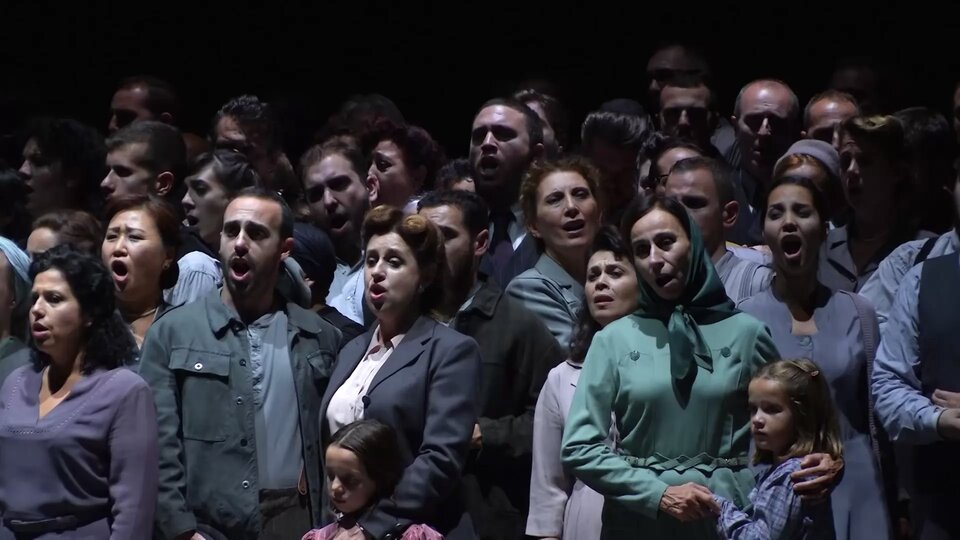
Giuseppe Verdi, a supporter of the unity of Italy, had a great influence on the national feelings of the Italians. Listen to the song Va, pensiero from Nabucco opera by Verdi. Specify its mood. Why, in your opinion, did it become a hymn to supporters of unification of Italy?
R15PLJMOr4IJA
Film przedstawiający fragment przedstawienia w operze.Stojący chór składający się z aktorów śpiewa doniośle piosenkę.
Film przedstawiający fragment przedstawienia w operze.Stojący chór składający się z aktorów śpiewa doniośle piosenkę.
Va, pensiero w wykonaniu teatru Gran Teatre del Liceu w Barcelonie
Source: Va, pensiero, reż. LiceuOperaBarcelona, 2015, licencja: CC BY-SA 3.0.
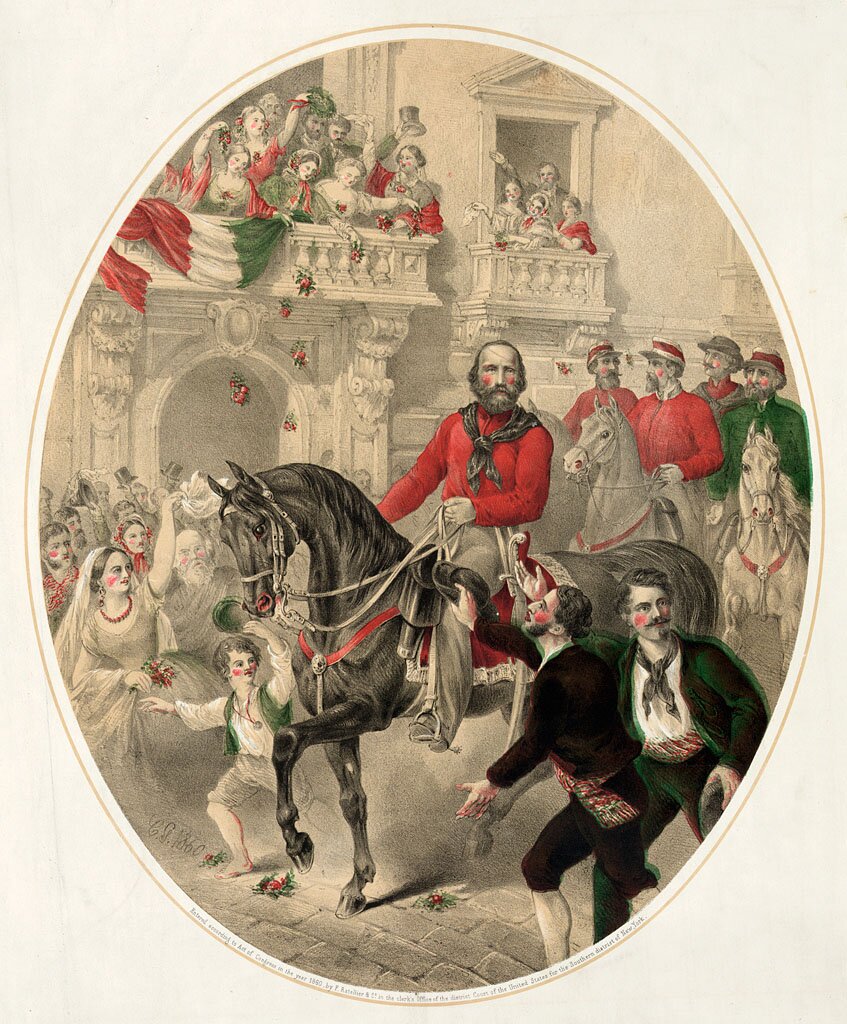
From 1845, Italian Legionnaires wore bizarre red shirts. Garibaldi also wore the same shirt. Red shirts of Garibaldi Legion later became famous in Europe as a symbol of his supporters. But the red colour of these uniforms is the reason for misunderstandings and confusion of concepts. Why?
R9j89Rm4s9KuG1
Ilustracja przedstawiająca scenę ludzi wiwatujących, gdy Giuseppe Garibaldi wjeżdża na koniu do Neapolu. Ludzie zewsząd skandują, uśmiechają się, machają do przywódcy. Stoją tuż obok niego jak i dalej, w balkonach budynków. Za przywódcą na koniach podążają za nim pozostali żołnierze.
People cheering as Giuseppe Garibaldi rides into Naples
Source: People cheering as Giuseppe Garibaldi rides into Naples, ca. 1860, domena publiczna.
The first associations between red colour and revolution came with the French Revolution. It was the colour of the Phrygian hat – its symbol. However, this symbolism did not immediately gain a recognized and widespread meaning. Purple was still too strongly associated with the coronation coats of the rulers or cardinals' hats. Therefore, revolutionists and republicans throughout the first half of the 19th century preferred rather black colour. Black suited well the secrecy and conspiracy to which they were pushed by the reaction after the Vienna congress. It also contrasted well with the white colour when the old white Bourbon flag returned along with the Bourbons.
Red, as the colour symbolizing revolution, republicanism and all left‑wing trends, become common only due to the Spring of Nations. At that time, a shirt covered several times with blood, tied with sleeves on the barrel of a rifle, was the only banner for the defenders of street barricades.
Finally, the shirts of Garibaldi's soldiers from 1848 and 1849 played an important role in preserving this symbolism. Their actions become extremely famous, and their outfits attracted attention with their exotic character, brought from La Plata in South America, where Garibaldi used to operate before.
In short, these were the Red Shirts of Garibaldi Legion defending the republican Rome that strengthened and made famous the symbolism of red, and not the symbolism decided about the selection of their outfits. When they made a decision on their shirts, their colour was not yet associated with revolution, radicalism or any ideological attitude at all.
R1UnWpY6CheP31
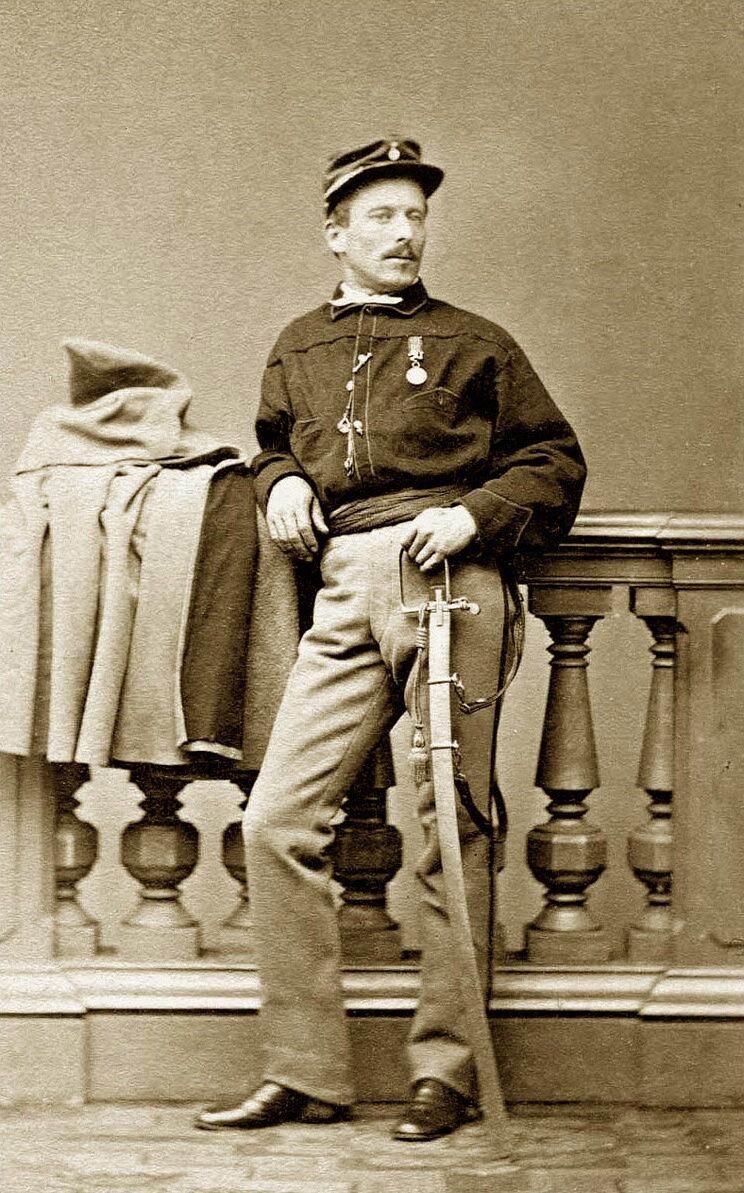
Fotografia czarno-biała przedstawiająca Giuseppe Barboglio, w mundurze i z szablą. Postać stoi lekko oparta o poręcz. Pozuje do zdjęcia. Obok na tej samej poręczy wisi płaszcz.
Giuseppe Barboglio a Red Shirt volunteer of the Thousand wearing the Marsala Medal
Source: Giuseppe Barboglio a Red Shirt volunteer of the Thousand wearing the Marsala Medal, 1865, Wikimedia Commons, domena publiczna.
The origins of this outfit were quite different and very ordinary. More precisely, they were not shirts, but loose blouses made of red thick canvas, usually long up to the knees, sewn together in a simple way, with a simple hole for the head and wide, easy to roll up sleeves. It was a professional outfit of the workers of large Argentinian and Uruguayan slaughterhouses. The colour was dictated by a workplace. The only innovation introduced by Garibaldi's supporters was to wrap a belt around the blouses. Since butchers used to wear them as loose aprons. The belts were supposed to give this unusual uniform at least a little of military character. In 1845, the need arose for relatively uniform clothes of the Italian legion. His soldiers had to be easy to distinguish from soldiers of the regular Uruguayan army, or English or French sailors, with whom they had contact on the battlefield more and more often. Only butcher's blouses intended for the large slaughterhouses in Buenos Aires were available, which now have been sequestrated and stored in Montevideo's port warehouses for years. Garibaldi without hesitation dressed up his people and himself in these uniforms. He and his people wore long, shoulder‑length hair, beards and moustache, which had no contact with a hairdresser for years. They probably evoked reactions among the townsmen similar to the hippies in more modern days – and they enjoyed it.
garibaldi Source: Garibaldi and the Red Shirts, [w:] Tomasz Wituch, Garibaldi, Wrocław 1998, s. 88–89.
Task 3
Read the text below. Who Camillo Cavour was?
RgKEODVNAjW921
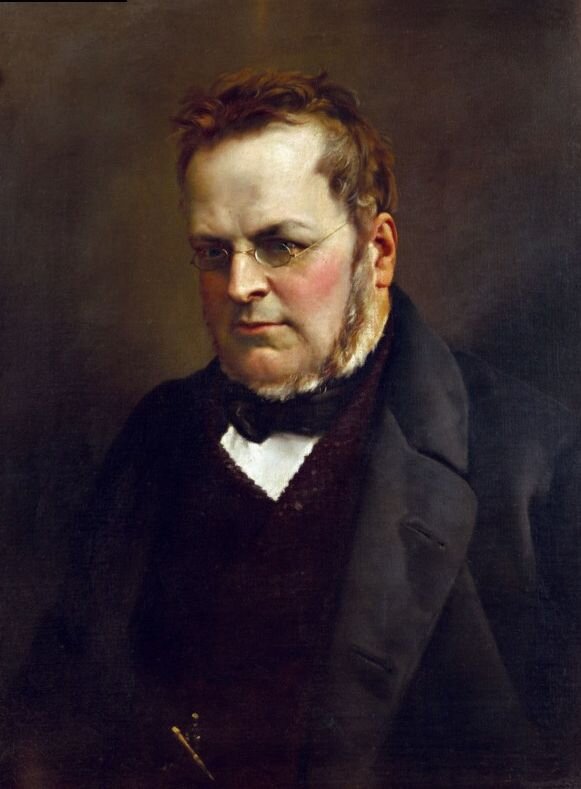
Obraz przedstawiający Camillo Benso di Cavour. Brodaty mężczyzna w okularach. Elegancko ubrany w muchę pod szyją i gruby płaszcz pozuje do własnego portretu.
Camillo Benso di Cavour
Source: Antonio Ciseri, Camillo Benso di Cavour, licencja: CC BY-SA 3.0.
Camillo Cavour, actually Camillo Benso di Cavour (1810–1861) was an Italian count, politician and statesman. In 1852 he became a Prime Minister and Minister of Foreign Affairs of the Kingdom of Sardinia. His aim was to modernize the country. He advocated the unification of Italy under the leadership of the King of Sardinia. He believed that this could be done by means of an effective policy. He was aware of the economic differences between the poor south and the rich north of Italy, therefore he assumed the need to create a loose federationfederationfederation of Italian countries. He treated the dreams of democrats and revolutionists of the national revival of Italians and political unity of Italy with caution. He strengthened the country's position in international relations by skillfully conducted diplomacy, providing Piedmont with military and diplomatic support from Napoleon III. The Emperor of France was the first of Europe's monarchs to advocate the right of nations to be politically „self‑determined”, that is to gain their own independence. However, he did not support Piedmont voluntarily. He hoped to acquire lands for France: Savoy and Nice. He gained them thanks to the defeat of Austria in 1859. Sardinia received then Lombardy, which was handed over to it by the winning France. Later, Napoleon did not want to be a protector of Risorgimento anymore, but the reunification process continued. In 1860, revolutions broke out against the Austrian princes – the absolute rulers of Parma, Tuscany and Modena. After their downfall, due to plebiscites, residents of these countries decided to join the Kingdom of Sardinia. Cavour paid for the support of Napoleon III for these activities by agreeing to incorporate the French‑speaking provinces that the Napoleon wanted: Nice and Savoy, into the Second Empire: If Cavour had been able to maintain his complete influence on the accidents in Italy, they would have ended at this stage.
Task 4
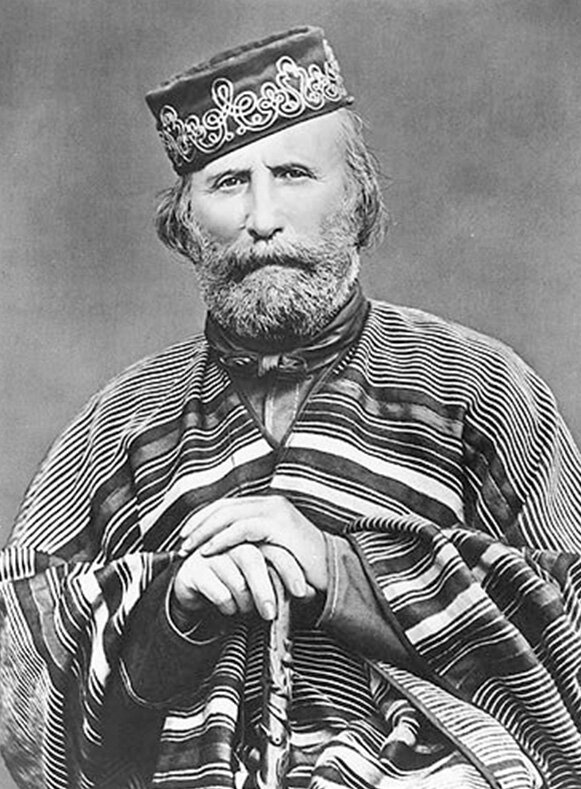
Read the text below. Who was Giuseppe Garibaldi?
R1NQB5539aWJ81
Fotografia czarno-biała przedstawiająca Giuseppe Garibaldiego. Brodaty mężczyzna w narzucie w pasy. Ma elegancko wyszyte nakrycie głowy, dość duży zarost na twarzy. Obydwie dłonie trzyma oparte na lasce. Pozuje do zdjęcia.
Giuseppe Garibaldi
Source: Giuseppe Garibaldi, 1866, Wikimedia Commons, domena publiczna.
Giuseppe Garibaldi (1807–1882) was an Italian general, a fighter for the liberation and unification of Italy, a democrat and a republican. When the south of Italy also rebelled in May 1860, the Italian general and revolutionist Garibaldi actively supported it. He set off from a small port near Genoa (in the north‑west of Italy) to the Kingdom of Both Sicily with a group of trained and armed Italian volunteers, embarked on two steamships. This expedition was called the “Expedition of the Thousand”. Their weapons and equipment were the donations collected all over Italy, as well as sent from abroad. Garibaldi conquered Sicily and then headed for Naples, crushing the army of the Kingdom of Both Sicily and overthrowing the House of Bourbon. France and England initially considered military intervention to prevent the Italian general from transferring his army to the peninsula, but eventually abandoned this intention. As one of the participants of the expedition later said in a speech to the crowds, 'only a revolution can create Italy, diplomacy will never do it'. Garibaldi and his volunteers declared that they are acting on behalf of the King of Piedmont, but for Victor Emmanuel and Prime Minister Cavour, the political action of the Italian democrats was as beneficial as worrying. The success of the expedition made Garibaldi the actual ruler of southern Italy. As a democrat, he faced then a dilemma: establish a republic or subordinate the conquered area to the Sardinian monarchy. Finally, he chose obedience to Victor Emmanuel II. Without Garibaldi's activities, the action to unite Italy, initiated by the king and the government, would not have been so successful., (1807‑1882) an Italian general, a fighter for the liberation and unification of Italy, a democrat and a republican. When the south of Italy also rebelled in May 1860, the Italian general and revolutionist Garibaldi actively supported it.
Rrs2Aj7qQ1kkX1
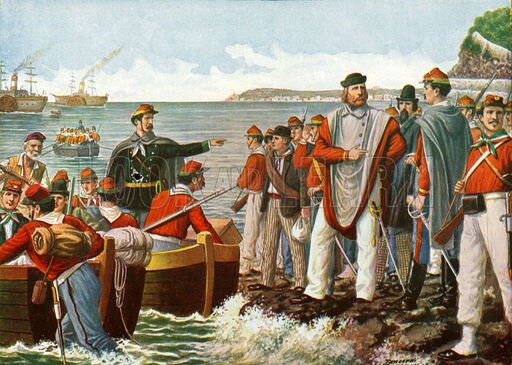
Ilustracja przedstawiająca scenę, kiedy Garibaldi wyjeżdża na wyprawę Tysiąca w 1860 roku. Mężczyźni w czerwonych mundurach wsiadają do łodzi.
Garibaldi departing on the Expedition of the Thousand in 1860
Source: Garibaldi departing on the Expedition of the Thousand in 1860, Wikimedia Commons, domena publiczna.
He set off from a small port near Genoa (in the north‑west of Italy) to the Kingdom of Both Sicily with a group of trained and armed Italian volunteers, embarked on two steamships. This expedition was called the “Expedition of the Thousand”. Their weapons and equipment were the donations collected all over Italy, as well as sent from abroad. Garibaldi conquered Sicily and then headed for Naples, crushing the army of the Kingdom of Both Sicily and overthrowing the House of Bourbon. France and England initially considered military intervention to prevent the Italian general from transferring his army to the peninsula, but eventually abandoned this intention. As one of the participants of the expedition later said in a speech to the crowds, 'only a revolution can create Italy, diplomacy will never do it'. Garibaldi and his volunteers declared that they are acting on behalf of the King of Piedmont, but for Victor Emmanuel and Prime Minister Cavour, the political action of the Italian democrats was as beneficial as worrying. The success of the expedition made Garibaldi the actual ruler of the southern Italy. As a democrat, he faced then a dilemma: establish a republic or subordinate the conquered area to the Sardinian monarchy. Finally, he chose obedience to Victor Emmanuel II. Without the Garibaldi’s activities, the action to unite Italy, commenced by the king and the government, would not have been completed so successfully.
Exercise 1
Wymyśl pytanie na kartkówkę związane z tematem abstraktu.
Wymyśl pytanie na kartkówkę związane z tematem abstraktu.
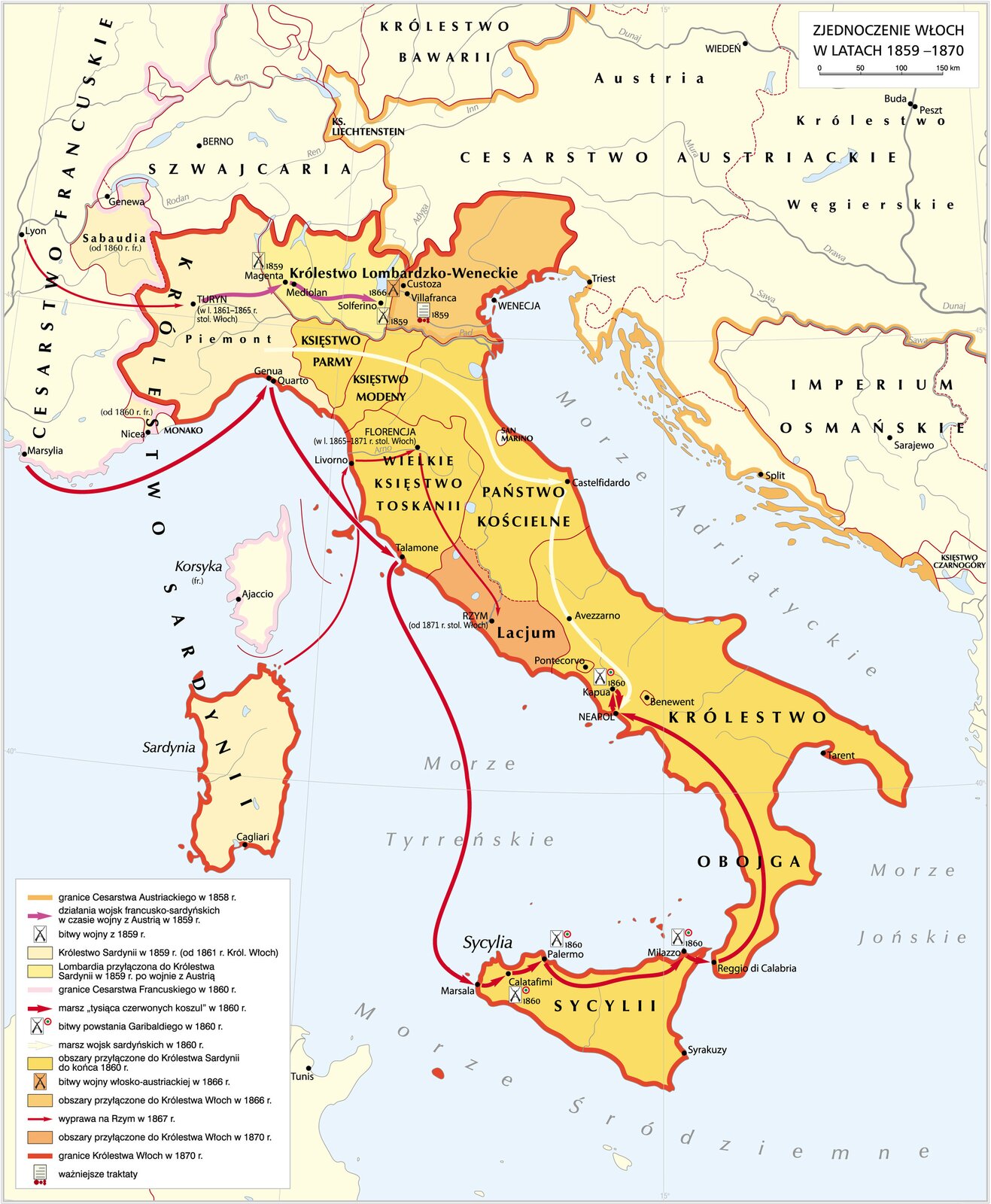
Analyze the map, presenting the unification of Italy and answer the question.
R1TZ6bAZQDaU91
Grafika mapy przedstawiającej Zjednoczenie Włoch w latach 1859-1870.
Unification of Italy
Source: Zjednoczenie Włoch, Krystian Chariza i zespół.
R1el00erFPy7z
Zadaj swoje pytanie koledze. Czy był w stanie na nie odpowiedzieć?
Zadaj swoje pytanie koledze. Czy był w stanie na nie odpowiedzieć?
Put the events in a chronological order.
The inhabitants of Parma, Tuscany and Modena decided in plebiscites to join the Kingdom of Sardinia.
Venice joins Italy.
The King of Piedmont receives the title of the King of Italy.
Naples joins Piedmont.
After the war against Austria, Piedmont (Kingdom of Sardinia) gains Lombardy
Rome joins Italy.
R1I6rynEtoRFr
Exercise 2
Match the information with the correct name. The famous Italian general and revolutionist is... Możliwe odpowiedzi: 1. Camillo Cavour, 2. Wiktor Emmanuel II, 3. Giuseppe Garibaldi., The Prime Minister of the Kingdom of Sardinia, the great advocate of the unification of Italy is... Możliwe odpowiedzi: 1. Camillo Cavour, 2. Wiktor Emmanuel II, 3. Giuseppe Garibaldi., The King of Sardinia, and later of the united Italy is... Możliwe odpowiedzi: 1. Camillo Cavour, 2. Wiktor Emmanuel II, 3. Giuseppe Garibaldi
Match the information with the correct name. The famous Italian general and revolutionist is... Możliwe odpowiedzi: 1. Camillo Cavour, 2. Wiktor Emmanuel II, 3. Giuseppe Garibaldi., The Prime Minister of the Kingdom of Sardinia, the great advocate of the unification of Italy is... Możliwe odpowiedzi: 1. Camillo Cavour, 2. Wiktor Emmanuel II, 3. Giuseppe Garibaldi., The King of Sardinia, and later of the united Italy is... Możliwe odpowiedzi: 1. Camillo Cavour, 2. Wiktor Emmanuel II, 3. Giuseppe Garibaldi
Match the information with the correct name.
Camillo Cavour, Giuseppe Garibaldi, Victor Emmanuel II
The famous Italian general and revolutionist is...
The Prime Minister of the Kingdom of Sardinia, the great advocate of the unification of Italy is...
The King of Sardinia, and later of the united Italy is...
Keywords
unification of Italy, Giuseppe Garibaldi, Camillo Cavour
Piemont – region w północno‑zachodnich Włoszech, przy granicy z Francja i Szwajcarią; zamienne określenie Królestwa Sardynii, we władaniu dynastii sabaudzkiej;