RHhfxJ5I5WkC6

Manipulation in the media – not everything is true

Source: domena publiczna.

Link to the lesson

Before you start you should know
  • We live in a society where media are omnipresentomnipresentomnipresent.

  • The media should mostly concentrate on conveyingto conveyconveying sound and reliablereliablereliable information, but often they try to manipulate the viewer/reader.

You will learn
  • You will know what manipulation is.

  • You will understand the difference between a true and a manipulated piece of information.

  • You will be able to spot various kinds of manipulation.

R1TVTmQhvKCvo
nagranie abstraktu

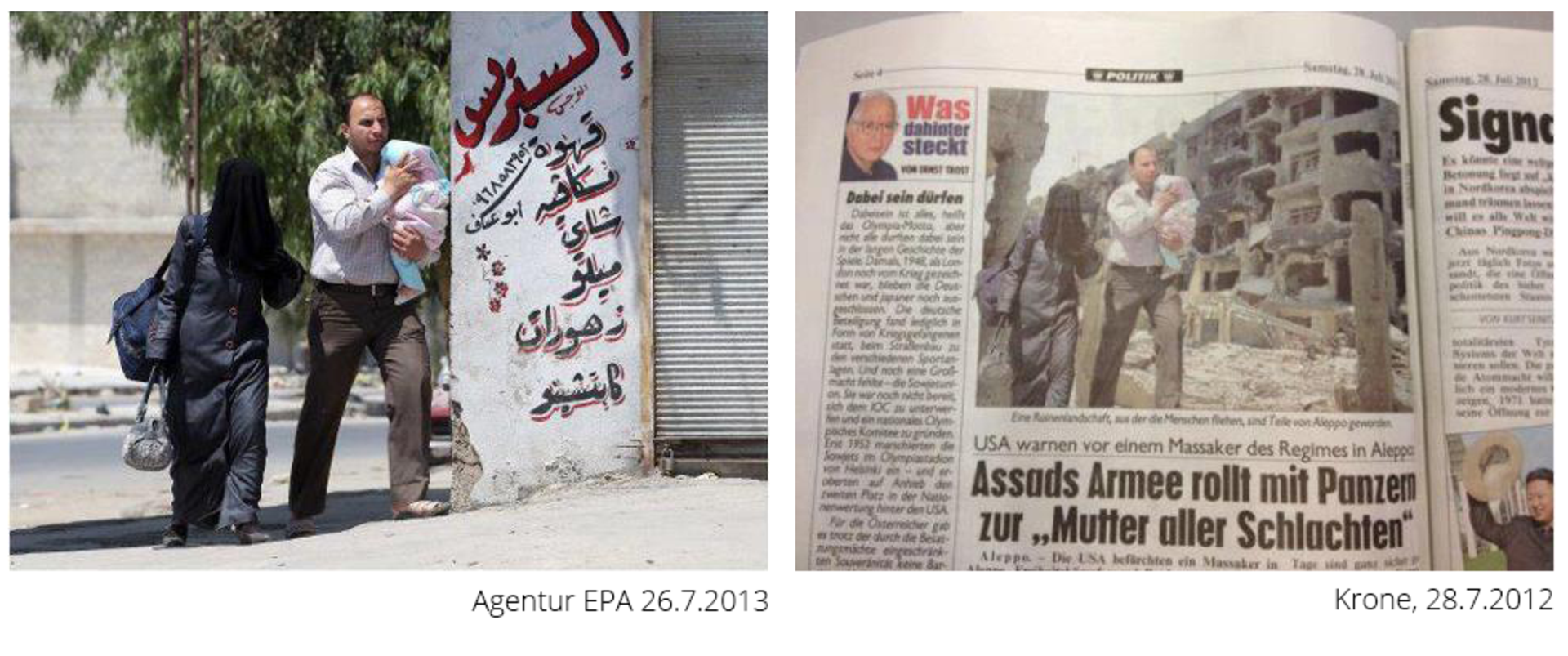
The media often try to influenceto influenceto influence our emotions by making the stories sound or look more dramatic. Manipulation is about mixing truth and falsehoodfalsehoodfalsehood or presenting facts in a context convenientconvenientconvenient for the publishers.

Take a look at the pictures – they are a good example.
RYEObnIBude5Q1

In 2012 an Austrian newspaper “Kronen Zeitung” publish a picture of a family fleeingto fleefleeing from a war‑tornwar‑tornwar‑torn Syria. Unfortunately, the publishers decided to make the picture more dramatic by photoshopping some bombed buildings into the background. Internet users quickly discovered the scamscamscam, and the newspaper had to apologizeto apologizeto apologize.

RACoWQ7WleCib1
Schemat przedstawiający popularne techniki manipulacji w mediach. Zapoznaj się z elementami schematu. Popular manipulation techniques in the media. 1. Playing on people’s heartstrings. Headlines that evoke deep negative or positive feelings (like anger or compassion) in readers, indicate the will to manipulate them. For example: “A Polish child has not been accepted to a German school!”. And maybe the child did not know the language well enough, and would not be able to cope with the material? 2. Questioning. Using questions in headlines, for example “Does the government want to forbid the citizens to leave for EU states?” makes the reader alarmed, and later in the article the author describes how the law would limit all citizens. It is not until the end of the article, when he clarifies, that the government has no plans of that kind - the reader will remember that the threat is there anyway. 3. Opinion polls. When the poll is carried out on a small sample of people it is not credible. Headlines like “87% of Poles support the government” is manipulative, if the article mentions casually, that the poll was run on a group of 100 people. 4. „Foreign newspapers write…”. This kind of manipulation uses our complexes. If we are being talked about abroad it has to be taken seriously. Not necessarily! Often the foreign media use Polish journalist and their opinions – it is a common and effective method to confuse people. Later the Polish journalists often use headlines like “Foreign press says, that X happened”. Double check information like this in different sources. 5. Taking out of the context. Headline reads: X said “I can’t imagine my child attending a German school”. When in reality X said “I can’t imagine my child attending a German school, if he did not spoke German well enough”. Taking the part out of the context gives the reader a completely different impression, doesn’t it? Manipulation like this one is often used in the media and in political debate. 6. Capslock. SHOCK! UNBELIEVABLE! URGENT! BREAKING NEWS! SCANDAL! – headlines using big, screaming letters usually have only one purpose: to provoke the reader to click the link. 7. Outright lies. The worst kind of manipulation is making up a lie, publishing it, and allowing it to be repeated by all the TV stations, journalists etc. After 12 hours the lie is removed on the demand of the person being attacked. The case goes to court, the trial lasts forever, and the dementi is published in small print. And the readers… only remember the lie. Based on: A.J. Wichura, Techniki manipulacji w mediach – część 1, www.czlowiek.info
Popular manipulation techniques in the media
RAYahDfGAEOdu1
Exercise 1
Ćwiczenie alternatywne: Decide which characteristics characterize true information and which characterize manipulated one. Characteristics: 1. credible source 2. only opinions are presented 3. honesty 4. incomprehensible language 5. no specific facts 6. only facts are being presented 7. sensational headline 8. verifiability
R1Tascs5h5zhX
Exercise 2
Listen to the abstract recording to review the material and new vocabulary. Then do the vocabulary exercise. Explain the meaning of following words: omnipresent; to convey; reliable; to influence; convenient; war‑torn; scam; to apologize. If it's too difficult use lesson's glossary.

Keywords

manipulation, information, headline, fact, credible source, verifiability

Glossary

omnipresent
omnipresent
RapvJKTJkwdBF
Nagranie słówka: omnipresent

wszechobecny

to convey
to convey
RvWwtAtgkpVN1
Nagranie słówka: to convey

przekazywać

reliable
reliable
RTxzPICyyn1zJ
Nagranie słówka: reliable

wiarygodna

to influence
to influence
R1CnLqtl2y5wp
Nagranie słówka: to influence

wpływać (na coś)

falsehood
falsehood
R4pYQX6D0W7ni
Nagranie słówka: falsehood

fałsz

convenient
convenient
R1EP8lPCpiZV6
Nagranie słówka: convenient

wygodny

to flee
to flee
R1UjJHB4DY79x
Nagranie słówka: to flee

uciekać

war‑torn
war‑torn
ROoRz7dYL5A05
Nagranie słówka: war‑torn

pogrążona w wojnie

scam
scam
R9HQhTpoKmVHM
Nagranie słówka: scam

oszustwo

to apologize
to apologize
R1YzjdMLARjxh
Nagranie słówka: to apologize

przepraszać

sound
sound
Rvy9D3xPR5QgS
Nagranie słówka: sound

rzetelny, solidny