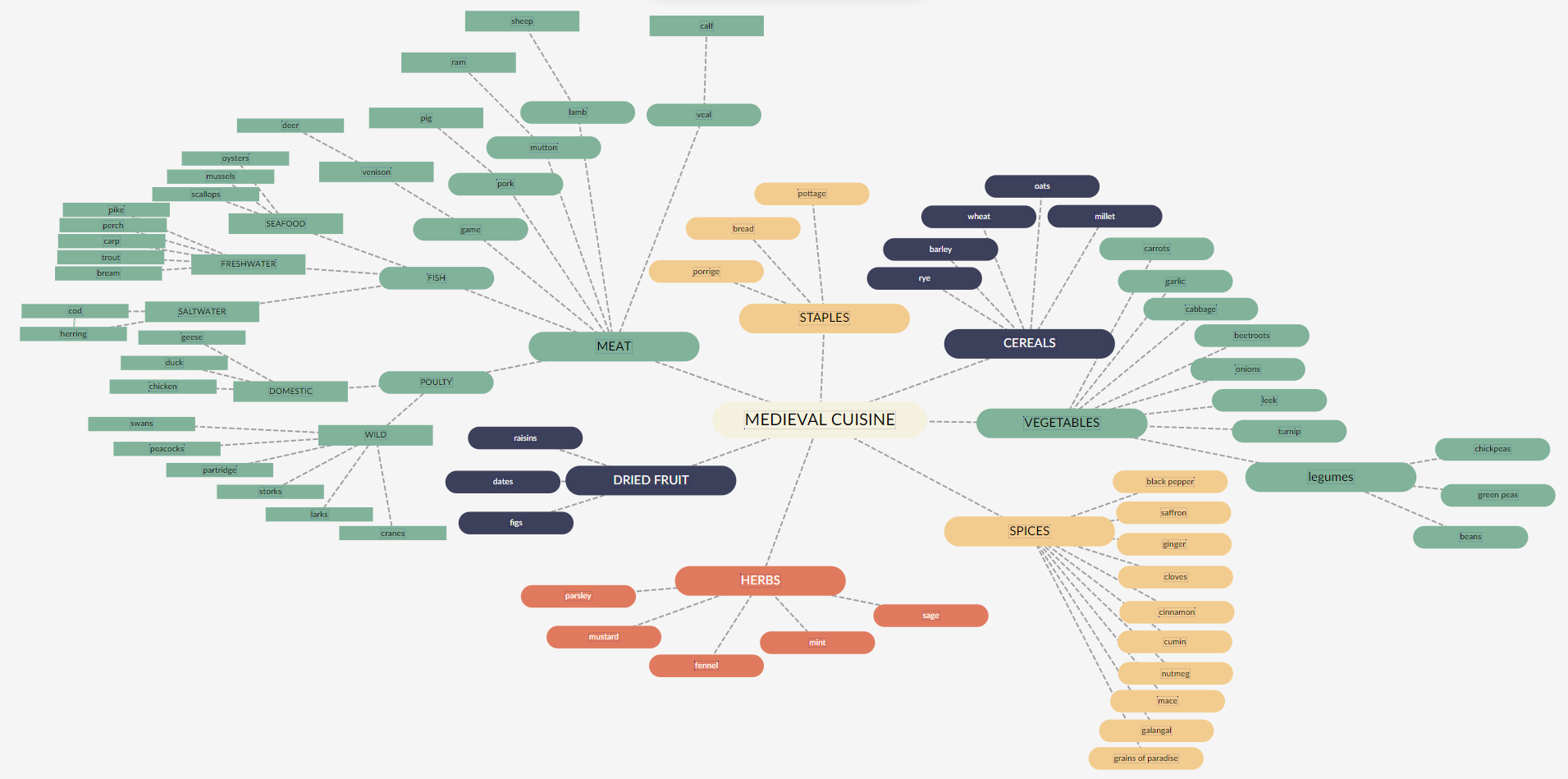
In this section you are going to work with a mind map organising vocabulary connected to medieval cuisine. Did you know that according to the latest research, using mind maps can save you 7+ hours per week and increase your creativity by 50%? It’s really worth learning in this way, so analyse the mind map below and let your creative skills be ignited!
W tej sekcji popracujesz z mapą pojęć organizującą słownictwo związane z kuchnią średniowieczną. Czy wiedziałeś/wiedziałaś, że według ostatnich badań używanie map pojęć może zaoszczędzić siedem lub więcej godzin tygodniowo i zwiększyć twoją kreatywność o 50%? Naprawdę warto uczyć się w ten sposób, więc przeanalizuj poniższą mapę pojęć i rozpal swoją kreatywność!
R6NTkPmy7gJJO
Zdjęcie przedstawia kobietę w średniowiecznym stroju siedzącą przy stole w zielonej poświacie. Kobieta je posiłek pałeczkami. Transkrypcja nagrań znajduje się poniżej.
The pleasure of eating medieval food
Przyjemność jedzenia w średniowieczu
Źródło: dostępny w internecie: www.freepik.com [dostęp 13.01.2022], domena publiczna.
Exercise1
Match the names of vegetables with their translations.
FRUIT POULTRY, peacocks, larks, cod, herring, perch, trout
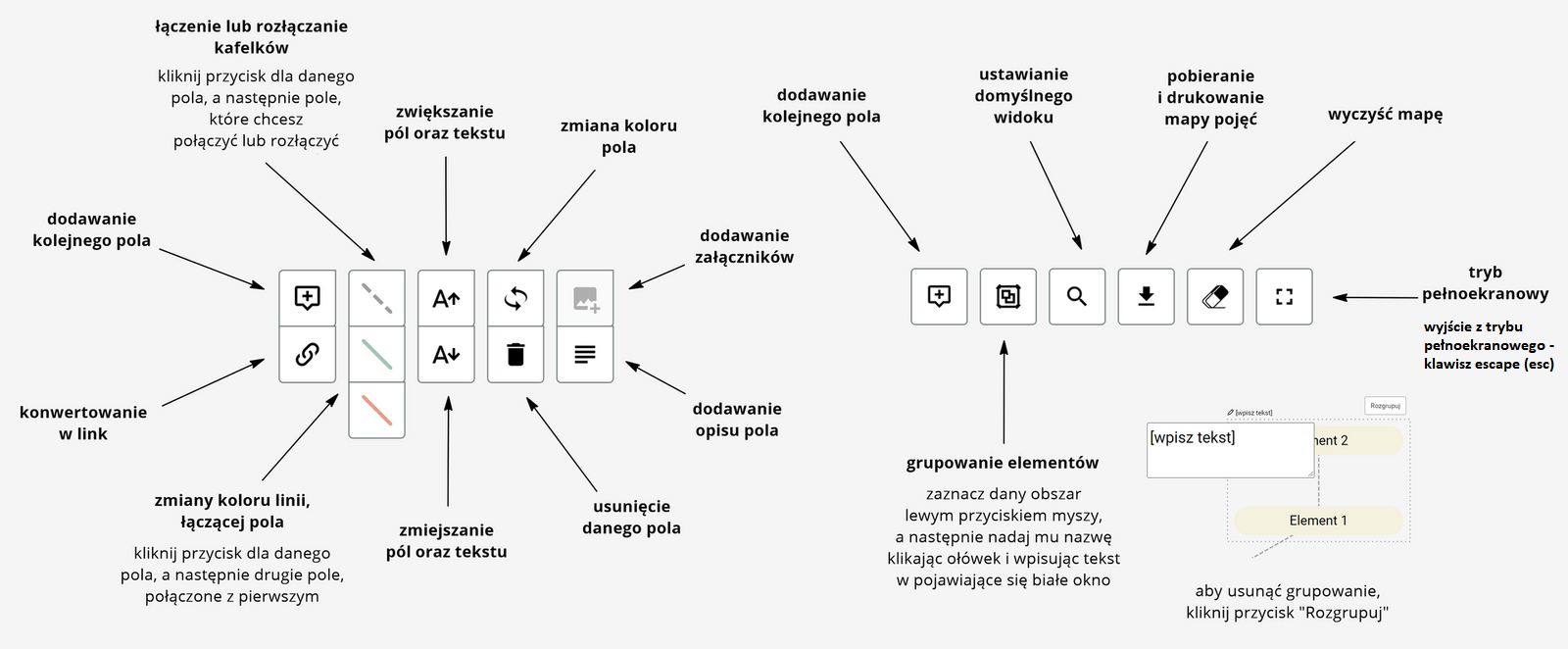
INSTRUKCJA DO MAPY POJĘĆ1azurewhite
RBQ55WVV1pVq5
Ilustracja
Źródło: GroMar Sp. z o.o., licencja: CC BY-SA 3.0.
RMCc9jB7Yz7xJ1
Źródło: GroMar Sp. z o.o., licencja: CC BY-SA 3.0.
Check your answer1azurewhite
RZWsgAkPvAM5G
Ilustracja
Źródło: GroMar Sp. z o.o., licencja: CC BY-SA 3.0.
Exercise3
R3iiVlAdy7MkQ
Refer to the mind map above and choose the correct answers. There is only one correct answer in every point. 1. Which word means meat from wild animals (e.g. bears or deer)?
a) mutton
b) veal
c) game
d) pork
2. Which word means grain used for making white flour?
a) oats
b) rye
c) barley
d) wheat
3. Which word means a spice similar to mace?
a) nutmeg
b) ginger
c) saffron
d) cloves
4. Which word is a type of singing bird?
a) partridge
b) lark
c) peacock
d) geese
5. Which adjective can be used to refer to fish living in rivers?
a) crucial
b) saltwater
c) freshwater
d) staple
Refer to the mind map above and choose the correct answers. There is only one correct answer in every point. 1. Which word means meat from wild animals (e.g. bears or deer)?
a) mutton
b) veal
c) game
d) pork
2. Which word means grain used for making white flour?
a) oats
b) rye
c) barley
d) wheat
3. Which word means a spice similar to mace?
a) nutmeg
b) ginger
c) saffron
d) cloves
4. Which word is a type of singing bird?
a) partridge
b) lark
c) peacock
d) geese
5. Which adjective can be used to refer to fish living in rivers?
a) crucial
b) saltwater
c) freshwater
d) staple
Źródło: GroMar Sp. z o.o., licencja: CC BY-SA 3.0.
Exercise4
Answer the questions below with 2‑3 sentences.
Which medieval food would you never like to taste and why?
Which food eaten in the Middle Ages do you include in your diet and how often do you eat it?
Is there any type of food from the mind map that you have never eaten but you wouldn’t mind tasting one day? Why?/Why not?
RQoFMwXrqyfpb
Which medieval food would you never like to taste and why?
Which food eaten in the Middle Ages do you include in your diet and how often do you eat it?
Is there any type of food from the mind map that you have never eaten but you wouldn’t mind tasting one day? Why?/Why not?
(Uzupełnij).
Źródło: GroMar Sp. z o.o., licencja: CC BY-SA 3.0.
I think I would never want to eat… I find it really… that medieval people would eat…
I regularly eat…, such as… I also use…, for example… Occasionally, I eat…
I have never eaten…, and I think I would like to try it. It is said to be…, and I wonder…
I think I would never want to eat birds like storks, swans or singing birds such as larks. I find it really strange that medieval people would eat these birds on a regular basis, while they have a totally different status today: people feed them and care for them rather than treat them as a potential meal.
I regularly eat a lot of the vegetables which were also popular in the Middle Ages, such as carrots, onions or beets. I also use plenty of spices with my meals, for example black pepper, cinnamon or ginger. Occasionally, I eat fish like trout, but that’s not my favourite food.
I have never eaten any kind of game, and I think I would like to try it. It is said to be good, lean meat and I wonder what it tastes like.
R6Hy48kgCF291
Exercise5
Study the mind map above. Type in the missing letters to fill in the gaps in the text. As with many other historical periods, what medieval people ate largely depended on their social status. Peasants’ 1. sTu uzupełnij were based on cereals and grains, mostly 2. bTu uzupełnij or 3. rTu uzupełnij. They ate a lot of 4. pTu uzupełnij, a kind of stew made from 5. oTu uzupełnij and vegetables. Most people preserved foods that had been salted or pickled, such as pickled 6. hTu uzupełnij or 7. pTu uzupełnij from pigs, which were cheap to keep as they were able to fend for themselves in the forest. Peasants were forbidden to hunt animals such as 8. dTu uzupełnij or rabbits that lived in woodland surrounding most villages, as they were considered to be the property of the lord. In contrast, a nobleman’s diet consisted of freshly killed meat, for instance 9. gTu uzupełnij, and river fish like 10. tTu uzupełnij or 11. bTu uzupełnij. Their dishes were heavily flavoured with valuable imported spices, such as 12. pTu uzupełnij or 13. nTu uzupełnij. Banquet tables were decked with spectacular dishes, for example roasted 14. pTu uzupełnij adorned with their own feathers and dried fruit like dates. All the dishes looked very colourful, and many of them were dyed to achieve this effect, for example by using 15. sTu uzupełnij for vivid yellow, or sandalwood for red.
Study the mind map above. Type in the missing letters to fill in the gaps in the text. As with many other historical periods, what medieval people ate largely depended on their social status. Peasants’ 1. sTu uzupełnij were based on cereals and grains, mostly 2. bTu uzupełnij or 3. rTu uzupełnij. They ate a lot of 4. pTu uzupełnij, a kind of stew made from 5. oTu uzupełnij and vegetables. Most people preserved foods that had been salted or pickled, such as pickled 6. hTu uzupełnij or 7. pTu uzupełnij from pigs, which were cheap to keep as they were able to fend for themselves in the forest. Peasants were forbidden to hunt animals such as 8. dTu uzupełnij or rabbits that lived in woodland surrounding most villages, as they were considered to be the property of the lord. In contrast, a nobleman’s diet consisted of freshly killed meat, for instance 9. gTu uzupełnij, and river fish like 10. tTu uzupełnij or 11. bTu uzupełnij. Their dishes were heavily flavoured with valuable imported spices, such as 12. pTu uzupełnij or 13. nTu uzupełnij. Banquet tables were decked with spectacular dishes, for example roasted 14. pTu uzupełnij adorned with their own feathers and dried fruit like dates. All the dishes looked very colourful, and many of them were dyed to achieve this effect, for example by using 15. sTu uzupełnij for vivid yellow, or sandalwood for red.
Źródło: GroMar Sp. z o.o., licencja: CC BY-SA 3.0.