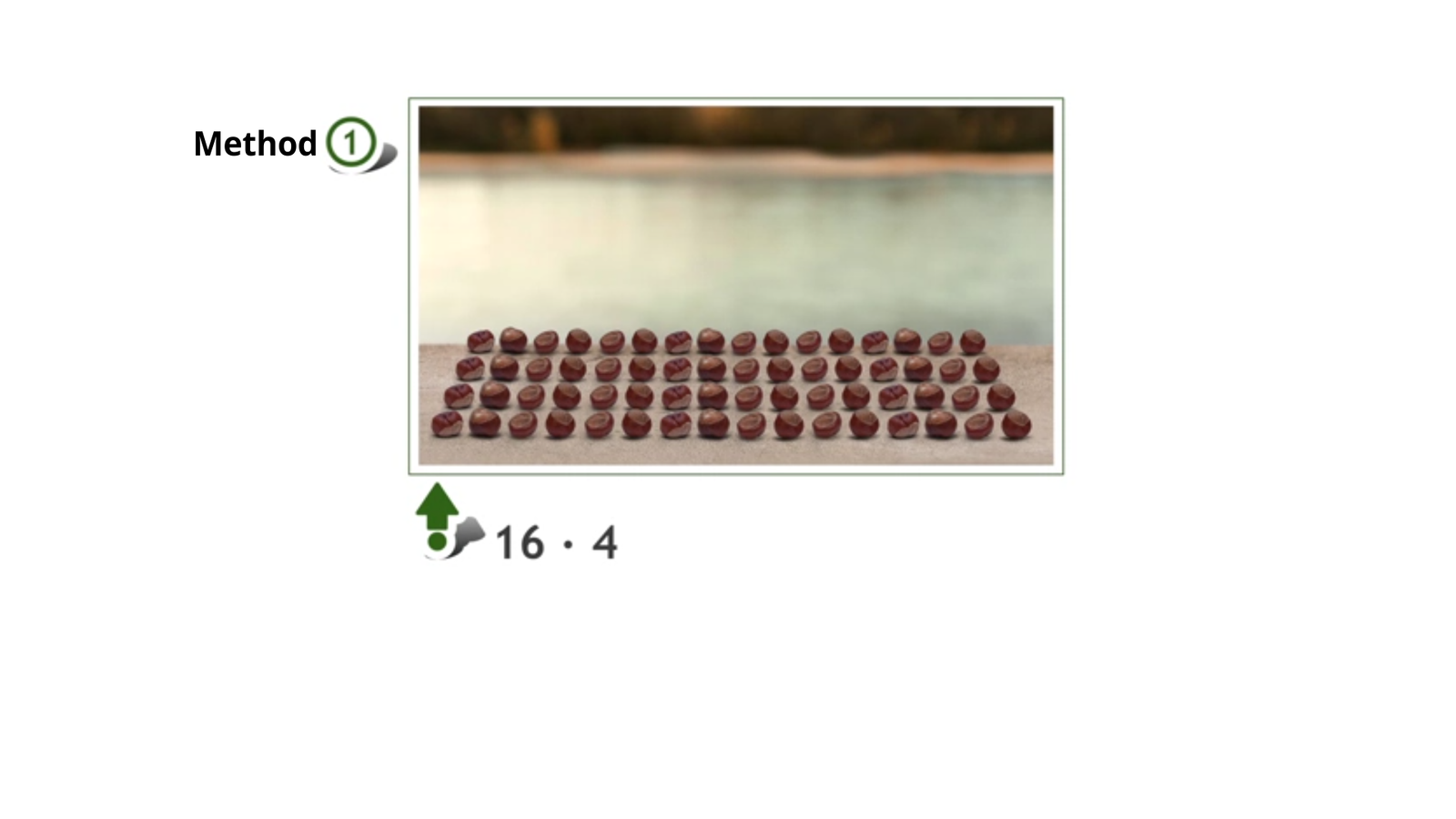
Students work individually using computers. They open slideshow and observe how we can multiply two natural numbersnatural numbersnatural numbers in memory.
R1SlW66TvJuCG11
Pokaz multimedialny - sposoby mnożenia liczb. Instrukcja obsługi z poziomu klawiatury: 1. Uruchomienie aplikacji - ENTER, 2. Na każdym ze slajdów czytany jest automatycznie tekst alternatywny po polsku, 3. Przy pierwszym uruchomieniu na pierwszym slajdzie, czytanie tekstu po angielsku - TAB, 4. Przejście między slajdami: do następnego slajdu - TAB, do poprzedniego slajdu - TAB + SHIFT, 5. Przejście do czytania napisu po angielsku - strzałka w górę + strzałka w dół (czyta tekst po angielsku widoczny na slajdzie).
Pokaz multimedialny - sposoby mnożenia liczb. Instrukcja obsługi z poziomu klawiatury: 1. Uruchomienie aplikacji - ENTER, 2. Na każdym ze slajdów czytany jest automatycznie tekst alternatywny po polsku, 3. Przy pierwszym uruchomieniu na pierwszym slajdzie, czytanie tekstu po angielsku - TAB, 4. Przejście między slajdami: do następnego slajdu - TAB, do poprzedniego slajdu - TAB + SHIFT, 5. Przejście do czytania napisu po angielsku - strzałka w górę + strzałka w dół (czyta tekst po angielsku widoczny na slajdzie).
Students work in groups. Using the acquired knowledge they solve the problems. They compare their solutions, discuss the methods of multiplicationmultiplicationmultiplication used, check the correctness of their solutions. The teacher assesses students’ work.
A cup of yoghurt costs PLN 2. Yoghurts are packed in cartons, in which there are three rows of six cups of yogurt. How much change will the customer receive if he/ she buys two such cartons and pays with a PLN 100 banknote?
- When multiplying natural numbersnatural numbersnatural numbers you can use associative and commutative properties of multiplicationmultiplicationmultiplication.
- When multiplying in memory, two‑digit factorfactorfactors can be broken down into sumsumsum or productproductproduct and multiplicationmultiplicationmultiplication can be done in stages.
Exercises
Exercise 2
Rp5JIp3vzJpFn
Wersja alternatywna ćwiczenia: In the maths room there are three rows of chairs, each with six double desks. How many students can fit in this classroom? Możliwe odpowiedzi: 1. 6, 2. 12, 3. 36, 4. 18
Wersja alternatywna ćwiczenia: In the maths room there are three rows of chairs, each with six double desks. How many students can fit in this classroom? Możliwe odpowiedzi: 1. 6, 2. 12, 3. 36, 4. 18
In the maths room there are three rows of chairs, each with six double desks. How many students can fit in this classroom?
6
12
36
18
zadanie
Source: GroMar, licencja: CC BY 3.0.
Exercise 3
Calculate each of the products with two different methods.
a) ,
b) ,
C) .
Sample solutions
a)
b)
c)
Exercise 4
Write the following operation as a product and calculate it by any method.
Complete the sentence and write it in English.
Addition [tu uzupełnij] [tu uzupełnij] can be replaced by [tu uzupełnij].
Addition [tu uzupełnij] [tu uzupełnij] can be replaced by [tu uzupełnij].
Addition ................... ...................... can be replaced by ............................
Adding the same numbers can be replaced by multiplication.
Exercise 5
RckNc286hNrOd
Wersja alternatywna ćwiczenia: Indicate which pairs of expressions or words are translated correctly. Możliwe odpowiedzi: 1. łączność mnożenia - associative property of multiplication, 2. przemienność mnożenia - commutative property of multiplication, 3. zapis czynników dwucyfrowych w postaci sumy pełnych dziesiątek i jedności - notation of two-digit factors in the form of a sum of full tens and units, 4. rozkład czynników dwucyfrowych na iloczyn - distribution of two-digit factors on the product, 5. suma - factor, 6. iloczyn - sum
Wersja alternatywna ćwiczenia: Indicate which pairs of expressions or words are translated correctly. Możliwe odpowiedzi: 1. łączność mnożenia - associative property of multiplication, 2. przemienność mnożenia - commutative property of multiplication, 3. zapis czynników dwucyfrowych w postaci sumy pełnych dziesiątek i jedności - notation of two-digit factors in the form of a sum of full tens and units, 4. rozkład czynników dwucyfrowych na iloczyn - distribution of two-digit factors on the product, 5. suma - factor, 6. iloczyn - sum
Indicate which pairs of expressions or words are translated correctly.
łączność mnożenia - associative property of multiplication
przemienność mnożenia - commutative property of multiplication
zapis czynników dwucyfrowych w postaci sumy pełnych dziesiątek i jedności - notation of two-digit factors in the form of a sum of full tens and units
rozkład czynników dwucyfrowych na iloczyn - distribution of two-digit factors on the product
suma - factor
iloczyn - sum
zadanie
Source: GroMar, licencja: CC BY 3.0.
RIKMyRGxxlP9k1
Interaktywna gra, polegająca na łączeniu wyrazów w pary w ciągu jednej minuty. Czas zaczyna upływać wraz z rozpoczęciem gry. Jeden ruch to odkrywanie najpierw jednej potem drugiej karty z wyrazem. Każdy wyraz jest odczytywany. Kolejny ruch to odkrywanie trzeciej i czwartej karty. W ten sposób odsłuchasz wszystkie wyrazy. Nawigacja z poziomu klawiatury za pomocą strzałek, odsłuchiwanie wyrazów enterem lub spacją. Znajdź wszystkie pary wyrazów.
Interaktywna gra, polegająca na łączeniu wyrazów w pary w ciągu jednej minuty. Czas zaczyna upływać wraz z rozpoczęciem gry. Jeden ruch to odkrywanie najpierw jednej potem drugiej karty z wyrazem. Każdy wyraz jest odczytywany. Kolejny ruch to odkrywanie trzeciej i czwartej karty. W ten sposób odsłuchasz wszystkie wyrazy. Nawigacja z poziomu klawiatury za pomocą strzałek, odsłuchiwanie wyrazów enterem lub spacją. Znajdź wszystkie pary wyrazów.
Match Polish terms with their English equivalents.
łączność mnożenia
rozkład czynników dwucyfrowych na iloczyn
commutative property of multiplication
distribution of two-digit factors on the product
associative property of multiplication
przemienność mnożenia
zapis czynników dwucyfrowych w postaci sumy pełnych dziesiątek i jedności
zapis czynników dwucyfrowych w postaci sumy pełnych dziesiątek i jedności
Source: Zespół autorski Politechniki Łódzkiej, licencja: CC BY 3.0.