The Moon is the natural satellitenatural satellitenatural satellite of the Earth. Its mean distance from the Earth is 384405 km. There is no water, and practically no atmosphere on the Moon.
A natural satellitenatural satellitenatural satellite is any celestial body that orbits around another larger object. A natural satellite orbiting planets are called moons.
The Moon orbits the Earth. If we measure the motion of the Moon around the Earth in relation to the distant stars then we speak of the sidereal period of its revolution. The moon moves completely around the celestial sphere in about 27,3 days as observed from the Earth.
If the motion of the Moon is consider relative to the Sun then we speak of the synodic period. The synodic period is the time required to return to the same position relative to the Sun as seen by an observer on the Earth (i.e. time between the same moon phases). The synodic period is 29,5 days.
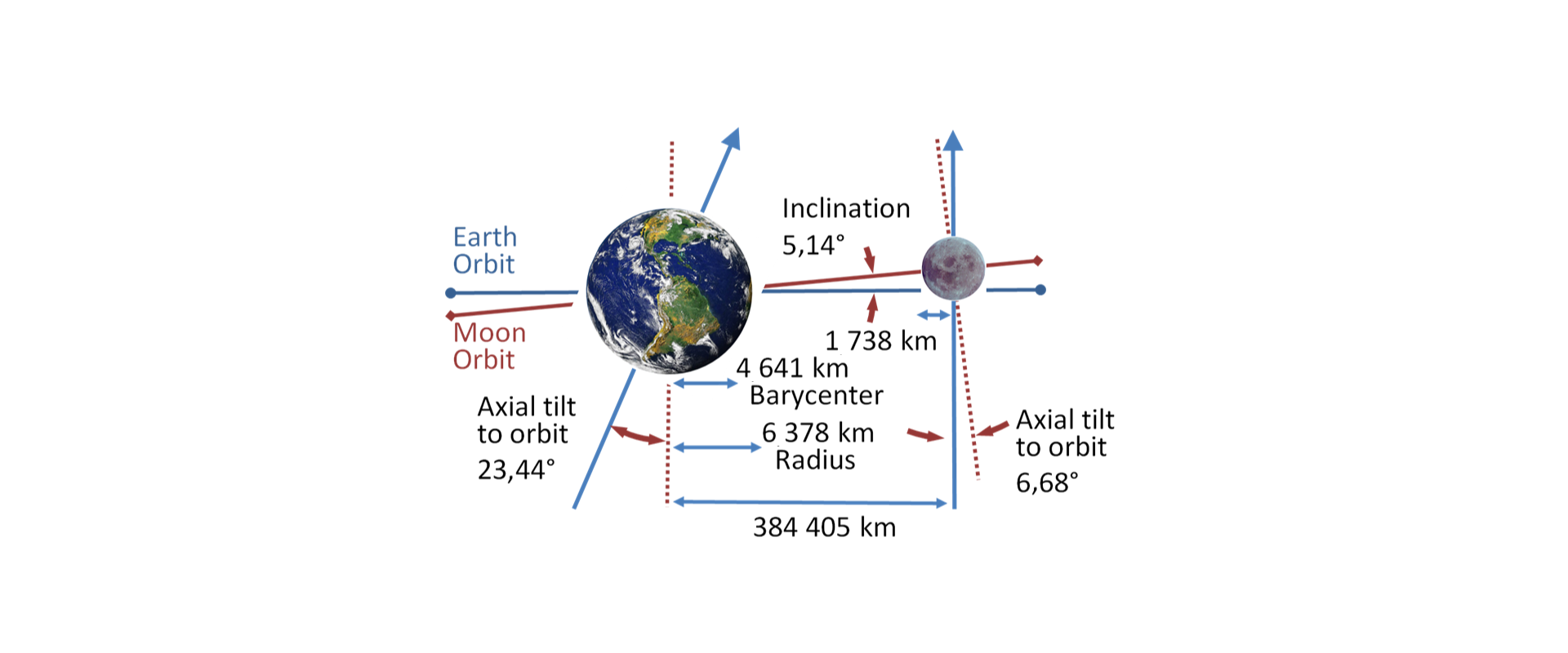
The Moon revolves around Earth in an ellipticalellipticalelliptical orbit which is tilted of about 5⁰ in respect to the Earth’s orbitorbitorbit. Hence, the Moon's centre‑to‑centre distance from the Earth varies with mean values of 363396 km at perigeeperigeeperigee to 405504 km at apogeeapogeeapogee.
ApogeeapogeeApogee is the point in the orbitorbitorbit of the Moon at which it is furthest from the Earth.
R4rUbT5DU0NmB
Ilustracja przedstawia Słońce, wokół którego po orbicie, oznaczonej numerem 2, krąży Ziemia oraz orbitę Księżyca, oznaczoną numerem 1, krążącego wokół Ziemi. Na ilustracji widoczne są numery, a na nich podpisy. 1. orbit of the Moon {audio}, 2. orbit of the Earth {audio}.
Ilustracja przedstawia Słońce, wokół którego po orbicie, oznaczonej numerem 2, krąży Ziemia oraz orbitę Księżyca, oznaczoną numerem 1, krążącego wokół Ziemi. Na ilustracji widoczne są numery, a na nich podpisy. 1. orbit of the Moon {audio}, 2. orbit of the Earth {audio}.
Orbits of the Earth and Moon
Source: GroMar, licencja: CC BY 3.0.
RqVlR9dGCRFhl
Na rysunku przedstawiona jest symbolicznie w postaci kół Ziemia i Księżyc. Niebieską linią zaznaczona jest orbita Ziemi - Earth Orbit, czerwoną linią orbita Księżyca - Moon Orbit. Zaznaczone są liniami przerywanymi linie przechodzące przez środek każdego obiektu prostopadłe do orbit oraz strzałki przechodzące przez nie, zgodnie z kierunkiem ich osi obrotu. Na rysunku zamieszczone są wszystkie parametry liczbowe opisujące wzajemne położenie Księżyca i Ziemi. Strzałka przechodząca przez Ziemię opisana Axial tilt to orbit 23,44 stopnia, linia przerywana przechodząca przez Księżyc opisana Axial tilt to orbit 6,68 stopnia. Kąt między orbitami opisany Inclination 5,14 stopnia. Promień Księżyca opisany 1738 km, promień Ziemi 6378 km. Odległość środka Ziemi od środka Księżyca 384405 km. Środek masy Ziemi opisany Barycenter 4641 km.
Parameters describing the orbits of the Earth and Moon
Source: GroMar, licencja: CC BY 3.0.
The figure shows the mutual position of the orbits of the Moon and the Earth. The axes of the Earth and the Moon are inclined to the planes of their orbits. The angle between the orbital planes of the Earth and the Moon is called inclination.
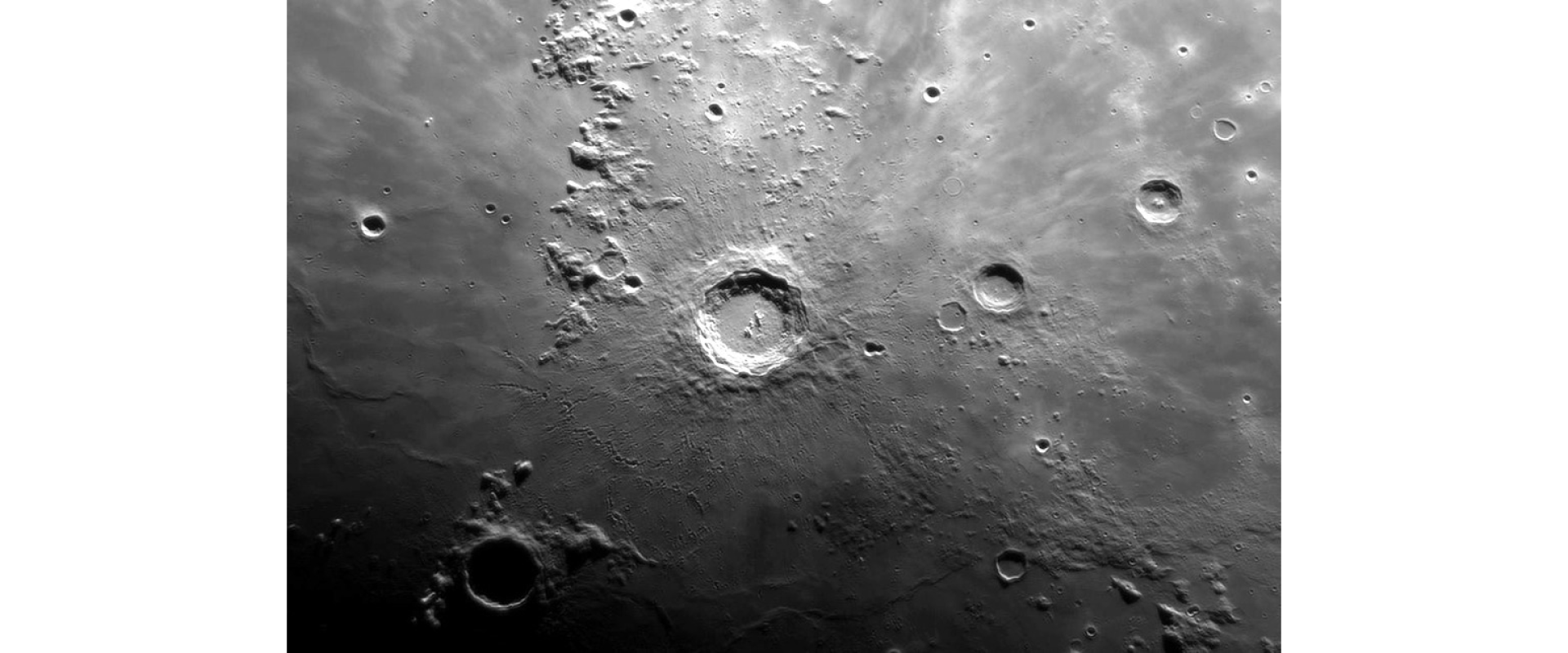
The surface of the Moon is covered with the dark and light areas. The dark areas are called maria. They cover about 17% of the Moon’s surface. The place where for the first time the astronauts landed is Mare Tranquilitatis (Sea of Tranquillity). The maria are large, dark, basaltic plains formed by ancient volcanic eruptions. Early astronomers were convinced that they are seas (Latin; singular: mare, plural: maria). The light areas between maria, highlands, are covered by large number of impact and volcano craters, lava, and mountains. Highlands have no names, but the craters are named for famous figures in the history of science.
SelenographyselenographySelenography is introduced by Galileo, is the study of the surface and physical features of the Moon.
RIcEWrtMDfEYH1
Na zdjęciu widoczna jest powierzchnia Księżyca – jej ciemnoszary wycinek w kształcie kwadratu. W centralnej części widoczny jest duży krater otoczony przez mniejsze rozrzucone w dowolny sposób wokół niego.
The Moon is a natural satellitenatural satellitenatural satellite of the Earth.
Moon revolves around Earth in an ellipticalellipticalelliptical orbit which is tilted of about 5⁰ in respect to the Earth’ orbitorbitorbit.
Its sidereal period is about 27,3 days and synodic is 29,5 days.
Exercises
R6B6FzYeSGVzN
Exercise 1
Wersja alternatywna ćwiczenia: Determine which sentences are true. Możliwe odpowiedzi: 1. The Moon travel around the Earth in a circular orbit., 2. The moon reflects the light from the Sun., 3. The Moon’s orbit is tilted in respect to the Earth’s orbit., 4. Practically Moon has no atmosphere.
Wersja alternatywna ćwiczenia: Determine which sentences are true. Możliwe odpowiedzi: 1. The Moon travel around the Earth in a circular orbit., 2. The moon reflects the light from the Sun., 3. The Moon’s orbit is tilted in respect to the Earth’s orbit., 4. Practically Moon has no atmosphere.
Determine which sentences are true.
The Moon travel around the Earth in a circular orbit.
The moon reflects the light from the Sun.
The Moon’s orbit is tilted in respect to the Earth’s orbit.
Practically Moon has no atmosphere.
Exercise 2
What part of the Earth's diameter is the diameter of the Moon?
Exercise 3
Describe in English how the surface of the Moon looks like.
RUcTaXaE0zdyp
Exercise 4
Wersja alternatywna ćwiczenia: Indicate which pairs of expressions or words are translated correctly. Możliwe odpowiedzi: 1. naturalny satelita - natural satellite, 2. okres orbitalny - orbital period, 3. perygeum - perigee, 4. apogeum - apogee, 5. wyżyna - tilt, 6. orbita - tilt
Wersja alternatywna ćwiczenia: Indicate which pairs of expressions or words are translated correctly. Możliwe odpowiedzi: 1. naturalny satelita - natural satellite, 2. okres orbitalny - orbital period, 3. perygeum - perigee, 4. apogeum - apogee, 5. wyżyna - tilt, 6. orbita - tilt
Indicate which pairs of expressions or words are translated correctly.
naturalny satelita - natural satellite
okres orbitalny - orbital period
perygeum - perigee
apogeum - apogee
wyżyna - tilt
orbita - tilt
zadanie
Source: GroMar, licencja: CC BY 3.0.
R128pjr2OU9lR1
Interaktywna gra, polegająca na łączeniu wyrazów w pary w ciągu jednej minuty. Czas zaczyna upływać wraz z rozpoczęciem gry. Jeden ruch to odkrywanie najpierw jednej potem drugiej karty z wyrazem. Każdy wyraz jest odczytywany. Kolejny ruch to odkrywanie trzeciej i czwartej karty. W ten sposób odsłuchasz wszystkie wyrazy. Nawigacja z poziomu klawiatury za pomocą strzałek, odsłuchiwanie wyrazów enterem lub spacją. Znajdź wszystkie pary wyrazów.
Interaktywna gra, polegająca na łączeniu wyrazów w pary w ciągu jednej minuty. Czas zaczyna upływać wraz z rozpoczęciem gry. Jeden ruch to odkrywanie najpierw jednej potem drugiej karty z wyrazem. Każdy wyraz jest odczytywany. Kolejny ruch to odkrywanie trzeciej i czwartej karty. W ten sposób odsłuchasz wszystkie wyrazy. Nawigacja z poziomu klawiatury za pomocą strzałek, odsłuchiwanie wyrazów enterem lub spacją. Znajdź wszystkie pary wyrazów.
Match Polish terms with their English equivalents.
orbital period
perygeum
naturalny satelita
okres orbitalny
apogeum
perigee
nachylenie
apogee
tilt
natural satellite
Source: Zespół autorski Politechniki Łódzkiej, licencja: CC BY 3.0.