Neutralization reaction, part 2
that there are water‑soluble hydroxides (eg NaOH) and weakly and sparingly water‑soluble (eg. Mg(OH)Indeks dolny 22, Al(OH)Indeks dolny 33, Fe(OH)Indeks dolny 33, Mg(OH)Indeks dolny 22);
that bases dissociate in water into metal cations and hydroxide anions;
that hydroxide solutions are alkaline,
that the acids dissociate in water into hydronium cations and anions of the acid residue;
that water solutions of acids are acidic.
to show in molecular and ionic form (full and truncated) the equation of the reaction between hydrochloric acid and sodium hydroxide taking place in an aqueous solution;
to explain what a neutralization reaction is;
to indicate substances that undergo neutralization;
how to design and experimentally carry out the neutralization reaction on the indicated examples.
Watch the video and pay attention to the course of the experiment. What do you think is received as a result of the reaction? Remember how to name this reaction? Write down the answer here or in the notebook.
Film dostępny na portalu epodreczniki.pl
Film pokazuje eksperyment. Problem badawczy: Czy słabo rozpuszczalne wodorotlenki reagują z kwasami? Hipoteza: wybierz jedną z przedstawionych hipotez, a następnie ją zweryfikuj. Słabo rozpuszczalne wodorotlenki reagują z kwasami. Słabo rozpuszczalne wodorotlenki nie reagują z kwasami. Będziesz potrzebował: probówki, pipety, bagietki, przygotowane przez nauczyciela tuż przed wykonaniem doświadczenia wodorotlenki: miedzi dwa, żelaza trzy, magnezu dwa, glinu (otrzymane np. w wyniku reakcji chlorków: miedzi dwa, żelaza trzy, magnezu, glinu z wodorotlenkiem sodu lub potasu), rozcieńczone roztwory kwasów: solnego, siarkowego sześć, azotowego pięć. Instrukcja: Zawiesinę (od jednego do dwóch centymetrów sześciennych) każdego z badanych wodorotlenków umieść w czterech probówkach. Do każdej z probówek dodaj inny kwas: do pierwszej – solny, do drugiej – siarkowy sześć, do trzeciej – azotowy pięć. Do czwartej probówki wlej podobną objętość wody (próbka kontrolna). W wyniku reakcji z kwasami wszystkie badane wodorotlenki uległy roztworzeniu.
Do the slightly water‑soluble hydroxides react with acids?
Do sparingly soluble hydroxides react with acids?
Select one of the presented hypotheses, and then verify it.
Poorly soluble hydroxides react with acids.
Poorly soluble hydroxides do not react with acids.
test tubes,
pipette,
stirring tube,
prepared by the teacher just before the experiment, hydroxides: copper(II), iron(III), magnesium, aluminum (obtained, e.g., by the reaction of chlorides: copper(II), iron(III), magnesium, aluminum with sodium or potassium hydroxide),
diluted solutions of acids: hydrochloric, sulfuric, nitric.
Suspend (1–2 cmIndeks górny 33) each of the tested hydroxides in 4 test tubes.
Add a different acid to each of the tubes: first - hydrochloric, second - sulfuric, third - nitric.
Add a similar volume of water to the fourth tube (control sample).
Observe what happens to hydroxides after each liquid is added.
Examples of reactions between hydroxides and acids
Look at the photographs depicting reactions between hydroxides and acids. That, as you already know, the reactions of neutralization. As a result, salt forms often with water. Also read the table of examples of this type of reaction.
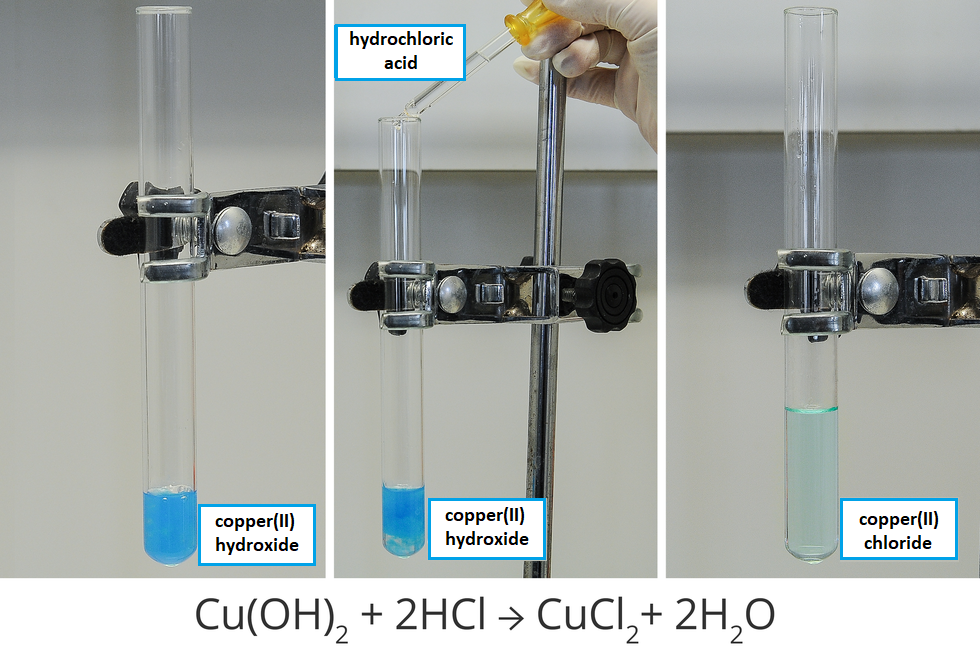
Examples of reactions of hydroxides with acids
Substrate 1 hydroxide | Substrate 2 acid | Direction of reaction | Product 1 | Product 2 |
KOH | HCl | → | HIndeks dolny 22O | KCl |
2KOH | HIndeks dolny 22SOIndeks dolny 44 | → | 2HIndeks dolny 22O | KIndeks dolny 22SOIndeks dolny 44 |
2NaOH | HIndeks dolny 22SOIndeks dolny 33 | → | 2HIndeks dolny 22O | NaIndeks dolny 22SOIndeks dolny 33 |
Cu(OH)Indeks dolny 22 | HIndeks dolny 22SOIndeks dolny 44 | → | 2HIndeks dolny 22O | CuSOIndeks dolny 44 |
Cu(OH)Indeks dolny 22 | 2HNOIndeks dolny 33 | → | 2HIndeks dolny 22O | Cu(NOIndeks dolny 33)Indeks dolny 22 |
Mg(OH)Indeks dolny 22 | HIndeks dolny 22SOIndeks dolny 44 | → | 2HIndeks dolny 22O | MgSOIndeks dolny 44 |
Mg(OH)Indeks dolny 22 | 2HNOIndeks dolny 33 | → | 2HIndeks dolny 22O | Mg(NOIndeks dolny 33)Indeks dolny 22 |
2Fe(OH)Indeks dolny 33 | 3HIndeks dolny 22SOIndeks dolny 44 | → | 6HIndeks dolny 22O | FeIndeks dolny 22(SOIndeks dolny 44)Indeks dolny 33 |
Fe(OH)Indeks dolny 33 | 3HCl | → | 3HIndeks dolny 22O | FeClIndeks dolny 33 |
Fe(OH)Indeks dolny 33 | 3HNOIndeks dolny 33 | → | 3HIndeks dolny 22O | Fe(NOIndeks dolny 33)Indeks dolny 33 |
The use of neutralization reactions
The neutralization reaction allows to regulate the acidity of the solutions. Where the excess of acids is harmful, we neutralize them by acting with principles. Conversely, the excess of the base can be neutralized with acid.
Look at the interactive illustration showing the application of the neutralization reaction. What other examples of such activities do you know? Write down the suggestions.
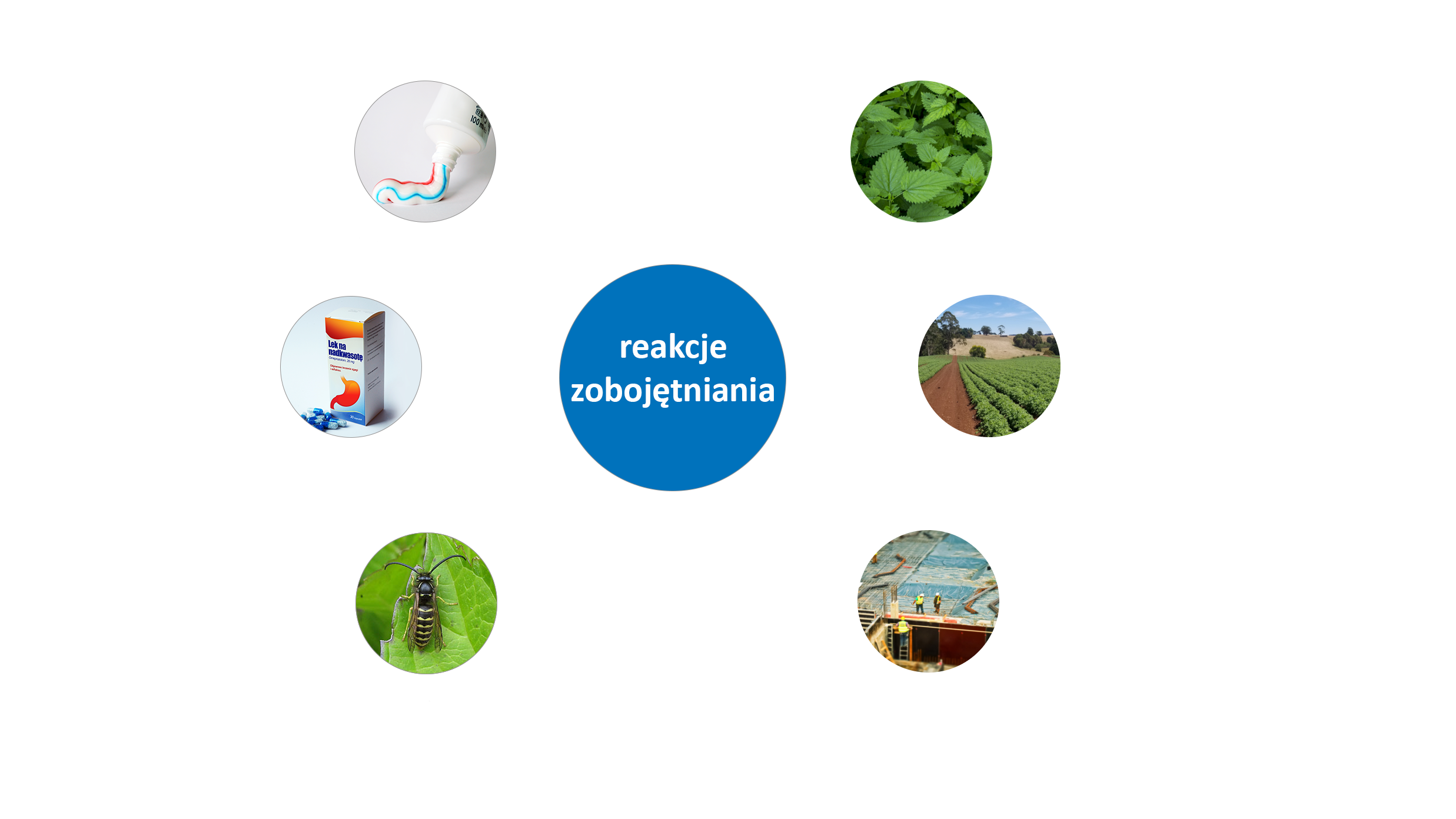
1. Próchnica Resztki pokarmów w jamie ustnej stanowią pożywkę dla bakterii. Te natomiast produkują kwasy, które niszczą szkliwo zębów i powodują próchnicę. Aby zneutralizować ich działanie, używamy past do zębów i płynów do płukania jamy ustnej o odczynie zasadowym.
2. Lek na nadkwaśność żołądka Substancjami czynnymi takich leków są np. wodorotlenek magnezu lub glinu, które zmniejszają kwasowy odczyn treści żołądkowej, reagując z kwasem solnym obecnym w żołądku.
3. Użądlenia Jad os zawiera substancje o odczynie zasadowym. Aby zniwelować jego działanie, miejsce użądlenia można przemyć roztworem o odczynie kwasowym, np. rozcieńczonym octem.
4. Pokrzywy W liściach pokrzywy znajduje się, podobnie jak w jadzie owadów (os, pszczół, mrówek), kwas mrówkowy. Dobrze wiemy, jak potrafi piec skóra po bliskim spotkaniu z tą rośliną! Dolegliwości można zmniejszyć poprzez przemycie bolącego miejsca rozcieńczonym roztworem wodorotlenku, np. wapnia.
5. Rolnictwo i uprawa roślin Kwaśne gleby neutralizuje się, posypując je wapnem palonym, który w reakcji z wodą glebową tworzy zasadę wapniową (odczyn zasadowy).
6. Wypadki Podczas prac budowlanych zdarzają się poparzenia wapnem gaszonym o odczynie zasadowym. Pierwsza pomoc w takich wypadkach polega na neutralizacji tego odczynu, np. roztworem octu (odczyn kwasowy).
Complete the definition
The reaction of neutralization – reaction between acid and .................., which relies on reaction of hydronium .............. (or ions) with hydroxide ............ (or ions) to form water molecules.
Complete the text.
Red, diluted vinegar solution, metal cations Mn+, salt, diluted ammonia solution, water, hydroxide anions, yellow
The essence of the neutralization reaction is the formation of ................................................ molecules. The acids and bases undergo a neutralization reaction in which hydronium cations (H3O+) are combined with .................................................
The universal indicator paper found in the acid solution at the moment of neutralizing this acid with the base will take on the color ................................................. In the case of nettle burn, the red area can be washed with .................................................
Summary
In aqueous solution, hydroxides react with acids.
The transformation involving the reaction of hydroxide anions with hydrogen cations, resulting in inert water molecules, is called the neutralization reaction.
The neutralization reaction produces salt and often, but not always, water.
The neutralization reaction allows to regulate the acidity of the solutions.
Excess acid is neutralized with a base.
Low water soluble hydroxides also react with acids, such as, for example: sulfuric, hydrochloric, nitric.
Explain why there is no sodium hydroxide in the antacid composition in the stomach. For suggestions, search for example in the safety data sheet for this substance.
Keywords
neutralization reaction, hydroxides, acids, salts
Match the pairs: English words with Polish definition.
reakcja między kwasem a wodorotlenkiem, która polega na reakcji kationów oksonowych (w uproszczeniu - wodorowych) z anionami wodorotlenkowymi z utworzeniem cząsteczek wody., równanie reakcji przebiegającej w roztworze wodnym; przedstawia substancje i jony faktycznie biorące udział w reakcji, zapis przedstawiający przebieg reakcji w roztworze wodnym; przedstawia rozpuszczalne w wodzie substraty i produkty jako jony (zgodnie z ich dysocjacją)
| complete ionic equation | |
| neutralization reaction | |
| net ionic equation |
Glossary
pełny zapis jonowy – zapis przedstawiający przebieg reakcji w roztworze wodnym; przedstawia rozpuszczalne w wodzie substraty i produkty jako jony (zgodnie z ich dysocjacją)
reakcja zobojętniania – reakcja między kwasem a wodorotlenkiem, która polega na reakcji kationów oksonowych (w uproszczeniu - wodorowych) z anionami wodorotlenkowymi z utworzeniem cząsteczek wody.
skrócony zapis jonowy – równanie reakcji przebiegającej w roztworze wodnym; przedstawia substancje i jony faktycznie biorące udział w reakcji