The monarchy of the estatesMonarchy of the estatesmonarchy of the estates was in place in Poland in the 14th and the 15th centuries. Four estates developed in the Polish society: clergy, nobility, bourgeois and peasantry. Each estate had precisely specified tasks and obligations.
In case of the clergy they included religious service, social welfare and health care, as well as the spiritual strengthening of the society. In the case of nobles – military service and judicature. In the case of bourgeois – commerce and handicraft. Peasants did not own land, instead just used it, and consequently had to make provide services to the landowners.
The nobility developed from magnates and knights. The major factor that shaped nobility were the privileges bestowing in broad rights in the nobles. Nobles were exempt from paying taxes, and had guaranteed personal and property inviolability. To become a nobleman, one had to be born in a noble family. Most nobles had own coats of arms.
In the 15th century, the state interests were identified with the interests of just one estate - the nobility. Such institutions were created as sejm and regional sejmiksRegional sejmikregional sejmiks. The general sejmGeneral sejmgeneral sejm consisted of the „three estates”: the King, the Senate and the Chamber of Deputies. The debates were chaired by the King. The Senate consisted of the highest state officials and the hierarchs of the Church. The Chamber of Deputies consisted of deputies elected at semiks. The main competences of the sejm included: passing taxes, the directions of the state’s foreign policy, controlling the ministers and the right to ennobleEnnoblementennoble. Only the general sejm could pass constitutions, i.e. change the laws. The general sejm was convened every two years for the period of six weeks.
Additionally, there were also: extraordinary sejms convened in case of a threat to the state; convocation sejms convened after the death of the king and chaired by the Primate (interrex); election sejms, at which the monarchs were elected, and coronation sejms.
The sejm was convened by the king, while all assemblies of the nobles convened without the king’s consent were illegal and were referred to as RokoszRokoszRokosz. The assemblies of the nobles aimed at the establishment of an union to achieve common benefits were referred to as confederationsConfederationconfederations.
Task 1
R1TFBL534lUHo
Look at the timeline presenting the most important events of the epoch of noble's democracy and organize your knowledge. Which of the events were the most important and why? 1215 John the Lackland issues “the Great Charter of the Liberties” Illustration showing King John signing the Great Charter of the Liberties., 1222 The King of Hungary issues the “Golden Bull” to the Hungarian nobles, guaranteeing to them privileges enjoyed so far by magnates Illustration showing king Andrew II of Hungary., 1493 The first The general sejm of Poland in Piotrków , 1501 The Privilege of Mielnik Illustration showing Alexander I Jagiellon., 1530 The Diet of Augsburg adopted the Augsburg Confession The Diet of Augsburg – engraving by Christian Beyer., 1573 Warsaw Confederation The shows the Warsaw Confederation Act., 1613 The zemsky sobor in Moskow elects elected Mikhail Romanov the tsar Illustration showing elected Mikhail Romanov., 1649 Beheading of Charles I Stuart, King of England and Scotland Illustration showing the execution of Charles I.
Look at the timeline presenting the most important events of the epoch of noble's democracy and organize your knowledge. Which of the events were the most important and why? 1215 John the Lackland issues “the Great Charter of the Liberties” Illustration showing King John signing the Great Charter of the Liberties., 1222 The King of Hungary issues the “Golden Bull” to the Hungarian nobles, guaranteeing to them privileges enjoyed so far by magnates Illustration showing king Andrew II of Hungary., 1493 The first The general sejm of Poland in Piotrków , 1501 The Privilege of Mielnik Illustration showing Alexander I Jagiellon., 1530 The Diet of Augsburg adopted the Augsburg Confession The Diet of Augsburg – engraving by Christian Beyer., 1573 Warsaw Confederation The shows the Warsaw Confederation Act., 1613 The zemsky sobor in Moskow elects elected Mikhail Romanov the tsar Illustration showing elected Mikhail Romanov., 1649 Beheading of Charles I Stuart, King of England and Scotland Illustration showing the execution of Charles I.
Source: domena publiczna.
Task 2
Answer the questions:
What part of society was represented by the general sejm?
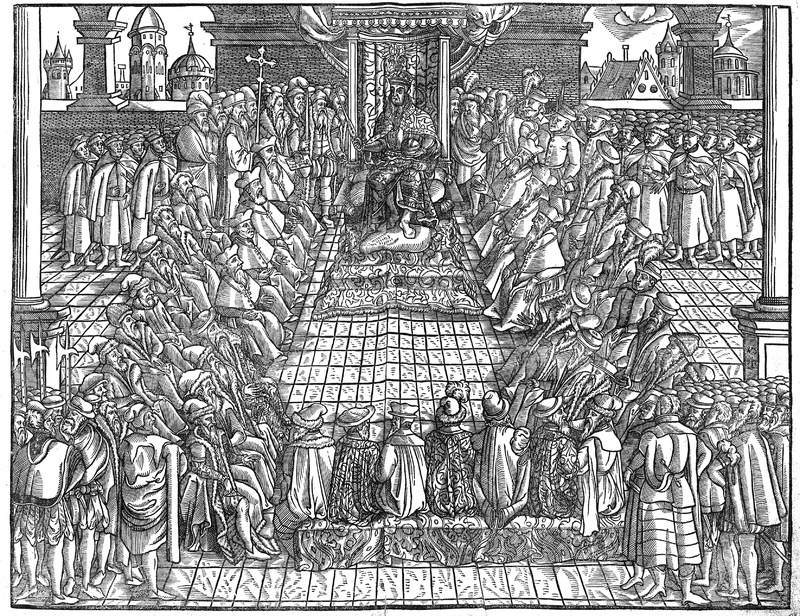
Consider how the location and ceremonies of the joint debates reflected the social structure in the Commonwealth. Did they show the accepted principle of equality of the nobility, or perhaps they showed the political strength of the so‑called „Parliamentary orders”?
R1QRcGbiXAWie
Ilustracja przedstawiająca Sejm za panowania Zygmunta II Augusta.
Seym during the reign of Zygmunt II August, artwork from the work of Jan Herburt Statuta y Przywileie Koronne from 1570
Source: Wikimedia Commons, domena publiczna.
Task 3
Wybierz dowolne angielskie słówko ze słowniczka i zapytaj kolegę o jego znaczenie.
Wybierz dowolne angielskie słówko ze słowniczka i zapytaj kolegę o jego znaczenie.
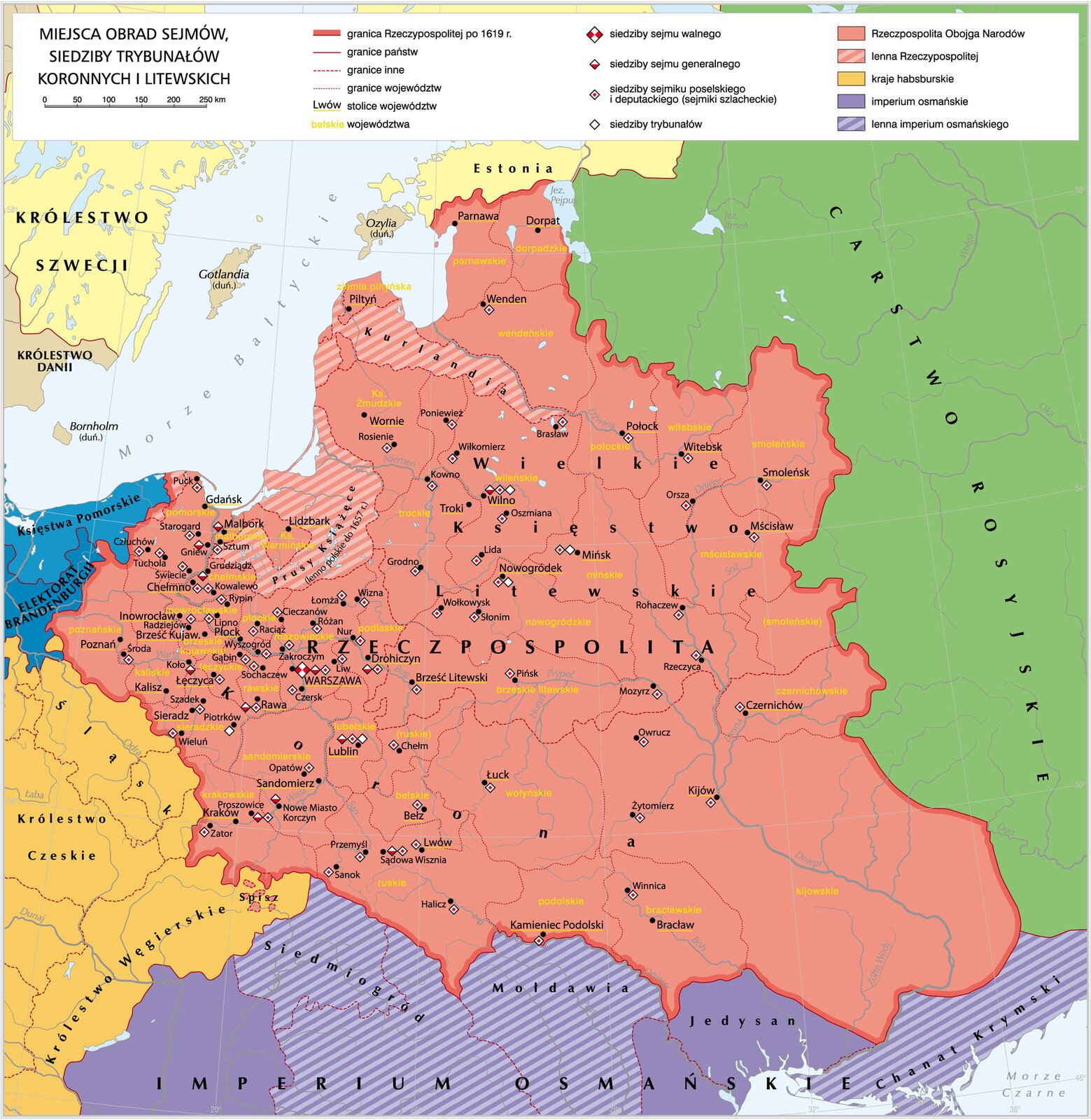
Using the scale of the map, calculate the approximate duration of the nobleman's journey from the remotest place of the given voivodship to the place of the sejmik meeting. Think about how this affected the attendance.
R1DzGpqF3HHel
Grafika mapy przedstawiającej Miejsca obrad Sejmów, siedziby trybunałów koronnych i litewskich.
Meeting places of the Sejms, headquarters of the Crown and Lithuanian Courts
Source: Krystian Chariza i zespół, Wikimedia Commons, licencja: CC BY 3.0.
R5dILovTm869Y
Exercise 1
Match terms to definitions. Nobles' democracy Możliwe odpowiedzi: 1. a legislative organ in Poland in the past, consisting of the "three estates": the King, the Senate and the Chamber of Deputies. It was convened every two years for the period of six weeks., 2. the political system of the Commonwealth in the 15th and the 16th centuries, characterising with the predominant role of the nobles in ruling the state., 3. regional assembly of nobles., 4. a temporary union of nobles, clergy, or towns in order to achieve particular goals; also: a union of states conducting common foreign policy., 5. a political system, in which the power of the monarch is limited in favour of a selected social group (estate): nobles, clergy, or sometimes bourgeoisie., 6. the Kingdom of Poland in years 1454–1791., 7. conferring of nobility on a person not originating from that social group., 8. a gathering or armed rebellion of nobles against the king, aimed at the protection of endangered privileges. Confederation Możliwe odpowiedzi: 1. a legislative organ in Poland in the past, consisting of the "three estates": the King, the Senate and the Chamber of Deputies. It was convened every two years for the period of six weeks., 2. the political system of the Commonwealth in the 15th and the 16th centuries, characterising with the predominant role of the nobles in ruling the state., 3. regional assembly of nobles., 4. a temporary union of nobles, clergy, or towns in order to achieve particular goals; also: a union of states conducting common foreign policy., 5. a political system, in which the power of the monarch is limited in favour of a selected social group (estate): nobles, clergy, or sometimes bourgeoisie., 6. the Kingdom of Poland in years 1454–1791., 7. conferring of nobility on a person not originating from that social group., 8. a gathering or armed rebellion of nobles against the king, aimed at the protection of endangered privileges. Monarchy of the estates Możliwe odpowiedzi: 1. a legislative organ in Poland in the past, consisting of the "three estates": the King, the Senate and the Chamber of Deputies. It was convened every two years for the period of six weeks., 2. the political system of the Commonwealth in the 15th and the 16th centuries, characterising with the predominant role of the nobles in ruling the state., 3. regional assembly of nobles., 4. a temporary union of nobles, clergy, or towns in order to achieve particular goals; also: a union of states conducting common foreign policy., 5. a political system, in which the power of the monarch is limited in favour of a selected social group (estate): nobles, clergy, or sometimes bourgeoisie., 6. the Kingdom of Poland in years 1454–1791., 7. conferring of nobility on a person not originating from that social group., 8. a gathering or armed rebellion of nobles against the king, aimed at the protection of endangered privileges. Ennoblement Możliwe odpowiedzi: 1. a legislative organ in Poland in the past, consisting of the "three estates": the King, the Senate and the Chamber of Deputies. It was convened every two years for the period of six weeks., 2. the political system of the Commonwealth in the 15th and the 16th centuries, characterising with the predominant role of the nobles in ruling the state., 3. regional assembly of nobles., 4. a temporary union of nobles, clergy, or towns in order to achieve particular goals; also: a union of states conducting common foreign policy., 5. a political system, in which the power of the monarch is limited in favour of a selected social group (estate): nobles, clergy, or sometimes bourgeoisie., 6. the Kingdom of Poland in years 1454–1791., 7. conferring of nobility on a person not originating from that social group., 8. a gathering or armed rebellion of nobles against the king, aimed at the protection of endangered privileges. Rokosz Możliwe odpowiedzi: 1. a legislative organ in Poland in the past, consisting of the "three estates": the King, the Senate and the Chamber of Deputies. It was convened every two years for the period of six weeks., 2. the political system of the Commonwealth in the 15th and the 16th centuries, characterising with the predominant role of the nobles in ruling the state., 3. regional assembly of nobles., 4. a temporary union of nobles, clergy, or towns in order to achieve particular goals; also: a union of states conducting common foreign policy., 5. a political system, in which the power of the monarch is limited in favour of a selected social group (estate): nobles, clergy, or sometimes bourgeoisie., 6. the Kingdom of Poland in years 1454–1791., 7. conferring of nobility on a person not originating from that social group., 8. a gathering or armed rebellion of nobles against the king, aimed at the protection of endangered privileges. Nobles' Commonwealth Możliwe odpowiedzi: 1. a legislative organ in Poland in the past, consisting of the "three estates": the King, the Senate and the Chamber of Deputies. It was convened every two years for the period of six weeks., 2. the political system of the Commonwealth in the 15th and the 16th centuries, characterising with the predominant role of the nobles in ruling the state., 3. regional assembly of nobles., 4. a temporary union of nobles, clergy, or towns in order to achieve particular goals; also: a union of states conducting common foreign policy., 5. a political system, in which the power of the monarch is limited in favour of a selected social group (estate): nobles, clergy, or sometimes bourgeoisie., 6. the Kingdom of Poland in years 1454–1791., 7. conferring of nobility on a person not originating from that social group., 8. a gathering or armed rebellion of nobles against the king, aimed at the protection of endangered privileges. The general sejm Możliwe odpowiedzi: 1. a legislative organ in Poland in the past, consisting of the "three estates": the King, the Senate and the Chamber of Deputies. It was convened every two years for the period of six weeks., 2. the political system of the Commonwealth in the 15th and the 16th centuries, characterising with the predominant role of the nobles in ruling the state., 3. regional assembly of nobles., 4. a temporary union of nobles, clergy, or towns in order to achieve particular goals; also: a union of states conducting common foreign policy., 5. a political system, in which the power of the monarch is limited in favour of a selected social group (estate): nobles, clergy, or sometimes bourgeoisie., 6. the Kingdom of Poland in years 1454–1791., 7. conferring of nobility on a person not originating from that social group., 8. a gathering or armed rebellion of nobles against the king, aimed at the protection of endangered privileges. Sejmik Możliwe odpowiedzi: 1. a legislative organ in Poland in the past, consisting of the "three estates": the King, the Senate and the Chamber of Deputies. It was convened every two years for the period of six weeks., 2. the political system of the Commonwealth in the 15th and the 16th centuries, characterising with the predominant role of the nobles in ruling the state., 3. regional assembly of nobles., 4. a temporary union of nobles, clergy, or towns in order to achieve particular goals; also: a union of states conducting common foreign policy., 5. a political system, in which the power of the monarch is limited in favour of a selected social group (estate): nobles, clergy, or sometimes bourgeoisie., 6. the Kingdom of Poland in years 1454–1791., 7. conferring of nobility on a person not originating from that social group., 8. a gathering or armed rebellion of nobles against the king, aimed at the protection of endangered privileges.
Match terms to definitions. Nobles' democracy Możliwe odpowiedzi: 1. a legislative organ in Poland in the past, consisting of the "three estates": the King, the Senate and the Chamber of Deputies. It was convened every two years for the period of six weeks., 2. the political system of the Commonwealth in the 15th and the 16th centuries, characterising with the predominant role of the nobles in ruling the state., 3. regional assembly of nobles., 4. a temporary union of nobles, clergy, or towns in order to achieve particular goals; also: a union of states conducting common foreign policy., 5. a political system, in which the power of the monarch is limited in favour of a selected social group (estate): nobles, clergy, or sometimes bourgeoisie., 6. the Kingdom of Poland in years 1454–1791., 7. conferring of nobility on a person not originating from that social group., 8. a gathering or armed rebellion of nobles against the king, aimed at the protection of endangered privileges. Confederation Możliwe odpowiedzi: 1. a legislative organ in Poland in the past, consisting of the "three estates": the King, the Senate and the Chamber of Deputies. It was convened every two years for the period of six weeks., 2. the political system of the Commonwealth in the 15th and the 16th centuries, characterising with the predominant role of the nobles in ruling the state., 3. regional assembly of nobles., 4. a temporary union of nobles, clergy, or towns in order to achieve particular goals; also: a union of states conducting common foreign policy., 5. a political system, in which the power of the monarch is limited in favour of a selected social group (estate): nobles, clergy, or sometimes bourgeoisie., 6. the Kingdom of Poland in years 1454–1791., 7. conferring of nobility on a person not originating from that social group., 8. a gathering or armed rebellion of nobles against the king, aimed at the protection of endangered privileges. Monarchy of the estates Możliwe odpowiedzi: 1. a legislative organ in Poland in the past, consisting of the "three estates": the King, the Senate and the Chamber of Deputies. It was convened every two years for the period of six weeks., 2. the political system of the Commonwealth in the 15th and the 16th centuries, characterising with the predominant role of the nobles in ruling the state., 3. regional assembly of nobles., 4. a temporary union of nobles, clergy, or towns in order to achieve particular goals; also: a union of states conducting common foreign policy., 5. a political system, in which the power of the monarch is limited in favour of a selected social group (estate): nobles, clergy, or sometimes bourgeoisie., 6. the Kingdom of Poland in years 1454–1791., 7. conferring of nobility on a person not originating from that social group., 8. a gathering or armed rebellion of nobles against the king, aimed at the protection of endangered privileges. Ennoblement Możliwe odpowiedzi: 1. a legislative organ in Poland in the past, consisting of the "three estates": the King, the Senate and the Chamber of Deputies. It was convened every two years for the period of six weeks., 2. the political system of the Commonwealth in the 15th and the 16th centuries, characterising with the predominant role of the nobles in ruling the state., 3. regional assembly of nobles., 4. a temporary union of nobles, clergy, or towns in order to achieve particular goals; also: a union of states conducting common foreign policy., 5. a political system, in which the power of the monarch is limited in favour of a selected social group (estate): nobles, clergy, or sometimes bourgeoisie., 6. the Kingdom of Poland in years 1454–1791., 7. conferring of nobility on a person not originating from that social group., 8. a gathering or armed rebellion of nobles against the king, aimed at the protection of endangered privileges. Rokosz Możliwe odpowiedzi: 1. a legislative organ in Poland in the past, consisting of the "three estates": the King, the Senate and the Chamber of Deputies. It was convened every two years for the period of six weeks., 2. the political system of the Commonwealth in the 15th and the 16th centuries, characterising with the predominant role of the nobles in ruling the state., 3. regional assembly of nobles., 4. a temporary union of nobles, clergy, or towns in order to achieve particular goals; also: a union of states conducting common foreign policy., 5. a political system, in which the power of the monarch is limited in favour of a selected social group (estate): nobles, clergy, or sometimes bourgeoisie., 6. the Kingdom of Poland in years 1454–1791., 7. conferring of nobility on a person not originating from that social group., 8. a gathering or armed rebellion of nobles against the king, aimed at the protection of endangered privileges. Nobles' Commonwealth Możliwe odpowiedzi: 1. a legislative organ in Poland in the past, consisting of the "three estates": the King, the Senate and the Chamber of Deputies. It was convened every two years for the period of six weeks., 2. the political system of the Commonwealth in the 15th and the 16th centuries, characterising with the predominant role of the nobles in ruling the state., 3. regional assembly of nobles., 4. a temporary union of nobles, clergy, or towns in order to achieve particular goals; also: a union of states conducting common foreign policy., 5. a political system, in which the power of the monarch is limited in favour of a selected social group (estate): nobles, clergy, or sometimes bourgeoisie., 6. the Kingdom of Poland in years 1454–1791., 7. conferring of nobility on a person not originating from that social group., 8. a gathering or armed rebellion of nobles against the king, aimed at the protection of endangered privileges. The general sejm Możliwe odpowiedzi: 1. a legislative organ in Poland in the past, consisting of the "three estates": the King, the Senate and the Chamber of Deputies. It was convened every two years for the period of six weeks., 2. the political system of the Commonwealth in the 15th and the 16th centuries, characterising with the predominant role of the nobles in ruling the state., 3. regional assembly of nobles., 4. a temporary union of nobles, clergy, or towns in order to achieve particular goals; also: a union of states conducting common foreign policy., 5. a political system, in which the power of the monarch is limited in favour of a selected social group (estate): nobles, clergy, or sometimes bourgeoisie., 6. the Kingdom of Poland in years 1454–1791., 7. conferring of nobility on a person not originating from that social group., 8. a gathering or armed rebellion of nobles against the king, aimed at the protection of endangered privileges. Sejmik Możliwe odpowiedzi: 1. a legislative organ in Poland in the past, consisting of the "three estates": the King, the Senate and the Chamber of Deputies. It was convened every two years for the period of six weeks., 2. the political system of the Commonwealth in the 15th and the 16th centuries, characterising with the predominant role of the nobles in ruling the state., 3. regional assembly of nobles., 4. a temporary union of nobles, clergy, or towns in order to achieve particular goals; also: a union of states conducting common foreign policy., 5. a political system, in which the power of the monarch is limited in favour of a selected social group (estate): nobles, clergy, or sometimes bourgeoisie., 6. the Kingdom of Poland in years 1454–1791., 7. conferring of nobility on a person not originating from that social group., 8. a gathering or armed rebellion of nobles against the king, aimed at the protection of endangered privileges.
Match terms to definitions.
the Kingdom of Poland in years 1454–1791., a legislative organ in Poland in the past, consisting of the "three estates": the King, the Senate and the Chamber of Deputies. It was convened every two years for the period of six weeks., the political system of the Commonwealth in the 15th and the 16th centuries, characterising with the predominant role of the nobles in ruling the state., regional assembly of nobles., conferring of nobility on a person not originating from that social group., a temporary union of nobles, clergy, or towns in order to achieve particular goals; also: a union of states conducting common foreign policy., a political system, in which the power of the monarch is limited in favour of a selected social group (estate): nobles, clergy, or sometimes bourgeoisie., a gathering or armed rebellion of nobles against the king, aimed at the protection of endangered privileges.
Nobles' democracy
Confederation
Monarchy of the estates
Ennoblement
Rokosz
Nobles' Commonwealth
The general sejm
Sejmik
Keywords
Confederation, ennoblement, general sejm, regional sejmik
Konfederacja – związek zawierany na pewien okres przez szlachtę, duchowieństwo lub miasta dla osiągnięcia określonych celów; także: związek państw, prowadzących wspólną politykę zagraniczną.
Monarchia stanowa – ustrój polityczny, w którym władza monarchy została ograniczona na rzecz wybranej grupy społecznej (stanu): szlachty lub duchowieństwa, a niekiedy także mieszczaństwa.
Rzeczpospolita szlachecka – Królestwo Polskie w latach 1454–1569, a od czau unii lubelskiej Rzeczpospolita Obojga Narodów składajaca się z Korony Królestwa Polskiego i Wielkiego Księstwa Litewskiego.
Sejm walny – w dawnej Polsce organ władzy ustawodawczej, składający się z „trzech stanów” sejmujących: króla, senatu i izby poselskiej. Był zwoływany co dwa lata na sześć tygodni.