RaDxuAMDLpYYr

On the paved streets of Paris, and beyond – 19th century Polish culture in exile

Paris, view of the Notre Dame cathedral
Source: Paryż, widok na katedrę Notre Dame, XIX wiek, domena publiczna.

Link to the lesson

You will learn
  • why the emigrationemigrationemigration after the November Uprising has been called ‘Great’;

  • where Poles emigrated in the first half of the 19th century;

  • about some outstanding Polish expatriates;

  • about the fate and work of Adam Mickiewicz, Fryderyk Chopin, Maria Skłodowska‑Curie and Helena Modrzejewska.

R12LrY9YZcbTB
Nagranie dźwiękowe abstraktu.

In the period of the Partitions of Poland, Poles could not freely develop their culture. The partitioners fought against Polishness through Germanization and Russification. Polish cultural life was, therefore, taking place in exile, mainly in Paris. It was there that, among others, the poet Adam Mickiewicz and the composer Fryderyk Chopin stayed and worked, and also there that Maria Skłodowska‑Curie, the most outstanding Polish and world researcher of the 19th century, pursued her scientific career.
1
Task 1
Do jakich krajów emigrowali Polacy w ramach tzw. Wielkiej Emigracji ?'Przypomnij sobie tytuł abstraktu, wysłuchaj nagrania i spróbuj zaproponować własny temat dla dzisiejszej lekcji.
RClTo9TIjyJL6
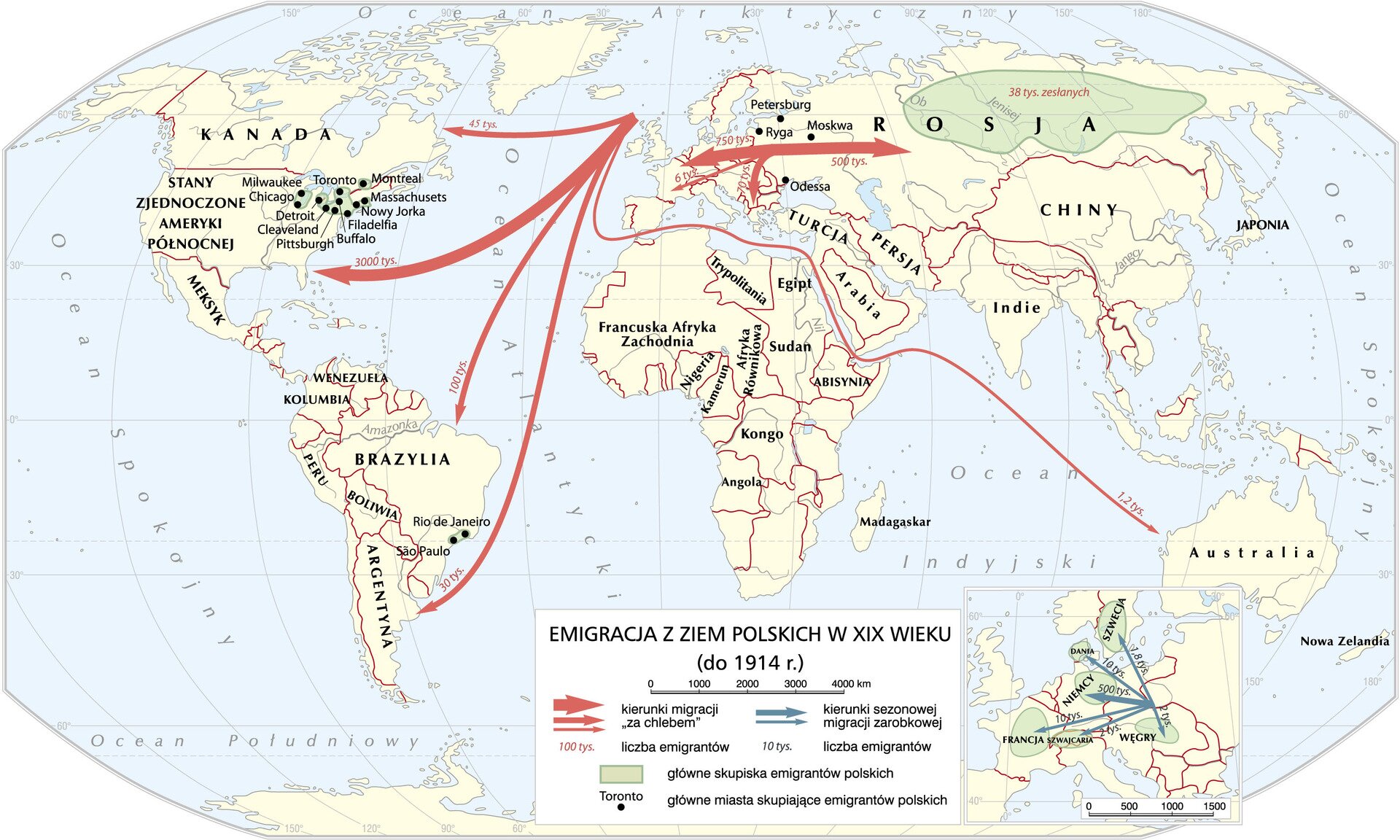
Emigration from Polish territories in the 19th century (until 1914)
Source: Krystian Chariza i zespół.
R108Gwgot4w7s
Exercise 1
Which of the following countries took in 100,000 or more Polish emigrants in the period of the Partitions of Poland? Możliwe odpowiedzi: 1. Switzerland, 2. Germany, 3. Turkey, 4. Russia, 5. Brazil, 6. Belgium, 7. USA, 8. France, 9. Argentina, 10. Austria
R16HrluTQEFVD
Exercise 2
The most people left Poland ‘seeking bread’ in the period of the last 15 years before the outbreak of World War I in 1914. Nevertheless, the term ‘Great Emigration’ is used after the November Uprising, when the country was abandoned by those who wanted to protect themselves from the repressions of the tsarist regime. Why is this emigration called ‘great’? Możliwe odpowiedzi: 1. Because Poles went to many countries., 2. Because eminent people emigrated who created great works in exile., 3. Because it lasted a very long time., 4. Because Poles settled in big cities.
Task 2
Jacy znani Polacy emigrowali do Paryża w XIX wieku?
ReftnJ7L1TGeN1
Obraz Teofila Kwiatkowskiego "Polonez Chopina". 1. Fryderyk Chopin. One of the most important Polish composers and expatriate artists. One of the most visible characters, behind him there are people directly connected with him. Marcelina Czartoryska (sitting) – Chopin’s student and performer of his music, and George Sand (standing) – the artist’s great love., 2. Country girl. A barefooted girl with braids; the composer’s muse. She symbolizes the longing for the homeland and its landscapes., 3. Adam Mickiewicz. Polish poet, an independence activist and organizer of Polish troops to fight with Russia.It is no coincidence that, being a prominent artist of romanticism, he was placed next to Chopin, a romantic composer. Both of them symbolize artists in exile., 4. Książę Adam Czartoryski. Leader of the political camp of the Paris expatriate community. Depicted as a gray old man wearing a royal coat – “as if he were carrying the destiny of Poland on his shoulders”. He was a great authority among Poles., 5. Family of Rev. Adam Czartoryski Dressed in national outfits, the closest family of Rev. Czartoryski symbolizes the next generation, whose task will be to nurture and take over the leadership of the Polish expatriate community., 6. Zawisza Czarny. One of the most outstanding knights in Polish history. Symbol of a reference to the glorious tradition, great history and virtues of knights., 7. Polish nobility. People in historical costumes who raise banners, crosses and insurgents' scythes with blades set upright. In the background, above their heads, there are the Hussar wings.
R1ehIXIG9QwVD1
Exercise 3
Match the terms to the names. Fryderyk Chopin Możliwe odpowiedzi: 1. actress, 2. California, 3. composer, 4. Pan Tadeusz, 5. Revolutionary Étude, 6. Polish Legion, 7. mazurkas, 8. Nobel Prize, 9. Constantinople, 10. Shakespeare, 11. romanticism, 12. theater, 13. Sorbonne, 14. polonium, 15. radioactivity, 16. Żelazowa Wola Adam Mickiewicz Możliwe odpowiedzi: 1. actress, 2. California, 3. composer, 4. Pan Tadeusz, 5. Revolutionary Étude, 6. Polish Legion, 7. mazurkas, 8. Nobel Prize, 9. Constantinople, 10. Shakespeare, 11. romanticism, 12. theater, 13. Sorbonne, 14. polonium, 15. radioactivity, 16. Żelazowa Wola Maria Skłodowska-Curie Możliwe odpowiedzi: 1. actress, 2. California, 3. composer, 4. Pan Tadeusz, 5. Revolutionary Étude, 6. Polish Legion, 7. mazurkas, 8. Nobel Prize, 9. Constantinople, 10. Shakespeare, 11. romanticism, 12. theater, 13. Sorbonne, 14. polonium, 15. radioactivity, 16. Żelazowa Wola Helena Modrzejewska Możliwe odpowiedzi: 1. actress, 2. California, 3. composer, 4. Pan Tadeusz, 5. Revolutionary Étude, 6. Polish Legion, 7. mazurkas, 8. Nobel Prize, 9. Constantinople, 10. Shakespeare, 11. romanticism, 12. theater, 13. Sorbonne, 14. polonium, 15. radioactivity, 16. Żelazowa Wola

Keywords

emigration, Adam Mickiewicz, Fryderyk Chopin, Maria Skłodowska‑Curie, Helena Modrzejewska, Paryż

Glossary

emigration
emigration
RniBdhab1qzUr
Nagranie dźwiękowe słówka.

emigracja – wyjazd, opuszczenie kraju na dłuższy czas lub na stałe, może być dobrowolna lub przymusowa.

Great Emigration
Great Emigration
R1dPlqzCZJEAl
Nagranie dźwiękowe słówka.

Wielka Emigracja – emigracja Polaków po klęsce powstania listopadowego w 1831 roku, opuszczających kraj z obawy przed prześladowaniami i represjami carskiej władzy. Została nazwana „wielką” nie tyle ze względu na liczebność, co jej charakter – emigrowali głównie ludzie młodzi i wybitne jednostki, które na emigracji tworzyły wybitne dzieła polskiej kultury.

sanctions
sanctions
RYslqRPI4QQ17
Nagranie dźwiękowe słówka.

represje – niesprawiedliwe kary nakładane przez państwo wobec obywateli lub prześladowania w formie odwetu na jakiejś grupie.

manuscript
manuscript
R1VLhqiRSai8O
Nagranie dźwiękowe słówka.

rękopis – zapisany odręcznie tekst, a także oryginał jakiegoś dzieła, utworu, kompozycji.

Sorbona
Sorbona
Rh5UVqL8V5Jx5
Nagranie dźwiękowe słówka.

Sorbona – francuski uniwersytet w Paryżu, założony już w XIII wieku.

Adampol
Adampol
RwqWApIFpAsPz
Nagranie dźwiękowe słówka.

Adampol – obecnie Polonezkoy – wieś w Turcji na obrzeżach Stambułu założona w 1841 roku przez polskich imigrantów z inicjatywy ks. Adama Czartoryskiego. Była symbolem trwania Polski w tym czasie.