Write the research question and hypotheses before watching the demonstration “Testing the behavior of sodium towards water”. Write also your observations and finally the conclusions.
R1X8XLFYWiQGr
Wykonaj ćwiczenie zgodnie z poleceniem.
Wykonaj ćwiczenie zgodnie z poleceniem.
Analysis of the demonstration “Testing the behavior of sodium towards water”
RsXw6DEsClZsc
Do wykonania eksperymentu służą: pippete, sodium, water, tweezer, red cabbage decotion. Do zlewki z wodą pipetą laborant dodaje kilka kropel fioletowgo red cabbage decotion. Roztwór miesza się całkowicie, ma barwę jasno fioletową. Następnie do tak otrzymanego roztworu laborant dodaje kawałek sody który zaczyna szybko pływać po powierzchni roztworu, tworząc brązowe ślady. Roztwór przyjmuje brązowy kolor, a następnie zielony.
Do wykonania eksperymentu służą: pippete, sodium, water, tweezer, red cabbage decotion. Do zlewki z wodą pipetą laborant dodaje kilka kropel fioletowgo red cabbage decotion. Roztwór miesza się całkowicie, ma barwę jasno fioletową. Następnie do tak otrzymanego roztworu laborant dodaje kawałek sody który zaczyna szybko pływać po powierzchni roztworu, tworząc brązowe ślady. Roztwór przyjmuje brązowy kolor, a następnie zielony.
Testing the behavior of sodium towards water
Source: GroMar Sp. z o.o., licencja: CC BY-SA 3.0.
Source: GroMar Sp. z o.o., licencja: CC BY-SA 3.0.
Do wykonania eksperymentu służą: pippete, sodium, water, tweezer, red cabbage decotion. Do zlewki z wodą pipetą laborant dodaje kilka kropel fioletowgo red cabbage decotion. Roztwór miesza się całkowicie, ma barwę jasno fioletową. Następnie do tak otrzymanego roztworu laborant dodaje kawałek sody który zaczyna szybko pływać po powierzchni roztworu, tworząc brązowe ślady. Roztwór przyjmuje brązowy kolor, a następnie zielony.
Sodium/potassium reaction with water – teacher's demonstration
Experiment 1
Research problem
What happens if we put a piece of sodium or potassium in water?
Hypothesis
Sodium/potassium will dissolve in water. A chemical reaction will occur between sodium/potassium and water.
You will need
crystallizer,
water,
red cabbage decoction,
a rice‑grain‑size piece of sodium or potassium,
tweezers,
blotting paper,
knife.
Instruction
Pour water into the crystallizer and add a few drops of red cabbage decoction.
Remove sodium or potassium from mineral oil or kerosene using tweezers, dry it thoroughly with blotting paper and cut a rice‑grain‑size piece.
Add the prepared piece of sodium or potassium to the crystallizer filled with water with the addition of red cabbage decoction.
Observe the occurring changes.
Summary
RGO0I1CPZM1j5
Wykonaj ćwiczenie zgodnie z poleceniem.
Wykonaj ćwiczenie zgodnie z poleceniem.
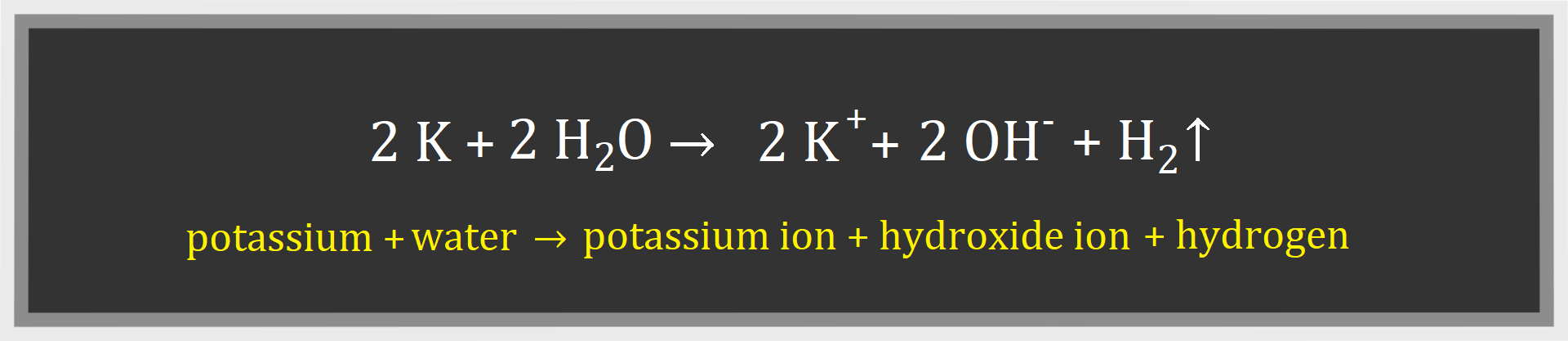
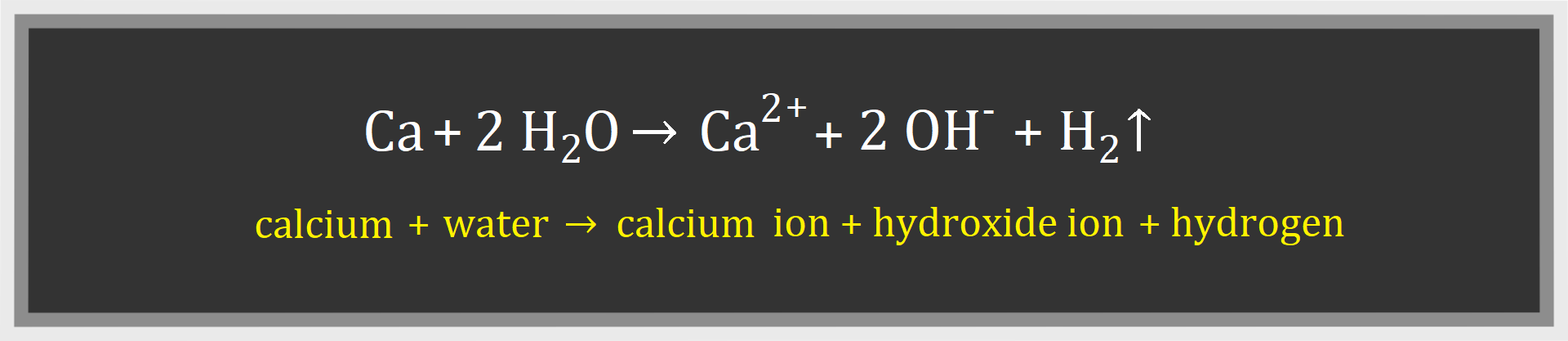
Hydroxides are obtained as a result of the reaction of active metals with water (metals from the 1st and 2nd groups of the periodic table, except for beryllium). As a result, bases (aqueous solutions of hydroxides) are formed and hydrogen is produced.
RkDWtOND3AMik
Ilustracja zawiera napis potas + woda strzałka w prawo jony potasu plus jony wodorotlenkowe + wodór strzałka w górę, potassium + water strzałka w prawo potassium ions hydroxide ions + hydrogren. Równanie reakcji: dwa Ka dodać ha dwa o powstaje dwa Ka plus dodać dwa o ha minus dodać ha dwa.
Source: licencja: CC BY-SA 3.0.
RaNJYracIYbHa
Ilustracja zawiera napis wapń + woda strzałka w prawo jony wapnia plus jony wodorotlenkowe + wodór strzałka w górę, calcium + water strzałka w prawo calcium ion + hydroxide anion + hydrogren.
Równanie reakcji: Ca dodać dwa ha dwa o powstaje dwa Ca dwa plus dodać dwa o ha minus dodać ha dwa.
Source: licencja: CC BY-SA 3.0.
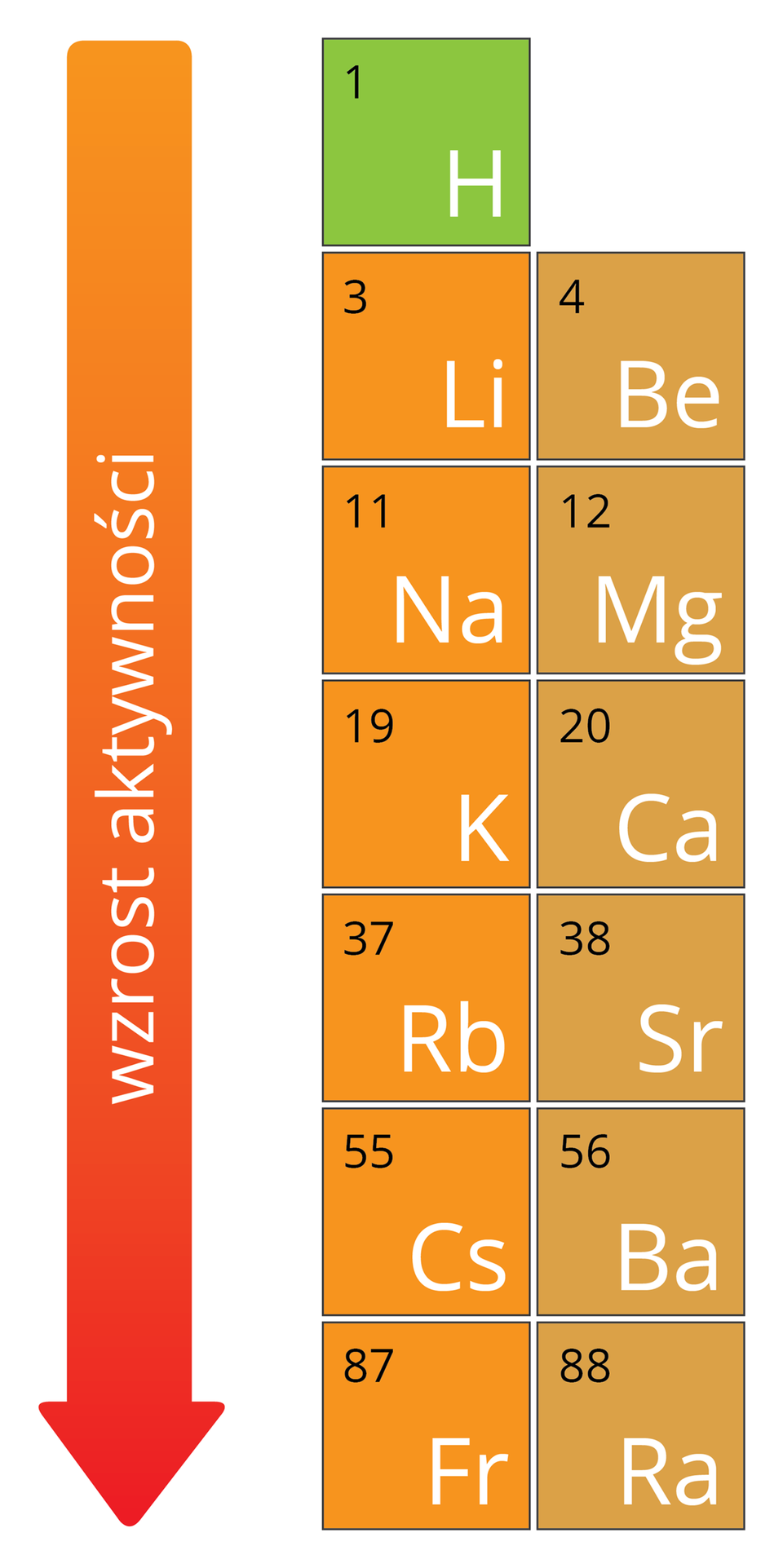
Alkali metals react with water more violently than alkaline earth metals. Magnesium reacts with water at increased temperature. Within the group, the activity of metals increases with the increase of the atomic number (this is related to the distance of valence electrons from the nucleus). The metals of other groups of the periodic table (e.g. copper) are less active and do not react with water. Hydroxides of metals from the 1st and 2nd groups of the periodic table are obtained by other methods.
R9JaEE2ADTgk4
Ilustracja przedstawia kierunki zmian aktywności metali w grupie litowców i berylowców. Wzrost aktywności zgodnie z pomarańczową strzałką następuje od H do Fr (1H, 3Li, 11Na, 19K, 37 Rb, 55 Cs, 87 Fr) i od Be do Ra (4Be, 12 Mg, 20 Ca, 38 St,56 Ba, 88 Ra)
Ilustracja przedstawia kierunki zmian aktywności metali w grupie litowców i berylowców. Wzrost aktywności zgodnie z pomarańczową strzałką następuje od H do Fr (1H, 3Li, 11Na, 19K, 37 Rb, 55 Cs, 87 Fr) i od Be do Ra (4Be, 12 Mg, 20 Ca, 38 St,56 Ba, 88 Ra)
1
1. Increase in activity
Task 2
Read the instructions before carrying out the experiment “Testing the behavior of a given oxide” Write the research question and hypotheses. Write also your observations and finally the conclusions.
R1Y6e1wsnJbM0
Wykonaj ćwiczenie zgodnie z poleceniem.
Wykonaj ćwiczenie zgodnie z poleceniem.
Analysis of the demonstration “Testing the behavior of a given oxide”
Experiment 2
You will need
beaker,
calcium oxide,
water,
glass rod,
thermometer,
phenolphthalein.
Instruction
Pour a little calcium oxide into the beaker.
Carefully add cold water and mix with the glass rod.
Insert the thermometer into the beaker.
Observe the thermometer indications.
Add a few drops of phenolphthalein.
Summary
R1SgTQEoxEzRg
Wykonaj ćwiczenie zgodnie z poleceniem.
Wykonaj ćwiczenie zgodnie z poleceniem.
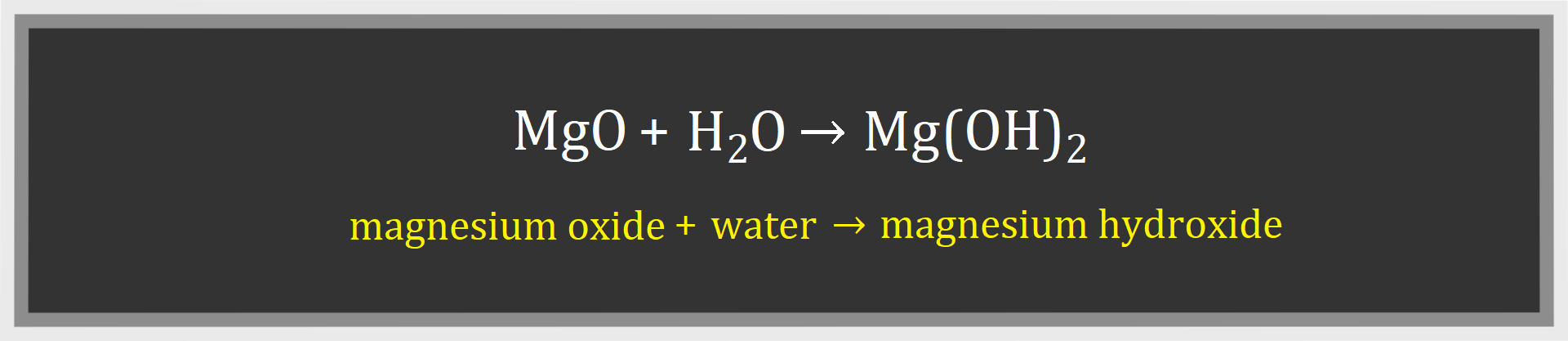
Another way of obtaining hydroxides is the reaction of active metal oxides (belonging to the 1st and 2nd group of the periodic table, except for beryllium), called basic oxides, with water.
R1QfrR7BrfWxM
Ilustracja zawiera zapis: ena dwa o + ha dwa o strzałka w prawo dwa ena o ha, sodium oxide + water strzałka w prawo sodium hydroxide.
Source: licencja: CC BY-SA 3.0.
R1INIJw2GiQPm
Ilustracja przedstawia zapis: em ge o plus ha dwa o strzałka w prawo em ge oha dwa razy wzięte, magnesium oxide + water strzałka w prawo magnesium hydroxide.
Source: GroMar Sp. z o.o., licencja: CC BY-SA 3.0.
These reactions generate bases – aqueous solutions of hydroxides.
Task 3
Watch the video “Preparation of hydroxide sparingly soluble in water”. Write your observations and conclusions, and then complete the equation of the reaction that occurred during the experiment shown in the video.
RU0y9ZhyfPICZ
Wykonaj ćwiczenie zgodnie z poleceniem.
Wykonaj ćwiczenie zgodnie z poleceniem.
Analysis of the experiment: “Preparation of hydroxide sparingly soluble in water”
R15K01oIKMH3t
Do wykonania eksperymentu służą: sodium hydroxide ( przeźroczysta substancja w pierwszej probówce), copper(two) sulfate (turkusowa substancja w drugiej probówce). Laborant przelewa turkusową substancję do przeźroczystej i miesza je. Wytrąca się niebieski osad.
Do wykonania eksperymentu służą: sodium hydroxide ( przeźroczysta substancja w pierwszej probówce), copper(two) sulfate (turkusowa substancja w drugiej probówce). Laborant przelewa turkusową substancję do przeźroczystej i miesza je. Wytrąca się niebieski osad.
Do wykonania eksperymentu służą: sodium hydroxide ( przeźroczysta substancja w pierwszej probówce), copper(two) sulfate (turkusowa substancja w drugiej probówce). Laborant przelewa turkusową substancję do przeźroczystej i miesza je. Wytrąca się niebieski osad.
RQVNQXmfnzwtw
Complete the chemical reaction observed in the experiment “Preparation of hydroxide sparingly soluble in water. Dostępne odpowiedzi: 1. 2NaSO4, 2. Na2SO4, 3. Cu2SO4, 4. CuSO4, 5. Na2SO2
Reakcja do uzupełnienia:
(Uzupełnij) + 2NaOH → Cu(OH)2 + (Uzupełnij)
Complete the chemical reaction observed in the experiment “Preparation of hydroxide sparingly soluble in water. Dostępne odpowiedzi: 1. 2NaSO4, 2. Na2SO4, 3. Cu2SO4, 4. CuSO4, 5. Na2SO2
Reakcja do uzupełnienia:
(Uzupełnij) + 2NaOH → Cu(OH)2 + (Uzupełnij)
RrUA79obqEnsn
Exercise 1
Which hydroxide cannot be obtained by the method: metal oxide + water? Możliwe odpowiedzi: 1. Cu(OH)2, 2. Ca(OH)2, 3. KOH, 4. NaOH
Which hydroxide cannot be obtained by the method: metal oxide + water? Możliwe odpowiedzi: 1. Cu(OH)2, 2. Ca(OH)2, 3. KOH, 4. NaOH
Which hydroxide cannot be obtained by the method: metal oxide + water?
Cu(OH)2
Ca(OH)2
KOH
NaOH
Rf2eWW0R9qDzm
Exercise 2
Several drops of phenolphthalein were added to 4 test tubes containing water; then to each of them a different hydroxide was added: Al(OH)3, NaOH, KOH, Ca(OH)2. In which test tube did phenolphthalein remain colorless? Możliwe odpowiedzi: 1. Al(OH)3, 2. Ca(OH)2, 3. KOH, 4. NaOH
Several drops of phenolphthalein were added to 4 test tubes containing water; then to each of them a different hydroxide was added: Al(OH)3, NaOH, KOH, Ca(OH)2. In which test tube did phenolphthalein remain colorless? Możliwe odpowiedzi: 1. Al(OH)3, 2. Ca(OH)2, 3. KOH, 4. NaOH
Several drops of phenolphthalein were added to 4 test tubes containing water; then to each of them a different hydroxide was added: Al(OH)3, NaOH, KOH, Ca(OH)2. In which test tube did phenolphthalein remain colorless?
Al(OH)3
Ca(OH)2
KOH
NaOH
RMl46XNz6CZIa
Exercise 3
What products are obtained from the reaction: active metal + water? Możliwe odpowiedzi: 1. hydroxide + hydrogen, 2. salt + hydrogen, 3. hydroxide + water, 4. hydroxide
What products are obtained from the reaction: active metal + water? Możliwe odpowiedzi: 1. hydroxide + hydrogen, 2. salt + hydrogen, 3. hydroxide + water, 4. hydroxide
What products are obtained from the reaction: active metal + water?
hydroxide + hydrogen
salt + hydrogen
hydroxide + water
hydroxide
Summary
Hydroxides are chemical compounds made of metal cations and hydroxide anions whose general formula is .
Hydroxides are obtained as an effect of the reaction of active metal oxides (basic oxides) with water and of some metals with water.
Solutions of hydroxides that are easily soluble in water (all hydroxides of metals from the 1st group of the periodic table and selected metals from the 2nd group) are traditionally called bases.
RdM1bd2tSK3e41
Tablica interaktywna. How was this lesson? Did you like it? Finish selected sentences. Propozycje 1.It was easy for me.(uzupełnij).., 2.It was difficult for me..(uzupełnij)., 3.Today I learned..(uzupełnij)., 4.I understood that..(uzupełnij)., 5. It surprised me.(uzupełnij)..
Tablica interaktywna. How was this lesson? Did you like it? Finish selected sentences. Propozycje 1.It was easy for me.(uzupełnij).., 2.It was difficult for me..(uzupełnij)., 3.Today I learned..(uzupełnij)., 4.I understood that..(uzupełnij)., 5. It surprised me.(uzupełnij)..
Source: GroMar Sp. z o.o., licencja: CC BY-SA 3.0.
Homework
Wyjaśnij, w jaki sposób można wykorzystać w codziennym życiu zawarte w abstrakcie informacje.
Wyjaśnij, w jaki sposób można wykorzystać w codziennym życiu zawarte w abstrakcie informacje.
Task 4
Prepare an infographic presenting the colors of selected indicators in neutral and alkaline environments.
Keywords
hydroxides, preparation of hydroxides, bases, sodium hydroxide, potassium hydroxide