Prevention and treatment of infectious diseases
diseases attack all human organs;
following prevention principles can reduce the risk of getting sick.
to discuss infectious disease prevention principles.
Prevention of infectious diseases
The most important elements of preventive healthcare are the avoidance of pathogens, compliance with hygiene principles, the consolidation and promotion of healthy lifestyle principles. Preventive healthcare encompasses all disease prevention activities. It consists of early disease detection, disease treatment and the reduction of complications.
Preventive vaccinations are one of basic preventive healthcare methods. Their main purpose is to mobilise the immune system to produce enough antibodies to defend the body against infections. Vaccinations are used against certain bacterial and viral diseases. It happens that the disease appears despite the use of vaccination, but almost always it is not that severe as it would be in unvaccinated people, and it does not entail dangerous health and life complications.
Treatment of infectious diseases
Some medicines can be bought at a pharmacy without any prescription. They are used in case of minor health problems such as running nose and cold. It should be remembered at the same time that medicines, vitamins and minerals, if overdosed, are ineffective or harmful. For example, overdosed vitamin C is excreted in urine, but vitamins such as A and D accumulate in the body and can disturb its functioning. Salicylic acid, a popular medicine against colds and headaches, thins blood and increases the risk of hemorrhage.
In case of severe cold, taking different medicines containing the same active substance may lead to its build‑up in the body. A medical substance present in the body in a too high concentration can be harmful to, for example, your liver, stomach, nervous system or kidneys. Medicines should always be taken according to instructions contained in their leaflet or provided by a doctor. You also need to be cautious when taking antibioticsantibiotics which are used to treat bacterial infections only if so indicated by a doctor. Taking antibiotics to fight viral diseases (running nose, influenza) is not only ineffective, but can also be harmful to the body.
Only a doctor can select an antibiotic and decide how often and how long a patient should take it. The antibiotic should not be discontinued in the first days after the improvement. This is how drug‑resistant bacteria can be left alive and can multiply under favourable conditions.
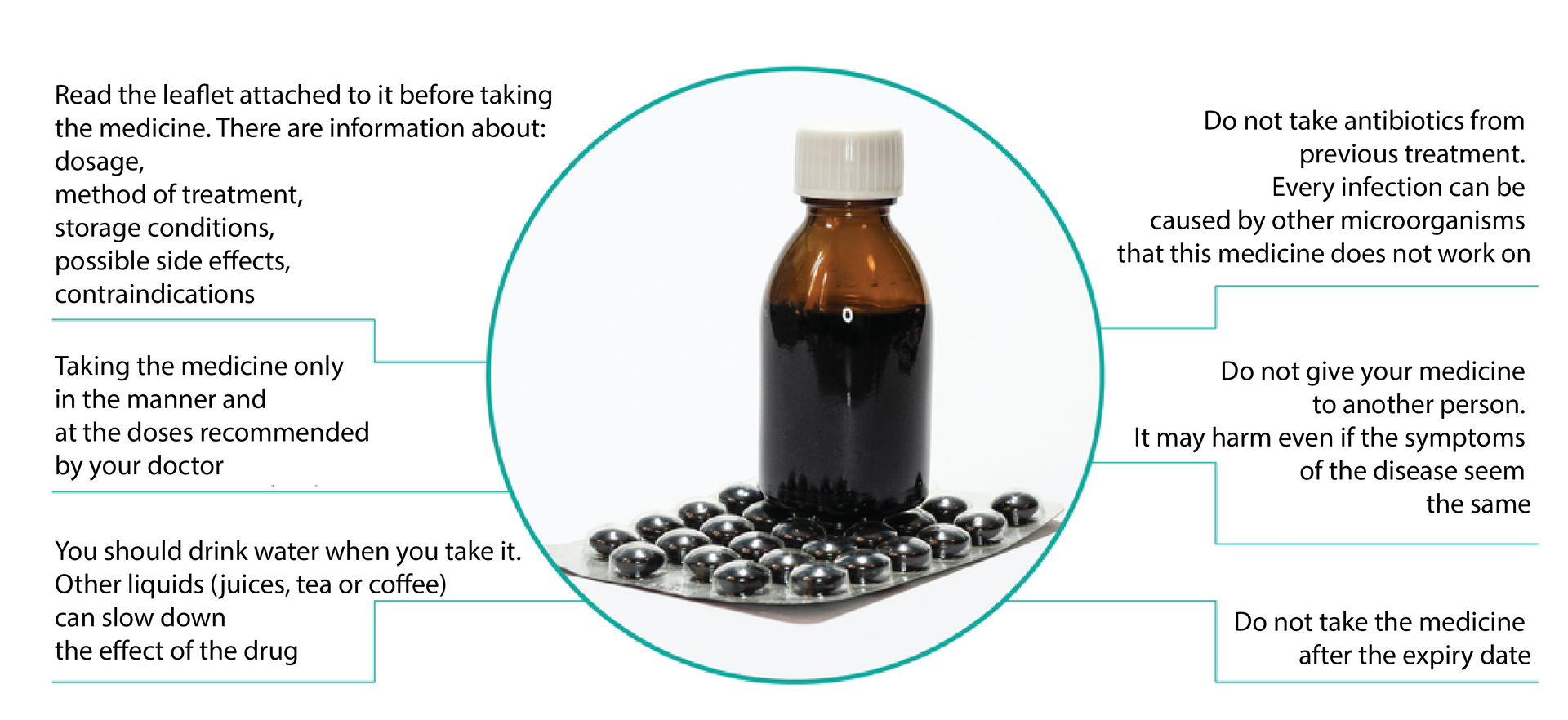
Antibiotics are bactericidal (they kill bacteria) or bacteriostatic (they inhibit bacterial growth). They can have a broad spectrum (range) of activity, i.e. to fight many species of bacteria, or can be species‑specific. The use of antibiotics has its dark side – being taken, they usually destroy intestinal microorganisms beneficial to our body. Their absence causes numerous digestive problems and reduces immunity.
The overuse of antibiotics made many bacteria, e.g. Staphylococcus aureus, resistant to medicines. This means that an infected person can be left without any help.
Think when a doctor recommends an antibiotic with a wide range of activity and when - with a narrow range. Compare the effects of taking antibiotics from both groups.
What is the purpose of preventive vaccinations? Select the correct answer.
- combating a disease faster if an infection has already occurred
- preventing microorganisms from entering the body
- creating enough antibodies to fight any future infection
- providing the body with energy resources to fight microorganisms
What effects should be taken into account when taking antibiotics? Select all the correct answers.
- destroying beneficial intestinal microorganisms
- no improvement or harmfulness in case of viral diseases
- creating antibodies in the body to protect against bacteria
- making respiratory and circulatory systems more efficient
- risk of creating strains of microorganisms immunised to a specific drug
- rapid health improvement in case of bacterial infections
Group the activities below appropriately.
healthy lifestyle, use of medicines that support general well-being, use of medicines prescribed by a doctor, following personal hygiene principles, avoidance of pathogens, undergoing protective vaccinations, application of measures to mitigate cold effects
| prevention of infectious diseases: | |
|---|---|
| treatment of infectious diseases: |
Summary
Infectious diseases are caused by pathogenic organisms and spread through direct contact with a sick person, by droplet, food and sex.
Follow healthy lifestyle principles to prevent diseases.
Medicines, in particular antibiotics, should be taken under the supervision of a doctor.
Keywords
prevention, treatment, infectious diseases
Glossary
antybiotyki – środki uszkadzające komórki bakteryjne lub zaburzające ich funkcjonowanie, stosowane w przypadku zakażeń bakteryjnych