Producers, Consumers, and Decomposers
we divide the organisms into autotrophic and heterotrophic;
plants change light energy into the energy of chemical bonds, and heterotrophic organisms use energy stored in the food they eat.
to indicate food dependence in the ecosystem;
to identify organisms as producers, consumers, decomposers.
Nagranie dostępne na portalu epodreczniki.pl
Nagranie dźwiękowe dotyczące producentów, Konsumentów, Destruentów
Producers
The basis for the functioning of most ecosystems is the presence of autotrophic organisms, the so‑called ProducersProducers. During the process of photosynthesis, producers produce organic matter (biomassbiomass). The amount of organic plant matter (produced per year per unit of ecosystem area) is used to assess the rate at which producers convert solar energy in the process of photosynthesis. It is different for different ecosystems (see figure below). The main factors conducive to the rapid growth of plant mass are respectively high temperature and humidity, long vegetation period and soil fertility.
![Diagram przedstawia produktywność wybranych ekosystemów w gramach/ m kwadratowy/ rok. Pustynia gorąca - 150, las strefy umiarkowanej - 500, las równikowy 2000, pole uprawne - 750, łąka - 700. Na diagramie są opisy: productivity of selected ecosystems [g/m2/rok],
desert hot,
taiga,
deciduous temperate forests,
tropical rainforests,
farmlands,
fields,](https://static.zpe.gov.pl/portal/f/res-minimized/R17G1xS3xA1co/1/1kxAr1Jc65dVm7RCvJufib0wKJKR0Ytu.png)
The production of organic matter takes place both on land and in the aquatic environment. Both in fresh and salt water, there are many plants and autotrophic bacteria and protists. Water covers about 2/3 of the Earth's surface, which is why biomass production in the oceans is a significant part of the total biomass production on Earth.
For the photosynthesis process the plants need water, carbon dioxide, and solar energy. Determine the availability of which of these components will be a factor limiting production in the aquatic ecosystem, and which in the terrestrial ecosystem. Explain why.
Consumers
The higher the mass of organic matter produced by plants per year, the more herbivorous animals can sustain themselves in a given ecosystem. They eat grass, leaves, fruits, seeds and even roots, wood and bark. The obtained nutrients are used by herbivores as an energy source and built into their own bodies, thanks to which they can grow and reproduce. Herbivores are food for carnivores. These, in turn, may fall prey to other predators, often larger than themselves.
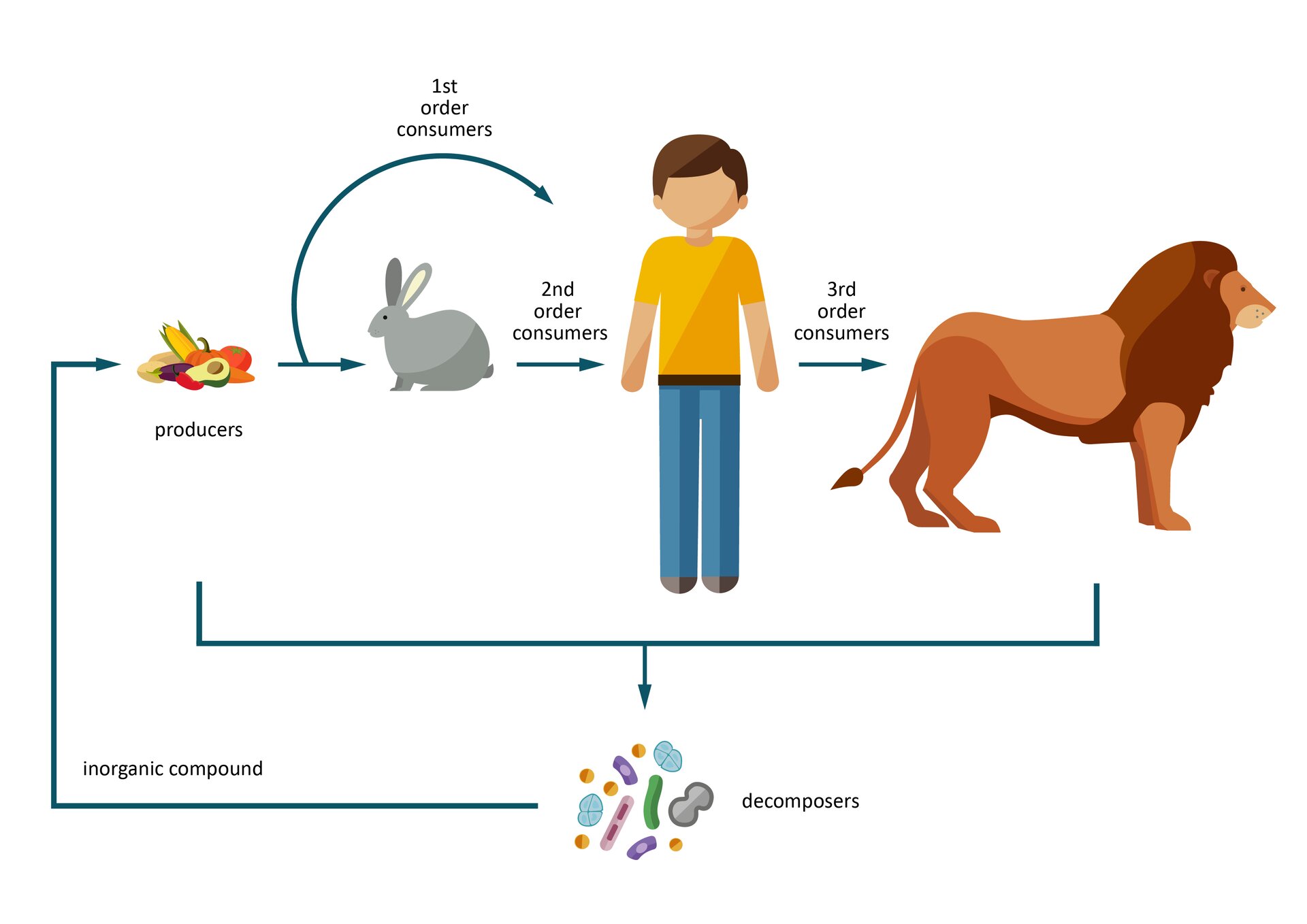
Both herbivores and carnivores use other organisms (plant or animal) as food. In the ecosystem, every heterotrophic organism is called the consumerthe consumer. Consumers can be sorted by certain categories. And so herbivores are called first‑order consumers. Second‑order consumers are the carnivores eating them, and the third and the next‑order consumers are carnivores feeding on other carnivores. Omnivores, depending on what they consume at the moment, belong to consumers I, II, III or any of the higher orders.
Producers are the largest biomass in ecosystems. Biomass of consumers on consecutive trophic levelstrophic levels makes up about 10% of the previous level.
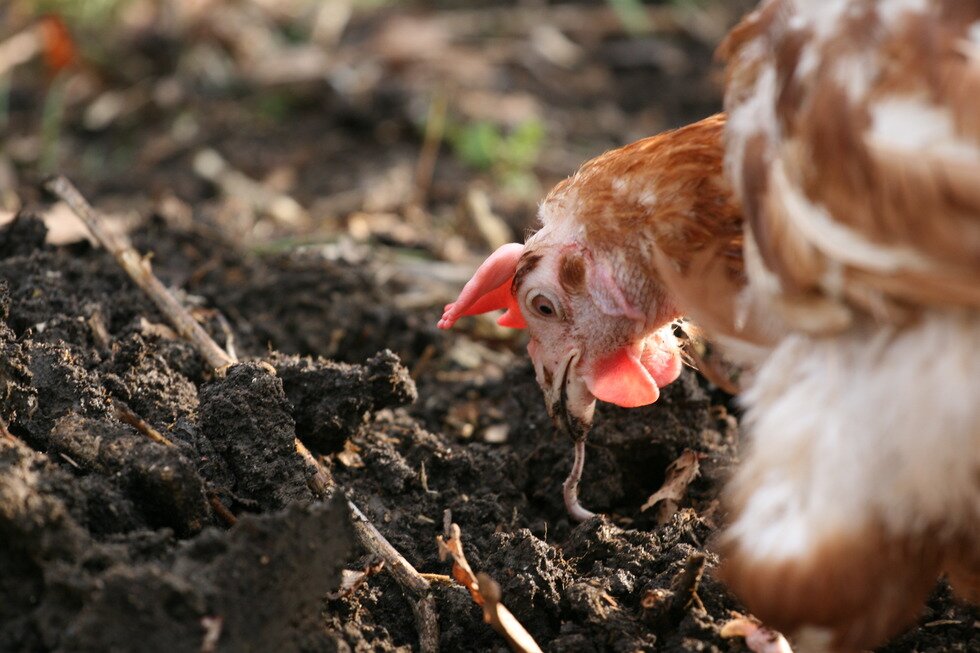
Omnivores, such as wild boar or man, can feed on both plants and meat. Specify to which group we can assign them – consumers of the first or second order? Try to assign a vulture to a specific order of consumers, which can feed on both antelope and lion carrion.
Decomposers
Heterotrophic organisms that feed on the dead organic matter are called saprobionts. Some of them perform the function of decomposersdecomposers in ecosystems. They are able to decompose the remains of organisms into mineral compounds, which then become air (carbon dioxide and water) and soil (mineral salts) and can be taken up by plants. Thanks to this process dead organic matter are not in arrears in ecosystems, but decomposed into simple substances is re‑incorporated into organisms - first plants and later animals. Decomposers include bacteria and fungi. Their presence in ecosystems is essential. Without their activity, the circulation of matter (circulation of elements) in nature would be impossible.
Comparison of the rate of decomposition of organic debris in various types of soil.
3 jars
3 soil samples with different properties (eg clay, sandy, peat)
3 slices of cooked carrot.
Fill the jars with moist soil.
Put a slice of carrot between the soil and the jar wall for each of them.
Cover the jars with the lids, but do not twist them. In this way, you will limit evaporation and provide air access.
If the slices of carrot in one of the jars were decomposed sooner, this indicates that there were more decomposers in the soil.
Before you do the experiment „Comparison of the rate of decomposition of organic debris in various types of soil”, write down the research question and the hypothesis. Watch the observations while watching the experiment, and finally - conclusions.
Organise the ecosystems depending on the amount of biomass they produce. Start with the ecosystem in which arises the most, and finish with the one in which is created the least.
- tropical rainforests
- farmlands
- temperate deciduous forests
- deserts
Match the definition to each of the following concepts.
chemical compounds produced by living organisms or being the product of the decay of their debris, mass of all plants and/or animals present on a specific surface, production of organic compounds from inorganic compounds with the participation of light, the circulation of elements in nature taking place due to the activity of decomposers
| biomass | |
| photosynthesis | |
| organic matter | |
| the cycling of matter |
Summary
All organisms in the ecosystem are connected by complex food dependencies – they form food (trophic) chains and trophic networks.
The ecosystem is distinguished by trophic levels: producers, consumers of the first, second and subsequent orders, and decomposers.
The decomposers break down dead organic matter into inorganic matter.
Keywords
producers, consumers, decomposers
Glossary
biomasa – masa materii organicznej wchodząca w skład organizmu; także masa wszystkich roślin i/lub zwierząt występujących na określonej powierzchni
destruenci – organizmy (głównie grzyby i bakterie) odżywiające się martwą materią organiczną i rozkładające ją do związków nieorganicznych
konsumenci – organizmy cudzożywne odżywiające się pokarmem roślinnym (roślinożercy – konsumenci I rzędu) lub pokarmem mięsnym (mięsożercy – konsumenci dalszych rzędów)
poziomy troficzne – poziomy troficzne – grupy organizmów pełniących podobną funkcję w łańcuchu pokarmowym; producenci, konsumenci i destruenci
producenci – organizmy samożywne; przekształcają energię świetlną lub chemiczną na energię wiązań chemicznych (ATP) w procesie foto- lub chemosyntezy; są pierwszym ogniwem większości łańcuchów pokarmowych