Przeczytaj
The picture below shows a charity organisation worker giving food to hungry children. This is not a typical sight we see in the modern world. In this section, you are going to study a text introducing you to the subject of hunger in the world. Before you explore it, think: do you think hunger can ever be ended? Can you take any steps which could help somebody who is hungry?
Poniższe zdjęcie ukazuje pracownika organizacji charytatywnej rozdającego jedzenie głodnym dzieciom. Nie jest to typowy obrazek we współczesnym świecie. W tej sekcji przeczytasz tekst wprowadzający cię w zagadnienie głodu na świecie. Zanim przeczytasz, zastanów się: czy sądzisz, że głód można kiedykolwiek zakończyć? Czy ty możesz podjąć jakieś kroki w celu pomocy komuś, kto jest głodny?
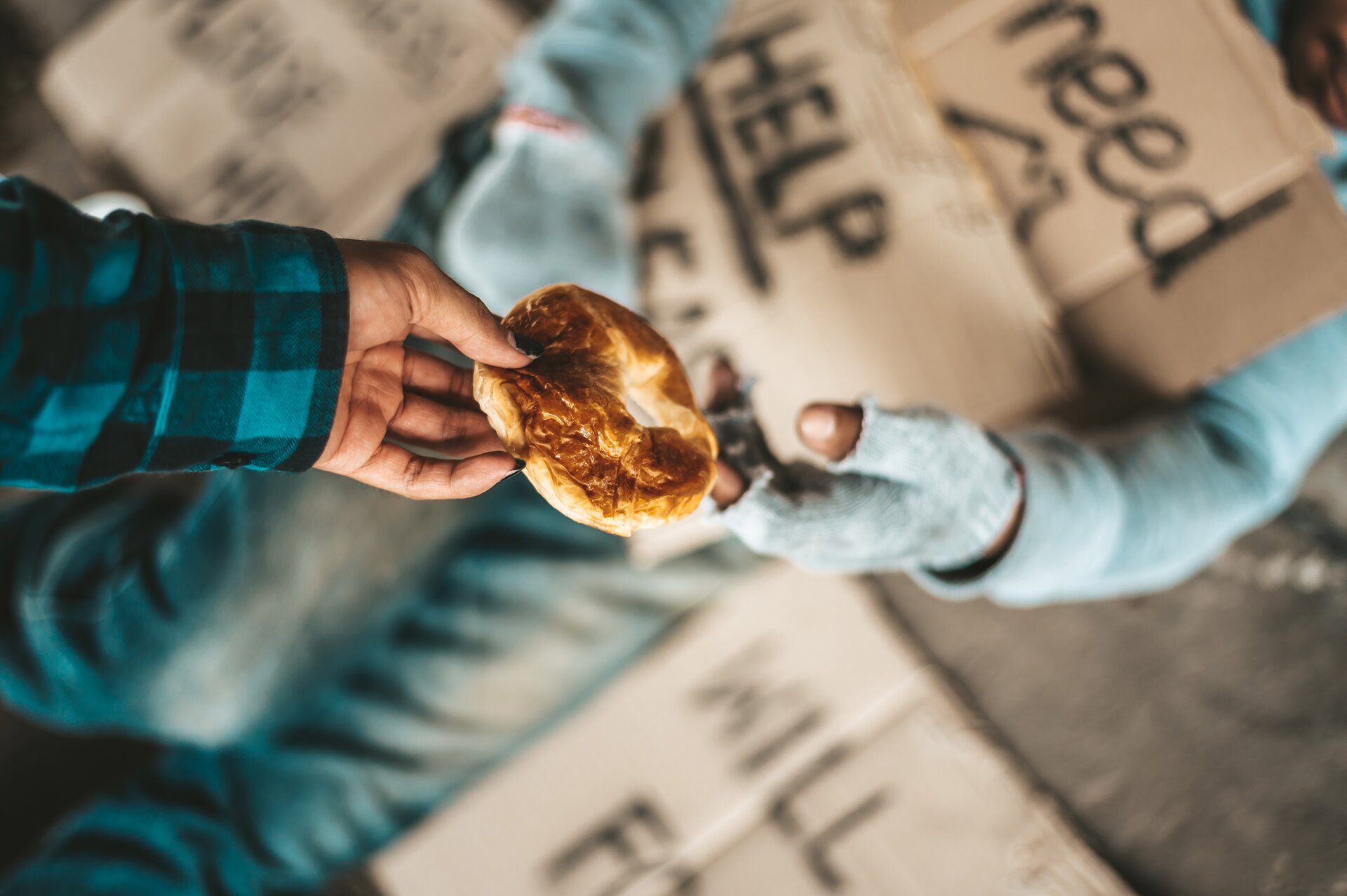
In your opinion, is it possible to end world hunger? Why? Why not? Explain your reasoning in 4‑5 sentences.
Study the pictures and choose all the words associated with them.
Study the text and do the exercises below.
Hungry for Facts?According to the United Nations World Food Programme, between 720 and 811 million people around the world faced hunger in 2020. Although the world produces enough food to feed everyone on the planet, about 16% of the world population is undernourishedundernourished due to food deprivationfood deprivation. And this is only one of many incredibly disconcertingdisconcerting facts about food insecurityfood insecurity in the world today.
UndernourishmentUndernourishment is defined by the Food and Agriculture Organization of the United Nations (FAO) as ‘the inability to acquire enough food to meet the minimum daily dietary energy requirement over a period of one year’. This is synonymous with hunger and the number of people affected by it is still growing, especially in recent years due to the COVID‑19 pandemic. Due to serious food shortagesfood shortages in many regions of the world rationingrationing, food has become the norm. Low fruit and vegetable intakeLow fruit and vegetable intake results in malnutritionmalnutrition, which is especially acuteacute and devastating in small children as it affects their growth and development.
MalnourishmentMalnourishment is becoming a new plague in countries like India, southern Sudan or Ethiopia because food has become scarce there, either due to political conflict, war, povertypoverty or poor harvestsharvests. However, it is also a problem in highly developed countries such as the USA, where people become obese because of the wrong diet based on cheap but not nutritious food. There is also a new catastrophe that has never occurred before: we are witnessing the world’s first climate‑inducedclimate‑induced faminefamine, that is a famine caused entirely by climate change. It is visible, for example, in southern Madagascar, where villagers in remote areas are on the brink ofon the brink of starvationstarvation due to five years of drought and a change of their surroundings: farmland has turned into sand dunes, there is no water and temperatures are still rising.
However, we cannot lose hope. With proper planning and coordination, famine can be prevented and food securityfood security can be re‑established. The FAO advocates putting more emphasis on sustainable food and agriculturesustainable food and agriculture so that people can use the crops of nature and not destroy it in return. There are many government and non‑government organisations whose aim is to limit global starvation. Some act as food banksfood banks, collecting and distributing food to those in need, usually through food pantries. They obtain food donationsfood donations from local neighbours, retailers, grocery stores and restaurants. Others raise money in the form of financial aidfinancial aid provided by governments, hunger relief charities, businesses and individuals.
Therefore, what can we do as individuals? We can start by adopting a zero food wastezero food waste attitude in our daily life, which means that we try to produce literally no waste when cooking our meals. We can make it a point to eat and shop localeat and shop local because in this way we support local farmers, suppliers and food business owners. We can develop urban farmingurban farming to reconnect people with nature and make our cities more self‑sufficientself‑sufficient.
If we make an effort and try, even with the smallest steps, we will work together to achieve one of the 17 FAO sustainable development goals (Target 2.1): “By 2030, end hunger and ensure access by all people, especially the poor and people in vulnerablevulnerable situations, including infants, to safe, nutritious and sufficientsufficient food throughout the year.”
Źródło: Agnieszka Sękiewicz‑Magoń , licencja: CC BY-SA 3.0.
- According to the first paragraph,
a) up to 811 million people are still starving.
b) there are more hungry people today than in the past.
c) our planet is able to provide food to all human beings.
d) hunger is one of many world problems.
- Undernourishment is similar in meaning to
a) malnutrition.
b) food deprivation.
c) food shortage.
d) food insecurity.
- Which phenomenon, mentioned by the text, manifests itself in two extreme forms?
a) Undernourishment.
b) Malnourishment.
c) Low fruit and vegetable intake.
d) Climate-induced famine.
- Food banks are
a) places where you buy food for people who need it.
b) places where food is produced for people who need it.
c) organisations which store and then distribute food to local food programmes.
d) a distribution centre where hungry families can receive food.
- The author of the text
a) appears to be very upset by the presented facts.
b) sounds a bit overwhelmed by the sad facts.
c) feels sorry for people who suffer from hunger.
d) seems hopeful that some actions will help end hunger.
2. When the body is deprived of vitamins, minerals and other nutrients it needs in order to function well, 1. famine, 2. malnutrition, 3. low fruit and vegetable intake, 4. food shortages, 5. financial aid, 6. on the brink of, 7. urban farming occurs.
3. In the 19th century, a severe 1. famine, 2. malnutrition, 3. low fruit and vegetable intake, 4. food shortages, 5. financial aid, 6. on the brink of, 7. urban farming happened in Ireland, and since there was hardly anything to eat, a lot of people emigrated abroad, mostly to the USA.
4. With all the unrest and political problems, the country seems to be 1. famine, 2. malnutrition, 3. low fruit and vegetable intake, 4. food shortages, 5. financial aid, 6. on the brink of, 7. urban farming another civil war.
5. The WHO has stressed in its declaration that greater 1. famine, 2. malnutrition, 3. low fruit and vegetable intake, 4. food shortages, 5. financial aid, 6. on the brink of, 7. urban farming to poorer countries is needed.
6. A lot of inhabitants of heavily-populated cities are interested in 1. famine, 2. malnutrition, 3. low fruit and vegetable intake, 4. food shortages, 5. financial aid, 6. on the brink of, 7. urban farming, as it gives them access to locally grown food and reconnects them with nature.
7. A new study has shown that 1. famine, 2. malnutrition, 3. low fruit and vegetable intake, 4. food shortages, 5. financial aid, 6. on the brink of, 7. urban farming may result in digestive disorders, as these foods are rich in fibre, so vital for our digestive system.
Słownik
/ əˈkjuːt /
ostry/ostra, poważny/poważna, dotkliwy/dotkliwa (very serious, extreme, or severe)
/ ˈklaɪmət ɪnˈdjuːst /
wywołany/wywołana klimatem (caused by the climate)
/ ˌdɪskənˈsɜːtɪŋ /
niepokojący/niepokojąca, zawstydzający/zawstydzająca (making someone feel uncertain and uncomfortable or worried)
/ ˈdraʊt /
susza (a long period when there is little or no rain)
/ iːt ənd ʃɒp ˈləʊkl̩ /
jeść i robić zakupy lokalnie (eat and shop in the place you live in)
/ ˈfæmɪn /
głód, klęska głodu (a situation in which there is not enough food for a great number of people, causing illness and death, or a particular period when this happens)
/ faɪˈnænʃl̩ eɪd /
pomoc finansowa (official help given to a person, organization, or country in the form of money, loans, reduced taxes, etc.)
/ fuːd bæŋks / / fuːd bæŋk /
banki żywności [bank żywności] (a place where food is given to people who do not have enough money to buy it, for example by a charity)
/ fuːd ˌdeprɪˈveɪʃn̩ /
tu: ograniczony dostęp do żywności, brak (możliwości) dostępu do żywności (limited access to food)
/ fuːd dəʊˈneɪʃn̩z / / fuːd dəʊˈneɪʃn̩ /
darowizny żywności [darowizna żywności] (food given to a charity or different organization)
/ fuːd ˌɪnsɪˈkjʊərɪti /
brak bezpieczeństwa żywnościowego (the fact that a person or family is not always able to get enough food)
/ fuːd sɪˈkjʊərɪti /
bezpieczeństwo żywnościowe (the fact that a person or family is always able to get enough food)
/ fuːd ˈʃɔːtɪdʒɪz / / fuːd ˈʃɔːtɪdʒ /
niedobory żywności [niedobór żywności] (a situation when food supplies within a bounded region do not provide the energy and nutrients needed by that region's population)
/ ˈhɑːvɪst /
żniwa, zbiory (the time of year when crops are cut and collected from the fields, or the activity of cutting and collecting them, or the crops that are cut and collected)
/ ləʊ ˈfru:t ənd ˈvedʒɪtəbl̩ ˈɪnteɪk /
niewielkie spożycie owoców i warzyw (a situation when someone does not enough fruit and vegetables)
/ ˌmalˈnʌrɪʃmənt /
niedożywienie, złe odżywianie się (the fact of being weak and in bad health because of having too little food or too little of the types of food necessary for good health)
/ ˌmælnjuːˈtrɪʃn̩ /
niedożywienie (physical weakness and bad health caused by having too little food, or too little of the types of food necessary for good health)
/ ˈɒn ðə brɪŋk ɒv /
na skraju, o krok od (likely that something will happen soon)
/ ˈpɒvəti /
bieda, ubóstwo (the condition of being extremely poor)
/ ˈræʃn̩ɪŋ /
racjonowanie, wydzielanie (a system of limiting the amount of something that each person is allowed to have)
/ stɑːˈveɪʃn̩ /
głodowanie (the state of having no food for a long period, often causing death)
/ səˈfɪʃnt /
wystarczający/wystarczająca (enough for a particular purpose)
/ səˈsteɪnəbl̩ fuːd ənd ˈæɡrɪˌkʌltʃə /
zrównoważone żywność i rolnictwo (food and agriculture causing, or made in a way that causes, little or no damage to the environment and therefore is able to continue for a long time)
/ ˌʌndəˈnʌrɪʃmənt / / ˌʌndəˈnʌrɪʃt /
niedożywienie [niedożywiony/niedożywiona] (the condition of not eating enough food to continue to be in good health)
/ ˈɜːbən ˈfɑːmɪŋ /
rolnictwo miejskie (the production, distribution, and marketing of food and other products within the geographical limits of a metropolitan area)
/ ˈzɪərəʊ fuːd weɪst /
zero marnowania żywności (no waste left behind when using food)
/ ˈvʌlnərəbl̩ /
wrażliwy (able to be easily hurt or attacked)
Źródło: GroMar Sp. z o.o., licencja: CC BY‑SA 3.0