bg‑azure

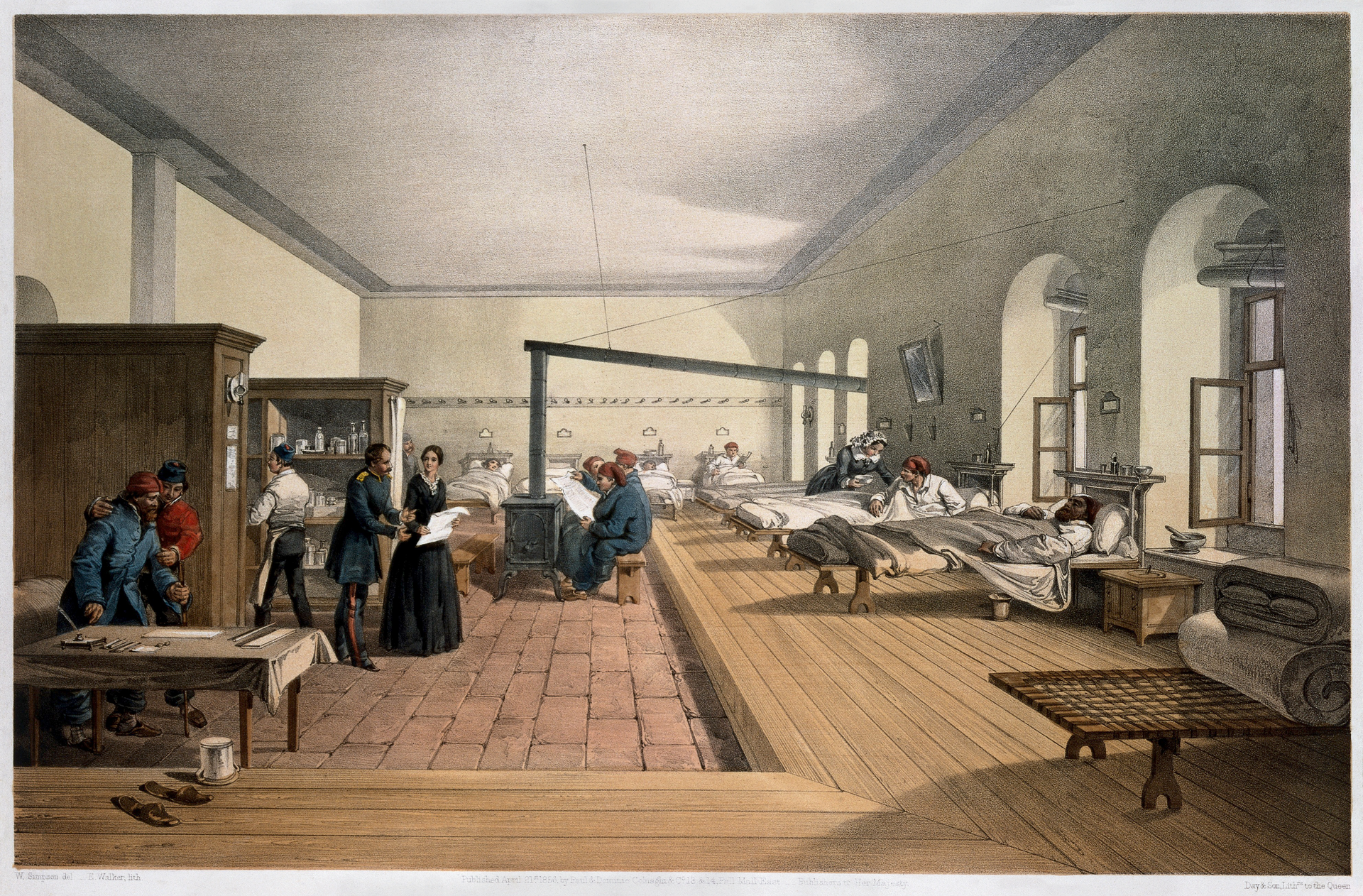
The picture below depicts the ward in which Florence Nightingale worked in Scutari, Turkey during the Crimean War. Notice the wounded in beds in the background. The figure of a woman on the left, is presumably Florence. You are going to study the text on the life of the nursing pioneer Florence Nightingale to learn more about this inspiring figure.

Poniższe zdjęcie przedstawia, jak wyglądał oddział, w którym pracowała Florence Nightingale w Scutari, w Turcji, podczas wojny krymskiej. Zwróć uwagę na rannych leżących w łóżkach w tle. Postać kobiety po lewej stronie to przypuszczalnie Florence. Zapoznaj się z tekstem o życiu pionierki pielęgniarstwa, Florence Nightingale, aby dowiedzieć się o niej więcej.
R12uq3jZN1DES
Florence Nightingale’s ward in Scutari – the lithograph by William Simpson
Oddział Florence NightingaleScutari – litografia autorstwa Williama Simpsona
Źródło: dostępny w internecie: https://www.wikimedia.org/ [dostęp 15.09.2022], domena publiczna.
Exercise 1
R1DijD9RaiGTE
Drag the following halves of sentences to learn the quotes by Florence Nightingale. “Live life when you have it. Możliwe odpowiedzi: 1. upon which I can look back without pain.”, 2. Life is a splendid gift-there is nothing small about it.”, 3. – I never gave or took any excuse.”, 4. under the spirit of fear.”, 5. in a hospital is that it should do patients no harm. “There is no part of my life, Możliwe odpowiedzi: 1. upon which I can look back without pain.”, 2. Life is a splendid gift-there is nothing small about it.”, 3. – I never gave or took any excuse.”, 4. under the spirit of fear.”, 5. in a hospital is that it should do patients no harm. “The very first requirement Możliwe odpowiedzi: 1. upon which I can look back without pain.”, 2. Life is a splendid gift-there is nothing small about it.”, 3. – I never gave or took any excuse.”, 4. under the spirit of fear.”, 5. in a hospital is that it should do patients no harm. “How very little can be done Możliwe odpowiedzi: 1. upon which I can look back without pain.”, 2. Life is a splendid gift-there is nothing small about it.”, 3. – I never gave or took any excuse.”, 4. under the spirit of fear.”, 5. in a hospital is that it should do patients no harm. “I attribute my success to this Możliwe odpowiedzi: 1. upon which I can look back without pain.”, 2. Life is a splendid gift-there is nothing small about it.”, 3. – I never gave or took any excuse.”, 4. under the spirit of fear.”, 5. in a hospital is that it should do patients no harm.
Źródło: GroMar Sp. z o.o., licencja: CC BY-SA 3.0.

Study the text and do the exercises below.

Florence Nightingale - the Nurse who Cared
Katarzyna Piotrowska Florence Nightingale - the Nurse who Cared

Florence was born in Italy on May 12, 1820. Her parents gave her the name inspired by her birthplace: Florence in Italy. Nightingale’s parents were affluentaffluentaffluent and she could therefore be well‑educated. 1. ___. She learnt Greek, Italian, Latin, French, German, history, maths, literature, and philosophy. She could marry a rich gentleman, but declined the offer, possibly due to her inner voice telling her to follow a different career path and decided to dedicate herself to helping others instead. Even though nursingnursingnursing was at that time socially underrated, Florence disregarded her family’s opinion and decided to train in this field as she felt she had a vocation forvocation forvocation for it.

Florence attended a nursing school at Kaiserwerth in Germany in 1850 and in 1851. Three years later, in 1854, Nightingale went to Scutari, Turkey when the Crimean War broke out. 2. ___. The omnipresent dirt, stink, and soldiers laying in their own excrementsexcrements [excrement]excrements; the view was horrifyinghorrifyinghorrifying. During that time she improved the sanitary conditions of soldiers. Such rudimentary issuesrudimentary issuesrudimentary issues as clean clothing, bedding, ventilation, regular bathing, reducing overcrowding, or providing nutritious meals for patients made the difference. It seemed that previously soldiers were dying mainly of poor sanitary conditions. The spread of the news of her successful lowering of the death rate made her famous in her motherlandmotherlandmotherland. Nightingale cared for the wounded even at night. This earned her the nickname ‘Lady with the Lamp’ and the respect of the medical personnel and patients.

In 1855, Florence developed brucellosisbrucellosisbrucellosis, an incurable illnessincurable illnessincurable illness that affected her until her final days.  In 1856, when the Crimean War was over, she met with Queen Victoria and Prince Albert to discuss the roles of nurses. Thanks to the statistical data she collected when working in Turkey, she managed to change their mindsetmindsetmindset on this matter. Nursing began to matter. Influencing the royal couple was only the beginning of her activism. 3. ___. She also set up a nursing school – the Nightingale Training School at St. Thomas Hospital in London in 1860. Two years later, in 1862, her efforts led to establishing a school for midwivesmidwives [midwife]midwives at King’s College Hospital. However, Florence’s nursing training wasn’t confined toconfine toconfined to England only. In the 1870s she provided training to an American nursing pioneerpioneerpioneer, Linda Richards, who then dedicated herself todedicated herself to [dedicate oneself to]dedicated herself to developing nursing standards in the U.S.

4 . ___. She was respected and admired. In 1883 she was awarded the Royal Red Crossthe Royal Red Crossthe Royal Red Cross. In 1907 she was the first woman awarded the Order of Meritthe Order of Meritthe Order of Merit. Nightingale died in 1910. She was even offered a funeral and burial place in Westminster AbbeyWestminster AbbeyWestminster Abbey, but her family respected her decision to be buried in Hampshire instead.

Two years after her death the International Committee of the Red Cross began to award Florence Nightingale’s Medal to nurses. She inspired and initiated immense change to elevateelevateelevate the status of nurses from uneducated pauperspaupers [pauper]paupers to well‑trained and educated women, able to show empathy and care for all wounded regardless of their social status. This must have won the public’s heart. 5. ___. Such a person was Florence Nightingale, the pioneer of modern nursing.

1 Źródło: Katarzyna Piotrowska, licencja: CC BY-SA 3.0.
Exercise 2
R16xi8DNTLcUm
Place the sentences into the correct gaps in the text. There are two extra sentences which do not fit any gap. 1. 1. She attended a local primary school where she learnt the basic skills such as writing and drawing., 2. Next, she published Notes on Nursing which provided practical advice to caretakers., 3. On arrival there, the conditions in which the wounded were treated shocked her and the accompanying nurses., 4. She even gave the first medals to the most distinguished nurses., 5. Putting oneself before the others and being able to sacrifice oneself for the sake of others, 6. Her father placed emphasis on her receiving extensive education., 7. Nightingale was among those whose success came during her lifetime.
2. 1. She attended a local primary school where she learnt the basic skills such as writing and drawing., 2. Next, she published Notes on Nursing which provided practical advice to caretakers., 3. On arrival there, the conditions in which the wounded were treated shocked her and the accompanying nurses., 4. She even gave the first medals to the most distinguished nurses., 5. Putting oneself before the others and being able to sacrifice oneself for the sake of others, 6. Her father placed emphasis on her receiving extensive education., 7. Nightingale was among those whose success came during her lifetime.
3. 1. She attended a local primary school where she learnt the basic skills such as writing and drawing., 2. Next, she published Notes on Nursing which provided practical advice to caretakers., 3. On arrival there, the conditions in which the wounded were treated shocked her and the accompanying nurses., 4. She even gave the first medals to the most distinguished nurses., 5. Putting oneself before the others and being able to sacrifice oneself for the sake of others, 6. Her father placed emphasis on her receiving extensive education., 7. Nightingale was among those whose success came during her lifetime.
4. 1. She attended a local primary school where she learnt the basic skills such as writing and drawing., 2. Next, she published Notes on Nursing which provided practical advice to caretakers., 3. On arrival there, the conditions in which the wounded were treated shocked her and the accompanying nurses., 4. She even gave the first medals to the most distinguished nurses., 5. Putting oneself before the others and being able to sacrifice oneself for the sake of others, 6. Her father placed emphasis on her receiving extensive education., 7. Nightingale was among those whose success came during her lifetime.
5. 1. She attended a local primary school where she learnt the basic skills such as writing and drawing., 2. Next, she published Notes on Nursing which provided practical advice to caretakers., 3. On arrival there, the conditions in which the wounded were treated shocked her and the accompanying nurses., 4. She even gave the first medals to the most distinguished nurses., 5. Putting oneself before the others and being able to sacrifice oneself for the sake of others, 6. Her father placed emphasis on her receiving extensive education., 7. Nightingale was among those whose success came during her lifetime.
Źródło: GroMar Sp. z o.o., licencja: CC BY-SA 3.0.
Exercise 3

Study the sentences below and choose the correct ending for each sentence.

RYFTlz5sg0sCK
1. Florence decided to pursue a nursing career Możliwe odpowiedzi: 1. because she was well-trained by her siblings., 2. because her family disapproved of her decision., 3. regardless of marriage proposals., 4. because of her father’s extensive support.
Źródło: GroMar Sp. z o.o., licencja: CC BY-SA 3.0.
Rx6UrYfffpgTV
2. Nightingale’s efforts proved successful and drew attention to improper sanitary conditions during Możliwe odpowiedzi: 1. her time spent in Scutari., 2. her academic career., 3. the meeting with Queen Victoria and Prince Andrew., 4. her work in Nightingale Training school.
Źródło: GroMar Sp. z o.o., licencja: CC BY-SA 3.0.
RSUyBMGbUjRIq
3. Florence managed to change the way of thinking about nurses due to Możliwe odpowiedzi: 1. her positions in the society., 2. facts and figures she gathered., 3. the awards she received., 4. the reputation of her school.
Źródło: GroMar Sp. z o.o., licencja: CC BY-SA 3.0.
RKbIxvZQnCh6z
4.Nightingale wasn’t awarded Możliwe odpowiedzi: 1. the Royal Red Cross., 2. the Order of Merit., 3. the Royal Order of Victoria and Albert., 4. any prizes in her lifetime.
Źródło: GroMar Sp. z o.o., licencja: CC BY-SA 3.0.
R1TG9pKfjED1y
5. Florence Nightingale became a pioneer in modern nursing because Możliwe odpowiedzi: 1. nurses’ earnings were equalled with those of soldiers., 2. she made the profession’s status respectable., 3. she carried a lamp and helped in designing nursing lamps to care for the soldiers at night., 4. she wrote an American textbook with nursing advice and practices.
Źródło: GroMar Sp. z o.o., licencja: CC BY-SA 3.0.
Exercise 4
RnsPW4OeTn7rr
Match the sentences based on Florence Nightingale’s life from the text with the correct dates. There are two extra sentences you do not need to use. 1820 Możliwe odpowiedzi: 1. Nightingale set up her first nursing school., 2. Florence was awarded the Order of Merit., 3. Nightingale’s first school for midwives was established., 4. The Crimean War began and Nightingale went to Turkey to aid the wounded soldiers., 5. Florence developed brucellosis and suffered from it from then onwards., 6. The Royal Couple met with Nightingale., 7. Florence Nightingale was born in Italy., 8. Nightingale died and was buried in Hampshire. 1854 Możliwe odpowiedzi: 1. Nightingale set up her first nursing school., 2. Florence was awarded the Order of Merit., 3. Nightingale’s first school for midwives was established., 4. The Crimean War began and Nightingale went to Turkey to aid the wounded soldiers., 5. Florence developed brucellosis and suffered from it from then onwards., 6. The Royal Couple met with Nightingale., 7. Florence Nightingale was born in Italy., 8. Nightingale died and was buried in Hampshire. 1855 Możliwe odpowiedzi: 1. Nightingale set up her first nursing school., 2. Florence was awarded the Order of Merit., 3. Nightingale’s first school for midwives was established., 4. The Crimean War began and Nightingale went to Turkey to aid the wounded soldiers., 5. Florence developed brucellosis and suffered from it from then onwards., 6. The Royal Couple met with Nightingale., 7. Florence Nightingale was born in Italy., 8. Nightingale died and was buried in Hampshire. 1856 Możliwe odpowiedzi: 1. Nightingale set up her first nursing school., 2. Florence was awarded the Order of Merit., 3. Nightingale’s first school for midwives was established., 4. The Crimean War began and Nightingale went to Turkey to aid the wounded soldiers., 5. Florence developed brucellosis and suffered from it from then onwards., 6. The Royal Couple met with Nightingale., 7. Florence Nightingale was born in Italy., 8. Nightingale died and was buried in Hampshire. 1860 Możliwe odpowiedzi: 1. Nightingale set up her first nursing school., 2. Florence was awarded the Order of Merit., 3. Nightingale’s first school for midwives was established., 4. The Crimean War began and Nightingale went to Turkey to aid the wounded soldiers., 5. Florence developed brucellosis and suffered from it from then onwards., 6. The Royal Couple met with Nightingale., 7. Florence Nightingale was born in Italy., 8. Nightingale died and was buried in Hampshire. 1862 Możliwe odpowiedzi: 1. Nightingale set up her first nursing school., 2. Florence was awarded the Order of Merit., 3. Nightingale’s first school for midwives was established., 4. The Crimean War began and Nightingale went to Turkey to aid the wounded soldiers., 5. Florence developed brucellosis and suffered from it from then onwards., 6. The Royal Couple met with Nightingale., 7. Florence Nightingale was born in Italy., 8. Nightingale died and was buried in Hampshire. 1907 Możliwe odpowiedzi: 1. Nightingale set up her first nursing school., 2. Florence was awarded the Order of Merit., 3. Nightingale’s first school for midwives was established., 4. The Crimean War began and Nightingale went to Turkey to aid the wounded soldiers., 5. Florence developed brucellosis and suffered from it from then onwards., 6. The Royal Couple met with Nightingale., 7. Florence Nightingale was born in Italy., 8. Nightingale died and was buried in Hampshire. 1910 Możliwe odpowiedzi: 1. Nightingale set up her first nursing school., 2. Florence was awarded the Order of Merit., 3. Nightingale’s first school for midwives was established., 4. The Crimean War began and Nightingale went to Turkey to aid the wounded soldiers., 5. Florence developed brucellosis and suffered from it from then onwards., 6. The Royal Couple met with Nightingale., 7. Florence Nightingale was born in Italy., 8. Nightingale died and was buried in Hampshire.
Źródło: GroMar Sp. z o.o., licencja: CC BY-SA 3.0.
Exercise 5

Answer the questions. Write 3‑4 sentences to each question. Use the information from the text and your own ideas.

  1. What changes did Nightingale introduce in caring for the wounded?

  2. According to the text, why was Florence Nightingale given the nickname ‘Lady with the Lamp’?

  3. Do you think that what Florence Nightingale did was significant? Why? Why not?

R1Wu55wclJkWa
(Uzupełnij).
Źródło: GroMar Sp. z o.o., licencja: CC BY-SA 3.0.

Słownik

affluent
affluent

/ ˈæfluənt /

RGX22cRtTnXzK1
Nagranie dźwiękowe

zamożny/zamożna (wealthy)

RjT8oTCfDZmVb1
Nagranie dźwiękowe
brucellosis
brucellosis

/ ˌbruːsəˈləʊsɪs /

RkjPF9oW4xATy1
Nagranie dźwiękowe

bruceloza, gorączka śródziemnomorska (an infectious disease that can spread from animals to humans and gives symptoms similar to flu)

R1QufY3BLholv1
Nagranie dźwiękowe
confine to
confine to

/ kənˈfaɪn tuː /

R1JQIrn9X8WTg1
Nagranie dźwiękowe

ograniczać do (limit to)

RveAK8JSuXiMS1
Nagranie dźwiękowe
dedicated herself to [dedicate oneself to]

/ ˈdedɪkeɪtɪd hɜːˈself tuː / / ˈdedɪkeɪt wʌnˈself tuː /

RGNJDKR9QWG2F1
Nagranie dźwiękowe

poświęcił/poświęciła się czemuś [poświęcać się czemuś] (commit herself to [commit oneself to])

RfVbGZC3lQDnj1
Nagranie dźwiękowe
elevate
elevate

/ ˈelɪveɪt /

Rai6XKBadCpjl1
Nagranie dźwiękowe

podnieść rangę czegoś (make something more important)

R1BIKHec56PJe1
Nagranie dźwiękowe
excrements [excrement]

/ ˈekskrəməntS / / ˈekskrəmənt /

R1IDbywkiVPMM1
Nagranie dźwiękowe

odchody, ekskrementy (faeces, solid waste material that is released from a person’s body)

R16L1UISNGWqd1
Nagranie dźwiękowe
horrifying
horrifying

/ ˈhɒrɪfaɪɪŋ /

RGA7EP98ug94F1
Nagranie dźwiękowe

przerażający/przerażająca (very shocking)

R1NZ4j7v81Mdj1
Nagranie dźwiękowe
incurable illness
incurable illness

/ ɪnˈkjʊərəbl̩ ˈɪlnəs /

RI0H68aVzESIb1
Nagranie dźwiękowe

nieuleczalna choroba (a disease that can’t be cured)

R9PyVPaX5DMXr1
Nagranie dźwiękowe
midwives [midwife]
midwives [midwife]

/ ˈmɪdwaɪvz / / ˈmɪdwaɪf /

RuL6LM1ejMgAr1
Nagranie dźwiękowe

położne [położna] (women trained in assisting women in childbirth)

R1T7LS0TaFrGi1
Nagranie dźwiękowe
mindset
mindset

/ ˈmaɪndset /

R1NvIZxq9dpaE1
Nagranie dźwiękowe

sposób myślenia (a person’s way of thinking)

R1J633axvqCAj1
Nagranie dźwiękowe
motherland
motherland

/ ˈmʌðəlænd /

R173nQtQmTsxB1
Nagranie dźwiękowe

ojczyzna (a person’s native land)

Ru49vUhsfkmpE1
Nagranie dźwiękowe
nursing
nursing

/ ˈnɜːsɪŋ /

R3FLuqoexy10V1
Nagranie dźwiękowe

pielęgniarstwo (the profession of providing care to the sick)

RFeox7uM1xWpx1
Nagranie dźwiękowe
paupers [pauper]
paupers [pauper]

/ ˈpɔːpəz / / ˈpɔːpə /

R5HB4JVCPRvES1
Nagranie dźwiękowe

ubodzy [ubogi/uboga] (very poor people)

R1OGZyzlzm5Yp1
Nagranie dźwiękowe
pioneer
pioneer

/ ˌpaɪəˈnɪə /

RyejAR3vUWKz61
Nagranie dźwiękowe

pionier/pionierka (a person who is among the first to do something)

R15uwd9p8KsXc1
Nagranie dźwiękowe
rudimentary issues
rudimentary issues

/ ˌruːdɪˈmentri ˈɪʃuːz /

RFu3umZsftzIG1
Nagranie dźwiękowe

sprawy [sprawa], kwestie podstawowe [kwestia podstawowa] (most basic matters)

RfNYLikVc5avo1
Nagranie dźwiękowe
sacrifice
sacrifice

/ ˈsækrɪfaɪs /

R1Ww5JpShO6dN1
Nagranie dźwiękowe

poświęcać (give up something valuable in order to help someone else)

R1RKb78DB6G8m1
Nagranie dźwiękowe
substantial sum
substantial sum

/ səbˈstænʃl̩ sʌm /

R19H5akL0oKoG1
Nagranie dźwiękowe

znaczna kwota (a considerable amount of money)

R12clxt33nVly1
Nagranie dźwiękowe
the Order of Merit
the Order of Merit

/ ði ɔ:dər əv ˈmerɪt /

R52Sjr1vLDsS11
Nagranie dźwiękowe

Order Zasługi (a special honour given to British people in recognition of their outstanding service)

R34Menpg4rilM1
Nagranie dźwiękowe
the Royal Red Cross
the Royal Red Cross

/ ðə ˈrɔɪəl ˈred ˈkrɒs /

RZVGpSwbIPfdT1
Nagranie dźwiękowe

Krzyż Królewskiego Czerwonego Krzyża (a British military award given to women in recognition for their outstanding service in military nursing)

RhDfafI3iYIRE1
Nagranie dźwiękowe
vocation for
vocation for

/ vəʊˈkeɪʃn̩ fɔː /

RAG0FzxZofaf31
Nagranie dźwiękowe

powołanie do (a calling, strong feeling one should do a particular job)

R1UXwBgI12y6d1
Nagranie dźwiękowe
Westminster Abbey
Westminster Abbey

/ ˈwestmɪnstə ˈæbi /

R1FF168J9em5O1
Nagranie dźwiękowe

Opactwo Westminsterskie (Gothic church in Westminster, London where important national events such as coronations are held)

RuVtzhqZcdRII1
Nagranie dźwiękowe

Źródło: GroMar Sp. z o.o., licencja: CC BY‑SA 3.0

R17Es9dzu3okB
(Uzupełnij).
Źródło: GroMar Sp. z o.o., licencja: CC BY-SA 3.0.