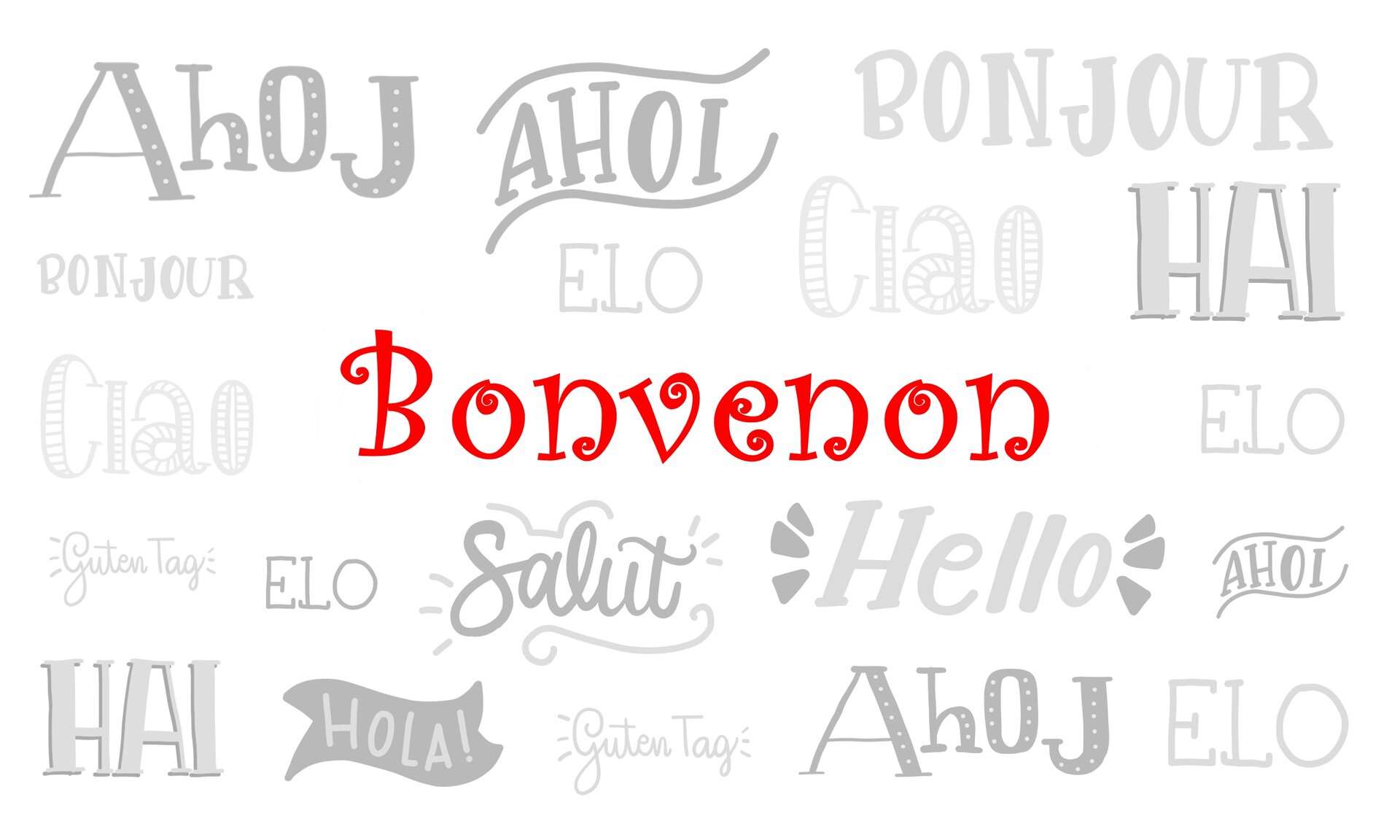
The word „bonvenon” means „welcome” in Esperanto. Have you ever wondered who invented Esperanto and why? How would you define the term „Esperanto”? What are the benefits of knowing Esperanto? Read the text in this section to find out.
Słowo bonvenon oznacza „witaj” w esperanto. Czy zastanawiałeś/zastanawiałaś się kiedyś, kto wynalazł ten język i dlaczego? Jak zdefiniowałbyś/zdefiniowałabyś termin esperanto? Jakie są korzyści ze znajomości tego języka? Przeczytaj tekst w tej sekcji, aby się dowiedzieć.
R9cq6ZGDwzEIn
Grafika przedstawia słowo"Bonvenon" zapisane w 11 różnych językach.
A common language? Why not!
Wspólny język? Dlaczego nie!
Źródło: dostępny w internecie: freepik.com [dostęp 21.12.2021], domena publiczna.
Exercise1
RAMbDEyReoHfb
Odpowiedz na pytania lub uzupełnij tekst. 1. Made by people, often as a copy of something natural, 2. The rules about how words change their form and combine with other words to make sentences, 3. The first language that you learn, 4. To become involved or have contact with someone or something, 5. To put together different parts to form something new, 6. To have something inside or include something as a part, 7. Another word for language, 8. Someone who speaks a particular language
Odpowiedz na pytania lub uzupełnij tekst. 1. Made by people, often as a copy of something natural, 2. The rules about how words change their form and combine with other words to make sentences, 3. The first language that you learn, 4. To become involved or have contact with someone or something, 5. To put together different parts to form something new, 6. To have something inside or include something as a part, 7. Another word for language, 8. Someone who speaks a particular language
Źródło: GroMar Sp. z o.o., licencja: CC BY-SA 3.0.
Esperanto: A Language of Hope?
AnetaWilemska‑RudnikEsperanto: A Language of Hope?
Esperanto is the most widely spoken auxiliary languageauxiliary languageauxiliary language in the world, with speakers located all across the globe. It is not officially the second language in any country, but some countries do teach it in schools, with Hungary and China being two notablenotablenotable examples. An auxiliary language is a language other than a person's native tongue. This means no country lists it as its first language officially, however, there are people who have learned Esperanto as their first language, which means that they are native speakersnative speakers [native speaker]native speakers of Esperanto and it is their mother tonguemother tonguemother tongue. As of 2017, Esperanto has around 30,000‑180,000 active speakersactive speakers [active speaker]active speakers, which means that many people have a good grasp ofhave a good grasp ofhave a good grasp of the language and are capable ofbe capable ofcapable of understanding it at A2 level.
Esperanto was foundedfoundedfounded in 1887 and is used in most parts of the world. However, it is most popular in Central and Eastern Europe, East Asia and South America. Esperanto is a constructed languageconstructed languageconstructed language and containscontains [contain]contains a wide diversity of languages. The Esperanto vocabulary is built on the basis of standard words from various European languages, such as Romance and Germanic languages. It was created by L.L. Zamenhof, a Polish ophthalmologistophthalmologistophthalmologist, who hoped Esperanto would be used as a common languagecommon languagecommon language throughout the world, enablingenablingenabling more people to communicate easily. Having a commonly spoken auxiliary language, which is universal, was supposed to allow people to engage withengage withengage with citizens of many countries, and Zamenhof hoped this would bring people together and ensure peace.
As an artificial languageartificial languageartificial language, Esperanto was designed to be simple. This made it easy for people to learn it, increasing, in turn, its attractiveness and making it widely availablewidely availablewidely available. grammar rules used in Esperanto are relatively simplerelatively simplerelatively simple, with no irregularitiesirregularities [irregularity]irregularities in past tenses, plurals or prepositions. This means that Esperanto is much easier to understand, even with a limited set of wordsset of wordsset of words, as the sentences often follow similar patterns and rules.
Esperanto has been around for over 140 years and has often survived difficult times. It was outlawed in several countries during the two World Wars. Recently, the language has seen a surge in popularitysurge in popularitysurge in popularity. With international travel becoming more and more common, the need for a shared language is growing. Countries, such as Slovakia, seem to find Esperanto more appealing toappealing toappealing to introduce, as they border many other countries all speaking different languages, meaning the idea for a single language that would be understood across many of these is much more attractive. The ease ofthe ease ofThe ease of learning Esperanto also potentially puts it ahead of English in these regions, as this is often the go‑to language to learn as an additional one, due to how far the language reaches.
Slovaks are champions ofchampions of [champion of]champions of Esperanto, promotingpromoting [promote]promoting it to the rest of the world. This means they are urgingurgingurging more and more people to join this growing network of Esperanto speakers around the world. Those who want to unite all people from all walks of life and all countries are often the same people who learn to speak Esperanto. They believe, just like the creator of Esperanto, that it can be the language of hope, the language uniting people under a common tongue, understood across many countries and nations. With Esperanto taking inspiration from other common languages, it can be very easy for people who may not speak it to understand certain words or phrases. It seems worth learning Esperanto if you have the opportunityhave the opportunityhave the opportunity.
1 Źródło: AnetaWilemska‑Rudnik, dostępny w internecie: https://www.worldatlas.com/articles/10-facts-about-esperanto-the-world-s-international-language.html [dostęp 22.11.2021], https://time.com/4417809/esperanto-history-invention/ [dostęp 22.11.2021], https://www.babbel.com/en/magazine/how-many-people-speak-esperanto-and-where-is-it-spoken [dostęp 22.11.2021], licencja: CC BY-SA 3.0.
Exercise2
Search for the information in the text and choose the correct answer.
R2bSktjAJisUX
1. When it comes to Esperanto, Możliwe odpowiedzi: 1. nobody speaks it as a native language., 2. it is taught in schools only in Hungary., 3. it is an artificial language.
Źródło: GroMar Sp. z o.o., licencja: CC BY-SA 3.0.
RvZXJp4VzG1Du
2. Zamenhof invented Esperanto Możliwe odpowiedzi: 1. to make communication among people easier., 2. because he wanted to communicate in this language., 3. to introduce it as a second language in selected countries.
Źródło: GroMar Sp. z o.o., licencja: CC BY-SA 3.0.
RHUHsxgt9D1zG
3. According to the text, Esperanto is easy to learn because of Możliwe odpowiedzi: 1. a limited set of words in it., 2. quite simple grammatical rules., 3. similarity to your native language.
Źródło: GroMar Sp. z o.o., licencja: CC BY-SA 3.0.
RcKndZ6S1bCCk
4. Esperanto Możliwe odpowiedzi: 1. is learned only by those who find it difficult to learn other foreign languages., 2. is largely promoted by the Slovaks., 3. does not require the knowledge of grammar rules.
Źródło: GroMar Sp. z o.o., licencja: CC BY-SA 3.0.
R1QuEhSLHfLkF
5. According to the author, Esperanto Możliwe odpowiedzi: 1. can be understood by people who don’t speak any foreign language., 2. is similar to European and Asian languages., 3. is largely promoted by speakers all over the world.
Źródło: GroMar Sp. z o.o., licencja: CC BY-SA 3.0.
Exercise3
Based on the information from the text, drag and drop the elements below to fill in the gaps. There are two extra items you don’t need.
R1GTHohFXzaxI
Convincing the reluctant learners to communicate in Esperanto was a 1. urging, 2. appealing, 3. artificial, 4. notable, 5. appalling, 6. outlawed, 7. noted achievement.
Since Esperanto is an 1. urging, 2. appealing, 3. artificial, 4. notable, 5. appalling, 6. outlawed, 7. noted language, it was designed to be simple.
Little did I realize that speaking Esperanto was 1. urging, 2. appealing, 3. artificial, 4. notable, 5. appalling, 6. outlawed, 7. noted in several countries during the two World Wars.
Some teachers at Ted’s school are 1. urging, 2. appealing, 3. artificial, 4. notable, 5. appalling, 6. outlawed, 7. noted students to learn Esperanto instead of English, which in my view is ridiculous.
The opportunity of learning another foreign language seems incredibly 1. urging, 2. appealing, 3. artificial, 4. notable, 5. appalling, 6. outlawed, 7. noted to me.
Convincing the reluctant learners to communicate in Esperanto was a 1. urging, 2. appealing, 3. artificial, 4. notable, 5. appalling, 6. outlawed, 7. noted achievement.
Since Esperanto is an 1. urging, 2. appealing, 3. artificial, 4. notable, 5. appalling, 6. outlawed, 7. noted language, it was designed to be simple.
Little did I realize that speaking Esperanto was 1. urging, 2. appealing, 3. artificial, 4. notable, 5. appalling, 6. outlawed, 7. noted in several countries during the two World Wars.
Some teachers at Ted’s school are 1. urging, 2. appealing, 3. artificial, 4. notable, 5. appalling, 6. outlawed, 7. noted students to learn Esperanto instead of English, which in my view is ridiculous.
The opportunity of learning another foreign language seems incredibly 1. urging, 2. appealing, 3. artificial, 4. notable, 5. appalling, 6. outlawed, 7. noted to me.
Źródło: GroMar Sp. z o.o., licencja: CC BY-SA 3.0.
Exercise4
Use the words and phrases from the text to fill in the gaps in the sentences below.
RjQchDSnSsr5q
Recently, there has been a noticeable Tu uzupełnij in popularity when it comes to the number of Esperanto speakers.
Many of my friends have a pretty good Tu uzupełnij of at least one foreign language, which enables them to communicate with others without any obstacles.
Are there any complex grammar rules Tu uzupełnij in Esperanto that I should be aware of?
Agnes speaks English fluently, yet she fails to Tu uzupełnij in conversations with foreigners.
Do you happen to know any Tu uzupełnij of Esperanto in your country?
Recently, there has been a noticeable Tu uzupełnij in popularity when it comes to the number of Esperanto speakers.
Many of my friends have a pretty good Tu uzupełnij of at least one foreign language, which enables them to communicate with others without any obstacles.
Are there any complex grammar rules Tu uzupełnij in Esperanto that I should be aware of?
Agnes speaks English fluently, yet she fails to Tu uzupełnij in conversations with foreigners.
Do you happen to know any Tu uzupełnij of Esperanto in your country?
Źródło: GroMar Sp. z o.o., licencja: CC BY-SA 3.0.
język sztucznie stworzony (a language that has been created for a particular purpose, rather than one that has developed naturally as a way for people to communicate)