Przeczytaj
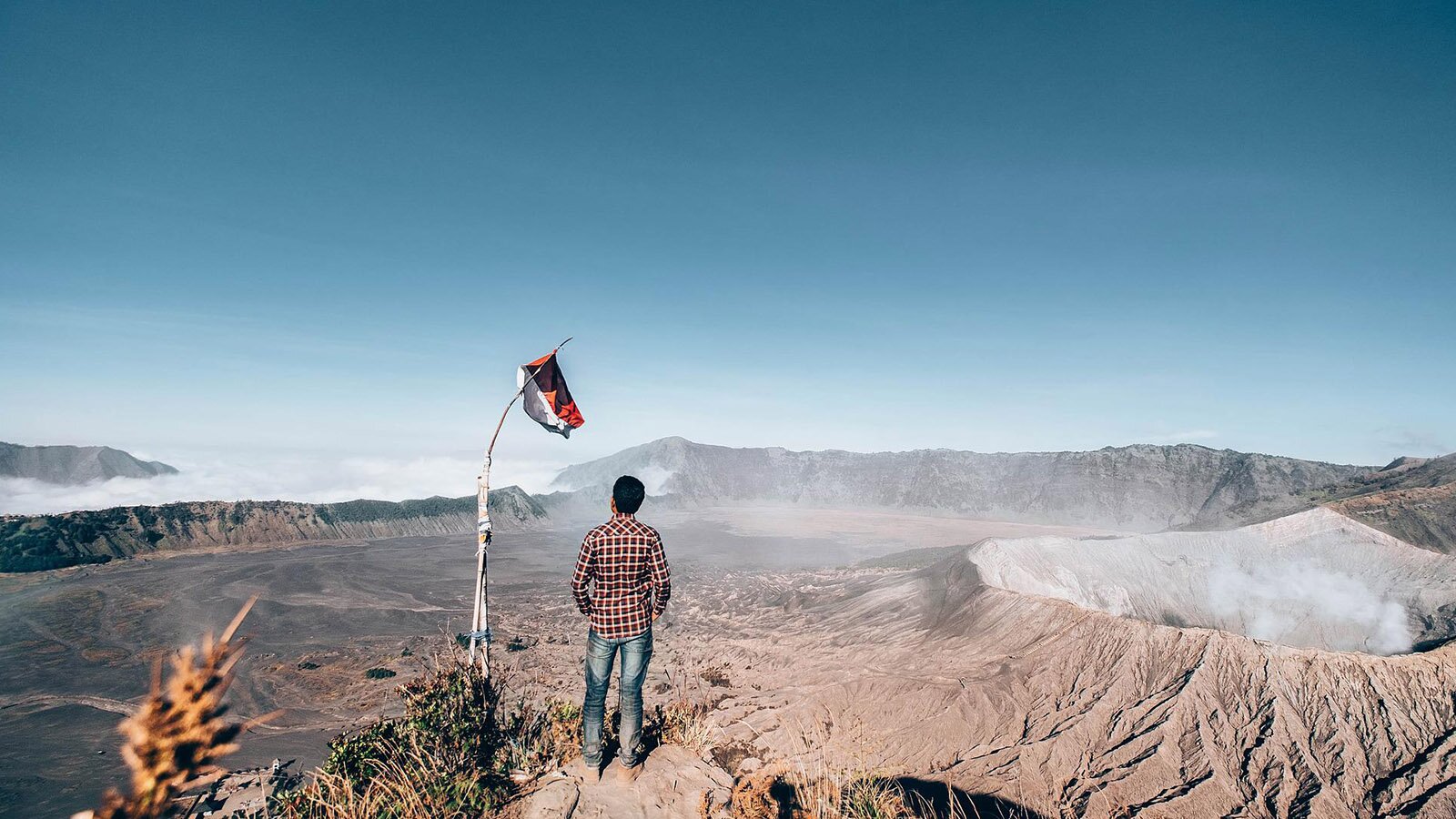
The picture below shows a man who is admiring the volcanic landscape in Java. On the right, you can see a volcano with some smoke coming out of it. Is it safe to be there? Read the text to find out how a volcanic eruption can be devastating for people and for the planet.
Poniższe zdjęcie przedstawia mężczyznę, który podziwia wulkaniczny krajobraz na indonezyjskiej wyspie Jawie. Po prawej stronie widać wulkan, z którego wydobywa się dym. Czy przebywanie w tym miejscu jest bezpieczne? Przeczytaj tekst, aby dowiedzieć się, jak niszczycielska dla ludzi i planety może być erupcja wulkanu.
Match the words with the correct translations.
Read the text to learn more about a horrible natural disaster that took place in the 19th century.
One Day in HistoryKrakatoa is the name of a tiny uninhabiteduninhabited volcanic island off the coast of Indonesia, around 160 kilometres from Jakarta – the capital city. It’s located between the islands of Java and Sumatra in the Sunda StraitStrait. Why is it worth reading about? The main island of Krakatoa (or Krakatau in Indonesian) erupted in August 1883, killing over 36,000 people and making it one of the most disastrousdisastrous volcanic eruptionseruptions in human history.
Most people believed that Krakatoa had erupted for the last time in 1680 and they assumedassumed it was extinctextinct. However, they couldn’t have been more wrong. At about 1 p.m. on August 26th, a cloud of gas and debrisdebris was ejectedejected 24 kilometres above Perboewatan crater. It was the beginning of a series of increasinglyincreasingly intense blastsblasts that would occur for the next 21 hours, culminatingculminating in a massive explosion about 10 a.m. on August 27th. It carried ashash 80 kilometres into the air and could be heard as far away as Perth in Australia (a distance of about 4500 kilometres). The calderacaldera submergedsubmerged around 23 square kilometres of the island, including Perboewatan and Danan – Krakatoa’s peakspeaks, to the depthdepth of about 250 metres below sea level.
The eruption resulted in a number of casualtiescasualties, but volcanic rocks and hot volcanic gases, produced by the blasts, killed just a small percentage of the victimsvictims. Tens of thousands more people drowneddrowned as a result of the volcano's collapse into the caldera, which resulted in tsunamis. The waves were as high as 30 metres and they wiped outwiped out about 160 coastal villages. The ash from the eruption spreadspread throughout the world and caused halo effectshalo effects around the moon and sun. In the year following the eruption, the ash acted as a solar radiationsolar radiation filter, decreasingdecreasing world temperatures by as much as 0.5°C. However, five years later, in 1888, temperatures returned to normal. A pyroclastic flowpyroclastic flow resulted from the Krakatoa eruption. It’s a high‑densityhigh‑density mixture of hot lava chunkschunks, pumicepumice and volcanic ash destroying almost everything in its path. It can travel at the speed of up to 80 kilometres per hour, knocking downknocking down, shatteringshattering, buryingburying or carrying away practically all objects and structures it encounters. The high temperatures of the rocks and gas inside the pyroclastic flow can reach 200°C to 700°C, ignitingigniting fires and burning living organisms right away.
Krakatoa was considered dormantdormant until the 1920s, when it resumedresumed volcanic activity. Since then, lesser eruptions have occurred, resulting in the formation of a new conecone called Anak Krakatau or the “child of Krakatoa”. On December 22nd, 2018, the volcano erupted, causing a devastatingdevastating tsunami. Over 400 people were killed, with another 30,000 injured and displaceddisplaced. The “child of Krakatoa” eruption has been one of the worst volcanic eruptions of the twenty‑first century. When will the volcano wake up again? We don’t know. One thing is certain, it remains highly active, but when it will erupt again remains a mystery.
Źródło: Dorota Giżyńska, licencja: CC BY-SA 3.0.
a) it happened in an unusual geographic location.
b) it’s the deadliest eruption in history.
c) it’s one of the oldest eruptions in human history.
2. Why was the eruption of the volcano surprising?
a) It erupted for the last time in the previous century.
b) The eruption was very strong.
c) People believed it would never erupt again.
3. Which sentence is TRUE about the Krakatoa eruption?
a) Hot volcanic gases killed the majority of people.
b) Most casualties died because of giant waves.
c) The island disappeared 23 kilometres under water.
4. A pyroclastic flow is:
a) dangerous and fast.
b) extremely hot, but slow.
c) destructive and wet.
5. In the last paragraph, the author of the text expresses his/her:
a) fear that the volcano will lead to a lot of deaths again.
b) belief that Anak Krakatau won’t erupt in the future.
c) certainty that the “child of Krakatoa” will erupt again.
2. In 1680, people believed it was ejected extinct.
3. As a result of the eruption, the caldera submerged drowned 250 metres below sea level.
4. There was a series of intense explosions decreasing culminating in a massive blast.
5. In 1920, Krakatoa resumed ignited its volcanic activity.
6. The eruption of the “child of Krakatoa” resulted in a shattering devastating tsunami in 2018.
Answer the questions. Use 2–3 sentences.
What is the most important piece of information that you would like to remember from the text? Why do you think so?
Give two reasons why volcanic eruptions are dangerous for humans.
What else would you like to learn about volcanic eruptions?
Słownik
/ æʃ /
popiół (the powdery residue left after the burning of a substance)
/ əˈsjuːmd / / əˈsjuːm /
przypuszczał/przypuszczała [przypuszczać] (to suppose to be the case, without proof)
/ blɑːsts / / blɑːst /
eksplozje, wybuchy [eksplozja, wybuch] (to put or hide underground)
/ buːm /
huk (a loud, deep, resonant sound)
/ ˈberɪɪŋ / / ˈberi /
grzebiąc [pogrzebać (przysypać kogoś, powodując jego śmierć)] (to put or hide underground)
/ ˌkælˈderə /
kaldera (a large volcanic crater, especially one formed by a major eruption leading to the collapse of the mouth of the volcano)
/ ˈkæʒʊəltɪz / / ˈkæʒʊəlti /
ofiary [ofiara] (a person killed or injured in a war or accident)
/ tʃʌŋks / / tʃʌŋk /
spore kawałki [spory kawałek] (a thick, solid piece of something)
/ kəʊn /
stożek (a solid or hollow object which tapers from a circular or roughly circular base to a point)
/ ˈkreɪtə /
krater (a large bowl‑shaped cavity in the ground or on a celestial object, typically one caused by an explosion or the impact of a meteorite)
/ ˈkʌlmɪneɪtɪŋ / / ˈkʌlmɪneɪt /
kończąc się [kończyć się czymś] (to reach a climax or point of highest development)
/ ˈdeɪbriː /
odłamki, gruz (loose natural material consisting especially of broken pieces of rock)
/ dɪˈkriːsɪŋ / / dɪˈkriːs /
zmniejszający/zmniejszająca [zmniejszać] (to make or become smaller or fewer in size, amount, intensity, or degree)
/ deptheta /
głębokość (the distance from the top or surface to the bottom of something)
/ ˈdevəsteɪtɪŋ /
niszczycielski/niszczycielska (highly destructive or damaging)
/ dɪˈzɑːstrəs /
katastrofalny/katastrofalna (causing great damage)
/ dɪsˈpleɪst / / dɪsˈpleɪs /
przesiedlony/przesiedlona [przesiedlić] (to force someone to leave their home, typically because of war, persecution, or natural disaster)
/ ˈdɔːmənt /
uśpiony (o wulkanie) (a „dormant” volcano is one that is not erupting now)
/ draʊnd / / draʊn /
utonął/utonęła [utonąć] (to die through submersion in and inhalation of water)
/ ɪˈdʒektɪd / / ɪˈdʒekt /
wyrzucił/wyrzuciła [wyrzucać] (np. lawę, gaz) (to force or throw sth out in a violent or sudden way)
/ ɪˈrʌpʃn̩z / / ɪˈrʌpʃn̩ /
erupcje [erupcja]
/ ɪkˈstɪŋt /
tu: wygasły (o wulkanie)
/ ˈheɪləʊ ɪˈfekts / / ˈheɪləʊ ɪˈfekt /
efekty halo [efekt halo] (a bright ring around the moon appearing after a volcano’s eruption)
/ ˌhaɪ ˈdensɪti /
o wysokiej gęstości (having a high concentration)
/ ɪɡˈnaɪtɪŋ / / ɪɡˈnaɪt /
wzniecając [wzniecać] (to catch fire or cause to catch fire)
/ ɪnˈkriːsɪŋli /
coraz bardziej (more and more)
/ ˈnɒkɪŋ daʊn / / ˈnɒk daʊn /
powalając, przewracając [powalać, przewracać] (to demolish)
/ ˈlɑːvə /
lawa (hot molten or semi‑fluid rock erupted from a volcano or fissure)
/ ˈmæɡmə /
magma (hot fluid or semi‑fluid material below or within the earth's crust from which lava and other igneous rock is formed on cooling)
/ meɪn vent /
główny odpowietrznik (an opening that allows air, gas, or liquid to pass out of or into a confined space)
/ piːks / / piːk /
szczyty [szczyt] (the pointed top of a mountain)
/ ˈpʌmɪs /
pumeks (a very light and porous volcanic rock formed when a gas‑rich froth of glassy lava solidifies rapidly)
/ ˌpʌɪrəʊˈklastɪk fləʊ /
lawina piroklastyczna (a dense, destructive mass of very hot ash, lava fragments, and gases ejected explosively from a volcano and typically flowing at great speed)
/ rɪˈzjuːmd / / rɪˈzjuːm /
wznowił/wznowiła [wznawiać] (to start again)
/ ˈʃætərɪŋ / / ˈʃætə /
roztrzaskując [roztrzaskiwać] (to break or cause to break suddenly and violently into pieces)
/ ˌsəʊlə ˌreɪdɪˈeɪʃn̩ /
promieniowanie słoneczne (a general term for the electromagnetic radiation emitted by the sun)
/ spred /
rozszerzać się (to extend over a large or increasing area)
/ streɪt /
cieśnina (a narrow passage of water connecting two seas or two other large areas of water)
/ səbˈmɜːdʒd / / səbˈmɜːdʒ /
zatopił się/ zatopiła się [zatapiać się] (to cause sth to be under water)
/ ˌʌnɪnˈhæbɪtɪd /
niezamieszkały/niezamieszkała (without inhabitants)
/ ˈvɪktɪmz / / ˈvɪktɪm /
ofiary [ofiara] (a person harmed, injured, or killed as a result of a crime, accident, or other event or action)
/ waɪpt ˈaʊt / / waɪp ˈaʊt /
zmiótł/zmiotła z powierzchni ziemi [zmieść z powierzchni ziemi] (to eliminate something completely)
Źródło: GroMar Sp. z o.o., licencja: CC BY‑SA 3.0