bg‑azure

Before 2019 only the bravest employers trusted their employees to work from home, causing a lot of speculation as to how much work really gets done. But the pandemic lockdowns proved to be a gamechanger. Everyone but doctors and certain services got to live the dream and work from home. By the time the office doors opened again, it was obvious to everyone that corpo culture had changed forever. The question now isn’t “is it possible to work remotely?” but “what working conditions would be best for me?” What do you think?

Przed 2019 rokiem tylko najodważniejsi pracodawcy ufali swoim pracownikom na tyle, żeby pozwolić im pracować z domu, co wywoływało wiele spekulacji na temat tego, ile pracy naprawdę zostanie wykonane. Ale lockdowny pandemiczne zmieniły reguły gry. Wszyscy, z wyjątkiem lekarzy i niektórych służb, mogli spełnić marzenie i pracować w domu. Kiedy drzwi biur zostały ponownie otwarte, stało się jasne, że kultura korporacyjna zmieniła się na zawsze. Teraz pytanie brzmi: „jakie warunki pracy byłyby dla mnie najlepsze?”, a nie „czy można pracować z domu?”. Co o tym sądzisz?

R7Dw2cpUn7hCh
Are empty offices the future of workplaces?
Czy puste biura to przyszłość zakładów pracy?
Źródło: dostępny w internecie: www.unsplash.com [dostęp 13.01.2021], domena publiczna.
1
Exercise 1

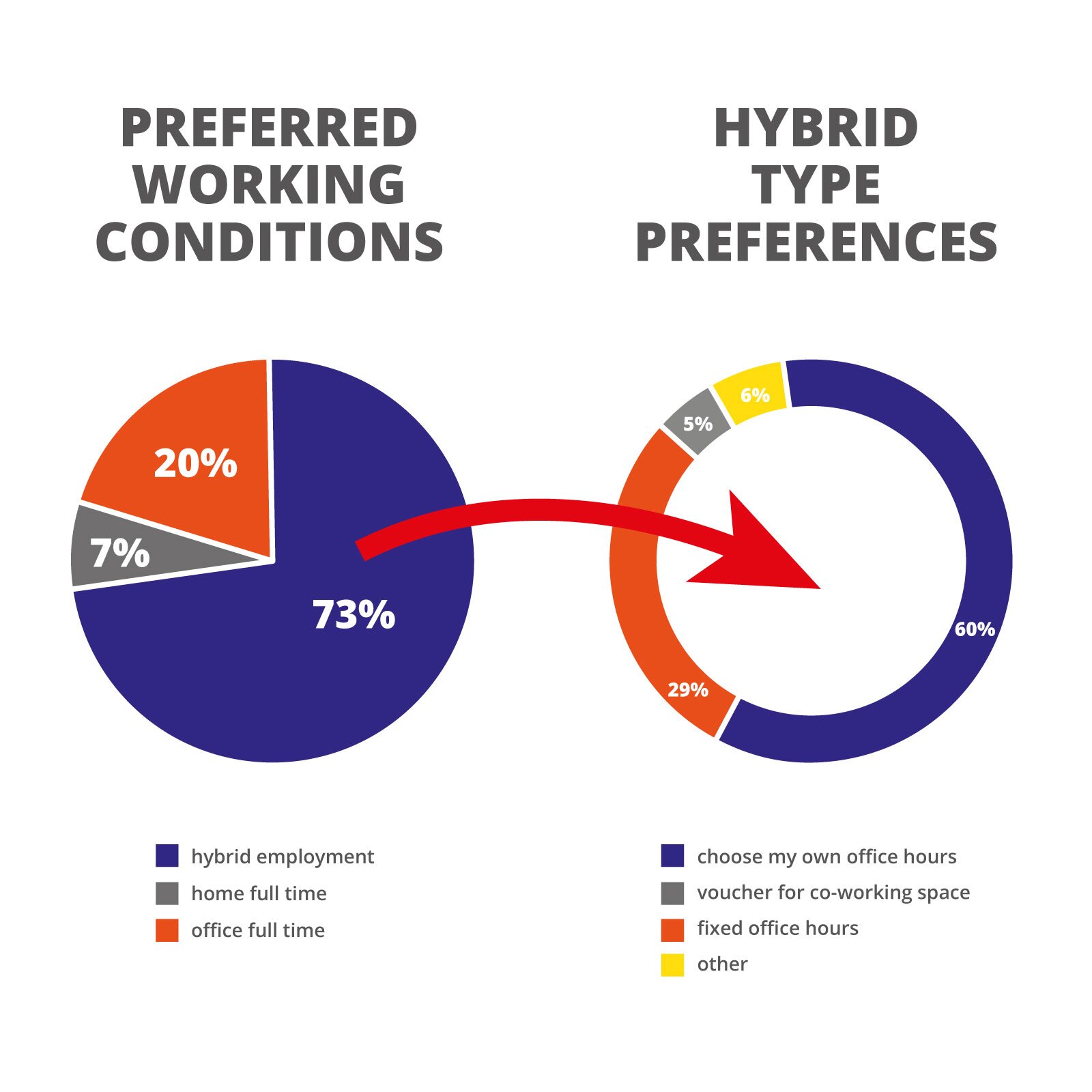
Study the text below. Then decide if the sentences are true or false.
R1etiifp1QjBY
About 73% of the population prefers hybrid employment. About 20% prefer working at the office. Only 7% of the population wants working at home to be their full time job. When it comes to hybrid employment, the type preferences are diverse. For example, 60% would like to choose their own office hours. 29% of the population prefers having fixed office hours. About 5% want to have a voucher for co-working space, whereas 6% have other preferences.
Źródło: GroMar Sp. z o.o., licencja: CC BY-SA 3.0.
Exercise 1
RPczz0ni8Fskh
Źródło: Konrad Szczodrak, domena publiczna.
R1cnua8iCrCFr
Based on the charts above, decide if the following statements are True or False.
  1. More than a quarter of the population wants to be working at home all the time TRUE FALSE
  2. Most people prefer a mixture of office and home based work. TRUE FALSE
  3. Full time office is no longer the preferred working style. TRUE FALSE
  4. More people prefer working from the office than from co-working spaces. TRUE FALSE
  5. Over 1/3 of those preferring hybrid still want to have fixed office hours. TRUE FALSE
  6. Overall, the most popular option is hybrid working with flexible office hours.TRUE FALSE
Źródło: GroMar Sp. z o.o., licencja: CC BY-SA 3.0.

Study the text and do the exercises below.

The New Working Reality
Joanna Sobierska-Paczesny The New Working Reality

A

As the world changes, develops, and throws at us challenges such as the global pandemic, our workplaces are changing with it, physically and ideologically. The basic question on everyone’s lips today is what kind of working conditionsworking conditionsworking conditions will yield highest productivityyield highest productivityyield highest productivity and employee engagementemployee engagementemployee engagement? Does a 40 hour workweek40‑hour workweek40 hour workweek spent in the office make sense in this new reality? Many studies seem to indicate that the answer is „No”. The countries with the longest working week do not have the highest productivity. So what’s the future of workplaces?

B

One answer to this is flexitimeflexitimeflexitime. Productivity resulting from the pandemic lockdowns busted the mythsbusted the myths [bust a myth]busted the myths about the ineffectivenessineffectivenessineffectiveness of working from home. As a result, many companies happily adjusted to remote workingremote workingremote working. The employees can now clock in and outclock in and outclock in and out (metaphorically speaking) during hours that suitsuitsuit their rhythm, which is fantastic for family life and work‑life balancework‑life balancework‑life balance, but has its downsides as well.

C

Surprisingly, for many, remote work created not the problem of less, but more work. Because work can now be done basically anywhere and at any time, people find it difficult to disconnectdisconnectdisconnect and put work away. Clearly, there’s an urgent need for safety regulationssafety regulationssafety regulations that would prevent people from becoming overworkedoverworkedoverworked or developing certain occupational diseasesoccupational diseaseoccupational diseases such as eye straineye straineye strain or backachesbackaches [backache]backaches from spending too many hours a day in front of a screen. There’s also the issue of organising company meetings when everyone works a different schedule, so evidently some regulations are called forare called for [be called for]are called for.

D

Another solution that many countries from Japan to Spain are experimenting with is a 32 hour workweek. Whether that means a three day weekend or shortened workdaysshortened workdayshortened workdays varies, but the idea is the same. Naturally, less hours should not translate into wage cutswage cuts [wage cut]wage cuts. Spain decided to subsidisesubsidisesubsidise workers and pay them the missing 20% in their pilot program that’s supposed to check the validityvalidityvalidity of such a schemeschemescheme. However, most of the time it just means that the work that used to take 40 hours is now compressed intocompressed intocompressed into 32, which leads to more hectic and tighter scheduleshectic and tight schedules [hectic and tight schedule]hectic and tighter schedules and possibly even more competitive workplacescompetitive workplacecompetitive workplaces.

E

Naturally, there are many opponentsopponents [opponent]opponents to these ideas, who believe that only if employees are at the office and all at the same time can the manager make sure they do what they’re supposed to and the teams share ideas effectivelyshare ideas effectively [share an idea]share ideas effectively. Their numbers, however, are decreasing. Proponentsproponents [proponent]Proponents of changes point out that when trade unionstrade unions [trade union]trade unions succeeded in their struggle and a 40 hour week was introduced over a century ago, it also raised a lot of questionsraised a lot of questions [raise a question]raised a lot of questions. Not to mention the fact that it was created for a totally different world, so how can it suit today’s employers’ and employees’ needsneeds [need]needs?

1 Źródło: Joanna Sobierska-Paczesny, licencja: CC BY-SA 3.0.
Ri1CA2GFXmkOx
Exercise 2
Complete the table with the letters corresponding to the paragraphs in the text above.
Źródło: GroMar Sp. z o.o., licencja: CC BY-SA 3.0.
R1e4Tjqzma7Ln
Exercise 3
Drag the following phrases to make collocations. share ideas Możliwe odpowiedzi: 1. workplace, 2. one’s needs, 3. conditions, 4. schedule, 5. the myth, 6. disease, 7. workday, 8. engagement, 9. working, 10. effectively tight Możliwe odpowiedzi: 1. workplace, 2. one’s needs, 3. conditions, 4. schedule, 5. the myth, 6. disease, 7. workday, 8. engagement, 9. working, 10. effectively shortened Możliwe odpowiedzi: 1. workplace, 2. one’s needs, 3. conditions, 4. schedule, 5. the myth, 6. disease, 7. workday, 8. engagement, 9. working, 10. effectively working Możliwe odpowiedzi: 1. workplace, 2. one’s needs, 3. conditions, 4. schedule, 5. the myth, 6. disease, 7. workday, 8. engagement, 9. working, 10. effectively bust Możliwe odpowiedzi: 1. workplace, 2. one’s needs, 3. conditions, 4. schedule, 5. the myth, 6. disease, 7. workday, 8. engagement, 9. working, 10. effectively employee Możliwe odpowiedzi: 1. workplace, 2. one’s needs, 3. conditions, 4. schedule, 5. the myth, 6. disease, 7. workday, 8. engagement, 9. working, 10. effectively occupational Możliwe odpowiedzi: 1. workplace, 2. one’s needs, 3. conditions, 4. schedule, 5. the myth, 6. disease, 7. workday, 8. engagement, 9. working, 10. effectively competitive Możliwe odpowiedzi: 1. workplace, 2. one’s needs, 3. conditions, 4. schedule, 5. the myth, 6. disease, 7. workday, 8. engagement, 9. working, 10. effectively suit Możliwe odpowiedzi: 1. workplace, 2. one’s needs, 3. conditions, 4. schedule, 5. the myth, 6. disease, 7. workday, 8. engagement, 9. working, 10. effectively remote Możliwe odpowiedzi: 1. workplace, 2. one’s needs, 3. conditions, 4. schedule, 5. the myth, 6. disease, 7. workday, 8. engagement, 9. working, 10. effectively
Źródło: GroMar Sp. z o.o., licencja: CC BY-SA 3.0.
RI7AB2ZKOXMZS
Exercise 4
Read the text above. Then, type in the missing phrases to complete the summary below. Hi Sam, Just read an article that might interest you since you were complaining about your boss forcing you to work from the office all the time. It actually says that if we look at how the world has changed, then it doesn’t make sense to have a 40-hour office week anymore and studies     1. Tu uzupełnij.     So with that myth busted, it goes on to say that many companies have already     2. Tu uzupełnij     into their policy for good. They call it flexitime and allow people to     3. Tu uzupełnij     their work whenever it is good for them. Apparently though, new safety regulations     4. Tu uzupełnij     because many people get sick. I think the advice to them would be to     5. Tu uzupełnij     in front of the screen, and that would take care of it, but I don’t think you’re going to have such a problem. There’s also another option you might want to suggest to your boss – if he listens that is. It’s something that’s also been tested all over the world – a 32-hour week. The article seems to suggest that while in the Spanish version of this program 32 hours a week means people just work less, in other countries they do     6. Tu uzupełnij     in less time. Not sure how that would work out for you. Anyway, your boss might be one of those people who are against such innovations, believing that if employees     7. Tu uzupełnij     he won’t be able to control them. Well, the author of the article seems to take the side of those who think the 40-hour week     8. Tu uzupełnij.    
Źródło: GroMar Sp. z o.o., licencja: CC BY-SA 3.0.

Słownik

40‑hour workweek
40‑hour workweek

/ ˈfɔːti ˈaʊə ˈwɜːkˌwiːk /

R9H7Yddl46DQF1
Nagranie dźwiękowe

czterdziestogodzinny tydzień pracy (a 40‑hour working week)

RbDPxMaugrJtL1
Nagranie dźwiękowe
are called for [be called for]

/ a: kɔːld fɔː / / bi kɔːld fɔː /

R1VAvd06sKZh21
Nagranie dźwiękowe

są potrzebne [być potrzebnym] (are needed)

R1cKJg1IJJE211
Nagranie dźwiękowe
backaches [backache]

/ ˈbækeɪks / / ˈbækeɪk /

RVcaGAFkD85eN1
Nagranie dźwiękowe

bóle pleców [ból pleców] (a pain in the back)

R1YohHYo5ouBJ1
Nagranie dźwiękowe
busted the myths [bust a myth]

/ ˈbʌstɪd ðə mɪthetas / / ˈbʌst ə mɪtheta /

RiSEBigY0ABsl1
Nagranie dźwiękowe

obaliły mity [obalać mit] (to reject old widely held ideas)

RvX4CiaNgN7A31
Nagranie dźwiękowe
clock in and out
clock in and out

/ klɒk ɪn ənd ˈaʊt /

R50ms1MW6DNku1
Nagranie dźwiękowe

zarejestrować czas rozpoczęcia i zakończenia pracy (to record the start and end times of work)

RbTrCXUq4erm21
Nagranie dźwiękowe
competitive workplace

/ kəmˈpetətɪv ˈwɜːkpleɪs /

R1JB02Je5DBsA1
Nagranie dźwiękowe

miejsce pracy, w którym dominuje rywalizacja (a workplace dominated by competition)

R1YEvaA9lsSCt1
Nagranie dźwiękowe
compressed into
compressed into

/ kəmˈprest ˈɪntə /

R1H2cG2X9sGa81
Nagranie dźwiękowe

zredukowany/zredukowana do (reduced to)

RajNryFNc1Yq71
Nagranie dźwiękowe
disconnect
disconnect

/ ˌdɪskəˈnekt /

R58FkWRjiC2BY1
Nagranie dźwiękowe

rozłączyć się (to break the connection)

RXmUkHpNJJZk31
Nagranie dźwiękowe
employee engagement
employee engagement

/ ˌemploɪˈiː ɪnˈɡeɪdʒmənt /

R180KICz2aV9A1
Nagranie dźwiękowe

zaangażowanie pracowników (employee involvement)

R1CoxL2xtBt191
Nagranie dźwiękowe
eye strain
eye strain

/ eɪ streɪn /

RSATV8f7mdAPC1
Nagranie dźwiękowe

przemęczenie oczu (a condition of tired eyes)

Rz8aQ7tXFtmOh1
Nagranie dźwiękowe
flexitime
flexitime

/ fleksɪˈtaɪm /

R1BCBTOSGS5BY1
Nagranie dźwiękowe

nienormowany czas pracy (irregular working hours)

RNaLAMDNG5Rjf1
Nagranie dźwiękowe
hectic and tight schedules [hectic and tight schedule]

/ ˈhektɪk ənd ˈtaɪt ˈʃedjuːlz / / ˈhektɪk ənd ˈtaɪt ˈʃedjuːl /

RIz0iPgIGy4Ol1
Nagranie dźwiękowe

napięte terminy [napięty termin] (tight deadlines)

R1XQHAPdn9fCc1
Nagranie dźwiękowe
ineffectiveness
ineffectiveness

/ ˌɪnɪˈfektɪvnəs /

R1eNROl5RxI621
Nagranie dźwiękowe

brak skuteczności (giving no effects)

R1ZnyklvSWBCS1
Nagranie dźwiękowe
needs [need]
needs [need]

/  niːdz / /  niːd / 

R1SXeTw373uaG1
Nagranie dźwiękowe

potrzeby [potrzeba] (a thing which is necessary)

R1As1bp7b7PWL1
Nagranie dźwiękowe
occupational disease

/ ˌɒkjʊˈpeɪʃnəl dɪˈziːz /

R1Xhr2Awz3L5X1
Nagranie dźwiękowe

choroba zawodowa (illness connected with doing a specific job)

RADDALf7lBw3P1
Nagranie dźwiękowe
opponents [opponent]

/ əˈpəʊnənts / / əˈpəʊnənt /

R14A646rWLBF71
Nagranie dźwiękowe

przeciwnicy [przeciwnik/przeciwniczka] (rivals)

R1I2XxxuYr3bE1
Nagranie dźwiękowe
overworked
overworked

/ ˌəʊvəˈwɜːkt /

R3WRPSGQ5b4Dh1
Nagranie dźwiękowe

przepracowany/przepracowana (an adjective describing a person who works beyond their capacity)

Rh6bcg2rv9Lgr1
Nagranie dźwiękowe
proponents [proponent]

/ prəˈpəʊnənts / / prəˈpəʊnənt /

RFgRw0jhgcT321
Nagranie dźwiękowe

zwolennicy [zwolennik/zwolenniczka] (a supporter)

Rl8YlBbo5ENji1
Nagranie dźwiękowe
raised a lot of questions [raise a question]

/ reɪzd ə lɒt əv ˈkwestʃənz / / reɪz ə ˈkwestʃən /

R5k3gSExKUZ0I1
Nagranie dźwiękowe

budziło wiele wątpliwości [wzbudzić wątpliwość] (to give reasons to doubt)

R145oywTceegd1
Nagranie dźwiękowe
remote working
remote working

/ rɪˈməʊt ˈwɜːkɪŋ /

RaIPxhzWVmBoZ1
Nagranie dźwiękowe

praca zdalna (working from home)

R1KjHU2GO9GFd1
Nagranie dźwiękowe
safety regulations
safety regulations

/ ˈseɪfti ˌreɡjʊˈleɪʃn̩z /

RciJ40mCCcbi21
Nagranie dźwiękowe

zasady bezpieczeństwa (rules that are to guarantee safety)

R1OJ2HUVcDZbW1
Nagranie dźwiękowe
scheme
scheme

/ skiːm /

R1aTbYHz980hD1
Nagranie dźwiękowe

plan, program (a plan)

R17TYr8leDRTR1
Nagranie dźwiękowe
share ideas effectively [share an idea]

/ ˈʃeər aɪˈdɪəz ɪˈfektɪvli / / ˈʃeər ən aɪˈdɪə /

RbcM4FXRkzegq1
Nagranie dźwiękowe

skutecznie dzielić się pomysłami [podzielić się pomysłem] (to give your concept to others and have the use of it)

RTIFsOaNC0EWA1
Nagranie dźwiękowe
shortened workday
shortened workday

/ ˈʃɔːtn̩d ˈwɜːkdeɪ /

R73H7vc8iKtMq1
Nagranie dźwiękowe

skrócony dzień pracy (a reduced working day)

RDKYaIN6PBjjk1
Nagranie dźwiękowe
subsidise
subsidise

/ ˈsʌbsɪdaɪz /

R16q154j22DzF1
Nagranie dźwiękowe

dotować (to support financially)

R14FOEBAts9ng1
Nagranie dźwiękowe
suit
suit

/ suːt /

Rhsf3YDabSPxa1
Nagranie dźwiękowe

dopasować (to adjust)

RnqFRModkvyc61
Nagranie dźwiękowe
trade unions [trade union]

/ ˈtreɪd ˈju:nɪənz / / ˈtreɪd ˈju:nɪən /

RD73RP6g0HgHj1
Nagranie dźwiękowe

związki zawodowe [związek zawodowy] (organisation formed by workers to protect their rights)

R1FR7ebgDOYSo1
Nagranie dźwiękowe
underpaid
underpaid

/ ˌʌndəˈpeɪd /

RnBRXxZp5JHKg1
Nagranie dźwiękowe

zbyt nisko opłacany/opłacana (an adjective describing a person who earns not enough)

RyYbW0nqbVYyX1
Nagranie dźwiękowe
validity
validity

/ vəˈlɪdɪti /

R1La5sptF2stQ1
Nagranie dźwiękowe

zasadność (the state of being acceptable)

R8N4tSVQertXX1
Nagranie dźwiękowe
wage cuts [wage cut]

/ ˈweɪdʒ kʌts / / ˈweɪdʒ kʌt /

RMAEs3aRg6Mm71
Nagranie dźwiękowe

obniżki płac [obniżka płac] (reduced money you get for the work done)

RPJVjtwgXOckh1
Nagranie dźwiękowe
work‑life balance
work‑life balance

/ ˈwɜ:k ˈlaɪfs ˈbæləns /

RMdrImRK7cnJs1
Nagranie dźwiękowe

równowaga życia prywatnego i pracy (the proper proportions between a private life and work)

RLat0wwgGPaFC1
Nagranie dźwiękowe
working conditions
working conditions

/ ˌwɜ:kɪŋ kənˈdɪʃn̩z /

R15ncVse8E9oO1
Nagranie dźwiękowe

warunki pracy (working conditions cover hours of work, rest periods, work schedules and safety rules)

R1UU3tH8bWduO1
Nagranie dźwiękowe
yield highest productivity

/ jiːld ˈhaɪɪst ˌprɒdʌkˈtɪvɪti /

R1dsHJ5M3vGty1
Nagranie dźwiękowe

skutkować maksymalną produktywnością (to result in highest efficiency)

R1AXhtkJ48jkJ1
Nagranie dźwiękowe
R1PgCUOg84BD0
(Uzupełnij).
Źródło: GroMar Sp. z o.o., licencja: CC BY-SA 3.0.