When we go to a restaurant, we expect a nice atmosphere and delicious food. Unfortunately, sometimes things go wrong. In this section, you are going to study a text about Mark’s family’s Sunday visit to a restaurant. What do you think of his experience?
Kiedy idziemy do restauracji, oczekujemy miłej atmosfery i smacznego jedzenia. Czasami jednak takie wyjście może się nie udać. W tej sekcji przeczytasz tekst o niedzielnej wizycie rodziny Marka w restauracji. Co sądzisz na temat doświadczenia chłopca?
ROviNzB9jtUB4
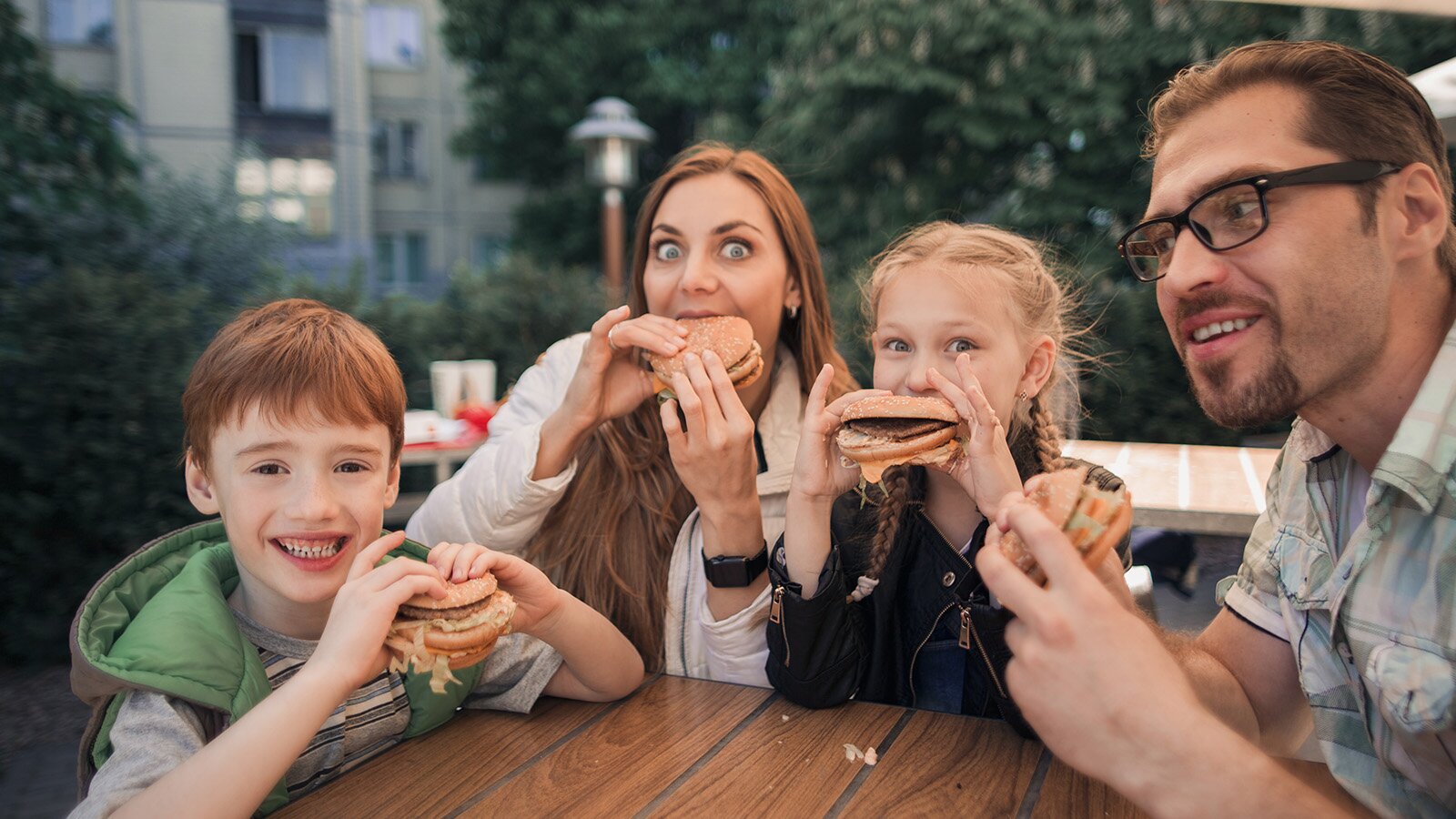
Zdjęcie przedstawia czwórkę ludzi, dwójkę dorosłych i dwójkę dzieci. Wszyscy siedzą przy stole i jedzą hamburgery.
Eating out can be fun!
Jedzenie na mieście może być fajne!
Źródło: dostępny w internecie: https://www.freepik.com/ [dostęp 26.03.2022], domena publiczna.
Exercise1
Match the words to the definitions.
Dopasuj wyrazy do definicji.
RdgPb7fmwoF4r
Źródło: GroMar Sp. z o.o., licencja: CC BY-SA 3.0.
Study the text below to find out why Mark’s family don’t like the restaurant. Then, do the exercises below.
Przeczytaj poniższy tekst o niedzielnym obiedzie Marka w restauracji, aby dowiedzieć się, dlaczego nie poleci tego miejsca znajomym, a następnie wykonaj poniższe ćwiczenia.
Sunday Dinner at a Restaurant
Ela Borowiec, Zuzanna KościukSunday Dinner at a Restaurant
“Yes! That’s a fantastic idea!” we all shouted happily.
But there was a problem. We didn’t know where to go.
“Let’s have Italian food!” Mum said.
“Let’s have Chinese food!” Dad suggested.
“Let’s go to a burger restaurant!” my sister shouted.
“Why don’t we go to the World Food restaurant? It’s new in town,” I said.
“That’s a great idea,” said everyone.
Dad called the restaurant, booked a tablebooked a table [book a table]booked a table for us and we wentwent [go]went to dinner.
I love going to restaurants. There is always a smiling waiterwaiterwaiter or waitresswaitresswaitress that comes to our table and gives us the menumenumenu. That is the moment Dad ordersorders [order]orders drinks for us all. Then we choose the dishesdishes [dish]dishes we want. FinallyfinallyFinally, the waiter or waitress comes and takes our ordertakes our order [take an order]takes our order.
The startersstarters [starter]starters come first. We eat and talk about our week. It’s great to have a family that listens to you! Then we eat a deliciousdeliciousdeliciousmain coursemain courses [main course]main course. Finally, Mum and Dad order coffee and we get ice cream. I love ice cream! In the end, the billbillbill comes. Dad pays and leaves a tiptiptip for the serviceserviceservice.
UnfortunatelyunfortunatelyUnfortunately, our visit to the World Food restaurant on Sunday was different. There were a lot of guests. The waiters and waitresses were very busy. We waited 30 minutes for our table! But the real problem was our mealmealmeal. We wanted Italian pizzas and pasta. InsteadinsteadInstead, we got burgers and chips. What’s more, the forksforks [fork]forks, knivesknives [knife]knives and spoonsspoons [spoon]spoons were dirty! Also, we couldn’tcouldn’t [can’t]couldn’t talk because everybody was very loud. It was awful!
After we ate, we had to wait for the bill, too. Because of the bad experiencebad experiencebad experience, Dad didn’t leave a tip. We went back home tired and unhappy. We are never visiting this restaurant again!
1 Źródło: Ela Borowiec, Zuzanna Kościuk, licencja: CC BY-SA 3.0.
Exercise2
Study the text and choose the sentence that summarises it best.
Przeczytaj tekst i wybierz zdanie, które najlepiej go podsumowuje.
RZsw8HMr2ZcSN
Źródło: GroMar Sp. z o.o., licencja: CC BY-SA 3.0.
Exercise3
Put the sentences in the correct order to describe Mark’s family’s typical visit to a restaurant.
Ułóż poniższe zdania we właściwej kolejności, tak aby powstał opis wizyty rodziny Marka w restauracji.
R13LbTmf2Uncx
Elementy do uszeregowania: 1. Starters come., 2. Dad pays the bill and leaves a tip., 3. The main courses come., 4. The waiter takes our orders., 5. We order ice cream., 6. We choose the dishes.
Elementy do uszeregowania: 1. Starters come., 2. Dad pays the bill and leaves a tip., 3. The main courses come., 4. The waiter takes our orders., 5. We order ice cream., 6. We choose the dishes.
Źródło: GroMar Sp. z o.o., licencja: CC BY-SA 3.0.
Exercise4
Study the text again and decide if the following sentences are true or false.
Ponownie przeczytaj tekst, a następnie zdecyduj, czy podane zdania są prawdziwe, czy fałszywe.
R10AdEFnttsKh
Źródło: GroMar Sp. z o.o., licencja: CC BY-SA 3.0.
Exercise5
What is your favourite restaurant? Why? Answer in 1–2 sentences.
Jaka jest twoja ulubiona restauracja? Dlaczego? Twoja odpowiedź powinna składać się z 1–2 zdań.
RXVcC07bFvx6B
(Uzupełnij).
Źródło: GroMar Sp. z o.o., licencja: CC BY-SA 3.0.
Show hintazurewhite
My favourite restaurant is… because I like eating… and… It is a/an… restaurant with delicious/good/tasty/yummy food.
Show answerazurewhite
My favourite restaurant is Mr Burger because I like eating burgers and chips. It is an American restaurant with delicious food.
GRAMATYKA
Making suggestions – przedstawianie propozycji
Kiedy chcemy coś zaproponować, możemy zastosować dwie konstrukcje: Let’s… orazWhy don’t we…?
Let’s + bezokolicznik wyraża propozycję lub zachętę do zrobienia czegoś wspólnie.
Przykłady:
Let’s go to a restaurant. – Chodźmy do restauracji.
Let’s eat Italian food. – Zjedzmy włoskie potrawy.
Why don’t we + bezokolicznik wyraża grzeczną propozycję.
Przykłady:
Why don’t we have a pizza? – Może zjemy pizzę?
Why don’t we go to a restaurant? – Może poszlibyśmy do restauracji?
Exercise6
Explore the situations and choose the correct answer.
Zapoznaj się z poniższymi sytuacjami, a następnie wybierz prawidłowe odpowiedzi.
R1SspTlHU6ymU
Źródło: GroMar Sp. z o.o., licencja: CC BY-SA 3.0.
Exercise7
Study the grammar section and put the words in the correct order.
Przeczytaj dział „Gramatyka” i utwórz zdania, układając poniższe wyrazy w odpowiedniej kolejności.
RnmlS02oBFM6c
1. 1. to, 2. go, 3. restaurant, 4. a, 5. Let’s 1. to, 2. go, 3. restaurant, 4. a, 5. Let’s 1. to, 2. go, 3. restaurant, 4. a, 5. Let’s 1. to, 2. go, 3. restaurant, 4. a, 5. Let’s 1. to, 2. go, 3. restaurant, 4. a, 5. Let’s.
1. 1. to, 2. go, 3. restaurant, 4. a, 5. Let’s 1. to, 2. go, 3. restaurant, 4. a, 5. Let’s 1. to, 2. go, 3. restaurant, 4. a, 5. Let’s 1. to, 2. go, 3. restaurant, 4. a, 5. Let’s 1. to, 2. go, 3. restaurant, 4. a, 5. Let’s.
Źródło: GroMar Sp. z o.o., licencja: CC BY-SA 3.0.