How often should you go to a doctor? Should you only do it when you’re ill? Read the text to find out when to visit a doctor and what happens during a check‑up visit.
Jak często powinieneś/powinnaś chodzić do lekarza? Czy tylko wtedy, gdy jesteś chory/chora? Przeczytaj tekst, aby dowiedzieć się, kiedy warto odbyć wizytę lekarską oraz co dzieje się podczas badania kontrolnego.
R1MSGqMNruUzg
Zdjęcie przedstawia młodego, uśmiechniętego mężczyznę w białym fartuchu lekarskim, na szyi przewieszony ma stetoskop lekarski. Pochłonięty jest rozmową z dwiema osobami w białych fartuchach.
Ready for your check-up?
Gotowy/gotowa na badanie kontrolne?
Źródło: dostępny w internecie: http://www.freepik.com/ [dostęp 18.05.2022], domena publiczna.
Exercise1
Match the words with their definitions.
Połącz wyrazy z definicjami.
Rj6yTXUnGJRbR
flu Możliwe odpowiedzi: 1. a feeling of being ill, for example having a fever, 2. when your ear hurts, 3. not healthy, 4. an illness with fever and headache, 5. to check someone to find if they’re healthy earache Możliwe odpowiedzi: 1. a feeling of being ill, for example having a fever, 2. when your ear hurts, 3. not healthy, 4. an illness with fever and headache, 5. to check someone to find if they’re healthy symptom Możliwe odpowiedzi: 1. a feeling of being ill, for example having a fever, 2. when your ear hurts, 3. not healthy, 4. an illness with fever and headache, 5. to check someone to find if they’re healthy sick Możliwe odpowiedzi: 1. a feeling of being ill, for example having a fever, 2. when your ear hurts, 3. not healthy, 4. an illness with fever and headache, 5. to check someone to find if they’re healthy examine Możliwe odpowiedzi: 1. a feeling of being ill, for example having a fever, 2. when your ear hurts, 3. not healthy, 4. an illness with fever and headache, 5. to check someone to find if they’re healthy
flu Możliwe odpowiedzi: 1. a feeling of being ill, for example having a fever, 2. when your ear hurts, 3. not healthy, 4. an illness with fever and headache, 5. to check someone to find if they’re healthy earache Możliwe odpowiedzi: 1. a feeling of being ill, for example having a fever, 2. when your ear hurts, 3. not healthy, 4. an illness with fever and headache, 5. to check someone to find if they’re healthy symptom Możliwe odpowiedzi: 1. a feeling of being ill, for example having a fever, 2. when your ear hurts, 3. not healthy, 4. an illness with fever and headache, 5. to check someone to find if they’re healthy sick Możliwe odpowiedzi: 1. a feeling of being ill, for example having a fever, 2. when your ear hurts, 3. not healthy, 4. an illness with fever and headache, 5. to check someone to find if they’re healthy examine Możliwe odpowiedzi: 1. a feeling of being ill, for example having a fever, 2. when your ear hurts, 3. not healthy, 4. an illness with fever and headache, 5. to check someone to find if they’re healthy
Źródło: GroMar Sp. z o.o., licencja: CC BY-SA 3.0.
Read the text about a doctor’s check‑up and then, do the exercises below.
Przeczytaj tekst na temat badania kontrolnego u lekarza. Następnie wykonaj poniższe ćwiczenia.
A Check‑Up
Marta Hilgier, Zuzanna KościukA Check‑Up
Most of us visit the doctor only when we’re feeling sickfeeling sick [feel sick]feeling sick. Usually, it’s because we caught the flucaught the flu [catch the flu]caught the flu or a cold. Sometimes, it’s because something in our body achesaches [ache] (verb)aches – for example, we could be having a stomach achestomach achestomach ache or an earacheearacheearache. You should also see a doctor even if you feel ok. We call such visits a check‑upcheck‑upcheck‑up. After all, one check‑up a year can keep all diseases at baykeep at baykeep all diseases at bay! Check‑ups are usually done by a GPGP (General Practitioner)GP or General PractitionerGP (General Practitioner)General Practitioner. GPs are family doctors. They work at your local health centrehealth centrehealth centre and give general medical treatmentgeneral medical treatmentgeneral medical treatment.
What happens during the visit? A nurse takes your bloodtakes your blood [take one’s blood]takes your blood and the doctor examinesexamines [examine]examines you. He or she listens to your heart, takes your blood pressuretakes your blood pressure [take one’s blood pressure]takes your blood pressure, and checks your ears and throatchecks your throat [check one's throat]checks your ears and throat to make sure everything is fine. The doctor also collects informationcollects information [collect information]collects information about you such as your heightheightheight and weightweightweight. Finally, he or she asks about any health worrieshealth worries [health worry]health worries you have. You mustn’t hide any symptomshide symptoms [hide a symptom]hide any symptoms from your doctor. You must always tell the doctor if you feel something is wrong. And if there’s nothing wrong? Then, you’re in the clearin the clearin the clear. You should come back next year for another check‑up.
Between visits, it’s important to keep a healthy lifestylekeep a healthy lifestylekeep a healthy lifestyle. You should remember about a balanced dietbalanced dietbalanced diet. It’s best to have five meals a day and eat a lot of fruit and vegetables. Physical exercise is also very important. It doesn’t really matter which sport you decide to do as long as you move a lot. A very simple way of getting more exercise is walking to school instead of taking a bus. You should also get enough sleep. You mustn’t stay up latestay up latestay up late or use your phone before sleeping. The lack of sleeplack of sleeplack of sleep and a bad diet can result inresult inresult in many diseases. But don’t worry! That’s why we go to a yearly check‑up. The doctor can help us if anything is wrong.
When was the last time you went for a check‑up?
1 Źródło: Marta Hilgier, Zuzanna Kościuk, licencja: CC BY-SA 3.0.
Exercise2
Match the words and phrases from the text with their translations.
Połącz wyrazy i wyrażenia z tekstu z ich tłumaczeniami.
Źródło: GroMar Sp. z o.o., licencja: CC BY-SA 3.0.
Exercise2
Match the pictures with the correct words or phrases from the text.
Połącz zdjęcia z odpowiadającymi im wyrażeniami z tekstu.
RPMWQdWqMnlUp
Źródło: GroMar Sp. z o.o., licencja: CC BY-SA 3.0.
Exercise3
Search for the information in the text and choose the correct answer.
Odszukaj informacje w tekście, a następnie wybierz prawidłową odpowiedź.
REDe13B6o4Auc
1. You should visit a doctor Możliwe odpowiedzi: 1. only when you feel sick., 2. when you do and don’t feel sick., 3. anytime you don’t feel sick.
Źródło: GroMar Sp. z o.o., licencja: CC BY-SA 3.0.
R50eQZF5BCqfz
2. During a check-up, the doctor Możliwe odpowiedzi: 1. tells you about different disease symptoms., 2. asks about any health problems you may have., 3. checks your entire body to see if it aches.
Źródło: GroMar Sp. z o.o., licencja: CC BY-SA 3.0.
R13KrgIsxBtRL
3. During a check-up, the doctor doesn’t Możliwe odpowiedzi: 1. take your height and weight., 2. check your throat and ears., 3. take your blood.
Źródło: GroMar Sp. z o.o., licencja: CC BY-SA 3.0.
RhkIoJmE51VUk
4. At a check-up, you must Możliwe odpowiedzi: 1. tell the truth about your symptoms., 2. lie about any symptoms you have., 3. hide the symptoms from the doctor.
Źródło: GroMar Sp. z o.o., licencja: CC BY-SA 3.0.
RGRPLxIgVxNRS
5. Between check-ups, you should Możliwe odpowiedzi: 1. eat healthy food and get enough sleep., 2. go to bed late and have a healthy diet., 3. stay up late and eat unhealthy food.
Źródło: GroMar Sp. z o.o., licencja: CC BY-SA 3.0.
Exercise4
Based on the information from the text, fill in the gaps in the sentences below.
Na podstawie informacji z tekstu uzupełnij luki w zdaniach.
RvTlMGiosSHLI
When you visit a doctor, he or she will Tu uzupełnij you.
We usually visit a doctor because we caught an illness such as Tu uzupełnij.
When a doctor measures your height and weight, he or she Tu uzupełnij about you.
During a check-up, the doctor can take your Tu uzupełnij pressure.
A doctor Tu uzupełnij your ears and Tu uzupełnij to see if you’re healthy.
Sometimes we go to a doctor because something in our body Tu uzupełnij.
When you visit a doctor, he or she will Tu uzupełnij you.
We usually visit a doctor because we caught an illness such as Tu uzupełnij.
When a doctor measures your height and weight, he or she Tu uzupełnij about you.
During a check-up, the doctor can take your Tu uzupełnij pressure.
A doctor Tu uzupełnij your ears and Tu uzupełnij to see if you’re healthy.
Sometimes we go to a doctor because something in our body Tu uzupełnij.
Źródło: GroMar Sp. z o.o., licencja: CC BY-SA 3.0.
GRAMATYKA:should and must
W tym dziale poznasz czasowniki modalne związane z udzielaniem rad, dawaniem zaleceń oraz wyrażaniem zakazów.
SHOULD
Czasownika modalnegoshouldużywamy, aby wyrazić powinność i udzielić porady.
Bezpośrednio po nim stosujemy czasownik w bezokoliczniku. Przykłady:
You should see a doctor. –Powinieneś/powinnaś iść do lekarza.
We should eat healthy food. – Powinniśmy/powinnyśmy jeść zdrowe jedzenie.
She should go for a check‑up. – Ona powinna iść na wizytę kontrolną.
Aby powiedzieć, że czegoś nie powinno się robić, używamy shouldn’t (should not). Tak jak w zdaniu twierdzącym, po przeczeniu używamy czasownika w bezokoliczniku.
Przykłady:
He should not/shouldn’t use his mobile phone before bedtime. – Nie powinien korzystać z telefonu komórkowego przed położeniem sie spać.
You should not/shouldn’t stay up late. – Nie powinieneś/ nie powinnaś późno kłaść się spać.
You should not/shouldn’t hide your symptoms. – Nie powinieneś/ nie powinnaś ukrywać swoich objawów.
Pytania z czasownikiem modalnymshouldtworzymy poprzez postawienie go na początku zdania.
Przykłady:
Should I go to a doctor? – Czy powinienem/powinnam iść do lekarza?
Should we see a doctor every year even if we feel fine? –Czy powinniśmy chodzić do lekarza co roku, nawet jeśli czujemy się dobrze?
Should he tell the doctor about his symptoms? – Czy powinien powiedzieć lekarzowi o swoich objawach?
Exercise5
Choose the correct form of the should verb.
Wybierz prawidłową formę czasownika should.
Rz1yalmc0toeM
You shouldshouldn’t eat fruit and vegetables to stay healthy.
Ella shouldshouldn’t stay up late if she wants to get up early tomorrow.
Older people shouldshouldn’t take their blood pressure regularly to check if their hearts work properly.
How often shouldshouldn’t the doctor examine me?
Patients shouldshouldn’t hide any symptoms from a doctor.
ShouldShouldn’t I brush my teeth once or twice a day?
You shouldshouldn’t eat fruit and vegetables to stay healthy.
Ella shouldshouldn’t stay up late if she wants to get up early tomorrow.
Older people shouldshouldn’t take their blood pressure regularly to check if their hearts work properly.
How often shouldshouldn’t the doctor examine me?
Patients shouldshouldn’t hide any symptoms from a doctor.
ShouldShouldn’t I brush my teeth once or twice a day?
Źródło: GroMar Sp. z o.o., licencja: CC BY-SA 3.0.
MUST
Czasownika modalnegomustużywamy, aby wyrazić obowiązek wykonania jakiejś czynności (polecenie i nakaz) lub konieczność zrobienia czegoś. Bezpośrednio po nim stosujemy czasownik w bezokoliczniku.
Przykłady:
You must eat well. – Musisz dobrze się odżywiać.
She must tell a doctor if something is wrong. – Ona musi powiedzieć [o tym] lekarzowi, jeśli coś jest nie w porządku.
He must stay home because he’s got a fever. – On musi zostać w domu, bo ma gorączkę.
Czasownika modalnegomustn’t (must not) używamy, aby mówić o zakazach. Tak jak w zdaniu twierdzącym, po przeczeniu używamy czasownika w bezokoliczniku.
Przykłady:
You must not/mustn’t hide any symptoms. – Nie wolno ci ukrywać żadnych symptomów.
She must not/mustn’t stay up late. – Nie wolno jej siedzieć do późna.
We must not/mustn’t lie to a doctor. – Nie wolno nam kłamać lekarzowi.
Pytania z czasownikiem modalnymmusttworzymy poprzez postawienie go na początku zdania.
Przykłady:
Must I stay home because I’m sick? – Czy muszę zostać w domu, bo jestem chory/chora?
Must he stay in bed? – Czy on musi leżeć w łóżku?
Must they take their blood pressure every day? – Czy oni/one muszą mierzyć ciśnienie każdego dnia?
Exercise6
Choose the correct form of the verb must.
Wybierz prawidłową formę czasownika must.
R1JrtWcZhTvUX
John mustmustn’t eat sweets if he wants his teeth to be healthy.
MustMustn’t people go to hospital if they feel pain in their chest?
Jenny mustmustn’t exercise if she wants her leg to get better.
I mustmustn’t move when a school nurse gives me an injection.
Sir, you mustmustn’t take too many painkillers. It’s dangerous!
John mustmustn’t eat sweets if he wants his teeth to be healthy.
MustMustn’t people go to hospital if they feel pain in their chest?
Jenny mustmustn’t exercise if she wants her leg to get better.
I mustmustn’t move when a school nurse gives me an injection.
Sir, you mustmustn’t take too many painkillers. It’s dangerous!
Źródło: GroMar Sp. z o.o., licencja: CC BY-SA 3.0.
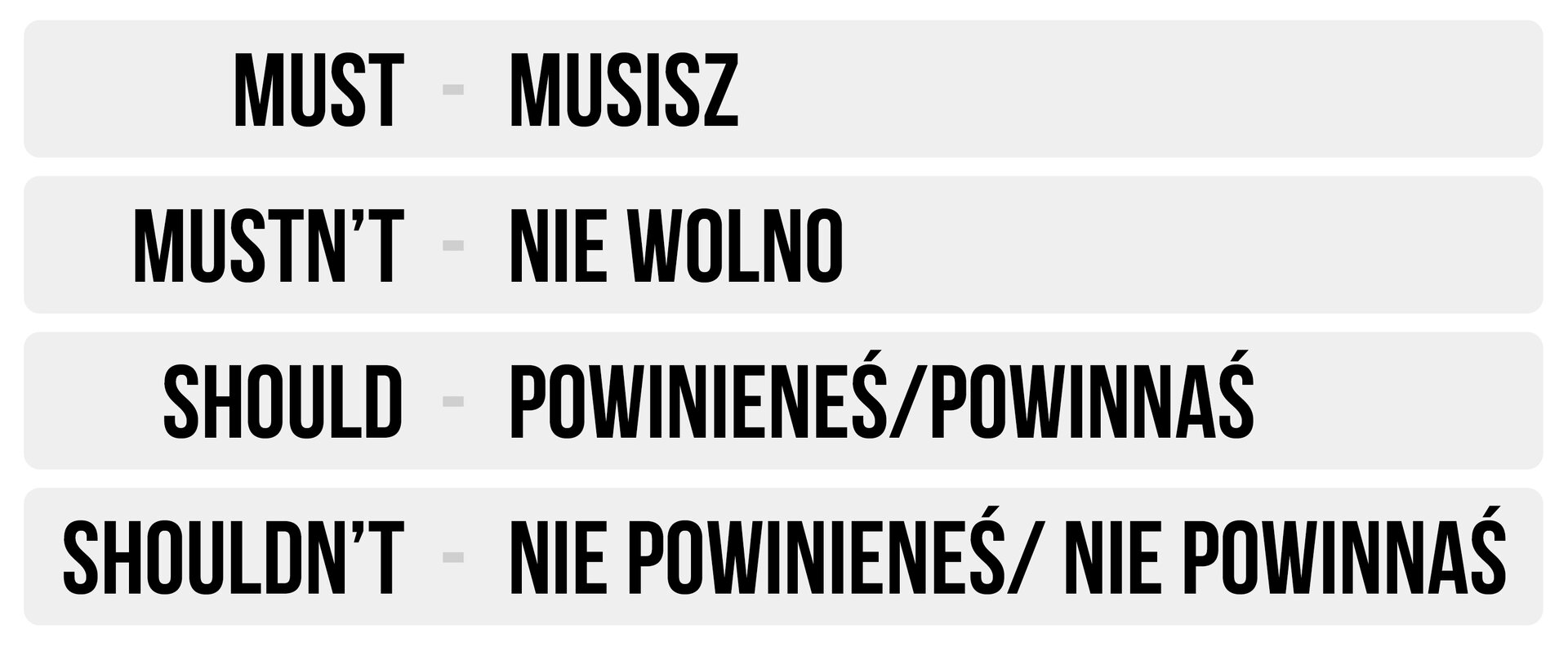
REMEMBER:
English
Polish
MUST
MUSISZ
MUSTN'T
NIE WOLNO
SHOULD
POWINIENEŚ/POWINNAŚ
SHOULDN'T
NIE POWINIENEŚ/ NIE POWINNAŚ
RREqjKyfh8qCJ
Ilustracja
Źródło: GroMar Sp. z o.o., licencja: CC BY-SA 3.0.
Exercise7
Choose the correct modal verbs.
Wybierz właściwe czasowniki modalne.
R17F4xF1aHiHO
Źródło: GroMar Sp. z o.o., licencja: CC BY-SA 3.0.