Przeczytaj
Remote learning has been a norm in certain parts of the world, but nowadays it’s becoming more and more widespread. In this section, you are going to read a text discussing both pros and cons of e‑learning. Before you read the text, think: what benefits and risks can the development of e‑learning platforms bring to students and educators?
Zdalne uczenie już wcześniej było normą w niektórych częściach świata, ale obecnie staje się coraz bardziej rozpowszechnione. W tej sekcji przeczytasz tekst omawiający zarówno zalety, jak i wady e‑learningu. Jednak zanim się z nim zapoznasz, zastanów się, jakie korzyści i jakie zagrożenia może przynieść uczniom i nauczycielom rozwój platform e‑learningowych.

Study the texts below connected with online learning and choose the correct answer in each point.
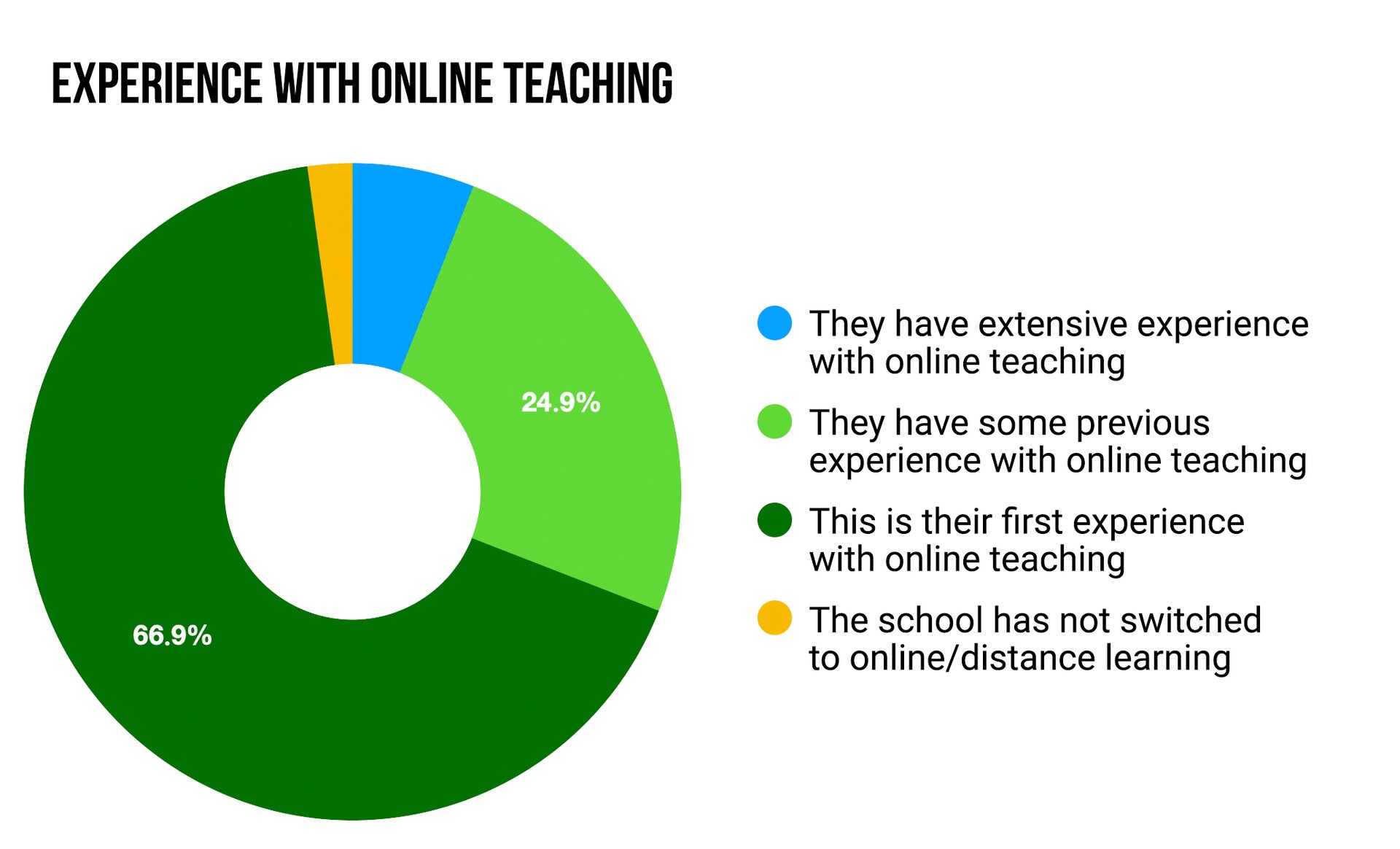
66,9% of teachers have no experience with online teaching and it’s their first time. Whereas 24,9% have some previous experience with online teaching.
1. Most teachers don’t have
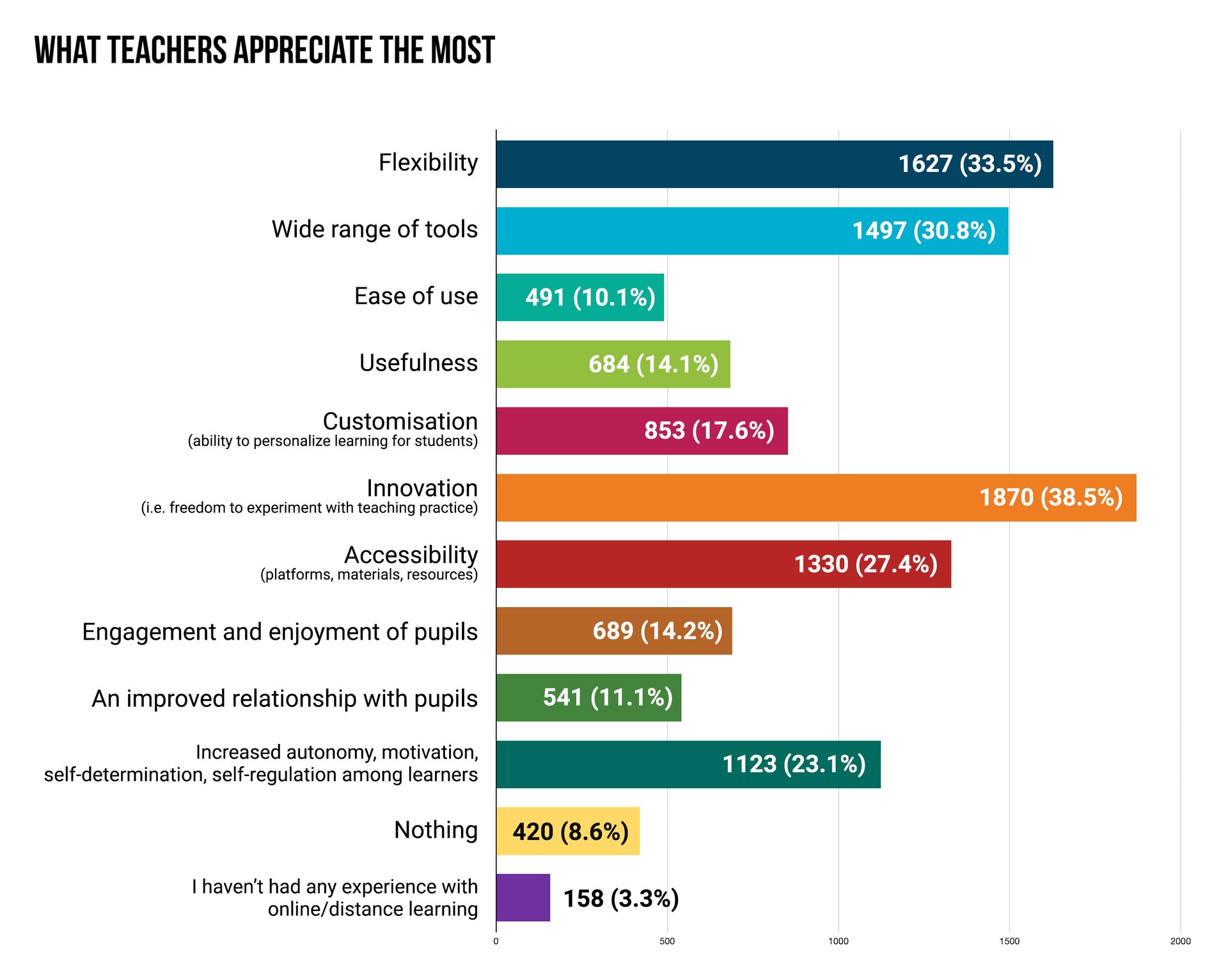
There are some aspects in online teaching that teachers appreciate. 33,5% of teachers appreciate its flexibility. 30,8% appreciate a wide range of tools and 38,5 % believe it’s innovative. Only 8,6% can’t think of anything that they appreciate.
2. The two aspects that teachers appreciate the most are
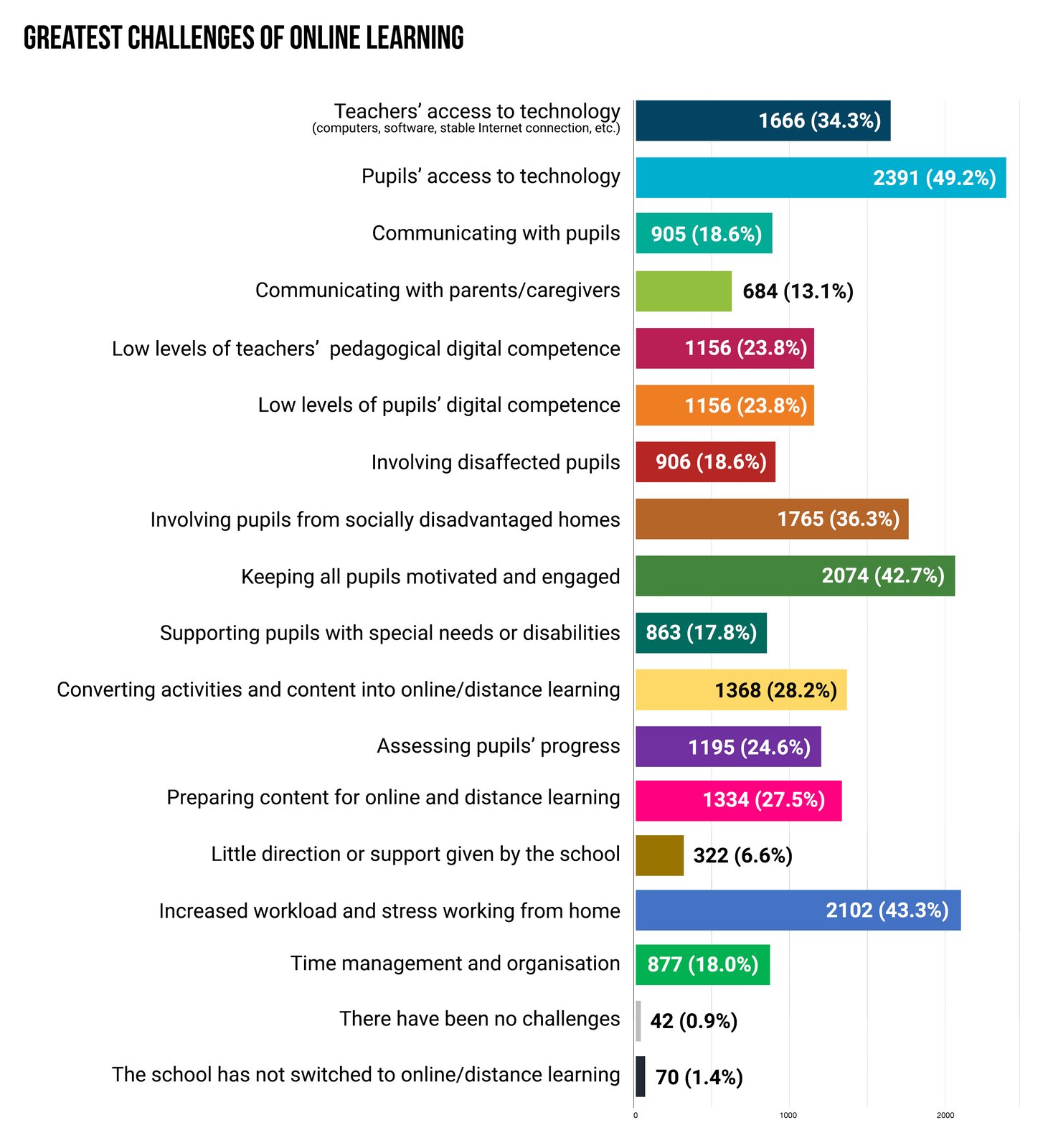
Apart from positive aspects of online learning, there are some negative ones. Teachers and students need to face some challenges. 49,2 % of teachers think that pupils’ access to technology can be a problem. Whereas 34,3 % of teachers think that their access to technology is problematic. 27,5 % of them believe that preparing content for online lessons can be difficult. 42,7 % think it’s not easy to keep students motivated and engaged all the time. 43,3 % of teachers claim that working from home is more stressful and it increases workload.
3. From the teachers’ perspective, what are the three greatest challenges of online learning?
Look at the charts and graphs connected with online learning and choose the correct answer in each point.
Most teachers don’t have
The two aspects that teachers appreciate the most are:
From the teachers’ perspective, what are the three greatest challenges of online learning?
Read the text about distance learning and do the exercises below.
E‑Learning - a Blessing or a Curse?In the past years, students and educators have experienced a paradigm shiftparadigm shift in our approach to education: the introduction of online learning on an unprecedentedunprecedented scale. The enthusiasts of this solution claim that remote educationremote education is highly effective and rewarding, while the sceptics are concerned about the long‑term social impact and equality of access. It is vital to consider both the pros and cons of online learning and ed‑teched‑tech so you can be prepared to face the challenge of this situation as well as embraceembrace the new opportunities it has to offer. So, is remote learning a blessing or a curse?a blessing or a curse?
Benefits of Online Learning
There are numerous reasons why online classes have become so popular. Remote learning offers opportunities for people who would otherwise have limited access to education, as well as for educators who can work on developing high‑quality courses. Below is a list of some of the benefits of online learning.
Place
The main advantage of online learning is that students can participate in classes from anywhere in the world, provided they have an appropriate device and Internet access. In addition, online classes do not exclude students and educators whose physical needs might prevent them from actively taking part in a traditional learning settinglearning setting.
Time and Pace
The virtual classroom is open 24/7. Students can access their classes at a time most convenient for them. Furthermore, they have continuous access to lectures, course materials, and class discussions. This is especially beneficial for those who may need to reread a lecture or take more time to absorb informationabsorb information before moving on.
Synergy
During online learning, ideas are shared and each individual can contribute tocontribute to the course discussions and comment on the work of others. The synergy that is formed in online learning situations is one of the most unique features that distance learningdistance learning possesses.
Level Playing Field
All learners can have a certain measure of anonymity in an online setting. Factors such as age, physical appearance, disabilities, race, and gender are, if not exactly a non‑issuenon‑issue, then definitely largely ignored. Instead, the focus seems to be firmlyfirmly on the content and the individual’s ability to contribute meaningfully to the discussion.
Access to Resources
Distinguished guest experts can be easily invited to an online class. Furthermore, students have access to resources and materials that may be physically located anywhere in the world. An educator can compile a selection of links to scholarlyscholarly articles and other materials relevant to the courserelevant to the course for students to access for research or extension.
Drawbacks of Online Learning
While distance learning has significant strengths, there are also drawbacks inherent in this solution that can limit its success. These problems can be divided into several categories.
EquityEquity and Access to Technology
First of all, students must be able to access the online learning environment. Lack of access is a significant issue in rural and lower socioeconomic neighbourhoodslower socioeconomic neighbourhoods. Students might also not be able to afford the technology their educational institution employs, e.g. VR gogglesVR goggles or wearables. Additionally, internet access is not universal and, in some areas of the world, it poses a significant cost to the user. Some users pay a fixed rate monthly, while others are charged for the time they actually spend online, or for data transfer. This means that will not be equitableequitable for all students.
Computer Literacy
Students and educators alike must possess a certain basic level of computer skills to function successfully in an online learning setting. For example, they must be able to use search engines or email and be comfortable navigatingnavigating a variety of websites. If they do not possess these basic tools, they have little chance of succeeding. In some cases, the technology might pose even greater levels of challenge; smart TVssmart TVs, interactive whiteboardsinteractive whiteboards, and other cutting edgecutting edge devices could create insurmountableinsurmountable obstacles for students and educators who are digital immigrantsdigital immigrants.
Limitations of Technology
Reliable technology is vital to distance learning. However, even the most sophisticated device isn’t fully reliable. Breakdowns can occur at any point and in any place in the system. For example, the server which hosts the educational materials could crash and individual students' devicesstudents' devices can have numerous problems severely limiting students’ access. Finally, the internet connection could fail, for instance, due to the connection becoming bogged downbogged down with users. As such, technology is not always seamlessseamless, which can detractdetract from the learning experience.
The Students
While online education can be a highly effective tool for the more mature, self‑disciplined student, it may be inappropriate for more dependent learners. Some types of online education allow for flexibility of schedules while placing greater responsibility on the student. In order to participate successfully in an online program, students must be highly self‑motivated and in possession of well‑developed time management skills.
The Curriculum
The curriculum of any online class must be carefully considered, as some parts of it and the methods used to teach it might not translate successfully to remote learning. High quality education can occur provided that the curriculum has been either developed anewanew or convertedconverted to fit the changed paradigmparadigm.
All in all, we are living in a very exciting time for technology and education. Educational platforms offer expanded learning opportunities and convenient solutions to conflicts with work, family, and study schedules at all levels of education. However, in order for online classes to be successful, all of the above‑mentioned factors must be carefully considered to take full advantage of this form of education, while avoiding pitfallspitfalls that could result from its weaknesses.
Źródło: Zuzanna Kościuk , Justyna Płachta, [na podstawie:] https://www.differencebetween.com/what-is-the-difference-between-e-learning-and-blended-learning/ [dostęp 18.03.2022], https://knowinsiders.com/how-many-types-of-online-education-learning-33575.html [dostęp 18.03.2022], licencja: CC BY-SA 3.0.
What are the benefits and drawbacks of online learning? Search for the information in the text and group the elements.
Based on the information from the text, drag and drop the elements below to fill in the gaps.
2. Being anonymous online means that discrimination is a 1. cutting-edge technology, 2. digital immigrants, 3. seamless experience, 4. learning environment, 5. achieve synergy, 6. bogged down, 7. non-issue, 8. wide-scale application, 9. paradigm shift for the most part.
3. Unfortunately, some problems stem from the fact that the majority of teachers are 1. cutting-edge technology, 2. digital immigrants, 3. seamless experience, 4. learning environment, 5. achieve synergy, 6. bogged down, 7. non-issue, 8. wide-scale application, 9. paradigm shift and experience problems online.
4. The use of 1. cutting-edge technology, 2. digital immigrants, 3. seamless experience, 4. learning environment, 5. achieve synergy, 6. bogged down, 7. non-issue, 8. wide-scale application, 9. paradigm shift could pose problems to some users.
5. At times, there are so many users online that the connection is 1. cutting-edge technology, 2. digital immigrants, 3. seamless experience, 4. learning environment, 5. achieve synergy, 6. bogged down, 7. non-issue, 8. wide-scale application, 9. paradigm shift and the platform crashes.
6. We converted the content for use in our remote 1. cutting-edge technology, 2. digital immigrants, 3. seamless experience, 4. learning environment, 5. achieve synergy, 6. bogged down, 7. non-issue, 8. wide-scale application, 9. paradigm shift.
It is our goal to 1. cutting-edge technology, 2. digital immigrants, 3. seamless experience, 4. learning environment, 5. achieve synergy, 6. bogged down, 7. non-issue, 8. wide-scale application, 9. paradigm shift in our virtual classrooms and to offer a 1. cutting-edge technology, 2. digital immigrants, 3. seamless experience, 4. learning environment, 5. achieve synergy, 6. bogged down, 7. non-issue, 8. wide-scale application, 9. paradigm shift for our students.
Search for the information in the text and then, answer the following questions in 1–3 sentences each.
What do you think is the main idea of the text?
What is the most important benefit of distance learning for you? Why?
In your opinion, how does distance learning level the playing field for students?
In your opinion, in what ways can technology be both a benefit and a drawback in online education?
In your opinion, which groups of students would benefit the most from remote education? Why?
Read the grammar section. Then, translate and type in the adverbs where they fit best to complete the sentences.
Słownik
/ əbˈzɔːb ˌɪnfəˈmeɪʃn̩ /
przyswajać informacje (to understand facts or ideas completely and remember them)
/ əkˌsesəˈbɪləti /
dostępność (the quality or characteristic of something that makes it possible to approach, enter, or use it)
/ əˈnjuː /
od nowa, na nowo (again or one more time, especially in a different way)
/ ə ˈblesɪŋ ɔːr ə kɜːs /
błogosławieństwo czy przekleństwo (something that is both a benefit and a burden)
/ bɒɡd daʊn / / bɒɡ daʊn /
spowolnione [spowolnić] (to prevent someone or something from moving on or progressing)
/ kənˈtrɪbjuːt tuː /
wnosić swój wkład (do czegoś) (to help to cause an event or situation)
/ kənˈvɜːtɪd / / kənˈvɜːt /
zmienione [zmienić] (to change in form or character)
/ kʌstəmʌɪˈzeɪʃən /
dostosowanie (making or changing something according to the buyer’s or user’s needs)
/ kʌtɪŋ edʒ /
najnowsze, najbardziej zaawansowane (the most modern stage of development)
/ dɪˈtrækt /
odciągnąć uwagę (to make something seem less valuable or less deserving of admiration)
/ ˈdɪdʒɪtl̩ ˈɪmɪɡrənts / / ˈdɪdʒɪtl̩ ˈɪmɪɡrənt /
osoby, które urodziły się przed rozwinięciem technologii cyfrowej i nie jest ona dla nich naturalnym środowiskiem [osoba urodzona przed rozwinięciem technologii cyfrowej] (a person who was raised prior to the digital age)
/ ˌdɪsəˈfektɪd /
zniechęcony/zniechęcona (no longer supporting or being satisfied with an organisation or idea)
/ ˈdɪstəns ˈlɜːnɪŋ /
nauka zdalna (a way of studying in which you do not attend a school)
/ ˈed.tek /
technologie cyfrowe używane w edukacji (the use of technology in education)
/ ɪmˈbreɪs /
obejmować, przyjmować (here: to adopt or accept something willingly)
/ ˈekwɪti /
sprawiedliwość, słuszność (the situation in which everyone is treated fairly and according to their needs)
/ ˈekwɪtəbl̩ /
sprawiedliwe (treating everyone fairly and in the same way)
/ ˈfɜːmli /
tu: stanowczo (with resolute determination and strength of character)
/ ˌhaɪ tek /
zaawansowany technicznie (using the most advanced and developed machines and methods)
/ ˌɪnsəˈmaʊntəbl̩ /
nie do pokonania (in relation to difficulty: so great that it cannot be dealt with successfully)
/ ˌɪntəˈræktɪv ˈwaɪtbɔːdz / / ˌɪntəˈræktɪv ˈwaɪtbɔːd /
tablice interaktywne [tablica interaktywna] (a large electronic screen used in a classroom)
/ ˈlɜːnɪŋ ˈsetɪŋ /
środowisko nauczania (the physical locations, contexts and cultures where students learn)
/ ˈləʊə soˌsiˌoˌekəˈnɑːmɪk ˈneɪbəhʊdz / / ˈləʊə soˌsiˌoˌekəˈnɑːmɪk ˈneɪbəhʊd /
obszary o niższym statusie społeczno‑ekonomicznym [obszar o niższym statusie społeczno‑ekonomicznym] (an area with a low socioeconomic standing)
/ ˈnævɪɡeɪtɪŋ / / ˈnævɪɡeɪt /
nawigując, poruszając się po [nawigować, poruszać się po] (to move around a website or computer screen, or between websites or screens)
/ ˌnɒn ˈɪʃuː /
mały problem, bez znaczenia (of little or no importance)
/ ɒf ˈkæmpəs /
poza szkołą, uczelnią (np. nauka) (not on the school grounds)
/ ʌnˈpresɪdentɪd /
niespotykany/niespotykana
/ ˈpærədaɪm /
paradygmat, model (a model of something, or a very clear and typical example of something)
/ ˈpærədaɪm ʃɪft /
zmiana sposobu myślenia o świecie, zazwyczaj bardzo poważna (a time when the usual and accepted way of doing or thinking about something changes completely)
/ ˈpɪtfɔːlz / / ˈpɪtfɔːl /
pułapki, niebezpieczeństwa [pułapka, niebezpieczeństwo] (a likely mistake or problem in a situation)
/ ˈreləvənt tu ðə kɔːs /
związane z lekcją (important for the class)
/ rɪˈməʊt ˌedʒʊˈkeɪʃn̩ /
nauczanie zdalne
/ ˈskɒləli /
naukowy/naukowa
/ ˈsiːmləs /
niezakłócony/niezakłócona (happening without any sudden changes, interruption, or difficulty)
/ smɑːt ˌtiːˈviːz / / smɑːt ˌtiːˈviː /
inteligentne telewizory, telewizory smart [inteligentny telewizor, telewizor smart]
/ ˈstjuːdnts dɪˈvaɪsɪz / / ˈstuːdənts dɪˈvaɪs /
urządzenia uczniów [urządzenie ucznia/uczennicy] (objects that students use to take part in distance learning)
/ ˈsɪnədʒi /
jedność
/ ˌviː ˈɑː(r) ˈɡɒɡl̩z /
gogle pozwalające zobaczyć rzeczywistość wirtualną
Źródło: GroMar Sp. z o.o., licencja: CC BY‑SA 3.0