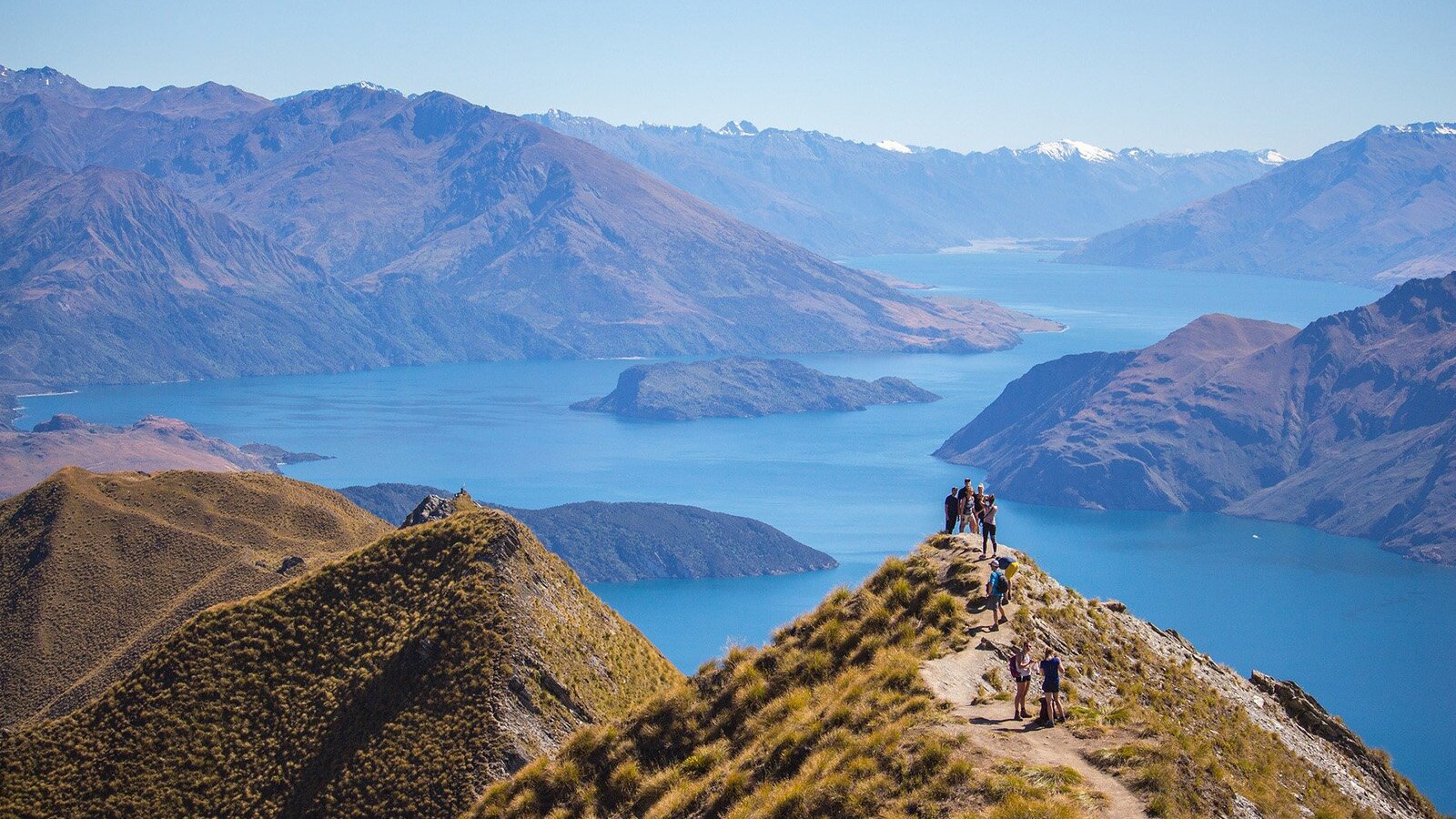
The picture shows a breathtaking view of a lake and surrounding mountains. There are also tourists who seem not to disturb the atmosphere of peace and quiet emanating from this scene. Do you like spending time in places like this? Do you enjoy being on holidays with lots of tourists around? In this section, you will read a text about different impacts of tourism on our life.
Poniższa ilustracja przedstawia zapierający dech w piersiach widok na jezioro i góry. Widać na niej także turystów, którzy wydają się nie zaburzać atmosfery ciszy i spokoju płynącej z tej sceny. Czy lubisz spędzać czas w tego typu miejscach? Czy sprawia ci przyjemność przebywanie na wakacjach tam, gdzie można spotkać wielu turystów? W tej części e‑materiału dowiesz się, jakiego rodzaju wpływy na różne aspekty naszego życia może wywierać turystyka.
Ra7LIUGMXTAzW
Zdjęcie przedstawia pagórki usytuowane w wodzie. Na jednym z nich widoczna grupka osób.
Unspoilt nature
Dziewicza natura
Źródło: dostępny w internecie: www.pixabay.com [dostęp 25.03.2022], domena publiczna.
1
Exercise1
RF8d9eVyx1nMI
Odpowiedz na pytania lub uzupełnij tekst. 1. An extreme crowd of people or a lot of cars in one place., 2. The natural world around us., 3. A document that proves your identity and allows you to cross borders., 4. A path in the mountain for tourists to walk., 5. A piece of paper that gives you the right to enter a place or travel by e.g. bus., 6. The place we are heading or set out to.
Odpowiedz na pytania lub uzupełnij tekst. 1. An extreme crowd of people or a lot of cars in one place., 2. The natural world around us., 3. A document that proves your identity and allows you to cross borders., 4. A path in the mountain for tourists to walk., 5. A piece of paper that gives you the right to enter a place or travel by e.g. bus., 6. The place we are heading or set out to.
Źródło: GroMar Sp. z o.o., licencja: CC BY-SA 3.0.
Study the text about the impacts of tourism on several places and communities in Poland, and do the exercises below.
Impacts of Tourism
AnnaFaszczaImpacts of Tourism
For a few years before the COVID‑19 pandemic, there was a significant increase in the number of foreign tourists visiting Poland. Our journalists asked several people how it influenced particular areas of life. Here is what they told us.
A. The Deputy Director of one of the Polish national parks
Undoubtedly, Poland developed into an alluring destinationalluring destinationalluring destination for foreign globetrotters and this was also noticeable in our national park. The increasing number of visitors meant not only more income from entry ticketsincome from entry ticketsincome from entry tickets we sold but also more pollution in the park itself and the surrounding area. Littering, both intentional and unintentional, became a real problem. Every day we struggled with cigarette buttscigarette butts [cigarette butt]cigarette butts, food wrappers and plastic bottles left by tourists. It is a broader concern, as tons of rubbish are generated by national parks yearly. To make the place remainremainremain as unspoiltunspoiltunspoilt as possible, the management decided that heavy finesheavy fines [heavy fine]heavy fines would be leviedlevied (levy)levied on those who throw even a single piece of litter along the tourist trailstourist trails [tourist trail]tourist trails. Our park, one of the most iconic in this part of the country, used to be among the most affected. Now we are pleased, since the policypolicypolicy brought positive effects remarkably swiftly and people can still admire the splendid beauty of nature here.
B. The mayor of a small town
Last year the local councillocal councillocal councilconductedconducted [conduct]conducted research in the field of tourismin the field of tourismin the field of tourism in our area. The results were rewarding, as the study showed that our town had attracted a vast number of foreign tourists in recent years. It would not have been attainableattainableattainable if we had not invested a lot of time and money in advertisements promoting the place abroad. Moreover, we had anticipatedanticipated [anticipate]anticipated that a growing number of tourists could have serious repercussions for the environmentserious repercussions for the environment [serious repercussion for the environment]serious repercussions for the environment, so we had prepared our infrastructure accordingly. We could see in neighbouring towns how an increased amount of waste, for example, undermined the quality of lifeundermined the quality of life [undermine the quality of life]undermined the quality of life. Another important thing was to ensure the sense of safetysense of safetysense of safety in public spaces. So, to make local people and tourists feel secure, we installed more CCTV cameras in the streets to prevent crime, such as break‑ins or muggings. Noticing the growth in the number of jobs and the developing entertainment industryentertainment industry entertainment industry in our area, which in turnin turnturn corresponds to a higher quality of life for the locals and an increase in wealthincrease in wealthincrease in wealth in the region, we already know the whole endeavourendeavourendeavour was worth the trouble.
C. An environmentalist
Being aware of the long‑term environmental threatlong‑term environmental threatlong‑term environmental threat that the growing number of visitors poses, all the activists of our local organisation started working on introducing some methods to minimise the degradationdegradationdegradation of tourist trails in the area. We are convinced that the only way to avert any possible destructionavert any possible destructionavert any possible destruction is a different scope of restrictionsscope of restrictionsscope of restrictions introduced by the local authorities. For example, we maintain that the use of any plastic containers ought to be prohibited and that diesel cars should be banned from entering the area. They adversely affectadversely affectadversely affect the environment and contribute not only to noise but also to air pollution. Diesel cars might emit lower carbon dioxide but still emit more nitrogen dioxide than petrol engines. Furthermore, the number of tourists visiting our nature reservesnature reserves [nature reserve]nature reserves daily should be limited in order not to scare wild animals or destroy unique plant life, and spending on expanding tourist infrastructure should be restrainedshould be restrainedshould be restrained.
D. An inhabitant of a small town
First of all, I must say that I am content living here as there is not a lot of traffic although the majority of local people were bothered due to the influx of travellersinflux of travellersinflux of travellers into our town. I had always been convinced we would handle that aspect owing to the well‑developed public transportation in our area. Moreover, on account of the development of tourismdevelopment of tourismdevelopment of tourism here I made my dream come true and started to earn a livingearn a livingearn a living running my own restaurant. I am of Tatar descentdescentdescent and it makes me truly happy to hear our guests praise us forpraise us for [praise somebody for]praise us for our traditional cuisine.
1 Źródło: AnnaFaszcza, dostępny w internecie: https://www.bbc.co.uk/bitesize/topics/zcmfb9q/articles/znspn9q [dostęp 19.03.2022], https://greentumble.com/positive-impacts-of-tourism-on-environment/ [dostęp 19.03.2022], licencja: CC BY-SA 3.0.
Exercise2
RQE91jYdSjHxD
Based on the information from the text, decide which person (A–D) mentioned a particular issue related to impacts of tourism. Decide which person:
1. suggested the need to implement some policy. 1. D, 2. C, 3. B, 4. A
2. enumerated a few positive aspects of tourism. 1. D, 2. C, 3. B, 4. A
3. didn’t share a common belief. 1. D, 2. C, 3. B, 4. A
4. mentioned an already-working limitation. 1. D, 2. C, 3. B, 4. A
Based on the information from the text, decide which person (A–D) mentioned a particular issue related to impacts of tourism. Decide which person:
1. suggested the need to implement some policy. 1. D, 2. C, 3. B, 4. A
2. enumerated a few positive aspects of tourism. 1. D, 2. C, 3. B, 4. A
3. didn’t share a common belief. 1. D, 2. C, 3. B, 4. A
4. mentioned an already-working limitation. 1. D, 2. C, 3. B, 4. A
Źródło: GroMar Sp. z o.o., licencja: CC BY-SA 3.0.
Exercise3
RjMso7NGK4ac3
Match the definitions below with the words from the text. A body of people who manage the town’s matters, elected by the people Możliwe odpowiedzi: 1. wealth, 2. scope of, 3. local council, 4. policy, 5. descent, 6. degradation A range of something Możliwe odpowiedzi: 1. wealth, 2. scope of, 3. local council, 4. policy, 5. descent, 6. degradation A state of being related to a particular group Możliwe odpowiedzi: 1. wealth, 2. scope of, 3. local council, 4. policy, 5. descent, 6. degradation A great quantity of money and other valuable objects Możliwe odpowiedzi: 1. wealth, 2. scope of, 3. local council, 4. policy, 5. descent, 6. degradation A set of ideas and plans for what to do Możliwe odpowiedzi: 1. wealth, 2. scope of, 3. local council, 4. policy, 5. descent, 6. degradation The process in which something is destroyed Możliwe odpowiedzi: 1. wealth, 2. scope of, 3. local council, 4. policy, 5. descent, 6. degradation
Match the definitions below with the words from the text. A body of people who manage the town’s matters, elected by the people Możliwe odpowiedzi: 1. wealth, 2. scope of, 3. local council, 4. policy, 5. descent, 6. degradation A range of something Możliwe odpowiedzi: 1. wealth, 2. scope of, 3. local council, 4. policy, 5. descent, 6. degradation A state of being related to a particular group Możliwe odpowiedzi: 1. wealth, 2. scope of, 3. local council, 4. policy, 5. descent, 6. degradation A great quantity of money and other valuable objects Możliwe odpowiedzi: 1. wealth, 2. scope of, 3. local council, 4. policy, 5. descent, 6. degradation A set of ideas and plans for what to do Możliwe odpowiedzi: 1. wealth, 2. scope of, 3. local council, 4. policy, 5. descent, 6. degradation The process in which something is destroyed Możliwe odpowiedzi: 1. wealth, 2. scope of, 3. local council, 4. policy, 5. descent, 6. degradation
Źródło: GroMar Sp. z o.o., licencja: CC BY-SA 3.0.
Exercise4
Based on the information from the text, answer the questions and write 4‑5 sentences to each.
What impact on the environment can tourism have?
Can you see any impact of tourism on your neighbourhood/area? What is it?
RKuANj4KRuq72
(Uzupełnij).
Źródło: GroMar Sp. z o.o., licencja: CC BY-SA 3.0.
Tourism has a huge/little impact on… When tourists visit... They also... Moreover,...
I can observe… More and more people… ,… which surely brings money to local businesses.
Tourism has a huge impact on the natural environment. Any time tourists visit a place, such as a national park, they leave a ton of rubbish on the trails: plastic cups, wet wipes, bottles, etc. They are also noisy, which scares wild animals living there. Moreover, a growing influx of tourists means more cars are coming to the area, which causes increased are pollution.
I live in a small town, but I can still observe some impact of tourism on my everyday life here, especially during the summer. When the city organises different music or theatre festivals, there are much more participants than before. More and more people attend cultural events and eat in restaurants, which surely brings money to local businesses. Also, some years ago a tourist office was opened.
Artykuł publicystyczny
Artykuł publicystyczny
W tej części dowiesz się:
czego może dotyczyć artykuł;
jak zaplanować i napisać artykuł;
jaki styl obowiązuje przy pisaniu tego typu artykułu;
jaki jest limit wyrazów;
jakiego słownictwa należy używać;
jakie są kryteria sukcesu przy pisaniu artykułu.
Planowanie pisania artykułu Zanim zaczniesz pisać, zastanów się, kim jest odbiorca artykułu i gdzie dana treść ma się ukazać. Pomyśl, czego będzie dotyczył artykuł. Zaplanuj, co umieścisz w każdym akapicie. Pamiętaj, by nadać artykułowi tytuł przyciągający uwagę czytelnika.
Styl artykułu Styl artykułu może być formalny, półformalny i nieformalny – w zależności od tego, kim jest odbiorca tekstu i gdzie artykuł ma się ukazać.
Limit wyrazów Zadanie maturalne tego typu zakłada użycie 200–250 wyrazów.
Przydatne wyrazy/wyrażenia
Wstęp
According to the latest research… – Według ostatnich badań… Nowadays, a very popular topic is… – W dzisiejszych czasach bardzo popularnym tematem jest… It has lately become a popular topic. – To stało się ostatnio popularnym tematem. Imagine... – Wyobraź sobie, że…
Latest findings hold that… – Wedle najnowszych odkryć…
Rozwinięcie
The most important advantage/disadvantage of… is… – Najważniejszązaletą/wadą… jest… Let's suppose that... – Załóżmy, że…In addition to / Moreover / Additionally… – W dodatku… Take... for example / instance. – Weźmy... za przykład. According to… – Według… On the one hand – Z jednej strony On the other hand – Z drugiej strony Nevertheless – Niemniej In spite of / Despite / Although – Pomimo ... seems to be – ...wydaje się (być)Due to / Because of ... – Z powodu… Yet,... – Jednak… Apparently… – Najwyraźniej...
Scientists say that… – Naukowcy twierdzą, że … Some claim that… – Niektórzy twierdzą, że … Needless to say,… – Ma się rozumieć, że …
Zakończenie
All in all,... / To conclude / In summary… – Podsumowując… It is vital/essential to... – Ważne jest, aby … I think you will agree that… – Myślę, że zgodzicie się, że…
Artykuł–kryteria sukcesu
Tytuł Tytuł powinien być krótki i ciekawy.Powinien przyciągać uwagę i zachęcić do przeczytania tekstu. W tytule można stosować uproszczone formy językowe. Dobry tytuł jest streszczeniem całego artykułu.
Wstęp Wstęp to krótkie wprowadzenie do tematu i przedstawienie treści. Ze wstępu odbiorca ma wywnioskować, czy artykuł będzie recenzją,opowiadaniem itp. Wstęp można wzbogacić o własną opinię. We wstępie można użyć cytatu, który w ciekawy sposób otworzy pracę.
Rozwinięcie Rozwinięcie składa się przynajmniej z dwóch akapitów. Każdy akapit szczegółowo omawia różne kwestie.
Zakończenie W zakończeniu zawiera się podsumowanie problemu, przedstawienie wniosków. Zakończenie można zamknąć cytatem.
przemysł turystyczno‑hotelarski (industry that caters to tourists and travellers; it includes hotels and guesthouses, restaurants, bars, tourism agencies, etc.)