Przeczytaj
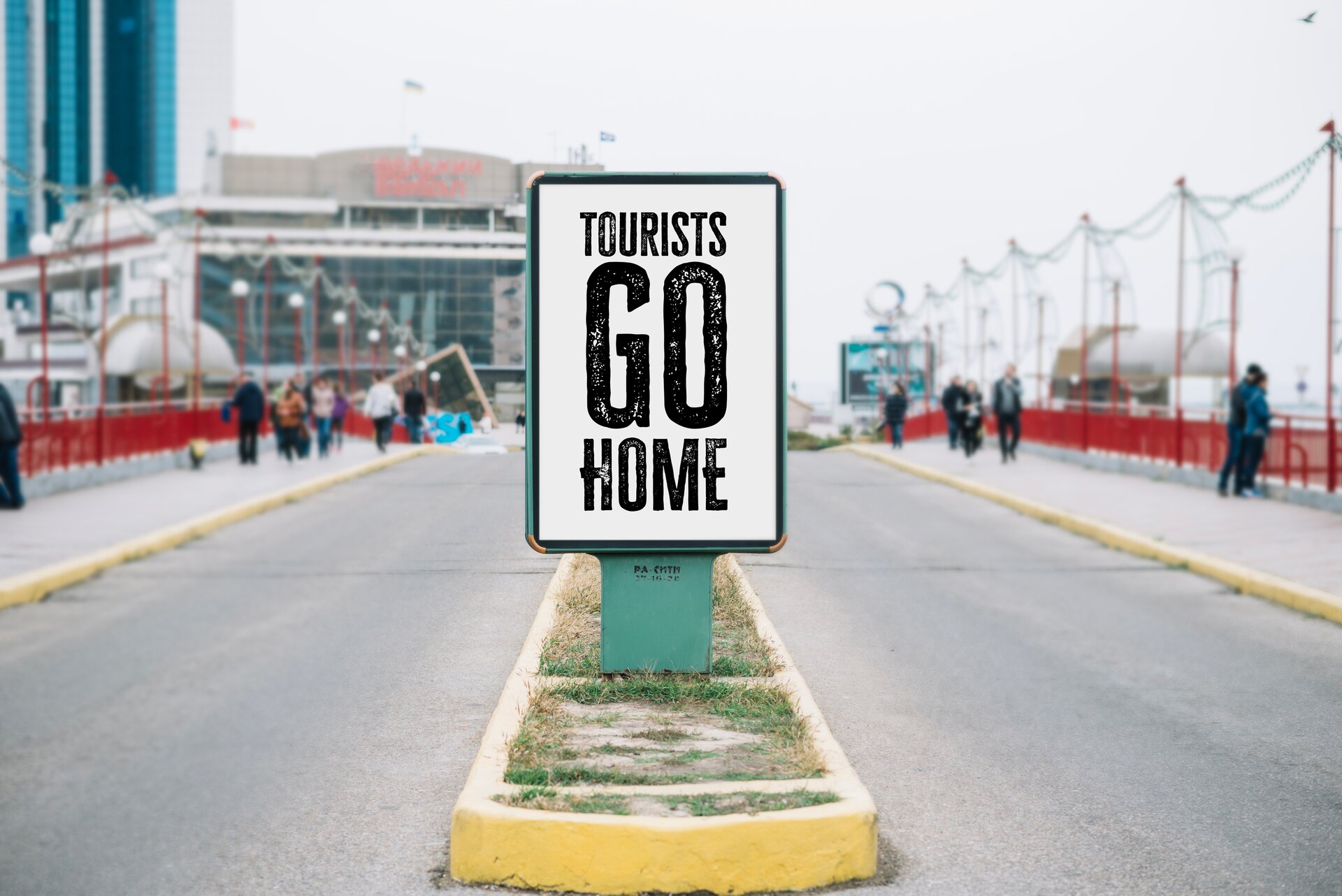
The picture below shows a sign saying “Tourists go home,” which was put up in a public place and might suggest an unfriendly attitude towards this group. You are going to read a text about overtourism, which is the rapid growth of tourists that results in conflicts with locals and might be a threat to the natural environment.
Poniższa ilustracja przedstawia umieszczony w miejscu publicznym napis o treści „Turyści do domów”, sugerujący nieprzyjazny stosunek autora tych słów do odwiedzających. Przeczytaj tekst dotyczący nagłego zwiększenia ruchu turystycznego, co powoduje konflikty z lokalnymi społecznościami i stanowi potencjalne zagrożenie dla środowiska naturalnego.
Study the words and phrases connected with people acting improperly on holiday and match them with their translations.
Study the following expressions connected with human behaviour on holidays and put them into the correct categories.
Read the text. There are five numbered gaps. Then do the exercises below.
All That Glitters Is Not GoldGoing to faraway places has long been a way of spending a holiday, as it became affordable for more and more people. While tourism is considered beneficial for both travellers who reach their dream destinations and locals who earn the money, overtourism raises some serious concerns.
The numbers show that in 1950, around 25 million people travelled worldwide, while in 2017 it was over 1.3 billion. It is estimated that by 2030, the number will have reached 1.7 billion tourists. Excessive tourism has been observed since the 1970s, but it reached its peak in 2017 when mass protests against an uncontrolled number of visitors took place in Madrid. This was when the term overtourism emerged and spread across the world. It means the congestioncongestion resulting from an excess of touristsexcess of tourists and refers to the carrying capacity of a destinationthe carrying capacity of a destination. (1) ___ Thus, this term refers to both locals and visitors. The former group sees tourists as a disruptive factordisruptive factor that mainly causes them trouble in everyday life, while the latter considers other visitors to be a real nuisancenuisance.
This overcrowdingovercrowding leads to conflicts with local people who blame visitors for rising prices of rent, noise in the streets, or littering. Locals complain that the cities lose their identity and unique character. People of various professions quit their jobs as they are no longer in demand; butchers or bakers close down their shops and are replaced by street souvenir vendors. In popular destinations such as Venice, local residents find it hard to buy everyday items. They also stress that a great number of tourists doesn’t necessarily mean a lot of money earned by the local businesses. As it turns out, travellers visit local shops rather to take nice selfies than to do any shopping. Cruise liners seem to be a real annoyance since they carry hundreds of people at a time, who wander around the city but don’t tend to buy anything while being on land (as the cruise is all‑inclusive). The message from the local people is very clear: they don’t want to be part of the tourism machine any longer.
Not all places with a lot of vacationers struggle with overtourism, though. (2) ___ People go there for a longer period of time looking for accommodation and tourist attractions, which the residents don’t mind.
There are a number of reasons for the spread of overtourism. Next to population growth and developing urbanisation, low‑cost airlines are to blame. With cheap flights, people can afford to travel around the world more often and choose more distant destinations. When you add cheap accommodation to this, travelling can surely be tempting. Last but not least, social media contribute to the growth in popularity of particular destinations. (3) ___All at once, everybody wished to go there, too.
Among the many issues connected with overtourism, its destructive impact on the surrounding area and the natural environment should be mentioned. So goes the rule: the more people in one place, the more noise and pollution is caused. As a result, some media outlets have shared a list of destinations which are not recommended. Among these places, surprisingly, Mount Everest is to be found. (4) ___ Many of them unfortunately die of altitude sickness while waiting. To avoid this, the Nepalese government plans to limit the number of permits issued to climbers. A growing influx of tourists is seen even in Antarctica, making scientists fear for the future of this continent.
Governments and citizens of places that suffer from overtourism sound the alarm before it is too late. In Barcelona, protesters placed anti‑tourist graffiti in tourist‑heavy neighbourhoodstourist‑heavy neighbourhoods. They demand limits to be introduced on the number of cruise ships arriving in the city and visitors entering its parks and beaches in seasonin season. Some authorities even decide to close some places to the public to protect the natural ecosystem, as was done in Thailand with Maya Bay. In other places, some restrictions have been implemented, like in Dubrovnik where the city reduced the number of tourists allowed to climb the ramparts.
Overtourism could lead to irreversible changes in cities and the natural environment. Unique places like Peru's Machu Picchu or Ecuador’s Galapagos Islands, or the Great Wall of China are in danger in spite of being on the UNESCO World Heritage List. In 2018, the World Tourism Organisation (UNWTO) published a report on overtourism and listed strategies on how to cope with its impacts. It underlined the significance of understanding tourism in a local context. Among these suggestions, popularising off‑season visitsoff‑season visits and keeping the dialogue with locals about their needs are highly recommended.
Dealing with the issue of overtourism is essential, and different strategies must be undertaken immediately. Local people are calling time on the era of unmanaged and unregulated tourism growth in order to preserve all the natural, urban, and rural wonders and let the residents lead their lives peacefully. National governments are expected to accept the responsibility to face the problem and introduce limits on the number of tourists that can be sustained.
Źródło: Anna Faszcza, dostępny w internecie: Overtourism, Wikipedia, the free encyclopedia, https://en.wikipedia.org/wiki/Overtourism [dostęp 19.02.2022], Dawid Mikoś, Overtourism, czyli gdzie nienawidzi się turystów i dlaczego, https://www.masaperlowa.pl/overtourism-czyli-nienawidzi-sie-turystow-dlaczego/#.Yg105ZaZNPY [dostęp 19.02.2022], Ten places ruined by tourism, Geography Bible, https://www.youtube.com/watch?v=EonK25A9MmY [dostęp 19.02.2022], Ten places ruined by tourism, Grace Media, https://www.youtube.com/watch?v=SXM32c-e5L8 [dostęp 19.02.2022], Why Venice is Europe’s worst placed city, RealLifeLore, https://www.youtube.com/watch?v=RuhHrEm7xGY [dostęp 19.02.2022], Crowded out: The story of overtourism, Responsible Travel, https://www.youtube.com/watch?v=U-52L7hYQiE [dostęp 19.02.2022], licencja: CC BY-SA 3.0.
3.2 1. Residents found it easier to communicate and, due to this fact, they decided to object to the masses., 2. For instance, in London, one of the most visited capitals in Europe with over 18 million tourists a year, overtourism does not negatively impact the locals. , 3. The World Tourism Organisation explains overtourism as “the impact of tourism on a destination, or parts thereof, that excessively influences perceived quality of life of citizens and quality of visitor experiences in a negative way”., 4. The Republic of Zimbabwe in Africa might be a perfect example. No sooner had celebrities in Poland posted their pictures from Zimbabwe on their social media than the plane tickets were sold out., 5. It turns out that there are so many people eager to reach the summit that they stand in a long queue on the trail.
3.3 1. Residents found it easier to communicate and, due to this fact, they decided to object to the masses., 2. For instance, in London, one of the most visited capitals in Europe with over 18 million tourists a year, overtourism does not negatively impact the locals. , 3. The World Tourism Organisation explains overtourism as “the impact of tourism on a destination, or parts thereof, that excessively influences perceived quality of life of citizens and quality of visitor experiences in a negative way”., 4. The Republic of Zimbabwe in Africa might be a perfect example. No sooner had celebrities in Poland posted their pictures from Zimbabwe on their social media than the plane tickets were sold out., 5. It turns out that there are so many people eager to reach the summit that they stand in a long queue on the trail.
3.4 1. Residents found it easier to communicate and, due to this fact, they decided to object to the masses., 2. For instance, in London, one of the most visited capitals in Europe with over 18 million tourists a year, overtourism does not negatively impact the locals. , 3. The World Tourism Organisation explains overtourism as “the impact of tourism on a destination, or parts thereof, that excessively influences perceived quality of life of citizens and quality of visitor experiences in a negative way”., 4. The Republic of Zimbabwe in Africa might be a perfect example. No sooner had celebrities in Poland posted their pictures from Zimbabwe on their social media than the plane tickets were sold out., 5. It turns out that there are so many people eager to reach the summit that they stand in a long queue on the trail.
Not used 1. Residents found it easier to communicate and, due to this fact, they decided to object to the masses., 2. For instance, in London, one of the most visited capitals in Europe with over 18 million tourists a year, overtourism does not negatively impact the locals. , 3. The World Tourism Organisation explains overtourism as “the impact of tourism on a destination, or parts thereof, that excessively influences perceived quality of life of citizens and quality of visitor experiences in a negative way”., 4. The Republic of Zimbabwe in Africa might be a perfect example. No sooner had celebrities in Poland posted their pictures from Zimbabwe on their social media than the plane tickets were sold out., 5. It turns out that there are so many people eager to reach the summit that they stand in a long queue on the trail.
a) places that deal with many tourists.
b) places that are located in urban areas.
c) places where residents and tourists share an area in a short period of time.
2. In some big cities,
a) residents do not find overtourism a bother.
b) residents always complain about tourists being everywhere.
c) residents demand a tourist-free neighbourhood.
3. Some places suddenly became tourists’ favourite attractions due to
a) social media communication.
b) cheap prices of accommodation.
c) convenient means of transport.
4. The author’s intention is to
a) complain about tourists going everywhere.
b) explain that the problem can be coped with only on careful consideration.
c) discourage people from going to faraway places.
Read the quotations below. Choose the one that you find most appealing and which would best summarise the problem of overtourism. Explain your choice (5‑6 sentences).
“Conflict is the beginning of consciousness.” /M. Esther Harding/
“Don’t hurry, don’t worry. You’re only here for a short visit. So be sure to stop and smell the flowers.” /Walter C. Hagen/
“Wise people travel to discover themselves.” / James Russell Lowell/
Słownik
/ ɔ:l ðæt ˈɡlɪtəz ɪz nɒt ɡəʊld /
nie wszystko złoto, co się świeci (said about something that seems to be good on the surface, but might not be when you look at it more closely)
/ ˈæltɪtjuːd ˈsɪknəs /
choroba wysokościowa (effects – such as nosebleed or nausea – of oxygen deficiency in the blood and tissues at high altitudes)
/ ˈkærɪɪŋ kəˈpæsɪti əv ə ˌdestɪˈneɪʃn̩ /
maksymalna liczba ludzi, zwierząt lub roślin, która może istnieć w danym środowisku bez szkody dla niego (the number of people, animals, or crops which a region can support without environmental degradation)
/ kənˈdʒestʃən /
zapchanie, przeludnienie (a situation in which a place is crowded with people or vehicles, so that it is difficult to move around)
/ ˈkɒrəl ˈri:f /
rafa koralowa (a ridge of rock in the sea formed by the growth and deposit of coral)
/ dɪsˈrʌptɪv ˈfæktə /
czynnik destrukcyjny, czynnik niszczący (a factor which prevents something from continuing or operating in a normal way)
/ ɪkˈses əv ˈtʊərɪsts /
nadmiar turystów (more tourists than is usual)
/ ɪn ˌhaɪ ˈsiːzn̩ /
w sezonie (at the time when particularly huge numbers of tourists visit a place)
/ ˈɪnflʊənsɪz / / ˈɪnflʊəns /
wpływa [wpływać] (to affect the way that someone thinks or behaves, or to affect the way that something happens)
/ ˈlɪtərɪŋ /
zaśmiecanie (making (a place) untidy by dropping waste)
/ ləʊ kɒst ˈeəleɪnz / / ləʊ kɒst ˈeəleɪn /
tanie linie lotnicze [tania linia lotnicza] (an airline that offers lower fares at the expense of fewer comforts)
/ ˌmæs ˈtʊərɪzəm /
turystyka masowa (travel by groups on pre‑scheduled tours, usually under the organisation of tourism professionals)
/ ˈmɒnjʊmənt /
pomnik (a structure built in a public place to celebrate an important person or event)
/ ˈneɡətɪvli ɪmˈpækt ðə ˈləʊkl̩z /
wpływają negatywnie na miejscowych (to have a negative influence on the people living in a place)
/ ˈnjuːsns /
utrapienie (something that is annoying and is a continuing problem)
/ ɒf ˈsi:zn ˈvɪzɪts / / ɒf ˈsi:zn ˈvɪzɪt /
wizyty poza sezonem [wizyta poza sezonem] (the time of the year when tourists don't normally visit)
/ ˌəʊvəˈkraʊdɪŋ /
przeludnienie (unpleasant conditions caused by too many people or things being in the same place)
/ ˈræmpɑːts / / ˈræmpɑːt /
wały [wał] (a high hill of earth, or a stone wall, built around a city or castle to protect it against an enemy)
/ ˈriːznəbl̩ ˈpraɪsɪz / / ˈriːznəbl̩ praɪs /
rozsądne ceny [rozsądna cena] (the price for a good or service that is fair to both parties involved in the transaction)
/ ˈsaʊnd ði əˈlɑːm /
biją na alarm [bić na alarm] (to cause a noise to be made or say or shout a message to warn people about something)
/ ˈswɪftli /
szybko (quickly)
/ ˈtɔːrɪst hevi ˈneɪbəhʊdz / / ˈtɔːrɪst hevi ˈneɪbəhʊd /
dzielnice mieszkaniowe, które odwiedza za dużo turystów [dzielnica mieszkaniowa, którą odwiedza za dużo turystów] (a neighbourhood which is visited by crowds of tourists)
/ ˌʌnæmˈbɪɡjʊəs /
jednoznaczny (clear and with only one possible meaning)