If the maximum amount of solute is found in the aqueous solution and the next addition of substance is no longer dissolved, it is a saturated solutionsaturated solutionsaturated solution. Any other solution that does not reach saturation is referred to as an unsaturated solutionunsaturated solutionunsaturated solution.
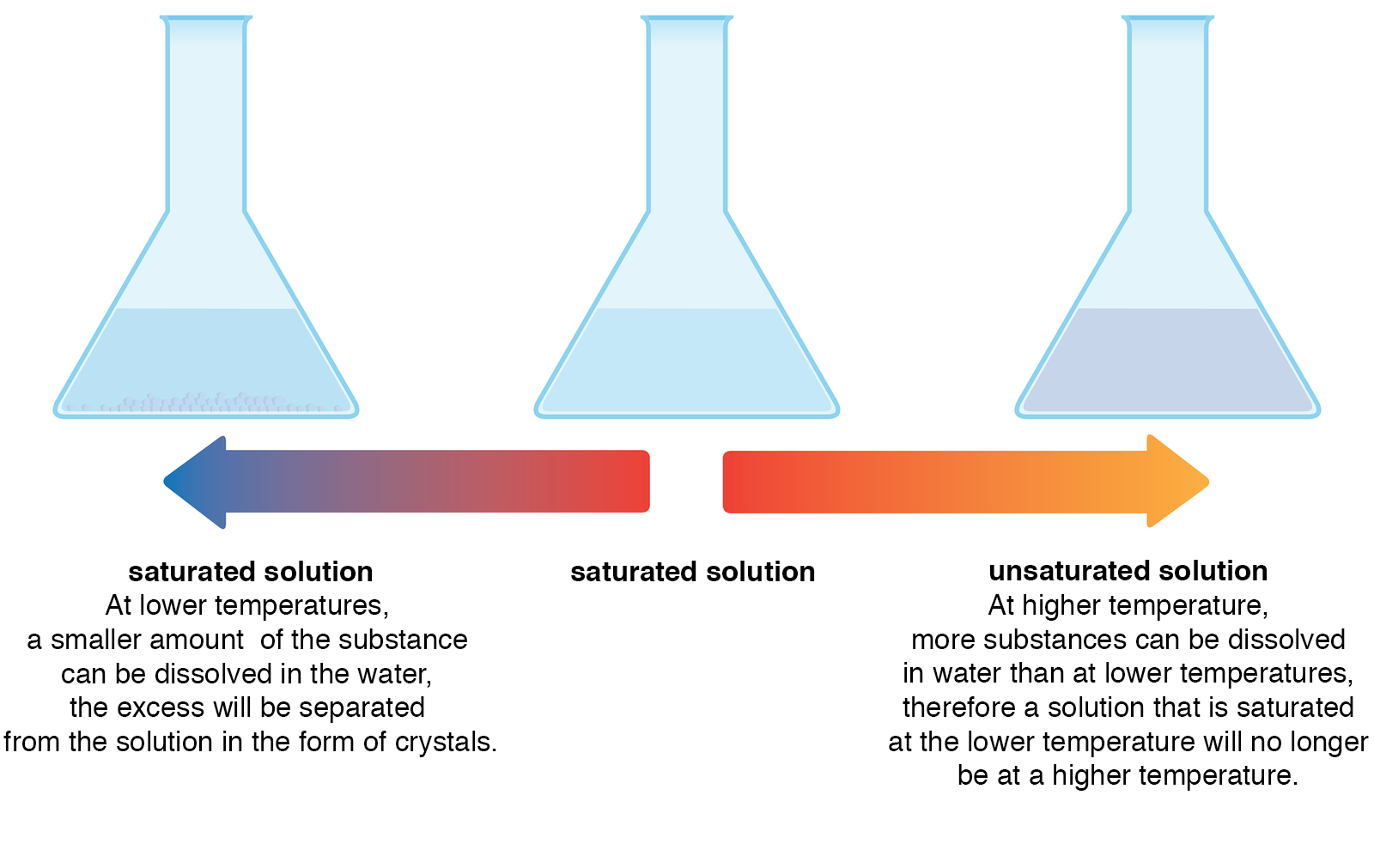
Due to the relationship between the amount of substance dissolved from the temperature, the solution that is saturated at the lower temperature will no longer be at a higher temperature at which more substances can be dissolved.
R13RSNFWcBKwn
Ilustracja przedstawia trzy kolby stożkowe z roztworami i zależność, jak zmienia się skład roztworu nasyconego w określonej temperaturze po obniżeniu lub podwyższeniu temperatury. Obniżając temperaturę roztworu zmniejsza się rozpuszczalność substancji w wodzie (nie dotyczy gazów) a nadmiar wydziela się z roztworu w formie kryształów. Roztwór pozostaje nasycony. W przypadku podwyższenia temperatury większa ilość substancji może ulec rozpuszczeniu w tej samej ilości wody, dlatego roztwór staje się nienasycony. Ilustracja zawiera anglojęzyczne napisy: At lower temperatures - saturated solution - a smaller amount of the substance can be dissolved in the water, the excess will be separated from the solution in the form of crystals. At higher temperature - unsaturated solution - the greater amount of the substance can be dissolved in the water than at lower temperatures therefore a solution that is saturated at the lower temperature will no longer be at a higher temperature.
The effect of temperature on the amount of substance dissolved in water
Chemists also use the terms of solutions relating to the amount of substance dissolved in them. They stand out on this basis:
concentrated solutionconcentrated solutionconcentrated solution, wherein the amount of solute is the same as in a saturated solution or slightly less;
diluted solutiondiluted solutiondiluted solution, that is, a solution that contains at least several times less substance than a concentrated solution.
R1XwCbzVRcET6
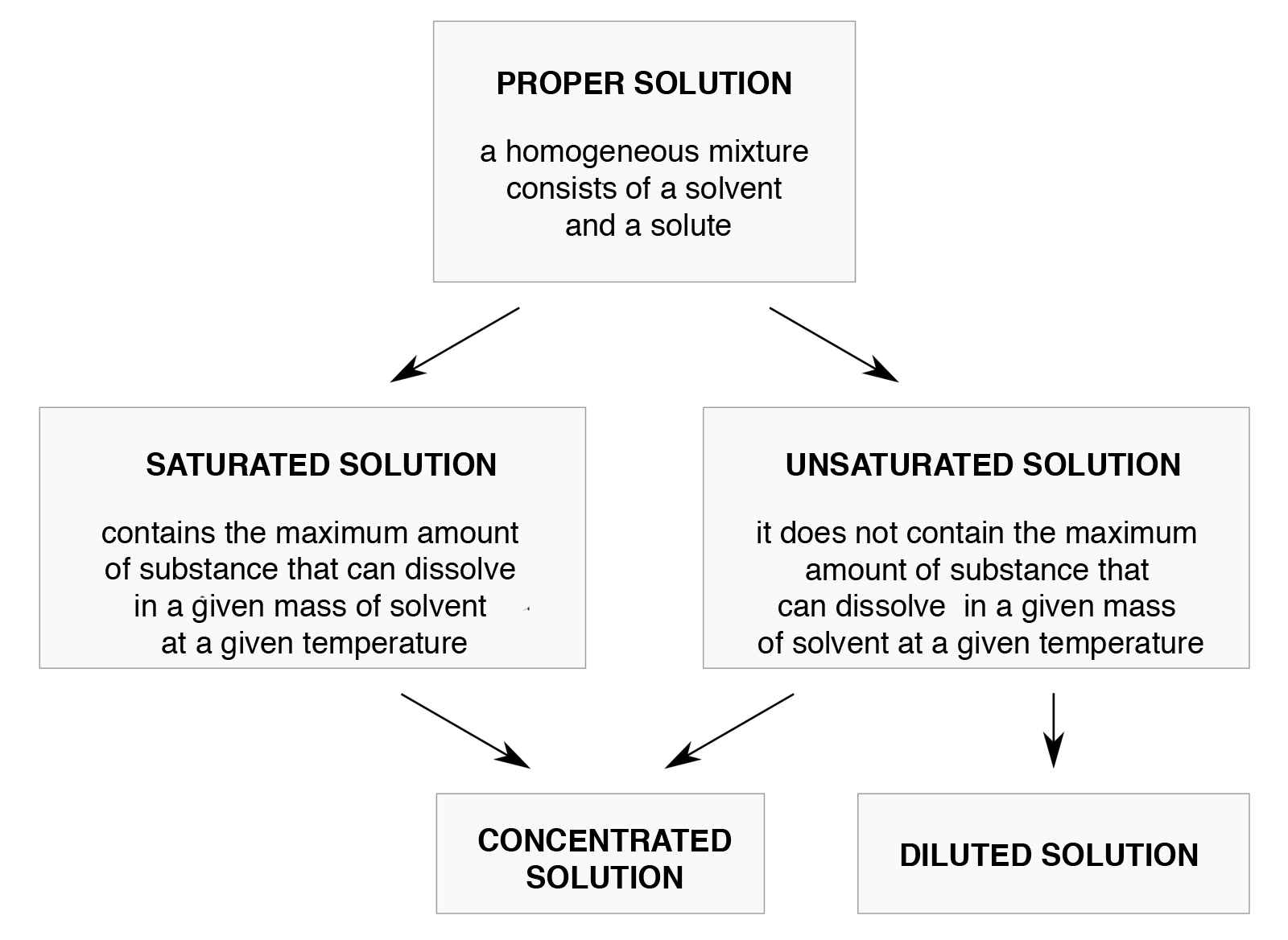
Ilustracja przedstawia podział roztworów właściwych, proper solution. Roztwory właściwe dzieli się na nasycone, saturated solutions, i nienasycone unsaturated solutions. Roztwór nasycony to taki, który zawiera maksymalną ilość substancji, która może się rozpuścić w danej masie rozpuszczalnika w określonej temperaturze. Roztwór nienasycony z kolei nie zawiera maksymalnej ilości tej substancji jaka może być rozpuszczona w określonej masie rozpuszczalnika w określonej temperaturze. Zarówno roztwór nasycony i nienasycony mogą być roztworami stężonymi. Natomiast nienasycony roztwór może być również roztworem rozcieńczonym. Ilustracja zawiera napisy w języku angielskim: 1. PROPER SOLUTION a homogeneous mixture consists of a solvent and a solute. 2. Saturated Solution contains the maximum amount of substance that can dissolve in a given mass of solvent at a given temperature. 3. Unsaturated solution it does not contain the maximum amount of substance that can dissolve in a given mass of solvent at a given temperature. 3. Concentrated solution 4. Diluted solution.
Types of solutions
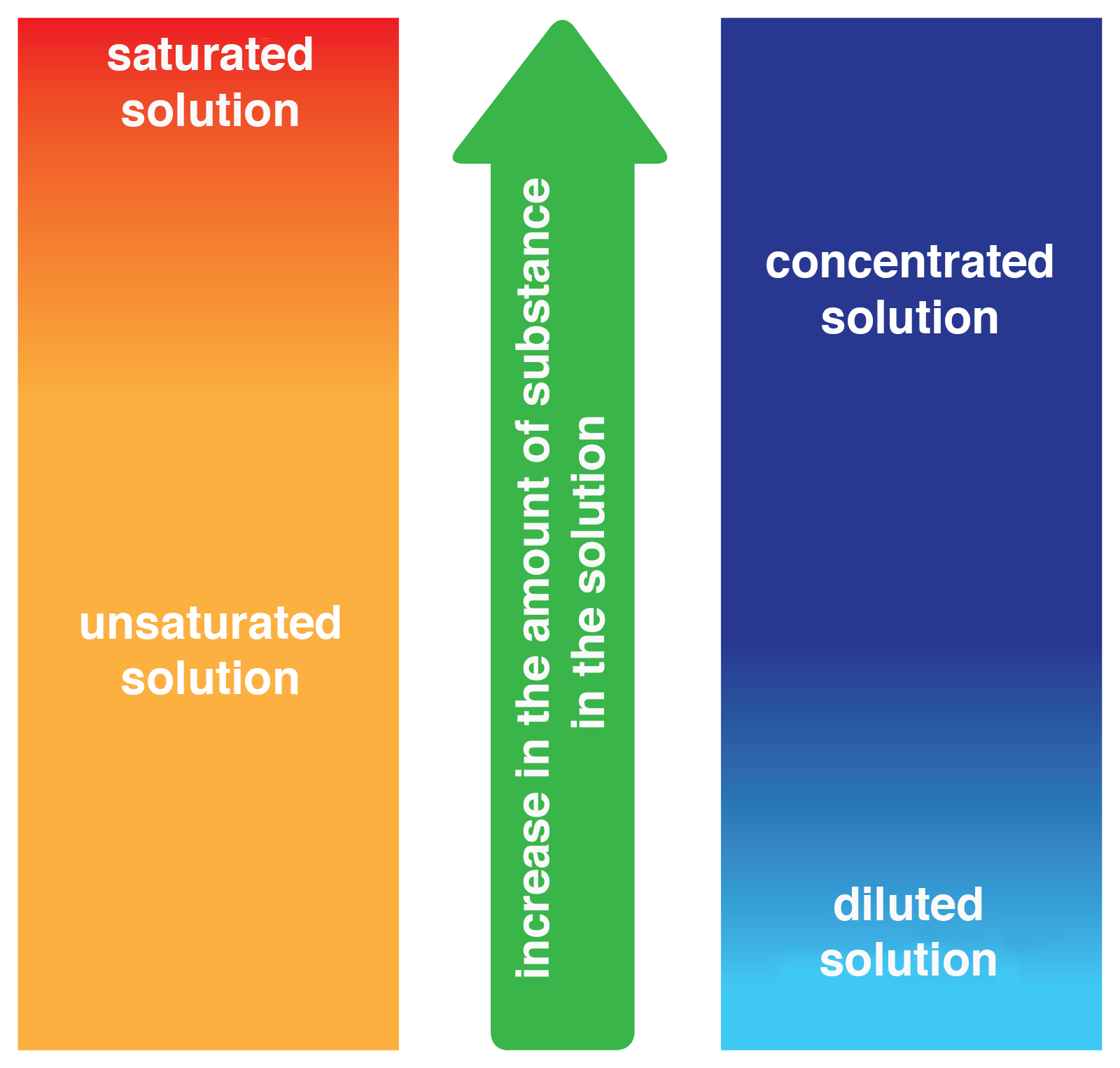
Each solution is saturated with a concentrated solution, but not every concentrated solution is saturated. Each dilute solution is simultaneously unsaturated, but the unsaturated solution can be either a dilute solution or a concentrated solution.
RlS806H6lBXa5
Ilustracja przedstawia relacje pomiędzy roztworem stężonym, concentrated solution a rozcieńczonym, diluted solution a także roztworem nasyconym, saturated solution i nienasyconym, unsaturated solution. W miarę wzrostu ilości substancji w roztworze, increase in the amount of substance roztwór nienasycony zmienia się w nasycony; a rozcieńczony w stężony.
Relationships between concentrated and diluted solutions as well as saturated and unsaturated solutions
Task 1
Write what you think is crystallizationcrystallizationcrystallization .
RZEagx7x5vr3z
Crystallization is (Uzupełnij).
Crystallization is (Uzupełnij).
RxuHJdvXlC8Ae
Exercise 1
Complete the definition. The reverse process to the dissolution process is called Tu uzupełnij. It occurs, for example, due to Tu uzupełnij of a solution due to the lowering of the temperature of a saturated Tu uzupełnij , solvent removal by evaporation or distillation.
Complete the definition. The reverse process to the dissolution process is called Tu uzupełnij. It occurs, for example, due to Tu uzupełnij of a solution due to the lowering of the temperature of a saturated Tu uzupełnij , solvent removal by evaporation or distillation.
Complete the definition.
The reverse process to the dissolution process is called ............................... It occurs, for example, due to ................................ of a solution due to the lowering of the temperature of a saturated ................ , solvent removal by evaporation or distillation.
RNp2fx4QRRfwI
Exercise 2
Indicate how to obtain a saturated solution from an unsaturated solution: Możliwe odpowiedzi: 1. heating the solution, 2. evaporation of water, 3. cooling the solution, 4. adding more solvent, 5. addition of this substance that is dissolved
Indicate how to obtain a saturated solution from an unsaturated solution: Możliwe odpowiedzi: 1. heating the solution, 2. evaporation of water, 3. cooling the solution, 4. adding more solvent, 5. addition of this substance that is dissolved
Indicate how to obtain a saturated solution from an unsaturated solution:
heating the solution
evaporation of water
cooling the solution
adding more solvent
addition of this substance that is dissolved
R1dbQkmGX0eZ4
Exercise 3
Combine the concept and its definition into pairs This is a solution in which, at a certain temperature, pressure and amount of solvent, we can dissolve more solute Możliwe odpowiedzi: 1. Concentrated solution, 2. Saturated solution, 3. Supersaturated solution, 4. Crystallization, 5. Unsaturated solution, 6. dissolution This is the process of going into a solution Możliwe odpowiedzi: 1. Concentrated solution, 2. Saturated solution, 3. Supersaturated solution, 4. Crystallization, 5. Unsaturated solution, 6. dissolution Isolation of a solute from a saturated solution Możliwe odpowiedzi: 1. Concentrated solution, 2. Saturated solution, 3. Supersaturated solution, 4. Crystallization, 5. Unsaturated solution, 6. dissolution A solution with a concentration greater than the concentration of saturated solution at a given temperature Możliwe odpowiedzi: 1. Concentrated solution, 2. Saturated solution, 3. Supersaturated solution, 4. Crystallization, 5. Unsaturated solution, 6. dissolution This solution, in which at a certain temperature, pressure and amount of solvent, we can not dissolve more solute Możliwe odpowiedzi: 1. Concentrated solution, 2. Saturated solution, 3. Supersaturated solution, 4. Crystallization, 5. Unsaturated solution, 6. dissolution A solution in which the mass of dissolved substance amounts to several dozen percent Możliwe odpowiedzi: 1. Concentrated solution, 2. Saturated solution, 3. Supersaturated solution, 4. Crystallization, 5. Unsaturated solution, 6. dissolution
Combine the concept and its definition into pairs This is a solution in which, at a certain temperature, pressure and amount of solvent, we can dissolve more solute Możliwe odpowiedzi: 1. Concentrated solution, 2. Saturated solution, 3. Supersaturated solution, 4. Crystallization, 5. Unsaturated solution, 6. dissolution This is the process of going into a solution Możliwe odpowiedzi: 1. Concentrated solution, 2. Saturated solution, 3. Supersaturated solution, 4. Crystallization, 5. Unsaturated solution, 6. dissolution Isolation of a solute from a saturated solution Możliwe odpowiedzi: 1. Concentrated solution, 2. Saturated solution, 3. Supersaturated solution, 4. Crystallization, 5. Unsaturated solution, 6. dissolution A solution with a concentration greater than the concentration of saturated solution at a given temperature Możliwe odpowiedzi: 1. Concentrated solution, 2. Saturated solution, 3. Supersaturated solution, 4. Crystallization, 5. Unsaturated solution, 6. dissolution This solution, in which at a certain temperature, pressure and amount of solvent, we can not dissolve more solute Możliwe odpowiedzi: 1. Concentrated solution, 2. Saturated solution, 3. Supersaturated solution, 4. Crystallization, 5. Unsaturated solution, 6. dissolution A solution in which the mass of dissolved substance amounts to several dozen percent Możliwe odpowiedzi: 1. Concentrated solution, 2. Saturated solution, 3. Supersaturated solution, 4. Crystallization, 5. Unsaturated solution, 6. dissolution
This is a solution in which, at a certain temperature, pressure and amount of solvent, we can dissolve more solute
This is the process of going into a solution
Isolation of a solute from a saturated solution
A solution with a concentration greater than the concentration of saturated solution at a given temperature
This solution, in which at a certain temperature, pressure and amount of solvent, we can not dissolve more solute
A solution in which the mass of dissolved substance amounts to several dozen percent
RBccwqDny4GUr
What solutions do you use in everyday life? soda water Możliwe odpowiedzi: 1. aqueous solution ce ha trzy ce o o ha – 3% – as table vinegar, 2. in the kitchen, for example, for pickling cucumbers, 3. in the food industry - a drink, 4. used as a coolant in car radiators, 5. used for the production of lemon-flavored beverages, 6. for disinfection hydrogen peroxide Możliwe odpowiedzi: 1. aqueous solution ce ha trzy ce o o ha – 3% – as table vinegar, 2. in the kitchen, for example, for pickling cucumbers, 3. in the food industry - a drink, 4. used as a coolant in car radiators, 5. used for the production of lemon-flavored beverages, 6. for disinfection vinegar Możliwe odpowiedzi: 1. aqueous solution c ha trzy c o o ha – 3% – as table vinegar, 2. in the kitchen, for example, for pickling cucumbers, 3. in the food industry - a drink, 4. used as a coolant in car radiators, 5. used for the production of lemon-flavored beverages, 6. for disinfection saline solution with water Możliwe odpowiedzi: 1. aqueous solution ce ha trzy ce o o ha – 3% – as table vinegar, 2. in the kitchen, for example, for pickling cucumbers, 3. in the food industry - a drink, 4. used as a coolant in car radiators, 5. used for the production of lemon-flavored beverages, 6. for disinfection Bory's liquid Możliwe odpowiedzi: 1. aqueous solution ce ha trzy ce o o ha – 3% – as table vinegar, 2. in the kitchen, for example, for pickling cucumbers, 3. in the food industry - a drink, 4. used as a coolant in car radiators, 5. used for the production of lemon-flavored beverages, 6. for disinfection aqueous citric acid solution Możliwe odpowiedzi: 1. aqueous solution ce ha trzy ce o o ha – 3% – as table vinegar, 2. in the kitchen, for example, for pickling cucumbers, 3. in the food industry - a drink, 4. used as a coolant in car radiators, 5. used for the production of lemon-flavored beverages, 6. for disinfection
What solutions do you use in everyday life? soda water Możliwe odpowiedzi: 1. aqueous solution ce ha trzy ce o o ha – 3% – as table vinegar, 2. in the kitchen, for example, for pickling cucumbers, 3. in the food industry - a drink, 4. used as a coolant in car radiators, 5. used for the production of lemon-flavored beverages, 6. for disinfection hydrogen peroxide Możliwe odpowiedzi: 1. aqueous solution ce ha trzy ce o o ha – 3% – as table vinegar, 2. in the kitchen, for example, for pickling cucumbers, 3. in the food industry - a drink, 4. used as a coolant in car radiators, 5. used for the production of lemon-flavored beverages, 6. for disinfection vinegar Możliwe odpowiedzi: 1. aqueous solution c ha trzy c o o ha – 3% – as table vinegar, 2. in the kitchen, for example, for pickling cucumbers, 3. in the food industry - a drink, 4. used as a coolant in car radiators, 5. used for the production of lemon-flavored beverages, 6. for disinfection saline solution with water Możliwe odpowiedzi: 1. aqueous solution ce ha trzy ce o o ha – 3% – as table vinegar, 2. in the kitchen, for example, for pickling cucumbers, 3. in the food industry - a drink, 4. used as a coolant in car radiators, 5. used for the production of lemon-flavored beverages, 6. for disinfection Bory's liquid Możliwe odpowiedzi: 1. aqueous solution ce ha trzy ce o o ha – 3% – as table vinegar, 2. in the kitchen, for example, for pickling cucumbers, 3. in the food industry - a drink, 4. used as a coolant in car radiators, 5. used for the production of lemon-flavored beverages, 6. for disinfection aqueous citric acid solution Możliwe odpowiedzi: 1. aqueous solution ce ha trzy ce o o ha – 3% – as table vinegar, 2. in the kitchen, for example, for pickling cucumbers, 3. in the food industry - a drink, 4. used as a coolant in car radiators, 5. used for the production of lemon-flavored beverages, 6. for disinfection
What solutions do you use in everyday life? Answer and then check the correctness of the answer by flipping the tab with a click.
soda water
in the food industry - a drink
hydrogen peroxide
for disinfection
vinegar
aqueous solution CH3COOH – 3% – as table vinegar
saline solution with water
in the kitchen, for example, for pickling cucumbers
Bory's liquid
used as a coolant in car radiators
aqueous citric acid solution
used for the production of lemon-flavored beverages
Summary
Different amounts of various substances dissolve in the same volume of water.
A solution that contains the maximum amount of solute at a given temperature, and the next added portion of the substance does not dissolve, is called a saturated solution.
A solution that at the given temperature does not contain the maximum amount of solute and in which it is possible to dissolve an additional portion of the substance, unsaturated solution.
The diluted solution contains at least several times less substance than a concentrated solution.
In a concentrated solution, the amount of solute is the same as in a saturated solution or slightly smaller.
The maximum amount of substance that can dissolve in a fixed mass or volume of solvent at a given temperature and under constant pressure is called solubility. It can be expressed as the number of grams of substance that can be dissolved in 100 g of solvent at a given temperature and under consistent pressure.
Crystallization is the reverse process to dissolve – occurs as a result of supercooling of steam or liquid or supersaturation of the solution (eg due to lowering the temperature of the saturated solution, removing the solvent by evaporation or distilling.
R13Js2Lzqusyd1
Grafika przedstawiająca tablicę szkolną, na której znajdują się zdania do dokończenia. Finish selected sentences. 1 It was easy for me (uzupełnij). 2 It was difficult for me (uzupełnij). 3 Today I learned (uzupełnij). 4 I understood that (uzupełnij). 5 It surprised me (uzupełnij).
Grafika przedstawiająca tablicę szkolną, na której znajdują się zdania do dokończenia. Finish selected sentences. 1 It was easy for me (uzupełnij). 2 It was difficult for me (uzupełnij). 3 Today I learned (uzupełnij). 4 I understood that (uzupełnij). 5 It surprised me (uzupełnij).
Source: GroMar Sp. z o.o., licencja: CC BY-SA 3.0.
krystalizacja – proces odwrotny do rozpuszczania – zachodzi w wyniku przechłodzenia pary lub cieczy albo przesycenia roztworu (np. wskutek obniżenia temperatury roztworu nasyconego, usuwania rozpuszczalnika przez odparowywanie lub oddestylowanie
roztwór nasycony – roztwór, który w danej temperaturze zawiera maksymalną ilość substancji rozpuszczonej, a dodana kolejna do niej porcja substancji nie ulega rozpuszczeniu
roztwór nienasycony – roztwór, który w danej temperaturze nie zawiera maksymalnej ilości substancji rozpuszczonej i w którym można rozpuścić dodatkową porcję tej substancji